


Table of Contents
Social reporting inside Meta is not enough if Walmart sales are the goal. Walmart Connect matters because it uses Walmart’s own transaction data to connect social impressions to actual retail outcomes, which is the only measurement standard that deserves budget.
That changes the job of social. You are no longer buying attention and hoping it turns into revenue later. You can build campaigns around known Walmart shopping behavior, push spend toward audiences with purchase intent, and measure whether those ads drove sales online or in stores. Brands that set this up early will make faster budget decisions while competitors keep optimizing for clicks, video views, and inflated platform conversions.
If you sell through Walmart, treat this as a profit system, not a media add-on. The upside is better targeting, cleaner closed-loop attribution, and less wasted spend from social campaigns that look good in platform dashboards but fail at the shelf.
Teams also using sponsorships or retail partnerships should find Walmart sponsorships.
Get My Profit ROI Forecast
15-minute diagnostic call. No pitch deck.
At a Glance
Walmart Connect social gives brands a cleaner way to turn social spend into Walmart sales. The advantage is not reach. It is Walmart transaction data, tighter audience selection, and closed-loop measurement that ties media exposure back to retail outcomes.
-
Use Walmart shopper data inside social campaigns. Audience building can reflect real shopping behavior, which makes social targeting more commercially useful than standard platform signals alone.
-
Prioritize Meta first. Walmart Connect has expanded self-service full-funnel access on Meta, while broader social expansion is rolling out across other platforms.
-
Watch Add to Cart closely. For managed service advertisers, Walmart has introduced a beta experience that lets shoppers add multiple items to their Walmart cart directly from supported social ads.
-
Measure against Walmart sales, not platform vanity metrics. The main win is seeing whether campaigns influenced retail purchases, including online and in-store results.
-
Fix setup before you scale. Weak audience mapping, poor SKU alignment, and bad measurement hygiene will burn budget fast.
-
Move early if Walmart matters to your channel mix. Brands that build this now will make faster budget calls and out-execute teams still optimizing to clicks and view-through noise.
If your team is still treating Walmart as a secondary retail channel, read this guide for Amazon brands on Walmart advertising. Walmart Connect outlined the latest social expansion in its retail-powered social media announcement.
What Walmart Connect’s Social Integration Does
Walmart Connect social turns shopper purchase data into social campaign inputs you can act on. It lets your team build audiences from Walmart buying behavior, push those audiences into social placements, and judge performance against retail outcomes instead of platform-reported engagement.
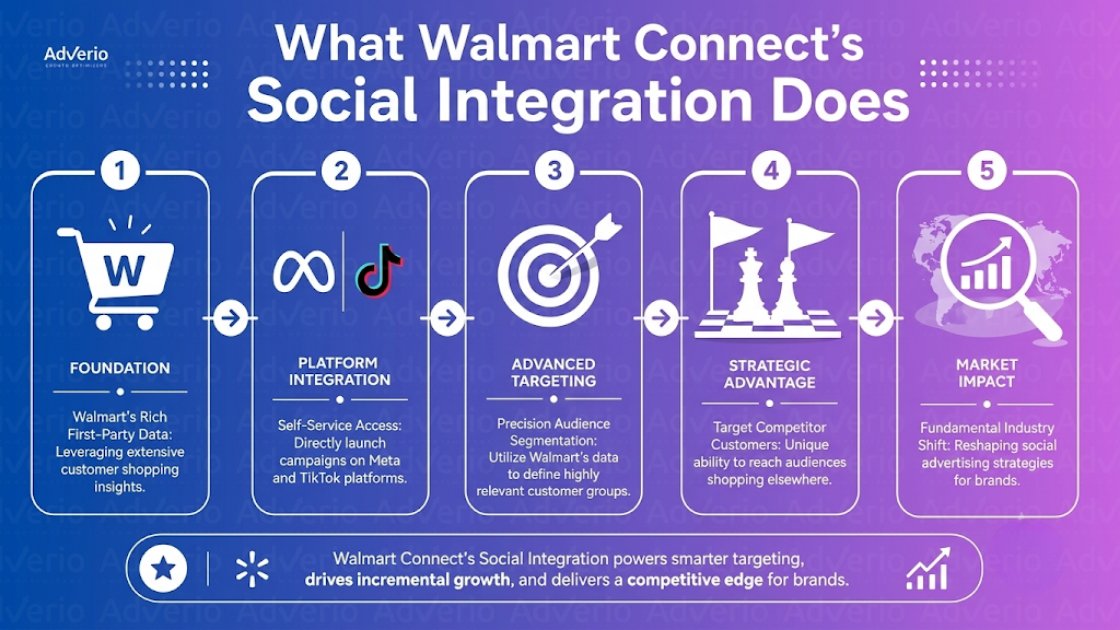
The important shift is operational. You are no longer relying only on Meta’s native interest signals or broad prospecting logic. You are using Walmart’s first-party transaction history and shopping patterns to decide who should see the ad, what product set belongs in the creative, and whether the campaign drove retail movement.
The practical capability
Use Walmart shopper behavior to build audience groups around retail intent. That can include category buyers, brand buyers, lapsed shoppers, and new-to-brand prospects. The value is simple. A shopper who has purchased in an adjacent category at Walmart is a stronger prospect than someone who merely fits a social interest label.
That changes campaign planning fast. Creative can map to real purchase context. Product selection can stay tied to the SKUs you need to move. Budget can shift toward segments with a clearer path to Walmart sales.
For operators tracking retail expansion beyond media, map the full Walmart ecosystem so you can see how it shows up across channels and partnerships.
Where the friction drops
The most commercially useful piece is the shortened path from ad exposure to Walmart cart. In supported formats, shoppers can move closer to purchase without the usual drop-off that comes from extra clicks, weak landing pages, or a poor mobile handoff.
That matters because social waste usually starts in the transition. You pay Meta for attention, then lose the shopper before product selection or checkout intent is established. Walmart’s social integration tightens that gap and gives performance teams a cleaner route from audience targeting to attributable retail action.
Practical rule: Build campaigns around SKU-level buying signals and a direct path to Walmart purchase. If your setup cannot connect audience, product, and retail outcome, fix that before you scale.
The Business Case for Walmart First-Party Social Targeting
Walmart first-party social targeting gives you a better profit model than standard Meta targeting. You stop paying to reach people who merely look interested and start paying to reach shoppers with actual Walmart purchase signals behind them.
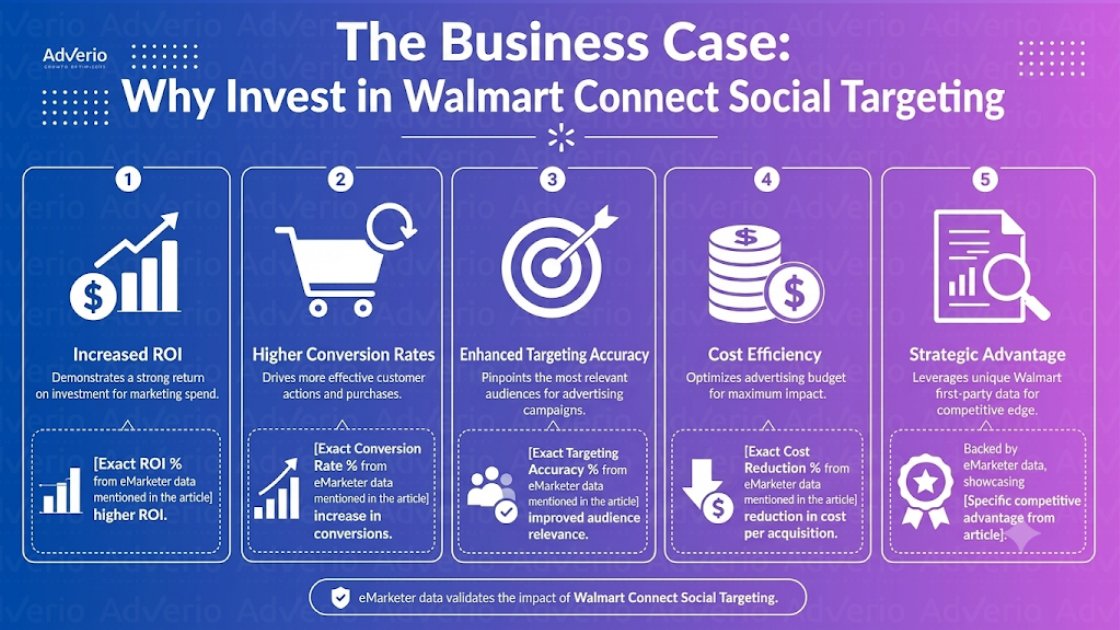
That difference matters because social performance usually breaks in two places. Audience selection gets too broad, and measurement gets trapped inside the ad platform. Walmart Connect fixes both if you use it correctly. It lets you build campaigns from real retail behavior and judge them against Walmart sales, not just clicks, view-throughs, or a flattering Meta dashboard.
The business case is simple. Better inputs produce better buyers. Better measurement protects budget.
If your brand sells products people already buy at Walmart, this is one of the clearest ways to reduce wasted impressions and get closer to closed-loop ROI. You can target based on category, brand, and shopper status, then read performance through a retail lens. That is a stronger operating model than guessing from site traffic alone, especially for brands with low direct site volume or weak pixel data.
Why this changes budget decisions
Standard social buying answers the wrong questions.
| Business question | Standard answer from social platforms | Better answer with Walmart data |
|---|---|---|
| Who should see the ad? | People modeled from site visits, content views, or interest signals | Shoppers tied to category, brand, or Walmart purchase behavior |
| What counts as success? | Reported platform conversions and engagement metrics | Walmart-linked sales impact and retail movement |
| What deserves more spend? | The campaign with the best in-platform efficiency | The campaign that drives attributable Walmart revenue |
That shift changes how you allocate media. It also changes how fast you cut underperforming campaigns. If an audience is cheap but does not move Walmart sales, it is not efficient. It is waste.
This is also where many brands miss the full opportunity. They treat Walmart Connect social as a targeting add-on instead of a retail growth system. The smarter move is to treat it as a transaction-data layer for social acquisition, remarketing, and incrementality testing. That gives your team a cleaner answer to one question leadership is focused on: did this campaign sell more product at Walmart, or did it just produce nice media metrics?
For brands expanding beyond Amazon, this guide for Amazon brands on Walmart advertising is the right starting point. The brands gaining share on Walmart are building around retail data, not copying their old Meta account structure and hoping it translates.
One more point. Strong creative still matters, but creative alone will not rescue weak audience logic. If conversion is where spend leaks, Walmart purchase data gives you a tighter way to validate whether social attention turns into retail revenue.
That is the business case. Higher-quality targeting. Cleaner revenue proof. Less room for budget fiction.
How to Set Up Your First Walmart Connect Social Campaign on Meta
Bad setup burns budget fast. If you wire Walmart’s transaction data into Meta the wrong way, you will get polished dashboards, weak retail lift, and no clean answer on what sold.

Run your first campaign with control, not enthusiasm. The goal is simple: match one audience, one offer angle, and one retail outcome so you can see what drives Walmart sales and scale only what earns the right.
Audience setup using Walmart’s first-party data
Build audiences from purchase behavior. Do not start with broad Meta interests, old prospecting stacks, or generic social engagement pools.
Inside Walmart Connect, create separate audiences tied to a single job:
-
Category conquesting: shoppers buying in your category but not clearly loyal to your brand
-
Brand defense: existing buyers or high-probability repeat purchasers
-
New-to-brand acquisition: shoppers with relevant purchase signals but no clear prior brand history
Keep each audience in its own ad set. That gives you a readable test. Once you combine defense, conquesting, and acquisition in one bucket, you lose the signal and turn optimization into guesswork.
Cap the first launch to a small number of audiences. Three is enough. More than that usually means your team has not decided what the campaign is supposed to do.
Campaign structure on Meta
Use a clean Meta build. One campaign objective. Separate ad sets by Walmart audience. Consistent creative format across ad sets. Equal budget allocation at launch.
That structure matters because you are testing the value of Walmart’s first-party shopper data, not running a creative free-for-all. If one ad set gets video, another gets static, and a third gets a different offer, your read is contaminated on day one.
A practical starting point looks like this:
-
One campaign aligned to a sales-focused objective
-
One ad set per Walmart audience
-
Two to three creative variants per ad set
-
One primary SKU set or product family per campaign
If your catalog is messy, fix that before you launch. A confused product story kills performance faster than audience quality can save it. For brands tightening both retail media and onsite conversion logic, this Walmart PPC strategy breakdown is the right companion read.
Creative requirements for Meta vs Walmart Connect
Meta still rewards strong hooks and clear visual hierarchy. Walmart retail performance adds another filter. Your ad has to match the product page people hit after the click.
Use creative that does three things well:
-
Shows the product clearly
-
Communicates the value fast
-
Matches the actual Walmart listing experience
Do not recycle Amazon-style creative with aggressive comparison language, crowded badges, or claims your Walmart page does not support. That mismatch creates drop-off after the click and makes a decent audience look weak.
If the listing is thin, the title is unclear, the images are weak, or reviews are shaky, fix the retail page before you push spend. Social traffic reaches the shelf faster. It does not fix a bad shelf.
For teams tuning both paid media and listing quality together, Adverio’s Walmart Connect management and its Walmart Sponsored Products guide are relevant companion reads.
The Add to Cart feature and how to use it
Add to Cart works best on products with low friction and clear intent. Use it for items shoppers already understand, trust, and buy without much education.
Strong fits include:
-
Repeat-purchase products
-
Routine household essentials
-
Multi-packs
-
High-conviction SKUs with strong ratings and clear images
Do not force Add to Cart onto products that need explanation, comparison, or heavy creative storytelling. That shortcut often increases low-quality sessions instead of completed purchases.
Use Add to Cart only after you confirm the Walmart product page converts well. If the PDP is weak, you are accelerating people into a worse buying experience and paying for the privilege.
How to Measure Walmart Connect Social Performance
If you judge these campaigns by CTR, views, or engagement, you will overpay for traffic that does not turn into Walmart revenue. Measure them like a retail operator. Start with sales tied back to Walmart transactions, then work outward.
Walmart Connect social works best when your scorecard is closed-loop and profit-first. The question is not whether Meta reported a cheap click. The question is whether Walmart matched ad exposure to real purchases and whether that spend produced incremental sales you would not have captured otherwise.
What to track first
Use a simple hierarchy and keep every report tied to it.
| Metric tier | What to watch | Why it matters |
|---|---|---|
| Primary | Walmart-attributed sales and ROAS | This shows whether social spend produced revenue on Walmart |
| Secondary | Add to Cart activity from social | This gives you an early read on audience quality and product intent |
| Contextual | Walmart sales trend during the campaign window | This helps you verify whether paid social is lifting total retail performance, not just platform activity |
Primary metrics decide budget. Secondary metrics help you diagnose. Contextual metrics keep you from celebrating a platform win while Walmart sales stay flat.
That order matters. Teams get into trouble when they optimize creative against top-of-funnel platform signals for too long. Meta can show healthy engagement while your Walmart sales report says the audience is wrong, the product offer is weak, or the campaign is reaching buyers who were already going to convert.
How to read performance correctly
Look at performance in weekly cuts, not just campaign totals. Break results out by SKU, audience, creative theme, and new-versus-repeat purchase behavior if your reporting setup supports it. You need to know what moved retail demand.
Watch for three patterns:
-
Strong CTR, weak Walmart sales: your ad gets attention but attracts the wrong shopper or sets the wrong expectation
-
Moderate CTR, strong Walmart ROAS: keep spending here. Retail efficiency matters more than social vanity metrics
-
High Add to Cart, weak completed sales: check for price friction, stock issues, shipping speed, or a disconnect between ad promise and product page reality
This is also where brands usually misread incrementality. A campaign can claim attributed sales and still deserve a budget cut if it mostly captures buyers who were already in-market. Compare campaign periods against your Walmart baseline, not just the ad dashboard.
For brands reporting across several retail channels, a clean effective marketplace attribution framework keeps Walmart performance from getting buried inside blended social numbers.
What not to confuse with proof
Platform metrics are diagnostics. They are not the final answer.
A polished Meta report can still hide bad economics. That’s why it’s worth getting an outside, unbiased look at your conversion paths, friction cuts revenue long before your dashboard makes the problem obvious.
Use Walmart-attributed sales as the main score. Use Meta metrics to explain why performance changed. That is the measurement setup that protects the budget and gives you a playbook for scaling what works.
How This Compares to Running Meta Ads Without Walmart Data
Running Meta ads without Walmart data is guesswork with nicer dashboards.
You can still get clicks, video views, and even reported conversions. You cannot see which audiences turned into Walmart sales with the same level of confidence. That gap matters because retail growth depends on transaction quality, not social platform activity.
| Capability | Standard Meta Ads | Meta Ads via Walmart Connect |
|---|---|---|
| Audience signal | Pixel activity, engagement, interest proxies | Walmart shopper and purchase behavior |
| Retail relevance | Indirect | Direct |
| Attribution | Platform model | Closed-loop to Walmart sales |
| Cart action path | Usually off-platform redirect | Can include Walmart-linked Add to Cart in beta |
| Optimization logic | Social efficiency | Retail efficiency |
The practical difference shows up in budget decisions. Standard Meta campaigns often push spend toward audiences that look efficient inside Meta but do not hold up at the retailer. Walmart Connect gives you a cleaner view of who buys, what they buy, and whether your social spend is creating retail lift or just harvesting easy demand.
That changes how you optimize. You stop rewarding cheap traffic and start rewarding sales tied back to Walmart. You also catch weak segments faster. If an audience clicks but does not convert at Walmart, cut it. If a segment looks average in Meta but drives strong retail outcomes, keep funding it.
Use Walmart Connect social as part of your broader Walmart PPC strategy breakdown so your audience targeting, retail media spend, and conversion reporting all point at the same revenue goal. It should also sit alongside your retail media full-funnel strategy, not inside a separate paid social silo.
Brands that skip this structure leave money on the table. Brands that use Walmart data get a tighter feedback loop, better audience decisions, and a clearer path to profitable scale.
Common Setup Mistakes to Avoid
Budget usually gets wasted before optimization starts. The problem is setup.
Mistake one: Reusing Amazon creative
Amazon-winning creative often underperforms here because the shopping context is different. Walmart shoppers respond to different price cues, packaging emphasis, and value framing. Build ads for the Walmart shelf, not a generic retail feed, or your click quality drops and your closed-loop sales data gets noisy fast.
Mistake two: Letting social and retail teams run separate plans
Walmart Connect social should share one audience map, one promo calendar, and one revenue target with your Walmart onsite media. If social pushes one hero SKU while search and display support another, attribution gets messy and spend gets misallocated. Align SKU priorities, offers, and audience exclusions before launch.
Mistake three: Sending paid traffic to weak product pages
Social can create demand. It cannot rescue a bad PDP. Thin copy, weak images, missing comparison points, and compliance issues will crush conversion after the click. Add understanding Walmart’s content requirements to your launch process and fix listing problems before you scale spend.
Mistake four: Launching without a measurement plan
Teams waste money when they treat Walmart Connect social like a standard Meta campaign and wait for platform metrics to tell the story. Set your reporting around Walmart sales outcomes from day one. Decide in advance which signals trigger budget cuts, which SKUs deserve more spend, and how often you will review audience, creative, and retailer performance together.
Weekly review is the minimum.
Mistake five: Optimizing for cheap clicks instead of retail results
Low CPC can hide bad traffic. A high-CTR ad can still fail if it drives visitors who never buy on Walmart. Judge early performance by retail intent and sales movement tied back to Walmart transactions, then cut segments that look busy inside Meta but do not produce revenue.
If a campaign looks efficient in Meta and weak at Walmart, it is not efficient. It is misread spend.
How Adverio Manages Walmart Connect Social Strategy
Walmart’s new social layer creates opportunity and complexity at the same time. Adverio treats it like a profit channel, not a media experiment. Our Growth Cultivator framework ties audience selection, listing quality, PPC, DSP, creative, and marketplace operations into one scorecard so your Walmart social spend does not fight your onsite Walmart strategy. That is how brands with large catalogs stop plateauing and start scaling with control. If you want a partner that runs Walmart Connect as a profit system, start with the math, not a retainer.
Frequently Asked Questions
Can I run Walmart Connect social campaigns myself on Meta?
Yes. Self-service access is real. Profit usually breaks at setup, not access. Build around Walmart transaction-based audiences, clean product detail pages, and closed-loop sales measurement from day one, or you will spend Meta budget with no clear read on retail impact.
Is Add to Cart available to every advertiser?
No. Walmart says Add to Cart is still in beta for managed service clients on Meta, TikTok, and Pinterest. Treat it as limited access until your account confirms eligibility, and plan your campaign KPIs around the tools you have.
Can influencer content from Walmart Creator feed closed-loop reporting?
Walmart has not publicly shown that connection in enough detail to treat it as a proven measurement path. Use creator content as a creative input, but do not assume it plugs into the same closed-loop reporting or new-to-brand targeting until Walmart documents that workflow clearly.
What KPI matters most in a Walmart Connect social media strategy?
Incremental sales tied to Walmart retail outcomes. Start there. Then watch attributed ROAS, new-to-brand performance when available, and cart or purchase actions that connect back to Walmart transaction data. Likes and click-through rate only matter if they improve sales efficiency.
Should I move budget from standard Meta campaigns into Walmart Connect social right away?
Move budget based on measured retail lift, not platform comfort. Run a clean comparison between standard Meta targeting and Walmart data-powered audiences, then shift spend toward the setup that drives stronger closed-loop ROI. Brands that wait for perfect certainty usually leave the cheaper acquisition window to faster competitors.
Read Next
If you want the next practical step, read the piece on incrementality measurement framework.
Then compare your retail media approach across major marketplaces, as noted earlier in this article, and pressure-test whether your Walmart budget is being measured with the same discipline as Amazon and Target.
If your Walmart program still runs like channel management instead of profit management, fix that next.
References
The sources cited earlier cover Walmart Connect’s social expansion, retail media adoption, and broader market context. They are enough to guide a smart rollout. The bigger risk at this point is not missing another article. It is running social with Walmart data half-configured, reading platform lift as business lift, and wasting budget on campaigns you cannot tie back to retail sales.
If your Walmart social program still reports clicks, ROAS, and blended platform conversions without a closed-loop retail view, fix that now. Teams that get this right use Walmart’s first-party transaction data to target paid social with more precision, measure sales impact against actual retailer outcomes, and cut spend faster when campaigns fail to move shelf velocity.
Adverio helps established brands build profit-first growth systems across Amazon, Target, and Walmart with PPC, DSP, catalog optimization, and full-funnel reporting built for operators, not spectators.
Book a 15-minute diagnostic call. No pitch deck.