


Table of Contents
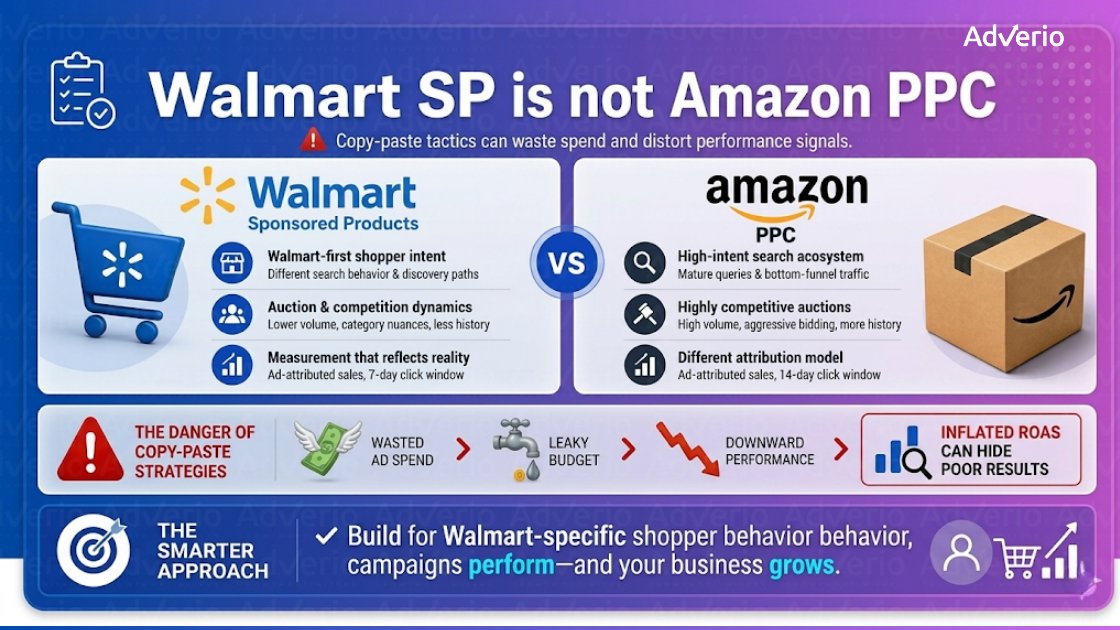
Amazon operators burn money on Walmart Sponsored Products when they port over Amazon assumptions and trust the same efficiency metrics. Walmart Sponsored Products rewards a different setup. If you treat it like a smaller Amazon account, you will misread performance, overpay for weak traffic, and call bad margin growth.
This guide is about campaign mechanics: how to build the three-campaign structure, how to set TACoS targets, and how to sequence the first 30 days without creating noise you cannot act on. The strategic framing, why retail readiness governs ad performance, and why Walmart punishes Amazon habits, lives in the Walmart PPC strategy guide. If you have not read it, start there first.
What follows here is the build.
There is no universal “good” Walmart Sponsored Products needs a three-campaign structure (auto, manual keyword, manual item), TACoS targets set 20-30% tighter than Amazon, and a fixed 30-day launch sequence that prioritizes data collection over weekly tuning. Listing quality and fulfillment readiness gate ad performance.
At a Glance Your Walmart SP Playbook
Walmart Sponsored Products pays off when ads, offers, and fulfillment run as one profit system. Amazon habits hide margin leaks here. The right Walmart setup catches them early.
-
Run a simple three-campaign structure. Use auto to mine search terms, manual keyword to scale proven intent, and manual item to win competitor traffic and support cross-sell.
-
Judge ad performance against blended profit. ROAS can look fine while Walmart spend drags down margin. TACoS gives you the cleaner read.
-
Fix catalog and ops problems before raising bids. Weak content, poor price position, low review trust, or slow shipping can suppress both rank and conversion. More spend on a weak offer just buys clearer proof that the offer is weak.
-
Protect signal in the first 30 days. Let campaigns gather enough search-term and conversion data before making major edits. Early tinkering usually creates noise, not control.
-
Use Walmart rules, not Amazon reflexes. The biggest profit gains come from respecting the platform’s operating model. If you need the broader marketplace context, start with this Amazon vs Walmart vs Target comparison.

Walmart sponsored products: the three-campaign build and 30-day launch protocol 25
Practical rule: Walmart ads do not fix weak listings. They expose weak offers faster.
How Walmart Sponsored Products Differ From Amazon
The comparison table below is a quick reference for operators building Walmart Sponsored Products campaigns who need to recalibrate expectations. For the full strategic breakdown of why these differences exist and how they affect profit decisions, read the Walmart PPC strategy guide.
| Dimension | Amazon Sponsored Products | Walmart Sponsored Products |
|---|---|---|
| What ads can overcome | Strong bids and conversion history can push harder, even with an offer that is not perfect | Retail readiness matters more. Weak price position, thin content, low review trust, or poor shipping can suppress both rank and conversion |
| Efficiency read | Platform metrics are easier to over-trust, but the system is more familiar to experienced operators | In-platform efficiency can mislead faster if you import Amazon targets without adjusting for Walmart’s structure |
| Targeting controls | More mature keyword and targeting options | Simpler controls put more pressure on clean campaign structure and disciplined search-term mining |
| Item targeting | Broadly used and easier to scale across large structures | Useful, but easier to waste spend with loose ASIN logic and weak placement assumptions |
| Reporting | Deeper native reporting in many workflows | Less reporting depth means account mess stays hidden until margin drops |
What this means for profit
Treat Walmart ads as a retail quality amplifier. Good offers get more out of every click. Weak offers burn budget and produce false confidence.
That’s a hard break from Amazon. You’re not buying traffic into a system that forgives execution gaps. You’re buying traffic into one that exposes them. Operators who respect that usually scale faster because they fix the offer before they force the bid. Operators who ignore it usually spend weeks chasing CPC and ROAS problems that started with price, content, and fulfillment.
The Three-Campaign Structure for Walmart Profit
Copying your Amazon campaign map into Walmart Sponsored Products is a margin leak. Walmart rewards cleaner separation of intent, tighter SKU selection, and faster isolation of wasted spend.
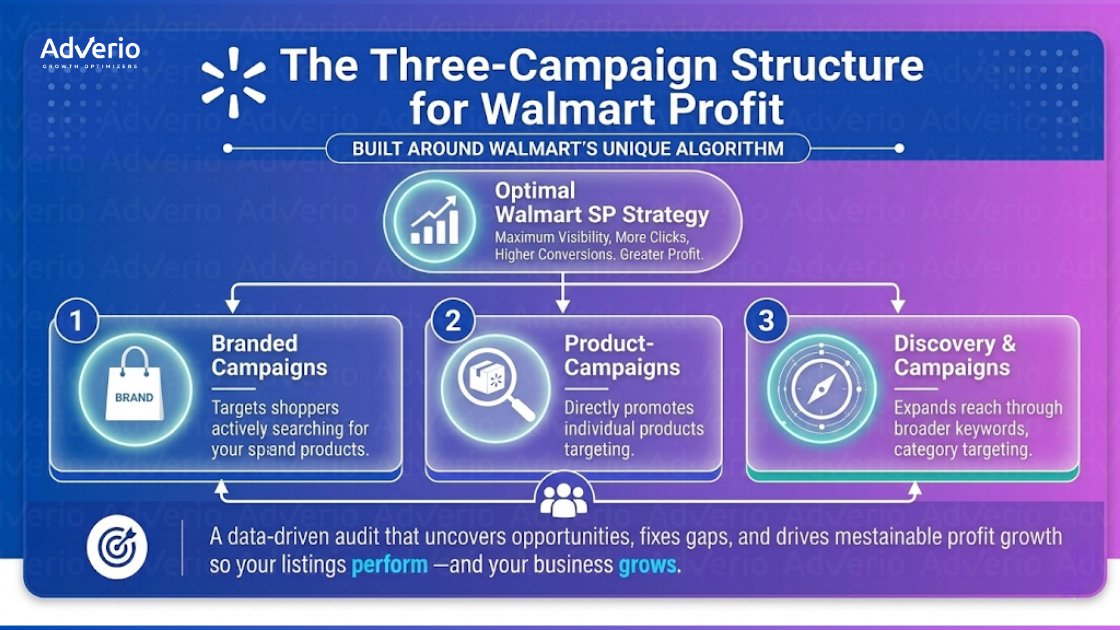
Use three campaign types only. Auto to mine demand. Manual keyword to capture profitable search terms. Manual item to pressure test competitor and cross-sell traffic after your keyword base is working.
That structure keeps reporting readable and budget decisions simple.
Auto campaigns for discovery and keyword generation
Auto campaigns exist to surface how Walmart matches your products to shopper queries. Use them on a narrow set of SKUs you are willing to scale. Keep budget controlled, but give the campaign enough room to produce useful search term data.
Do this
-
Start with priority SKUs only: Use products with healthy margin, strong content, and stable inventory.
-
Use auto as a mining tool: Pull search term reports and look for queries that convert cleanly.
-
Give the campaign time to mature: Early edits distort the read and waste the point of running auto in the first place.
Avoid this
-
Don’t dump the whole catalog into one auto build: You will hide winners under low-intent noise.
-
Don’t duplicate manual targets inside auto logic: Overlap makes it harder to tell what is working.
-
Don’t judge auto on ROAS alone: Its job is to reveal profitable search behavior you can isolate later.
Manual keyword campaigns for proven converters
Manual keyword campaigns should carry the account. Start with your strongest Amazon search terms, but treat them as hypotheses, not assets that automatically transfer. Walmart query behavior is different enough to punish lazy copy-paste execution.
Use exact for terms that already show purchase intent. Use broad with restraint to find nearby demand without turning the campaign into a junk drawer. If you want a stronger framework for account buildout, read Mastering Walmart PPC for brands.
Do this
-
Seed exact campaigns with your best proven terms: Start with terms tied to clear purchase intent.
-
Use broad for controlled expansion: Keep it separate so search term mining stays clean.
-
Promote winners out of auto fast: Once a term proves itself, move it into manual and bid with intent.
Avoid this
-
Don’t mix harvesting and testing in the same campaign: You lose clarity on where profit is coming from.
-
Don’t assume Amazon winners deserve budget forever on Walmart: Revalidate them with Walmart performance.
-
Don’t spread spend across too many keywords on day one: Concentration gets signal faster.
Manual item campaigns for product targeting and conquesting
Item targeting is useful, but it is a secondary layer. Brands often overfund it because it feels familiar. On Walmart, that habit usually creates expensive traffic with weaker conversion quality than strong keyword campaigns.
Run item campaigns after search campaigns are stable. Target close substitutes, not random category neighbors. Use your own complementary products only when the basket logic is obvious.
Do this
-
Target tightly related competitor items: Relevance matters more than list size.
-
Use your catalog for cross-sell where the fit is clear: Accessories and replenishment pairs are the best candidates.
-
Keep bids measured: Item traffic can help incrementality, but it often needs stricter cost control.
Avoid this
-
Don’t treat conquesting as your scale engine: It is usually a supporting tactic.
-
Don’t target broad sets of items just to spend budget: Loose targeting hides waste.
-
Don’t judge success by clicks: Item campaigns need sales and margin, not attention.
Bid Strategy on Walmart: What Works and What Doesn’t
Trying to “buy cheap clicks” on Walmart Sponsored Products is the wrong instinct. On Amazon, low bids can still pick up scraps of traffic. On Walmart, low bids often just get ignored.
Start at the suggested bid. Let the campaign run. Then adjust based on delivered CPC and actual sales behavior. The first month is not the time to prove how frugal you are. It’s the time to collect enough clean signal to know where margin lives.
What works
-
Use suggested bid as your opening price
-
Give campaigns room to deliver
-
Adjust after the platform shows you real traffic patterns
What does not
-
Bidding below the platform’s comfort zone on day one
-
Using Amazon bid rules as a copy-paste playbook
-
Cutting bids before you have enough search term evidence
Low bids don’t make you efficient if they also make you invisible.
Definition: TACoS (Total Advertising Cost of Sales) measures ad spend as a percentage of total channel revenue (organic + paid). Unlike ROAS, it shows whether ads are helping the whole business or just shifting credit between attribution buckets.
How to Set TACoS Targets on Walmart
Walmart needs a stricter profit standard than Amazon. If your Walmart TACoS looks like your Amazon TACoS, don’t blame Walmart first. Look at your campaign structure and product page quality.
A clean Walmart account should carry tighter blended efficiency because the traffic economics are usually more favorable inside the channel. If that isn’t happening, your problem is rarely “we need lower bids.” It’s usually one of these:
-
Weak listing quality: The product page isn’t converting the traffic you paid for.
-
Bad campaign segmentation: Discovery, proven demand, and item targeting are mixed together.
-
Poor CTR signal: Shoppers aren’t seeing a compelling product proposition.
If your click-through rate is soft, CTR problems usually begin with creative and merchandising choices, not keyword selection. Fix the main image and title before adjusting bids.
For operators coming from Amazon, this guide on why your TACoS is increasing helps frame the right blended efficiency mindset.
The benchmark to use
Set Walmart TACoS targets 20% to 30% below your Amazon equivalent for the same product set. If Walmart drifts near Amazon on blended cost, assume a structural issue first.
Need a clean read on whether your Walmart spend is building margin or hiding leaks? Book a Profit ROI Forecast.
The 30-Day Launch Protocol for New Campaigns
The first month of running Walmart Sponsored Products decides whether your data will help you or lie to you. Follow a fixed launch sequence.
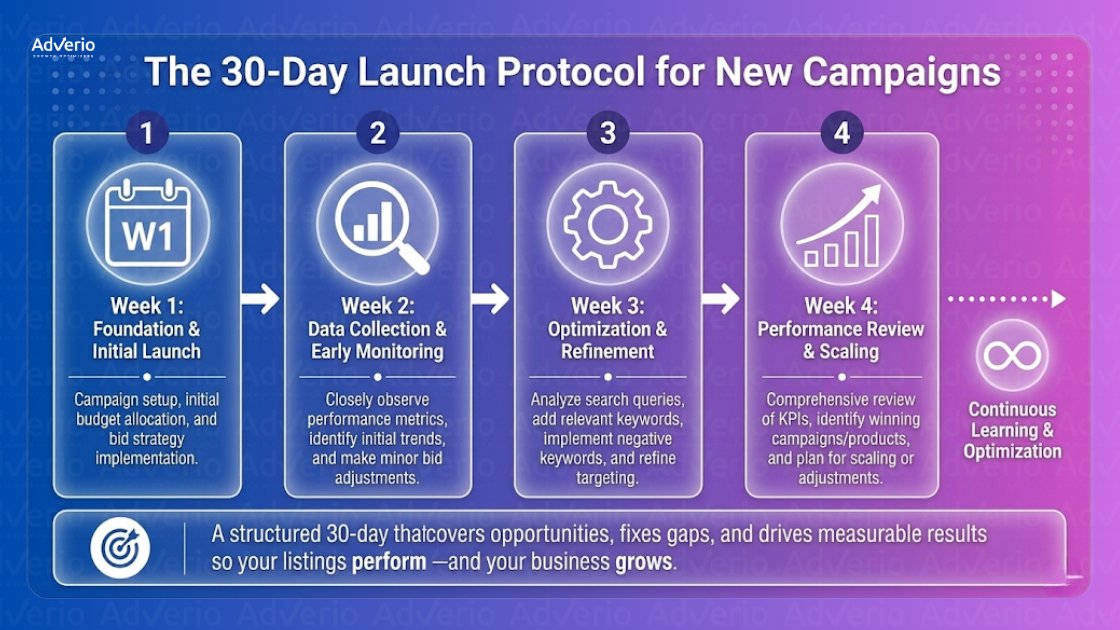
Day 1 to Day 3
Launch auto campaigns on your top five priority items. Keep auto at 20% of total budget. Don’t spread spend across marginal SKUs just because they exist.
Day 4 to Day 7
Check content health. Confirm every advertised item is above 70% Content Score. Pause anything below that line. Paying for traffic to a weak page is self-sabotage. If your listings still need cleanup before you scale spend, fix the content score first.
Day 30
Pull the search term report. Move proven converters into manual exact match campaigns. This is the handoff point from exploration to precision.
Day 45
Make your first serious bid optimization pass. Now you have enough manual data to make cuts and pushes with some confidence.
Operator move: Treat launch month as data acquisition. Not as a weekly optimization contest.
Common Walmart Sponsored Products Mistakes
Most wasted spend on Walmart is predictable. That’s good news, because predictable mistakes are easy to remove.
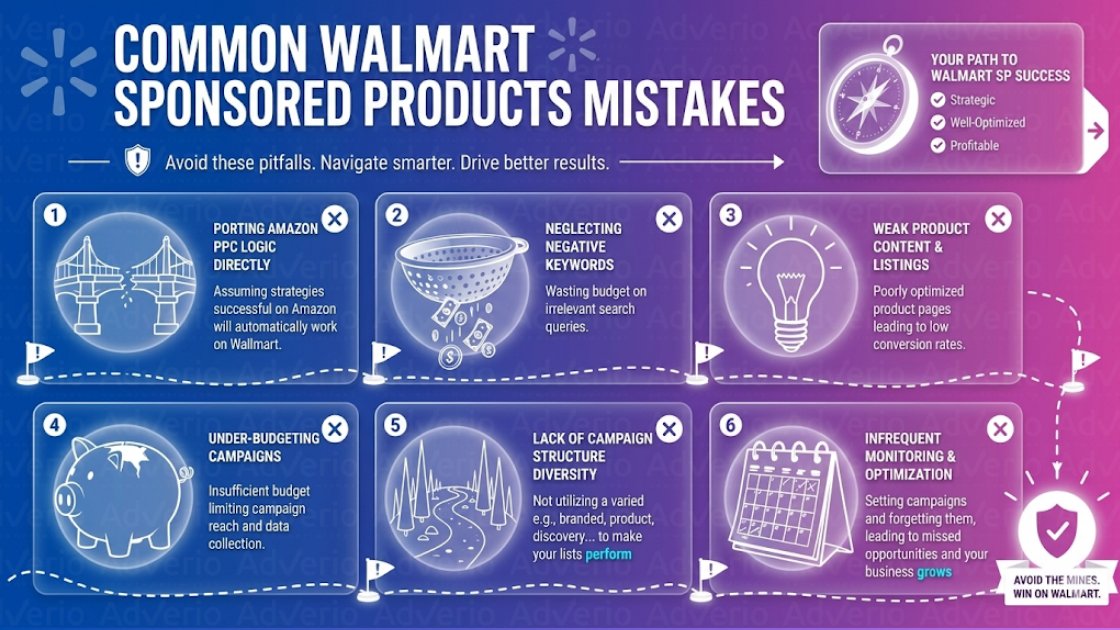
Six mistakes that bleed margin
-
Running ads on items with Content Score below 70%
You’re paying premium traffic prices for a page that hasn’t earned the conversion. -
Setting bids below suggested bid in the first month
That doesn’t create efficiency. It blocks delivery. -
Skipping auto campaigns
You miss Walmart-specific search behavior and build manual campaigns on guesswork. -
Applying Amazon bid logic directly to Walmart
Different ranking inputs. Different traffic behavior. Different profit outcome. -
Judging performance on last-click ROAS alone
ROAS can flatter a weak account. TACoS tells you whether the whole channel is getting healthier. -
Failing to control search term flow between campaigns
If discovery traffic and proven demand live in the same buckets, budget gets sloppy fast.
The real pattern
These mistakes all come from one bad assumption. People think Walmart is a lighter version of Amazon. It isn’t. It’s a retail-first ad system.
If the catalog, fulfillment, and campaign structure don’t line up, spend won’t save you. The same retail-first principle applies to Amazon listing optimization work, where weak pages cap every paid lever above them.
How Adverio Structures Walmart Campaigns
Adverio structures Walmart campaigns around one question. Which SKUs can grow without hiding margin loss behind flattering ROAS.
That changes the build. We do not treat Walmart like a lighter Amazon account or chase activity for its own sake. The same operating logic shapes how we run Amazon PPC management for established brands.
We group campaigns by retail readiness, margin profile, and search-term intent so budget flows to products that can hold conversion and stay profitable after fulfillment, fees, and price pressure.
The operating standard is simple. Discovery traffic gets room to learn. Proven terms get tighter control. Weak catalog pages do not get paid support until the retail fundamentals are fixed. It’s the same discipline we apply to Amazon account management, where structure decides whether spend builds margin or hides leaks. That keeps Walmart from turning into an expensive reporting exercise.
If you want a team running your Walmart PPC management, judge them on structure, search-term control, and how they report profit by SKU.
Fancy dashboards are easy to build. Clean economics are harder.
Frequently Asked Questions
Should I launch Walmart Sponsored Products before my listings are fully optimized?
No. If the listing is weak, the campaign data will be weak too. Walmart ties ad performance to listing quality and fulfillment signals, so unfinished pages distort everything downstream.
How many SKUs should I advertise first?
Start with a small priority set. Pick the products with the strongest margin profile, clean content, and reliable inventory. Walmart gets messy when brands advertise the whole catalog before proving which SKUs deserve budget.
Should I use Amazon search term data on Walmart?
Yes, but only as a starting point. Amazon data is a seed list, not a final answer. Walmart shoppers use different query patterns, so your auto campaigns still need to do discovery work.
When should I use manual item targeting?
After keyword structure is stable. Item targeting works best as a secondary layer for competitor pressure and complementary cross-sell, not as the foundation of the account.
What matters more on Walmart, bids or operations?
Both matter, but operations can block the value of bids. If fulfillment, in-stock position, reviews, or listing quality are weak, more aggressive bidding just buys more expensive disappointment.
Adverio works with established brands that want tighter campaign structure, cleaner spend, and a clearer path to profitable scale on Walmart Sponsored Products.
Book a Profit ROI Forecast to see where your campaign setup, catalog, and media strategy are creating margin and where they are leaking it.