


Table of Contents
Amazon growth stalls long before brands admit the strategy is broken.
The usual response is to push Sponsored Products harder, chase a cleaner ROAS, and call it discipline. That approach protects a reporting metric while CPCs climb, branded demand gets taxed, and contribution margin erodes. It does not build a business.
A serious Amazon retail media full funnel strategy starts with a different question. Is your ad spend creating profitable demand, or are you just paying to intercept shoppers who were going to buy anyway? That distinction matters more than any isolated campaign metric, and it is the gap behind most Amazon plateaus. If your team still evaluates media through a last-click lens, your ceiling is lower than you think.
A stronger read on ROAS vs TACoS on Amazon shows whether media is expanding demand, improving traffic quality, and protecting margin while revenue scales.
The mechanics behind that — when to use DSP vs PPC, how to structure campaigns by funnel stage, and how to allocate budget across ad types — live in the DSP vs PPC funnel guide and the Amazon campaign structure guide.
What this guide adds is the profit systems layer: how to connect each funnel stage to financial outcomes, when upper-funnel spend is justified, and how to measure whether the full system is creating incremental demand or just shifting attribution.
The standard awareness, consideration, purchase model is useful, but incomplete on its own. Brands fail because they treat the funnel like a media diagram instead of a profit system.
The primary job is to connect each stage to financial outcomes, set guardrails against margin cannibalization, and know when upper-funnel spend is creating future cash flow versus wasting budget.
That is the framework here. Build demand. Capture it efficiently. Measure the business impact across the whole funnel, not just the final click.
If you are still running Amazon like a bottom-funnel vending machine, you are giving up growth before the market does it for you.
Your Amazon Strategy Is Broken If It Only Chases ROAS
ROAS is a control metric, not a growth strategy. Brands that run Amazon media by ROAS alone usually protect a dashboard while their category position gets weaker and their margins get thinner.
That happens for a simple reason. Bottom-funnel campaigns capture intent that already exists. They do not create enough of it. If your spend is concentrated on branded search, competitor conquesting near purchase, and the highest-intent product queries, you are fighting expensive auctions for shoppers who were already close to converting.
That is not full-funnel strategy. It is demand harvesting.
A clear view of ROAS vs TACoS on Amazon starts with one financial question. Is ad spend creating incremental demand at an acceptable contribution margin, or is it cannibalizing organic sales and taxing branded traffic you would have won anyway? That distinction separates brands that scale from brands that stall.
What ROAS fails to measure
ROAS only measures revenue tied to ad-attributed clicks. It does not measure whether your media improved discovery, raised branded search volume, increased detail page engagement, or expanded your future buyer pool.
That blind spot is expensive. Teams cut upper-funnel spend because it looks weaker in last-click reporting, then act surprised when branded search softens, retargeting pools shrink, and conversion campaigns get less efficient a few weeks later.
The standard funnel model is still useful. The mistake is treating it like a media planning graphic instead of a profit system. Top-funnel activity should earn budget when it expands qualified reach and feeds stronger mid-funnel engagement. Mid-funnel activity should earn budget when it improves traffic quality and moves more shoppers toward conversion. Bottom-funnel activity should monetize that demand efficiently. If you force every campaign to clear the same ROAS bar, you train the account to capture demand late and ignore the economics of creating it early.
Practical rule: If every campaign must justify itself on immediate ROAS, your account is built to intercept existing demand, not grow market share.
The real cost of short-term optimization
Short-term optimization creates three predictable financial problems:
-
Higher acquisition costs because you are overexposed to the most competitive, highest-CPC traffic
-
More margin cannibalization because branded and high-intent terms often get credit for sales your organic rank already supported
-
Lower growth capacity because you are not filling the funnel with new shoppers who convert later
This is why so many Amazon brands hit a ceiling after a strong early run. They get better at bidding, reporting, and trimming spend. They do not get better at generating profitable demand.
The fix starts with measurement discipline. Stop asking which campaign has the prettiest ROAS. Ask which spend creates incremental revenue without breaking contribution margin, which spend protects branded demand, and which spend deserves scale because it improves total account economics over time. That same discipline matters in launches too. A poor launch plan often forces brands into expensive catch-up media later. Retail readiness, inventory position, and listing quality should all clear before budget goes live.
You do not win Amazon by babysitting bottom-funnel efficiency. You win by building a profit-first retail media system that creates demand, converts it, and protects margin while it scales.
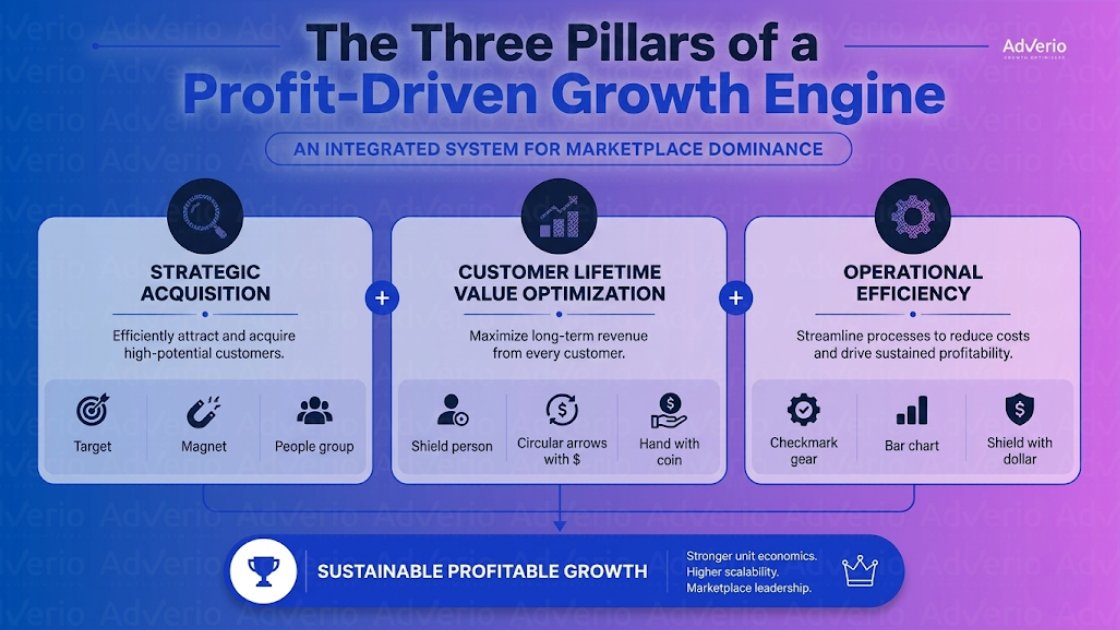
The Three Pillars of a Profit-Driven Growth Engine
The standard awareness-consideration-conversion graphic is too simplistic for Amazon. It explains shopper behavior. It does not explain how to grow profitably.
A real growth engine on Amazon runs on three linked pillars: catalog economics, media architecture, and conversion efficiency. Miss one, and the other two carry dead weight. Strong ads cannot rescue weak PDPs. Strong PDPs cannot fix poor audience sequencing. And neither protects margin if your traffic turns into low-quality sessions, discounted sales, or branded demand you would have captured anyway.
You are not building a prettier funnel. You are building a system that creates incremental revenue without letting ad spend eat contribution margin.
Profit-Driven Catalog Optimization
Your catalog is the balance sheet behind every media decision. Weak titles, poor images, broken variation logic, and inconsistent in-stock rates act like a tax on paid traffic.
Brands love to treat catalog work as hygiene. It is a profit driver. Better retail readiness improves click efficiency, lifts conversion rate, and gives you more room to scale before TACoS and contribution margin start breaking down. If the listing cannot convert cold traffic and reassure high-intent traffic, your ad account is funding waste.
Intelligent Growth Marketing
Media should be managed like a portfolio, not a bid dashboard. Each campaign needs a job. Each job needs a margin threshold. Each threshold needs to tie back to incrementality, not vanity ROAS.
Analysts at Amazon Science found in a study of 122,000 brands that new product launches and upper-funnel retail media advertising were especially effective for small brands (Amazon Science retail media budget allocation study). That matters because it reinforces a point many brands learn too late: growth does not come from harvesting the same bottom-funnel demand harder. It comes from creating new demand, then converting it without losing margin discipline.
Launches make this painfully obvious. If the product, offer, inventory position, and listing are not ready, media spend turns into expensive noise. Pressure-test retail readiness before the media spend goes live, not after.
Marketplace CRO
Traffic costs real money. Every weak detail page, cluttered image stack, low-conviction video, and fuzzy value proposition reduces the return on that spend.
Amazon CRO means tightening the exact surfaces that affect conversion and order value:
-
Main images need to earn the click and set clear expectations
-
A+ content and brand story need to answer objections fast
-
Variant structure needs to help shoppers choose, not stall
-
Reviews, pricing, and offer logic need to support the promise your ads are making
Treat these three pillars like one financial system. Catalog quality improves media efficiency. Smarter media brings in better traffic. Better conversion mechanics turn that traffic into profitable revenue instead of costly attrition.
Architecting Your Funnel Ad Products and Tactics
If every campaign in your account is judged by immediate ROAS, your funnel is misbuilt. You are asking closing tactics to do demand creation, brand building, and conversion recovery at the same time. That is how brands stall on Amazon while ad spend climbs faster than contribution margin.
Build your media like a P&L, not a dashboard.
Each stage should have one financial job. Top funnel expands qualified demand. Mid funnel improves the odds that interested shoppers come back and buy. Bottom funnel captures intent at the lowest possible cost. Keep those jobs separate, and each ad product becomes easier to evaluate, cut, or scale.
Full-Funnel Amazon Ad Product Matrix
| Funnel Stage | Primary Objective | Key KPIs | Recommended Ad Products |
|---|---|---|---|
| Top of funnel | Build awareness and qualified reach | Unique reach, CTR | Amazon DSP, Sponsored Brands |
| Middle of funnel | Increase engagement and product evaluation | Detail page views, new-to-brand percentage | Sponsored Brands, Sponsored Display, Amazon DSP |
| Bottom of funnel | Convert high-intent traffic into orders | ROAS, ACOS, conversion rate, units sold | Sponsored Products, Sponsored Display, Sponsored Brands |
Top of funnel
Top-funnel spend should create future revenue, not chase same-day efficiency. Use Amazon DSP and broader Sponsored Brands placements to put your hero SKU, category promise, and brand positioning in front of shoppers who are not searching for you yet.
This spend earns its keep by increasing branded search, detail page traffic, and retargeting pool quality later. If you force top-funnel campaigns to hit the same payback target as branded Sponsored Products, you will shut off demand creation and trap the account in a harvest-only cycle.
Middle of funnel
Mid funnel decides whether early interest becomes profitable intent or wasted traffic.
Use Sponsored Display, Sponsored Brands, and DSP retargeting to bring back product viewers, category browsers, and shoppers who engaged but did not purchase. The message needs to close the gap between curiosity and conviction. Focus on product proof, differentiators, offer clarity, and reasons to act now.
A serious profit-first Amazon ad strategy treats this stage as margin protection. Strong mid-funnel programs lower the pressure on bottom-funnel CPCs because more shoppers arrive pre-sold.
Bottom of funnel
Bottom funnel should convert demand with discipline. Sponsored Products usually carry that load, with Sponsored Display and Sponsored Brands supporting branded and high-intent recovery. Running this layer on profit instead of platform efficiency is the whole point of Adverio’s Amazon PPC management, which budgets from incrementality and funds only the SKUs that earn it.
This is your cash engine. Run exact-match terms, strong product targeting, branded defense, and high-converting ASIN recovery here. Watch TACoS, conversion rate, and contribution margin together. A campaign can post attractive ROAS and still damage profit if it over-relies on branded traffic, discount dependency, or expensive placements that would have converted anyway.
Bottom funnel closes the sale. It should not carry the full growth plan by itself.
The Audience and Creative Playbook for Each Funnel Stage
Campaign architecture matters. Audience quality and creative quality decide whether the architecture prints profit or burns it.
Amazon’s video benchmarks make the point clearly. Videos that show products in realistic settings performed 16% higher overall than out-of-context videos, and Amazon advises introducing the product in the first five seconds so the value proposition lands fast (Amazon video full-funnel success guide).
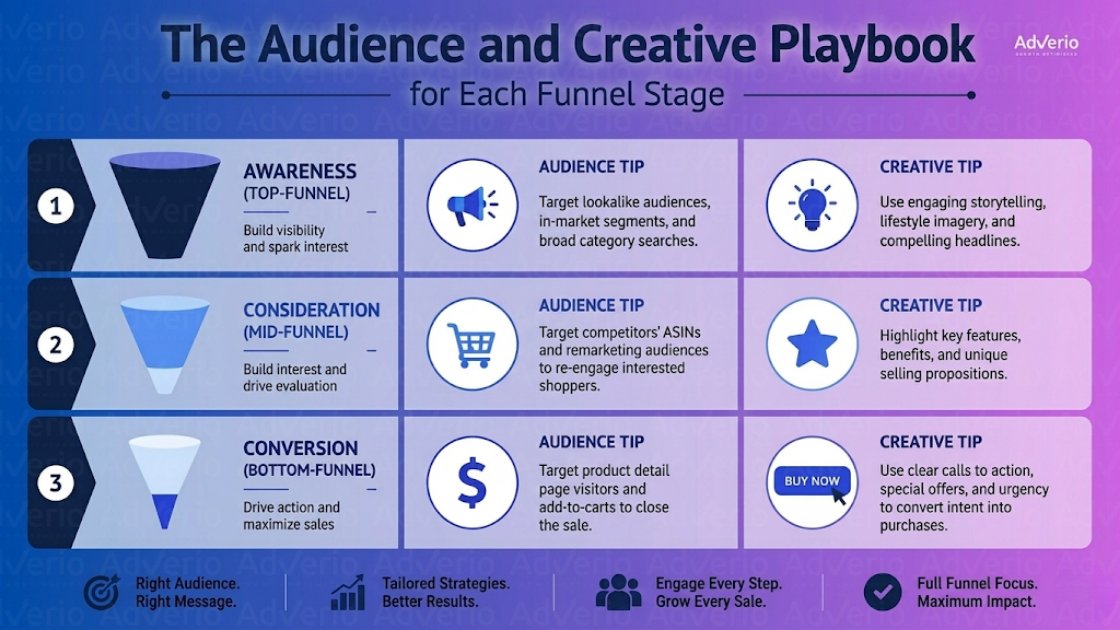
Top-funnel audiences need a story
Cold audiences don’t care about your campaign structure. They care whether they understand the product fast enough to keep watching.
For broad DSP or upper-funnel Sponsored Brands placements, build creative around category tension and immediate use case clarity.
-
Show the product in context so the shopper instantly understands where it fits
-
Lead with the core benefit early because delayed payoff loses attention
-
Design for silent viewing with readable on-screen text
Mid-funnel audiences need proof
These shoppers already know you exist. Now they need a reason to care more than they care about alternatives.
Mid-funnel creative should focus on product utility, differentiation, social proof, and objection handling. If shoppers watched video, visited a detail page, or searched your brand, you should already know what question you’re trying to answer next.
A lot of brands don’t have an ad problem here. They have a listing problem. If that’s the case, start with fix my Amazon listings before pouring more traffic into a weak conversion surface.
Run every video on mute before launch. If the shopper can’t understand what the product does and why it matters without sound, the asset isn’t ready.
Bottom-funnel audiences need clarity
At the bottom of the funnel, storytelling takes a back seat. Clarity wins.
Branded searchers, repeat visitors, and competitor comparison shoppers need obvious value. Your main image, price position, title clarity, review strength, and offer structure need to make purchase friction as close to zero as possible.
Many brands sabotage themselves by using the same generic creative logic across every audience temperature. A cold prospect wants relevance. A warm shopper wants confidence. A hot shopper wants a reason not to leave.
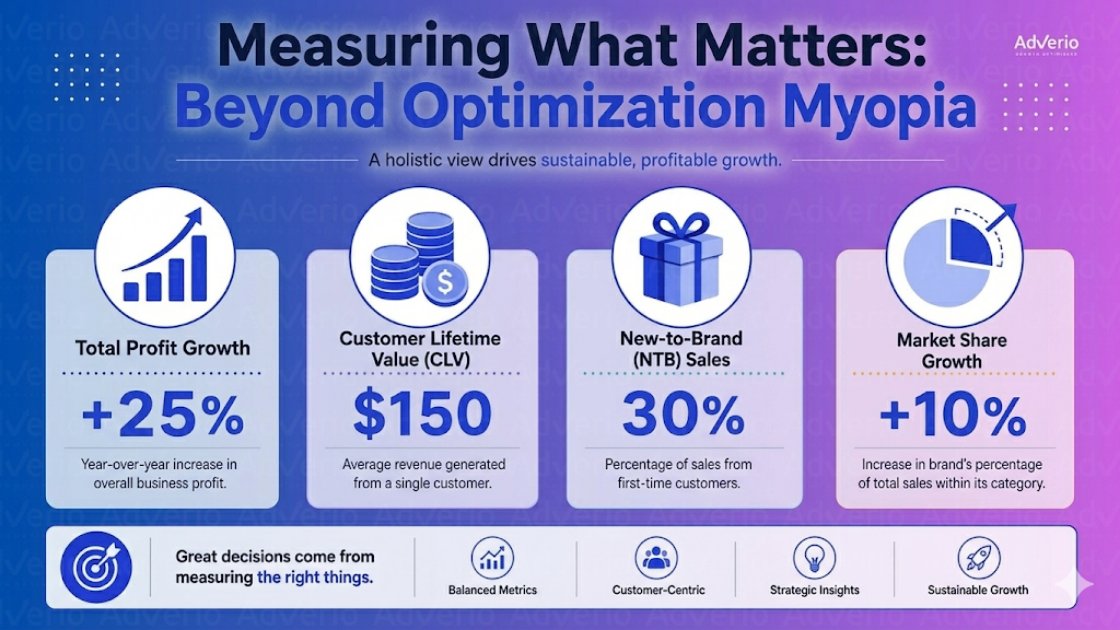
Measuring What Matters Moving Beyond Optimization Myopia
If your dashboard starts and ends with ROAS, you’re not running a growth system. You’re reading the receipt after the money is gone.
Most brands suffer from Optimization Myopia. They over-focus on the easiest metric to report and under-invest in the harder work of attribution, incrementality, and market-share movement.
The risk is larger now because retail media is too big for sloppy measurement. Industry commentary cited by Exverus notes that Amazon is projected to exceed $56.71B in retail media revenue in 2026 and hold roughly 75.2% of US retail media market share, which makes poor attribution a strategic risk, not a reporting nuisance (Exverus on full-funnel retail media measurement).
The scorecard that actually matters
A serious Amazon retail media full funnel strategy uses multiple lenses.
-
TACoS shows whether advertising is supporting total revenue, not just attributed revenue
-
New-to-brand metrics show whether media is bringing in fresh demand or just re-closing the same shoppers
-
Reach and frequency help assess whether upper-funnel spend is building useful exposure or just repetition
-
Share of voice and search presence show whether your brand is gaining or losing ground in the category
If your reporting can’t connect those views, you’re flying blind.
Why incrementality matters
Last-click logic over-credits bottom-funnel campaigns because they show up nearest to the sale. That doesn’t mean they created the sale.
That’s why Amazon incrementality measurement matters. You need a way to judge whether upper- and mid-funnel spend generated demand that wouldn’t have existed otherwise, and whether off-Amazon media is assisting Amazon outcomes.
Diagnostic question: If you cut your upper-funnel spend tomorrow and ROAS improved for two weeks, would your business actually be healthier next quarter? Most brands can’t answer that. They should.
What to stop doing
Stop pausing campaigns just because they don’t look like Sponsored Products on a last-click report.
Top-funnel media should earn its budget by improving downstream behavior. Mid-funnel media should earn its budget by increasing engagement and reducing drop-off. Bottom-funnel media should close demand efficiently.
Different jobs. Different scorecards.
Budget Allocation Scaling Triggers and Cross-Channel Strategy
If your budget model starts with ROAS targets, you are already behind. Full-funnel growth is a capital allocation problem. The job is to buy incremental demand without eroding contribution margin.
That requires discipline. It also requires saying no to spend that flatters dashboards and weakens P&L.
Amazon makes the same point in its full-funnel marketing overview. Awareness media should follow business readiness, not precede it. If category maturity is low, audience overlap is high, creative is mediocre, or inventory is shaky, upper-funnel spend will burn cash long before it builds durable demand.
When upper-funnel budget is justified
Upper-funnel budget earns its place when the retail machine can absorb and convert the demand it creates.
Use it when these conditions are true:
-
Inventory is stable so traffic growth does not lead to stockouts or suppressed conversion
-
Creative is sharp so shoppers understand the product fast
-
Category demand is broad enough to support incremental reach
-
Audience overlap is managed so you are not paying to hit the same users at every stage
Miss those conditions and awareness spend becomes a vanity tax.
Practical allocation logic
There is no fixed split that deserves blind trust. Budget should follow the commercial problem in front of you.
| Business condition | Budget bias | What to emphasize |
|---|---|---|
| New launch or weak brand demand | More top and mid funnel | Reach, education, detail page engagement |
| Established demand but poor conversion efficiency | More mid and bottom funnel | Listing fixes, retargeting, high-intent capture |
| Mature bestseller with stable retail readiness | Balanced portfolio | Market defense, NTB growth, margin protection |
The key is sequencing. Do not fund awareness because it sounds strategic. Fund it after you have retail readiness, conversion paths, and reporting tight enough to prove the spend is creating profitable demand.
If your campaign structure is messy, fix that first. Adverio’s Amazon campaign guide is a good benchmark for how to organize the account before you add more budget.
Scaling triggers that matter
Scale on signals of economic strength, not on one strong week.
Good triggers include rising branded search volume, stronger new-to-brand efficiency, better detail page engagement, and stable bottom-funnel conversion after upper-funnel spend increases. Those signals suggest your funnel is creating demand that converts later, not just shifting credit around the account.
Pressure-test CPC assumptions against your own category history and margin thresholds. If bids are rising faster than contribution profit, your scaling plan is wrong even if attributed sales look healthy.
Cross-channel strategy should follow the same rule. Use Amazon search term and audience data to sharpen Google Search, Meta, and lifecycle media. If Amazon insights stay trapped inside the retail media team, the rest of your acquisition spend gets dumber and more expensive.
Stop Babysitting Campaigns and Start Owning Your Growth
You didn’t build a brand to spend your week buried in bid modifiers, search term reports, and conflicting platform dashboards.
Most internal teams are overloaded. Most agencies are too tactical. They manage pieces of the machine without owning the economic outcome. That’s why brands end up with lots of activity and very little strategic clarity.
If you want a sharper operating standard, review Adverio’s Amazon campaign guide and compare it to how your account is being run today. The gap is usually painful.
A strong Amazon retail media full funnel strategy needs real operators, not dashboard tourists. It needs catalog control, creative discipline, audience sequencing, and measurement that ties back to profit. Anything less is expensive theater.
Market share on Amazon doesn’t wait for you to get organized. Competitors take it while you debate attribution models and trim bids.
Frequently Asked Questions
Is full-funnel Amazon strategy only for big brands
No. Smaller brands often need it more because they cannot afford to rely on branded search and discounting to drive sales. Amazon’s own research has shown that upper-funnel media and launch support can help emerging brands gain traction. The key constraint is not company size. It’s whether you can measure incrementality and protect contribution margin while you scale.
What should I measure besides ROAS
Measure the metrics that match the job of each campaign. Top-funnel campaigns should be judged on reach, video completion rate, CTR, and branded search lift. Mid-funnel campaigns should be judged on detail page views, add-to-cart rate, new-to-brand share, and remarketing efficiency. Bottom-funnel campaigns should still carry the hard numbers: conversion rate, TACoS, ACOS, units sold, and contribution profit after ad spend.
If your scorecard stops at ROAS, you are funding demand capture and calling it strategy.
When should an established brand spend more on upper funnel
Spend more when your product pages convert, inventory is healthy, and your branded search campaigns are no longer your only source of efficient revenue. Upper-funnel spend makes sense when you have room to create new demand, not when you are still leaking money at the listing level.
Set a financial trigger. If branded and high-intent campaigns have stabilized, repeat purchase behavior is strong, and your blended margin can absorb a longer payback window, increase top-funnel investment.
Does creative really matter that much on Amazon
Yes. Bad creative burns money fast.
Top-funnel Amazon media only works if the message is clear within seconds, the product benefit is obvious, and the visual matches shopper context. Strong targeting cannot rescue weak hooks, generic video, or cluttered imagery. Creative quality affects click-through rate, detail page engagement, and conversion efficiency all the way down the funnel.
Can Amazon be measured as part of a broader media mix
Yes, but you need a profit-first model, not a last-click report. Amazon should be evaluated alongside paid social, search, influencer, and retail media using incrementality, blended CAC, and contribution margin by channel.
The goal is simple. Know which channels create demand, which channels harvest it, and whether the combined system produces profitable growth.
If your Amazon account is producing more dashboards than profit, it’s time to fix the system. Adverio helps established brands build a profit-first marketplace growth engine across Amazon, Walmart, and Target.
If you want a clear view of what to scale, what to cut, and where margin is leaking, Book Your ROI Forecast. 15-minute diagnostic call. No pitch deck.