


Table of Contents
Most Amazon ad reporting is built to protect the agency, not your margin.
If your dashboard celebrates ROAS while your profit stalls, you don’t have a growth system. You have a story someone is telling to justify spend. Amazon incrementality measurement is the discipline that strips that story down to one blunt question: would the sale have happened anyway?
That question makes people uncomfortable because it exposes waste. It also happens to be the only question a serious operator should care about.
If your dashboard celebrates ROAS while your profit stalls, you don’t have a growth system. You have a story someone is telling to justify spending. The only question that matters is whether the sale would have happened anyway, and most brands have never run the test that answers it.
We model your account’s incrementality baseline, branded vs non-branded, organic capture vs paid lift, before recommending a single budget change. No pitch deck. No commitment.
Amazon ad incrementality measures how much of your ad-attributed revenue would have happened anyway through organic search. If 60% of your Sponsored Products conversions would have occurred without the ad, your true incremental ROAS is far lower than your dashboard shows.
The One Question Most Amazon Agencies Are Afraid to Ask
The most honest thing an Amazon agency can say is simple: some of your ad spend didn’t do anything useful.
Most won’t say it. They’d rather show a polished report, point at attributed revenue, and move on. That’s convenient for them. It’s expensive for you.
A lot of Amazon accounts are loaded with campaigns that look productive because they collect credit for demand that already existed. Branded search. Retargeting people who were already halfway to checkout. Bidding aggressively on products that already hold strong organic rank. On paper, that can look efficient. In your P&L, it can look like margin erosion.
You didn’t hire an agency to claim credit for sales your brand already earned.
The question that cuts through the noise is this: Would this sale have happened without the ad?
If the answer is yes, then the spend was defensive at best and wasteful at worst.
Why agencies avoid the question
Incrementality is harder to measure than ROAS. It requires testing, restraint, and the willingness to admit that some campaigns should be reduced or shut off. That creates a conflict. A lot of agencies get paid to manage spend, not to challenge whether the spend deserves to exist.
That’s why brands stuck on plateaued growth should look past glossy reporting and compare how different Amazon account management companies think about causality, not just attribution.
The difference between an agency that optimizes attribution and one that measures causality is the difference between a polished report and a real answer. Attribution tells you which campaigns touched the sale. Incrementality tells you which campaigns caused it. Only one of those questions is worth paying for.
We show you the causality, not just the attribution, before we recommend a single budget decision.
What ignoring it costs you
When you don’t measure incrementality, three things usually happen:
-
You overfund low-value demand capture and underfund real customer acquisition.
-
You mistake activity for growth because attributed sales rise while underlying efficiency weakens.
-
You train your team to optimize the wrong problem which is how accounts get busier and less profitable at the same time.
This isn’t academic. It’s budget discipline. Every dollar tied up in non-incremental spend is a dollar you can’t put into category conquesting, audience expansion, Amazon listing optimization, or marketplace share gains.
Your competitor doesn’t need you to make bad decisions. They just need you to keep trusting bad metrics.
Incrementality Defined In Plain Language
Incrementality means sales that happened because of the ad, not merely after the ad. No jargon is needed.

If someone searches your brand name, sees your Sponsored Products ad, clicks it, and buys the product that was already sitting in the top organic position, that isn’t necessarily growth. It may just be a paid detour to a sale you already owned.
If someone had no prior intent to buy your product, discovered it through a relevant non-branded query or a prospecting audience, and then converted, that’s much closer to real incremental value.
The cleanest way to think about it
Think of Amazon ads as having two jobs:
| Ad behavior | What it means |
|---|---|
| Demand capture | You intercepted a shopper who was probably going to buy from you anyway |
| Demand creation | You influenced a shopper who likely would not have purchased without the ad |
Both have a place. Only one deserves growth-level praise. Incrementality measurement changes how you allocate budget across the account. Applied consistently at the campaign and SKU level, it becomes one of the core diagnostic tools inside a governance-led Amazon PPC management system.
Cannibalization is the enemy
Cannibalization happens when paid media steals credit from organic momentum, existing brand intent, or repeat purchase behavior. You still get the sale. You just paid extra for it.
That’s why incrementality matters far more than platform-attributed performance. A channel can look efficient while taxing your own demand.
In January 2024, the Association of National Advertisers found that 71% of advertisers rank incrementality as their number one KPI for retail media investments, a shift away from old standbys like ROAS (ANA finding cited here).
Smart operators already know why. They don’t need more dashboards. They need a cleaner answer to whether paid media created net-new value.
Most agencies won’t run this test. The results make too many campaigns look unnecessary. Holdout testing requires restraint, pulling spend back on campaigns that look profitable and watching whether organic sales fill the gap. The brands that do it almost always find that 20 to 40 percent of their ad spend is defending sales they already own.
We run this analysis as part of the profit diagnostic before we recommend scaling anything.
Free incrementality diagnostic. We show you which campaigns are driving net-new revenue and which are just collecting credit.
What to measure instead of celebrating attributed sales
A practical shift starts when you stop asking, “How many sales did ads touch?” and start asking better questions:
-
Did ads bring in new demand or skim existing demand?
-
Did total account performance improve or did paid absorb organic share?
-
Did we gain new customers or just pay to reacquire familiar ones?
That change also forces a better KPI stack. If your team still treats platform attribution as the main scoreboard, fix that first. This guide on Amazon KPIs is a useful gut check for what deserves executive attention and what doesn’t.
Practical rule: If a metric can’t help you separate caused sales from claimed sales, it shouldn’t lead the conversation.
Cannibalization is the most expensive mistake that looks like success on a dashboard. Branded campaigns post clean ROAS because intent was already high. Retargeting converts well because the shopper already knew you. Defensive bidding looks rational because the click was likely yours anyway. None of that is incremental. We separate those buckets in the first diagnostic call.
We isolate which campaigns are capturing demand you already own versus which are actually creating new revenue. 15 minutes.
Why ROAS and ACoS Are Dangerous Vanity Metrics
ROAS and ACoS aren’t useless. They’re just routinely overpromoted by people who benefit from looking efficient.
A campaign can show a strong ROAS because it harvested branded traffic. ACoS can look tidy because the ad mostly recaptured shoppers who were already coming back. Neither metric tells you whether the spend produced a sale that would not have happened otherwise.
That’s the trap.

Why these metrics flatter bad strategy
ROAS rewards whatever gets attributed revenue. It doesn’t care whether that revenue was incremental. ACoS rewards efficiency inside the ad platform. It doesn’t care whether your total business improved.
That creates a bizarre incentive structure where the safest campaigns often look the best:
-
Branded campaigns can post clean numbers because intent is already high.
-
Retargeting pools can convert well because the shopper already knows you.
-
Defensive bidding can seem rational because the click was likely yours anyway.
If your team obsesses over those outputs without challenging causality, you’re stuck in optimization myopia.
Last-click logic misses the bigger business impact
Retail media doesn’t operate in a vacuum. One of the biggest flaws in pure platform attribution is that it ignores spillover and sequence effects.
For every 1% of sales volume incrementally driven by media to ecommerce channels, an additional 0.5% halo effect boosts Amazon-specific sales, which last-click ROAS misses because of cross-channel attribution gaps (measured in this analysis).
That matters for two reasons:
-
ROAS can understate some real value when upper-funnel media drives broader demand.
-
ROAS can also overstate value when the platform claims sales that were already in motion.
You need both truths in your head at the same time or you’ll make lazy budget decisions.
ROI is the adult metric
If your leadership team still uses ROAS as a stand-in for business impact, fix the language first. This breakdown of understanding the true difference between ROI vs ROAS is worth sharing internally because it forces the obvious conversation: efficiency inside an ad dashboard is not the same thing as profit returned to the business.
What to watch instead
ROAS and ACoS can stay on the dashboard. They just need to lose their throne.
Use them as secondary diagnostics, not final verdicts. Then add context that exposes whether the spend is doing anything useful.
A sharper review usually includes:
-
TACoS direction because it shows how ad spend relates to total revenue, not just ad-attributed sales
-
Branded versus non-branded mix because these behave very differently in terms of incremental value
-
New-to-brand behavior because acquisition quality matters more than platform credit
-
Organic rank movement because strong paid performance with collapsing organic support is not a win
If your account is loaded with branded traffic, this guide to branded vs non-branded Amazon ads helps frame where “efficient” campaigns often stop being useful.
A dashboard full of attractive efficiency metrics can still describe an account that is overpaying for its own success.
“More than 100 million impressions. Not revenue.”
Three Battle-Tested Ways to Measure Incrementality on Amazon
Talking about incrementality is easy. Measuring it requires discipline.
You do not need perfect visibility to start. You need a willingness to test assumptions that your agency may prefer not to test.
Spend holdout tests
This is the closest thing to a truth serum.
You deliberately reduce or pause spend on a defined campaign set, product set, or query class, then watch what happens to total sales, paid sales, and organic behavior. If ad-attributed revenue falls but total sales barely move, you just found spend that was taking credit rather than creating demand.
Holdout testing works best when you keep the scope clean. Don’t slash everything at once and then pretend the conclusion is precise.
A decent operating approach looks like this:
-
Pick a narrow target such as branded exact campaigns, one ASIN cluster, or one audience segment
-
Control the timing so you’re not testing through obvious inventory issues, deal periods, or listing changes
-
Judge total business movement not just platform-reported ad sales
-
Document pre and post conditions so your team can’t rewrite the story after the fact
Organic rank monitoring during spend changes
This method is less pure than a holdout, but it’s practical and often revealing.
If you cut spend on a product with strong paid support and your organic rank remains stable while total revenue holds, your ads may have been overclaiming influence. If organic position weakens and total demand softens, paid may have been contributing more than it appeared.
This is especially useful for brands that suspect they are overbidding on terms where they already dominate naturally.
What to watch:
| Signal | What it may suggest |
|---|---|
| Paid sales drop, total sales steady | Low incrementality |
| Paid sales drop, organic picks up | Cannibalization was likely present |
| Paid and total sales both weaken | Ads may be supporting real demand |
| Rank holds despite spend cuts | You may be overpaying for protection |
New-to-brand order rate tracking
This isn’t a perfect incrementality metric, but it’s one of the most useful directional indicators Amazon gives you.
If a campaign repeatedly pulls in existing shoppers rather than first-time buyers, that doesn’t automatically make it bad. It does mean you should stop treating it like a growth engine. New-to-brand data helps separate acquisition activity from loyalty or recapture activity.
Use it to compare:
-
Branded versus non-branded campaign groups
-
Sponsored Ads versus DSP prospecting efforts
-
Audience exclusions versus broad retargeting setups
Operator note: A campaign that looks mediocre on surface efficiency can still be more valuable if it’s consistently bringing in new buyers.
Where AMC changes the game
Amazon DSP used to leave more room for guesswork on incrementality. That gap narrowed materially once Amazon Marketing Cloud improved path visibility.
By 2025, Amazon Marketing Cloud expanded its lookback window from 1 year to 5 years, giving brands a much stronger way to connect upper-funnel impressions to later outcomes across the journey (documented here).
That doesn’t mean AMC magically fixes bad strategy. It means advanced teams have a better environment for tracing sequence, overlap, and delayed conversion behavior.
If your stack is still basic, start with campaign holdouts and rank monitoring. If you’re further along, the right Amazon analytics tools can help tie PPC, DSP, audience exposure, and SKU-level outcomes into one decision framework instead of four disconnected reports.
What Non-Incremental Spend Looks Like In Practice
Non-incremental spend is what happens when an account gets rewarded for taking credit, not creating demand.
That is why weak operators love branded search, lazy retargeting, and blanket catalog coverage. Those tactics make dashboards look efficient. They also let agencies report pretty ROAS while the brand pays to harvest sales that were coming anyway.
Four common ways brands burn money
-
Overfunded branded search
If you already own the click through brand recognition, strong organic rank, and repeat purchase behavior, branded ads often act like a toll booth on demand you had already won. -
Retargeting with weak exclusions
Serving ads to past purchasers, recent PDP visitors, or shoppers already at the point of purchase will inflate conversion rate fast. It will not prove incrementality. It proves you kept following people who were already halfway to checkout. -
Defensive bids without proof of threat
Competitor pressure can justify defense. Habit cannot. If nobody can show lost share, CPC pressure, or rank erosion, the campaign is probably funded by fear. -
Catalog-wide ad coverage with no SKU triage
Some SKUs deserve fuel. Others deserve to be left alone. Spreading budget across the whole catalog usually means strong products soak up easy attributed sales while weaker products burn through spend with no realistic path to contribution.
The nuance lazy audits miss
A lot of teams swing from one bad habit to another. First they overspend on obvious demand. Then they overcorrect and declare that any product with strong organic rank should get no paid support at all.
That rule is just as sloppy.
Ads on high-ranking products can still earn their keep if they expand query coverage, capture long-tail demand, or reach adjacent shoppers your organic listing is not pulling in yet, as explained in Perpetua’s discussion of Amazon ad incrementality.
The question is simpler. Are you paying to reacquire demand you already control, or are you using paid media to create access to demand you would have missed?
What to inspect in your account this week
Audit the account like someone trying to catch theft.
-
Search term intent, whether the query reflects true discovery or obvious brand demand
-
Organic position, before and after spend increases on the same SKU or term set
-
Audience recency, so you can separate prospecting from recycled bottom-funnel traffic
-
SKU concentration, to spot products getting budget because nobody bothered to challenge the default
One more test matters. Ask who benefits from avoiding this analysis. Usually it is the party getting paid on ad spend, not the brand trying to protect margin.
If you need a practical benchmark for what disciplined execution looks like, your Amazon PPC management process should answer those questions at the campaign, term, and SKU level. If it cannot, you are not managing growth. You are funding attribution theater.
How Adverio Operationalizes Incrementality for Profitable Growth
Most brands treat incrementality like an occasional analysis. That’s too late and too weak.
It needs to be an operating rule. Budget in. Budget out. Query in. Query out. Audience included. Audience excluded. If your team waits for quarterly reporting to ask whether spend caused anything, you’ve already paid the tuition.
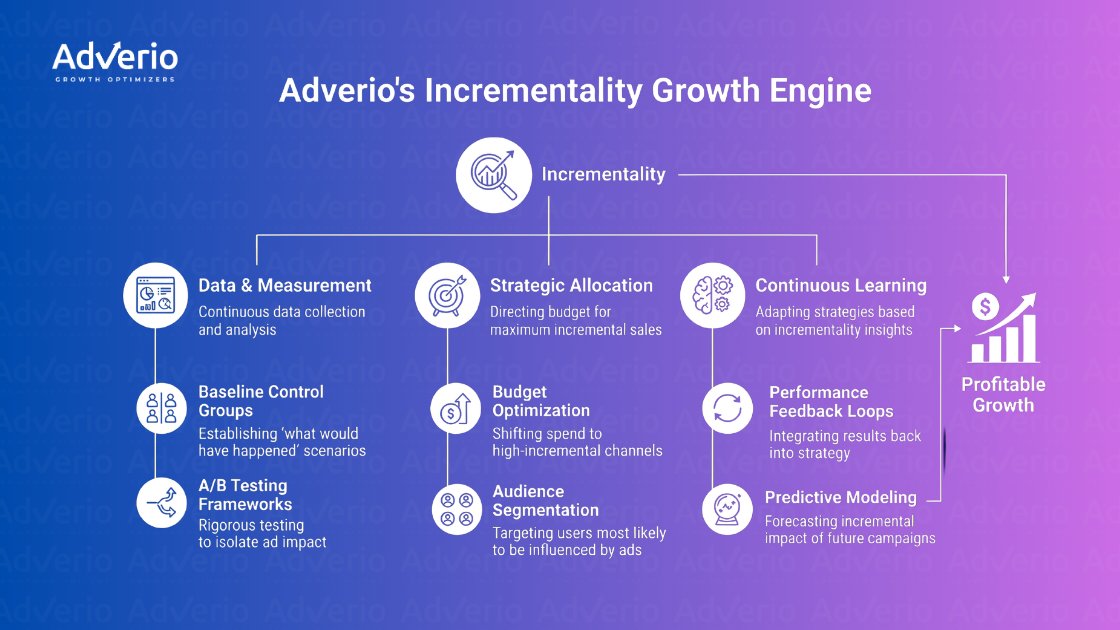
What disciplined execution looks like
The strongest incrementality programs usually share a few habits:
-
They allocate prospecting budget on purpose instead of letting branded and retargeting swallow the account.
-
They use exclusions aggressively to reduce recapture waste.
-
They judge performance at the SKU and query level rather than relying on blended account averages.
-
They connect Amazon PPC management and Amazon DSP with conversion work, so media isn’t forced to carry a broken listing or weak catalog structure.
Code3 has publicly described allocating 60% to 65% of budgets to consistently incremental tactics like In-Market audiences and conquesting, with reported reductions in cannibalization and stronger iROAS from upper-funnel efforts (outlined here). That’s the right direction of travel. Put more budget where demand can be created. Stop worshipping the campaigns that collect easy credit.
The operational standard
Inside a real growth model, incrementality should shape decisions like these:
| Decision area | Better question |
|---|---|
| Keyword expansion | Does this term open net-new demand or mirror traffic we already own? |
| Audience targeting | Are we reaching persuadable shoppers or familiar ones? |
| Budget shifts | Are we funding acquisition paths or just buying cleaner attribution? |
| Catalog support | Which SKUs deserve media because they can convert incremental traffic profitably? |
One practical example is Adverio’s Profit Re-Acceleration Engine, which treats incremental audience expansion as a defined operating component rather than a buzzword. The point isn’t the label. The point is that the system forces campaign decisions through a profit lens.
We don’t just optimize ads. We optimize profit.
That discipline only works if media strategy is tied to the rest of the account. PPC alone can’t solve weak detail pages, bad variant logic, or poor catalog structure. That’s also why a framework like the COSMO Framework matters in practice. It pushes growth decisions beyond bid management and into the messy reality where conversion, content, and media all affect incrementality.
If your current agency reports plenty but never asks what should be cut, that isn’t caution. That’s avoidance.
Your ad platform will always find a way to take credit. ROAS will always find a sale to attribute. The only protection against that is a measurement framework that forces the question: would this have happened anyway?
The brands that compound past 8 figures are the ones that ask it consistently and build their budget decisions around the answer, not the dashboard.
Free diagnostic. We model your incrementality baseline, separate net-new revenue from defended sales, and show you exactly which campaigns deserve to scale.
Frequently Asked Questions About Amazon Incrementality
Is incrementality only relevant for DSP
No. DSP gets a lot of attention because it sits higher in the funnel and can be harder to evaluate with simple attribution. But the most common incrementality problems often live in Sponsored Products and branded search.
Does low incrementality mean I should pause every branded campaign
No. Some branded defense is rational. The issue is scale and intent. If a branded campaign protects meaningful category share or helps during competitive pressure, keep it. Just don’t pretend it’s the same as acquiring net-new demand.
Is new-to-brand the same thing as incrementality
No. It’s useful, but it isn’t the full answer. A new-to-brand order can still come from a shopper who would have found you anyway. Treat NTB as a directional signal, not a final verdict.
How long should an incrementality test run
Long enough to capture a normal conversion cycle and avoid obvious distortions. The exact timing depends on your category, repeat behavior, deal cadence, and traffic volume. What matters is consistency and clean test design.
Can high-organic products still deserve ad support
Yes. The lazy answer is no. The correct answer is sometimes. If paid helps you reach relevant long-tail demand or expand visibility where organic strength doesn’t fully cover the opportunity, the spend may still be justified.
What’s the first sign my account has an incrementality problem
You pull back spend and total revenue barely changes. Or paid sales fall while organic fills the gap. That’s usually your cue to stop admiring attribution and start testing causality.
What should I ask my agency this month
Ask them three things:
-
Which campaigns are most likely non-incremental
-
What tests have you run to prove causality
-
What spend would you cut first if profit mattered more than attributed revenue
If they can’t answer clearly, they aren’t measuring amazon incrementality measurement in any serious sense. They’re reporting platform outputs.
Your budget either creates demand or claims it. If you can’t tell which, that’s the problem. Adverio builds incrementality accountability into every growth decision, from bid strategy to catalog structure.
and find out exactly where your spend is earning its keep.