


Table of Contents
Most advice on Amazon revenue reconciliation is backward. It tells you to compare sales reports, ad reports, payout reports, and then wonder why nothing ties out. That’s amateur hour.
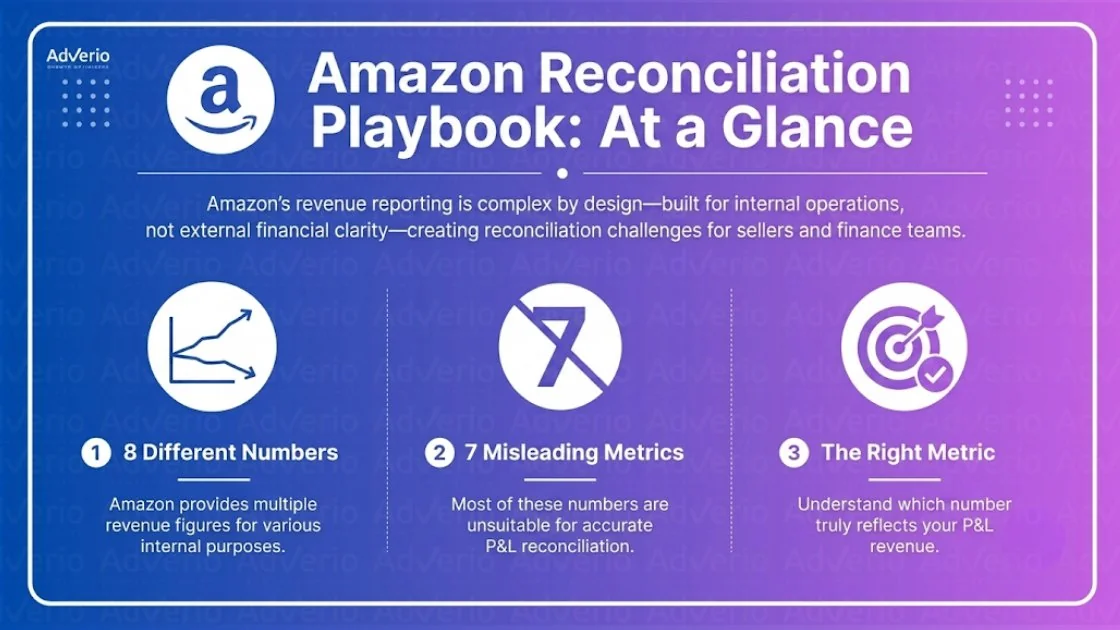
Your P&L doesn’t match Seller Central because Amazon gives you multiple revenue numbers built for different jobs. Most are operational. Only one is fit to anchor accounting. If your team is still starting with Business Reports or ad-attributed sales, you’re not reconciling. You’re chasing noise.
15-minute diagnostic call. No pitch deck.
Reconcile Amazon revenue to your P&L from the Settlement Report, not from sales or ad reports. The Settlement Report is your anchor. The Returns Report validates deductions. The Payments Report confirms cash timing. Everything else is operational context, not accounting. Match line items by Settlement ID, use Transaction ID for deferred activity, and carry unmatched items into the next cycle instead of forcing a close. Reconcile by marketplace first when you sell across regions. Start with settlement activity and your P&L stops fighting Seller Central.
At a Glance Your Amazon Reconciliation Playbook
-
Amazon reports disagree by design. Your finance team isn’t broken. Amazon gives you several revenue reports built for different teams, and most are not accounting numbers.
-
Settlement data is the P&L starting point. If you build month-end close off anything else, you introduce systematic error.
-
Five discrepancy patterns cause most of the pain. Ad-attributed sales, gross versus net treatment, deferred transactions, reserve adjustments, and marketplace currency splits.
-
The fix is procedural, not philosophical. Start with settlement activity, match by the right keys, and carry timing differences into the next cycle.
-
This is a profitability issue. If revenue recognition is sloppy, margin analysis is fiction. That’s why reconciliation discipline matters far beyond bookkeeping.
-

Amazon net revenue reconciliation: match your p&l 20
Operators who take this seriously stop debating which dashboard is “right.” They build one financial truth and move on.
That’s the standard Adverio holds for serious marketplace brands.
Why Amazon Gives You Five Revenue Reports That Disagree
A report labeled “sales” is not a P&L number. That’s the first mistake.
Amazon’s reporting stack was built for different teams solving different problems. Brand managers want demand signals. PPC teams want attributed revenue. Treasury wants payment timing. Customer service wants return visibility. Accounting wants a clean bridge from transaction activity to recognized revenue. Those are not the same thing, so the reports aren’t supposed to match line for line.

The complexity is structural, not accidental. Amazon layers fees, reserves, refunds, and timing differences into every cycle. Stare at net payout alone and all of it disappears from view. That is why a single export never ties to your P&L.
What each report is actually for
| Report family | Primary job | Why finance gets burned |
|---|---|---|
| Business Report | Marketplace performance | Gross activity looks like revenue truth when it isn’t |
| Ad Console | Campaign attribution | It answers ad efficiency questions, not close-the-books questions |
| Payments report | Disbursement timing | Cash timing is not the same as period revenue |
| Returns report | Return event tracking | Necessary input, not a standalone revenue number |
| Settlement report | Financial settlement activity | This is where accounting should start |
Stop trying to make operations reports behave like accounting reports. They won’t.
That distinction also matters for forecasting. If your treasury view is weak, your revenue close will usually be weak too. Good finance teams tie reconciliation discipline to cash flow strategies for Amazon sellers, not just month-end cleanup.
The Correct Revenue Hierarchy for P&L Reporting
You need a hierarchy, not a pile of exports.
If your controller lets each team defend its favorite Amazon report, month-end turns into a debate club. Shut that down. Define the reporting order once, document it, and use it every close.
Amazon Report P&L Usefulness
| Report Type | What It Measures | P&L Use |
|---|---|---|
| Business Report | Gross sales including buyer price | No. Use for performance analysis only |
| Ad Console | Attributed revenue from ad activity | No. Use for campaign analysis only |
| Settlement Report | Net cash disbursed after fees and returns | Yes. This is the P&L starting point |
| Returns Report | Customer return events and refund amounts | Yes. Use to validate returns deducted through settlements |
| Payments Report | Timing of actual disbursements | Yes, but secondary. Use to validate cash timing, not core revenue recognition |
Here’s the rule. The Settlement Report is your anchor. The Returns Report validates deductions. The Payments Report confirms timing. Everything else is operational context.
Pro Tip: If your finance team starts with the ad console because “that’s what marketing uses,” your close process is already compromised.
This is also why Amazon can look healthy in channel dashboards while your actual profitability deteriorates. If you want cleaner decision-making across Amazon, Walmart, and Target, start by developing your omni-channel P&L from a consistent accounting hierarchy.
The Five Most Common Reconciliation Discrepancies
Most Amazon reconciliation pain comes from repeatable failures, not mysterious exceptions. Once you isolate the failure type, the fix gets much simpler.
Discrepancy 1 Attributed ad revenue vs settlement revenue
The ad console measures attributed revenue. Finance needs settled revenue. Those are different universes.
Attributed revenue counts orders Amazon links to ad clicks. Settlement revenue reflects what survived fees, returns, and financial processing. If your team treats attributed sales as if they belong on the P&L, you’ll overstate performance and understate the actual cost to earn that revenue.
Fix: Keep ad-attributed revenue inside marketing analysis. Reconcile P&L revenue from settlement activity only. Then compare Amazon PPC management efficiency to settled outcomes at a management reporting level, not in the general ledger.
Discrepancy 2 Gross sales vs net sales after returns
Business Reports tempt people because they look clean. They are not financially complete.
Gross sales reflect the customer-facing sale amount. Your P&L needs the impact of returns, refunds, and deductions that change the amount you retain. Teams that reconcile to gross activity usually discover the mismatch only after margin review starts falling apart.
Fix: Treat gross sales as a top-of-funnel commercial metric. Pull returns data separately and validate that those deductions flow through the settlement-based close.
Discrepancy 3 Deferred transactions
This one got worse in 2024, when Amazon changed reporting from release date to posted date, introducing new columns including Transaction Status and Release Date, and forcing reconciliation teams to match by Transaction ID and track deferred transactions separately, a change Amazon rolled out in its settlement reporting.
If your team still reconciles on the old logic, you’ll keep finding phantom variances.
Fix: Reconcile 1099-K support using posted date reports, use Transaction ID as the primary key, and isolate deferred activity until it posts. For the deeper operational issue, see how to resolve Amazon deferred transaction issues.
Discrepancy 4 Reserve adjustments
Amazon withholds reserves for its own risk logic. Those reserves distort payout visibility if your ledger treats every reduction in cash as an expense or revenue hit.
Weak accounting design creates false margin swings. The reserve isn’t always a performance problem. It’s often a balance sheet problem being misclassified through the P&L.
Fix: Record reserves separately as liabilities or clearing items based on your accounting policy. Don’t bury them inside fees or net revenue.
Discrepancy 5 Currency and marketplace splits
Multi-marketplace selling breaks simple reconciliation models. Orders happen in local marketplaces. Settlements arrive in local currencies. Conversions don’t always line up with how finance recorded revenue at order time.
Fix: Reconcile by marketplace first, then by settlement cycle, then by currency treatment. Don’t force a single blended monthly number to do the work of a proper sub-ledger.
The Settlement-First Reconciliation Framework
Start with settlements. Not sales. Not ad reports. Not the number someone pasted into a Slack channel.
That’s the only approach that respects how Amazon moves money.
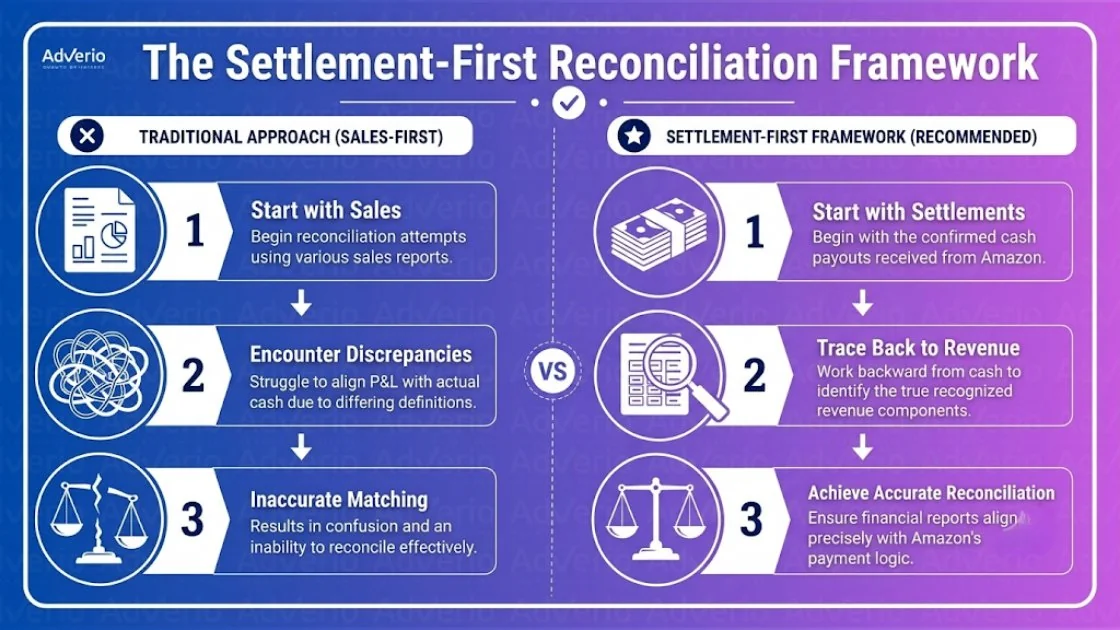
An effective settlement-based method is simple in concept and strict in execution. The method is simple in concept and strict in execution: download the settlement report, match line items using Settlement ID, mark reconciled items, and carry unmatched items into the next period with proper workpaper support.
The five-step framework
-
Pull the settlement report for the close period.
Use the settlement file as the source dataset, not a dashboard export. -
Match line items using the correct key.
Use Settlement ID as the primary key for settlement-level reconciliation. Where deferred timing is involved, use Transaction ID to trace posted activity. -
Separate financial components.
Break activity into gross sales, fees, refunds, and reserves. Don’t post one blended net figure and pretend that’s analysis. -
Validate return effects and timing differences.
Use return activity to confirm deductions. Leave unmatched timing items open for the next settlement instead of forcing a bad close. -
Document every variance in a reconciliation workpaper.
If you can’t defend the adjustment to a CPA or auditor, it doesn’t belong in your close.
Start with actual cash movement and work backward to revenue components. That’s how you stop month-end from becoming forensic accounting.
There’s one more rule finance teams ignore: don’t “fix” deferred timing with journal-entry guesswork. If the issue traces to Amazon’s posted-versus-release logic, you need the right transaction-level bridge. That’s how you resolve Amazon deferred transaction issues without corrupting your close.
How to Automate the Monthly Reconciliation
Manual reconciliation is acceptable as a temporary control. It is not a strategy.
Manual reconciliation does not scale. As SKU count, marketplaces, and settlement volume grow, the error rate grows with it. Missed reimbursements, misposted fees, and timing gaps quietly drain margin month after month. Automation stops being a luxury and becomes a control.
Your three automation paths
| Approach | Best for | Trade-off |
|---|---|---|
| Direct accounting integration | Brands that want speed | Less custom control |
| API integration | Enterprise teams with systems resources | More setup complexity |
| Documented manual framework | Teams stabilizing process first | More operator time |
Direct connectors such as A2X, Finaloop, or Connex can map settlement data into systems like QuickBooks or Xero. API-based pipelines make sense when your ERP, marketplace mix, and internal controls need more precision. Manual monthly reconciliation still works, but only if the framework is documented and disciplined.
Practical rule: Automate only after your chart of accounts and reconciliation logic are correct. Bad automation just scales bad accounting.
If you need the deeper context on deferred transactions specifically, how they create timing gaps between Amazon settlement and your accounting system, and how to fix the NetSuite reconciliation, that lives in the Amazon deferred transactions guide. What this guide covers is the upstream problem: which of Amazon’s eight revenue reports belongs in accounting vs operations, and how to map the five discrepancy patterns to procedural fixes before they distort your close.
15-minute diagnostic call. No pitch deck.
How Adverio Reconciles Revenue Across Marketplaces
Most agencies stop at dashboards. That’s why finance leaders don’t trust them.
Adverio works from a single profit lens that unifies advertising, listing performance, pricing, and inventory data through unified marketplace business intelligence. Profit leaks do not show up cleanly inside disconnected channel reports. Fragmented data creates fragmented decisions. If you want a team that runs full Amazon account management with finance-grade rigor, book the ROI conversation.
Frequently Asked Questions about Amazon P&L Reconciliation
Should my P&L revenue match the Business Report?
No. The Business Report is an operating report. It is useful for sales performance analysis, not for final P&L revenue.
Is the Settlement Report enough by itself?
It is the starting point, not the only input. Use it as the anchor, then validate returns, reserves, and payment timing around it.
What changed with deferred transactions?
Amazon shifted reporting logic to posted date instead of release date. That means teams need transaction-level matching discipline and separate tracking for deferred items until they post.
Why does cash received still differ from revenue recognized?
Because disbursement timing, reserves, refunds, and marketplace timing all affect cash separately from period revenue.
How do I get better SKU-level profit visibility after reconciliation?
Once channel revenue is anchored correctly, you can evaluate fee burden, ad spend, and true Amazon contribution margin by ASIN with far more confidence.
Read Next
References
Amazon revenue reconciliation isn’t a reporting nuisance. It’s a profit control system. If your books still depend on mismatched Seller Central exports, your margin analysis is softer than you think. Adverio helps established brands build a cleaner revenue truth across Amazon, Walmart, and Target, then turn that visibility into smarter growth decisions.
Book Your ROI Forecast. 15-minute diagnostic call. No pitch deck.