


Table of Contents
If you’re running $3M+ across Amazon, Walmart, and Target, your biggest growth leak probably isn’t ad spend. It’s measurement. Platform dashboards are built to take credit, not tell the truth. Amazon wants to prove Amazon. Walmart Connect wants to prove Walmart. None of them are built to show you where demand actually started.
The result: revenue grows, margin shrinks, and your team keeps funding channels that harvested intent they didn’t create.
This guide breaks down why multi-marketplace attribution breaks, what a real cross-platform model looks like, and how to stop budgeting off broken data. If your team still allocates spend from separate dashboards, this is the fix.
Ready to see where your current model is leaking margin? Get your free ROI Forecast from Adverio.
At a Glance
Multi-marketplace attribution fails when brands trust platform-native reporting as if it were objective. It isn’t. Amazon wants to prove Amazon. Walmart Connect wants to prove Walmart Connect. Target Roundel wants to prove Target. None of them are built to tell you where demand originated across the full path.
That creates a bad operating system for growth. A Google or Meta touch can influence a marketplace purchase. A Walmart ad can create branded search demand that closes on Amazon. A review syndication push can improve conversion on Target without getting fair credit anywhere. Your dashboards won’t reconcile because they were never designed to.
A strong multi-marketplace attribution model does three things:
-
Separates demand creation from demand capture
-
Normalizes inconsistent platform logic
-
Ties media decisions back to profit, not vanity efficiency
You don’t need another prettier dashboard. You need a model that stops multiple platforms from claiming the same outcome.
The brands that get this right stop asking which dashboard is correct. They start asking which touchpoints caused the sale, which channels assisted it, and which spend should be cut, protected, or scaled.
Why Multi-Marketplace Attribution Breaks Down
The core failure is structural, and it starts before reporting. Amazon, Walmart, and Target each use their own attribution logic, lookback assumptions, and reporting rules. None of them are built to tell you where demand originated across the full buying path.

Two posts cover the root causes in depth before you go further with this framework:
-
The incrementality problem — why platform attribution claims credit for sales that would have happened anyway: Amazon Incrementality Measurement
-
The fragmentation cost — why split marketplace management creates 20%+ revenue loss from attribution gaps alone: Hidden Costs of Split Marketplace Management
This guide picks up where those leave off. The three specific attribution problems every multi-marketplace brand faces — and the budget governance model to fix them.
The Three Attribution Problems Every Multi-Marketplace Brand Has
Most brands don’t have an attribution setup. They have three separate explanations for the same sale.
| Problem | Description | Impact on Your Business |
|---|---|---|
| Platform credit problem | Multiple platforms claim the same conversion because each measures in isolation | You overfund channels that look efficient on paper |
| Lookback window mismatch problem | Different windows and attribution rules make results incomparable | You make budget calls on distorted channel performance |
| Off-platform influence problem | External demand creation doesn’t get credited when the sale closes on a marketplace | You cut the channels that are actually driving future demand |
The platform credit problem everyone claims the same sale
A shopper sees a Meta ad, searches on Amazon, clicks a Sponsored Product ad, then buys later after encountering your product again on Walmart. Every platform involved can claim some version of that outcome. In practice, the last platform to touch the transaction often gets too much of the glory.
That creates a bad habit. Teams keep feeding spend into whatever closes the sale, even if another channel created the demand in the first place.
Practical rule: If one channel always looks amazing in isolation, assume it’s harvesting intent created elsewhere until proven otherwise.
The lookback window mismatch problem
You can’t compare channels fairly when they don’t use the same measuring stick. Some platforms are more generous with view-through credit. Others lean heavily on click-based logic. Some overstate recency. Others obscure assists.
Finance teams often assume reported ROAS is apples to apples. It isn’t. If one platform gets more time to claim a conversion, it will look stronger even if it wasn’t more persuasive.
The fix isn’t arguing over whose dashboard is best. The fix is standardizing measurement logic outside the platforms.
The off-platform influence problem
Most brands lose the plot here. Demand doesn’t respect channel boundaries.
A shopper might discover you through Google, social, influencer content, or retail media, then convert later on Amazon, Walmart, or Target. Without a unified model, off-platform influence disappears. That encourages teams to slash discovery spend and double down on branded capture.
The same blind spot shows up with operational levers. Review syndication, listing improvements, and variant strategy can shape conversion behavior across channels without earning clean last-click credit anywhere.
What a Unified Multi-Marketplace Attribution Model Looks Like
The answer isn’t replacing one bad dashboard with a shinier one. The answer is a layered model that sits outside the platforms entirely, one that applies consistent credit logic across every marketplace and media channel. Here’s how it works.
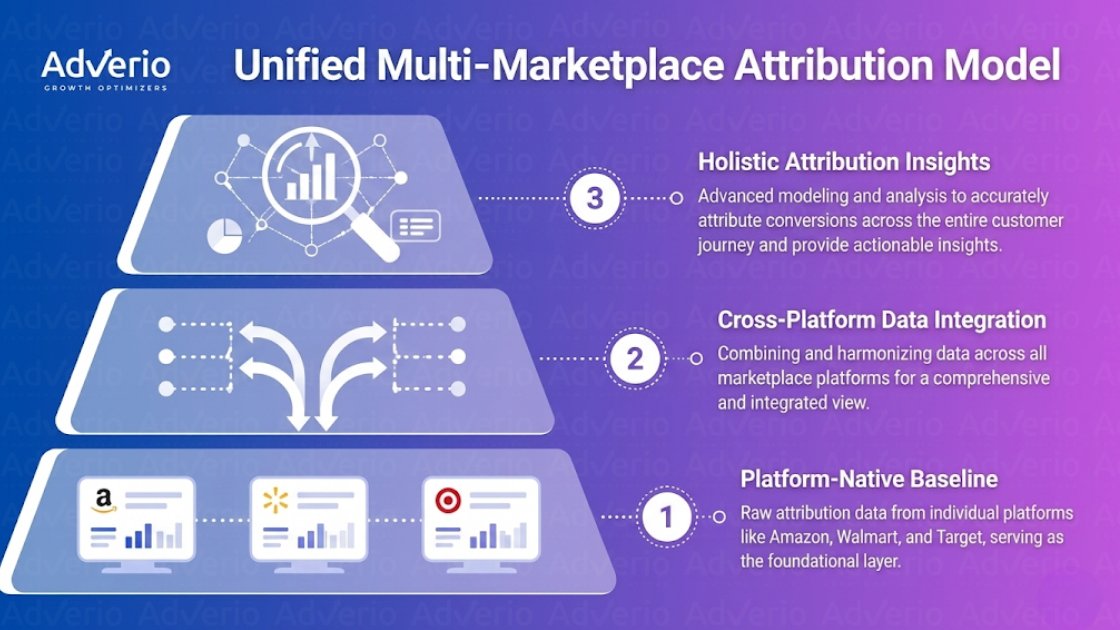
Layer 1 Platform-native attribution as the baseline
Start with the native data. Amazon Ad Console, Amazon DSP, Walmart Connect, and Target reporting still matter. For brands running upper-funnel media, your Amazon DSP management data is especially critical here since DSP influence rarely gets fair credit in last-click models. They give you raw observations, campaign outputs, and platform-defined conversion signals.
But baseline means baseline. Not true.
Layer 2 Cross-platform incrementality measurement
Serious operators separate correlation from causation. You need controlled tests, holdouts, geo-based comparisons, and business-level lift analysis to see whether spend changed the outcome.
If you want a useful conceptual reference point, the logic behind B2B multi-touch attribution is still helpful because it forces you to think in paths, assists, and fractional credit instead of platform ego.
Layer 3 Unified BI reporting connecting all three channels
This layer reconciles ad spend, sales, inventory, reviews, and channel performance into one operating view. It doesn’t just total data. It applies one consistent framework across all marketplaces.
For many marketplace brands, a position-based model is the right starting point. It assigns 40% credit to the first touch, 40% to the last touch, and 20% to assists, and it outperforms linear models by 15-20% in ROI precision for journeys spanning 5-12 touchpoints in CPG and apparel, according to Cometly’s attribution analysis for marketplace sellers.
That matters because a shopper journey across Amazon, Walmart, and Target is rarely a one-click event. If your reporting stack still behaves like it is, you’re under-measuring influence and over-measuring capture.
A real operating model makes this a budget decision system, not a reporting exercise. That’s what a unified marketplace strategy actually looks like.
The starting point for that strategy is understanding how each platform competes for the same shopper, which is the core of our Amazon vs Walmart vs Target marketplace comparison.
The Attribution Framework How to Measure ROI on Each Marketplace
The right framework isn’t identical across platforms. The logic is shared. The inputs are not.
Measuring Amazon attribution correctly
Use Amazon’s native signals first, then pressure-test them. Pull from Ad Console, DSP reporting, and your marketplace sales data. Separate branded capture from non-branded discovery. Watch what happens to total sales, not just ad-attributed sales, when upper-funnel activity changes.
If you’re exploring technical ways teams connect ad systems and automation workflows, this overview of connecting Amazon Ads to AI is a useful external reference.
Question for Amazon isn’t whether ads generated attributed sales. It’s whether they generated incremental sales. That’s how you maximize Amazon ad ROI.
Measuring Walmart Connect attribution correctly
Treat Walmart differently. It often plays a discovery or consideration role before Amazon closes the sale. That means last-click platform ROAS can understate or overstate its real role depending on the path.
Look for patterns such as:
-
Branded search spillover: Walmart activity increases demand elsewhere.
-
Category entry: Walmart introduces shoppers to the product even if it doesn’t close them.
-
Retail readiness interaction: Inventory, content quality, and review depth affect whether media can convert efficiently.
Measuring Target Roundel attribution correctly
Target usually requires more disciplined interpretation because media influence and conversion conditions are tightly linked to merchandising quality, review visibility, and retail context.
Evaluate Roundel against business outcomes, not just media outputs. If a campaign looks weak in platform reporting but improves overall marketplace demand capture or supports stronger cross-channel conversion, it still has value. If it doesn’t move the business, cut it.
Good attribution doesn’t reward the loudest dashboard. It rewards the touchpoints that changed buyer behavior.
How to Identify Where Budget Is Being Misallocated Across Platforms
Budget waste rarely looks like overspending. It usually looks like spending against the wrong job.
A platform that introduces demand should not be judged by the same standard as the platform that captures it. If your team still compares Amazon, Walmart, and Target on isolated ROAS, you’re not allocating budget. You’re rewarding whichever dashboard claims the sale.
Before running the audit, be clear on what job each marketplace is supposed to do. Amazon is typically your demand capture engine. Walmart is typically your efficiency and volume channel. Target is typically your brand validation layer. If your team hasn’t defined those roles explicitly, the audit will surface symptoms without fixing the structure. For the role definitions, see the Amazon vs Walmart vs Target marketplace comparison.
Use a simple audit:
-
Map platform role against actual behavior: Decide whether each marketplace is supposed to drive discovery, strengthen consideration, capture conversion, or retain buyers. Then verify that its observed contribution matches that role.
-
Compare reported efficiency to business lift: If marketplace media metrics improve while total sales stay flat, that spend is harvesting demand that already existed.
-
Look for assisted paths that lead to profitable outcomes: A marketplace can deserve budget without closing the transaction if it consistently creates the conditions for conversion elsewhere.
-
Flag role drift fast: If a platform has no clear job, or its spend keeps expanding without a measurable contribution to total demand, cut budget until the role is redefined.
Weak operating models fail when teams assign spend by platform owner, defend it with platform reporting, and miss the fact that money is being pushed into demand capture while demand creation is underfunded. The result is bad decisions dressed up as channel optimization.
That pattern shows up repeatedly in split account structures and fragmented retail teams. The same insights for profitable marketplace scaling explain why budget waste stays hidden until growth stalls.
If your unified model shows Amazon is capturing demand more efficiently than it is creating it, protect the capture engine but stop feeding it discovery budget it did not earn. Put that scrutiny into Amazon PPC management only after you’ve separated incremental demand from branded cleanup.
The Cross-Platform Budget Governance Model
This is where most teams stop. They build the attribution model, get a better read on which channels create vs. capture demand, and then keep allocating budget the same way they always did. Attribution without governance is just better-informed guessing.
Attribution isn’t useful if it only produces one-time insights. It needs governance.

Strong brands assign roles by platform, then review allocation against those roles on a recurring cadence. Amazon may be your primary demand capture engine. Walmart may be more effective for category expansion. Target may play a sharper role in specific product lines or audience segments.
A practical governance model includes:
-
Role-based KPIs: Judge each marketplace by the job it is meant to do.
-
Budget review cadence: Revisit allocation regularly instead of defending outdated assumptions.
-
Test-and-shift rules: Predefine what evidence is strong enough to move budget.
Budget allocation should work like portfolio management. Protect efficient assets. Trim weak ones. Increase exposure where causal impact is clear.
If you’re evaluating partners to help run this process, the standards in hiring an Amazon agency wisely apply here too. Don’t hire anyone who can’t explain how they separate platform reporting from business truth.
How Adverio Manages Multi-Marketplace Attribution
Marketplace attribution fails the moment you treat platform dashboards as truth. They are sales logs with incentives attached. Adverio replaces that with one operating model built to improve budget decisions across Amazon, Walmart, and Target. This is built into how Adverio’s Amazon account management operates; the attribution layer is not a reporting add-on, it’s part of how strategy decisions get made.

The process starts by consolidating marketplace, media, and profit data into a single measurement layer. That matters because attribution breaks long before reporting does. Once each marketplace is allowed to grade its own performance, budget shifts follow the wrong signals. Adverio fixes the system at the model level, not the dashboard level.
This is built into how Adverio’s Amazon account management operates; the attribution layer is not a reporting add-on, it’s part of how strategy decisions get made.
The measurement approach also moves beyond deterministic last-touch logic. Most attribution tools rely on deterministic last-touch logic. Probabilistic models that simulate touchpoint removal across the full path to purchase consistently outperform that approach on accuracy. That is the standard Adverio uses.
That is the standard Adverio applies. The team connects demand creation to demand capture, then evaluates every marketplace against contribution to profit, not isolated platform ROAS. If Amazon creates the first meaningful touch and Walmart closes the sale, both actions get measured in the same system. If Target absorbs branded demand created somewhere else, that gets called out instead of being misread as platform efficiency.
When a team stops arguing over whose dashboard is correct, it can reallocate spend based on what actually moved the sale. That is the only question worth asking.
FAQs
What’s the difference between MTA and MMM
Multi-touch attribution tracks touchpoints across a customer path and assigns fractional credit to those interactions. It’s useful when you need granular channel readouts and faster optimization loops.
Marketing mix modeling works at a broader level. It evaluates how media and non-media factors influence total sales over time. That’s useful for strategic budget planning when channel interactions are too messy for platform-level attribution alone.
The mature answer isn’t choosing one. It’s using MTA for operational decision-making and a broader model for validation.
How does review syndication factor into an attribution model
This is one of the most ignored issues in marketplace growth. Reviews are a mid-funnel influence lever, and standard reporting rarely gives them fair credit.
Data cited by New Breed’s attribution model analysis shows mid-funnel tactics like reviews can influence 25-35% of conversions, yet standard models dilute that credit. If review syndication improves conversion quality on Walmart or Target after strong Amazon review velocity, your attribution system should treat that as an assist, not a coincidence.
How long does it take to implement a unified attribution system
It depends on data quality, API access, and internal discipline. Clean data moves faster. Messy taxonomy, weak tagging, and disconnected reporting slow everything down.
The bigger point is this. Implementation has an endpoint. Refinement doesn’t. Good multi-marketplace attribution is an operating system that gets sharper as your team keeps testing, validating, and reallocating.
Stop Guessing. Start Allocating With Confidence.
If your team still splits budget decisions across platform dashboards, you’re not optimizing. You’re rationalizing bad data.
Adverio builds the measurement and execution model that tells you which touchpoints created demand, which ones captured it, and where to move money. One model. One operating view. Actual budget confidence.
Book your free ROI Forecast and see exactly where your current attribution setup is costing you margin.
Want to go deeper first? Read: Hidden Costs of Split Marketplace Management