


Walmart Content Score: The Ad Spend Gate You Cannot Afford to Ignore in 2026
Table of Contents
Flat Walmart sales don’t get fixed by more activity. They don’t get fixed by better ads either.
If your listings are weak, Walmart suppresses them before your media budget even gets a fair shot. That’s why a practical multi-marketplace strategy guide matters. You need the catalog right before you try to scale the channel. If that sounds harsh, good. Soft advice is why so many brands stay stuck.
If you need the full listing optimization mechanics, attribute standards, and title structure guidance, those live in the Walmart listing optimization guide and Walmart SEO guide. What follows here is the financial logic for why Content Score governs ad efficiency, how to read it in Seller Center, and how to sequence fixes by revenue impact before a single extra dollar of media goes live.
Book Your ROI Forecast: Get My Profit ROI Forecast
Small ask. Clear numbers. No long commitment.
What Walmart Content Score Actually Is
Walmart Content Score is an algorithmic gate. Until the listing clears it, you are paying to send traffic into a page that Walmart still reads as incomplete, weakly classified, or low-confidence.
That is the part many brand operators miss. The score does not exist to reward polished brand copy. It exists to measure whether your product page gives Walmart enough usable information to index the item correctly, match it to the right queries, and support conversion once the shopper lands. If that foundation is weak, ads do not fix the problem. Ads just expose it faster and make the waste easier to measure. The same logic applies to Amazon PPC management. Spend never rescues a page that was never built to convert.
Walmart evaluates listing quality inside a broader optimization system that includes content, offer strength, and operational performance. Content is the gate at the page level. It tells Walmart whether the listing has the structure, attributes, features, description depth, and image coverage needed to function in search and on-page conversion.
This is why flat sales often have nothing to do with bid levels or creative fatigue. The listing itself is throttling performance. A SKU can be in stock, priced competitively, and supported by media, then still miss because the page does a poor job of helping Walmart classify the item and helping shoppers decide to buy it.
On Walmart, content has one job. It must improve relevance, reduce ambiguity, and remove friction from the purchase decision. If your internal team still frames listing work as a branding exercise, that framing is what needs fixing first.
A weak listing creates hidden ad tax. You pay for clicks on traffic that was never likely to convert because the page was structurally underbuilt from the start.
That is why this metric matters. It is not a style score. It is a readiness score with direct consequences for discoverability, conversion rate, and media efficiency. For the broader organic context behind that, start with Adverio’s Walmart SEO advice.
How Content Score Is Calculated
Walmart does not publish a clean public formula for Content Score. Treat it like a weighted readiness model built from listing completeness, structured data quality, and media coverage. That is enough to manage the catalog correctly.
If your team is waiting for an exact equation before fixing pages, you are wasting time and burning ad dollars on listings that are still algorithmically handicapped.
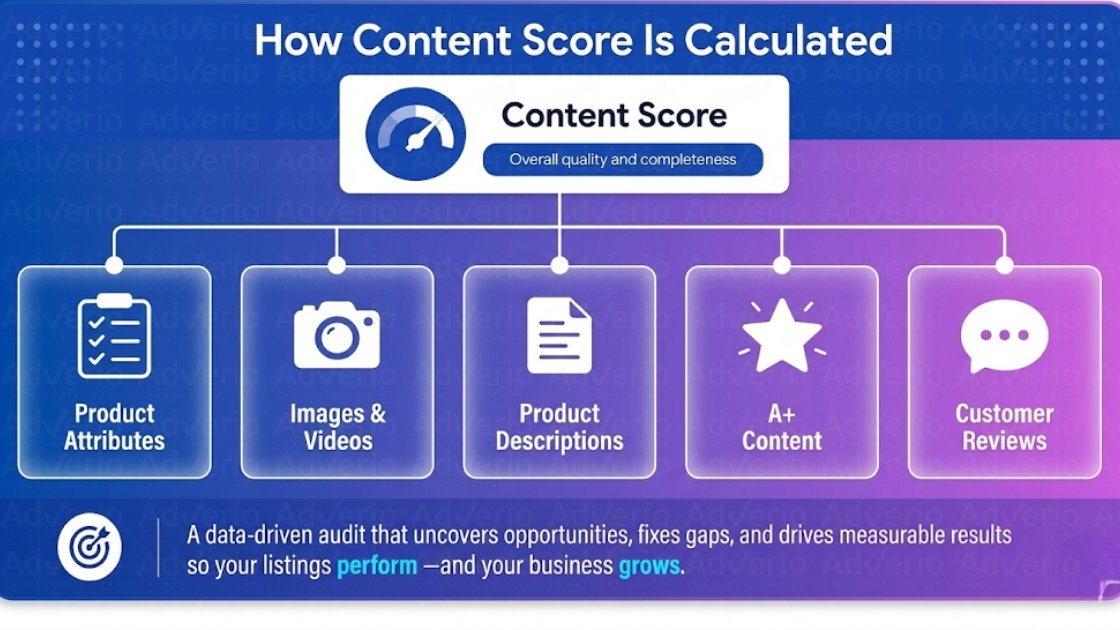
The score is driven by two inputs. First, Walmart checks whether the core listing structure is complete. Second, it rewards added content that improves item understanding and shopper confidence. Core fields carry the most weight because they help Walmart classify the SKU correctly. Rich media matters after that because it improves conversion and reduces ambiguity on the page.
Basic content elements and their weight
| Content element | Type | Relative importance | What complete looks like |
|---|---|---|---|
| Product title | Basic | High | Clear, specific title built for relevance and easy category matching |
| Key features | Basic | High | Concise bullets that explain use case, specs, dimensions, and differentiators |
| Description | Basic | High | Unique description that fills in missing detail and answers obvious buying questions |
| Required attributes | Basic | High | Every mandatory category field populated accurately |
| Recommended attributes | Basic | Medium | Extra fields completed where relevant to improve classification and filtering |
| Primary image set | Basic | High | Multiple compliant images that clearly show the item, packaging, and important details |
Rich content elements and their weight
| Content element | Type | Relative importance | What complete looks like |
|---|---|---|---|
| Image resolution | Rich-supporting | Medium | Zoom-capable files that meet Walmart image standards |
| Lifestyle imagery | Rich-supporting | Medium | Context images showing the product in use or in scale |
| Video | Rich | Medium | Short product video that removes uncertainty and explains function |
| Additional media assets | Rich | Low to medium | Supplemental visuals or content blocks that answer common objections |
Here is the part brands miss. Content Score is not grading your copywriter. It is screening whether the listing is ready to compete in search and ready to convert paid traffic efficiently.
A page with missing attributes, weak bullets, or thin image coverage gives Walmart worse inputs. The item is harder to classify, filters break, search relevance weakens, and ad traffic converts below its potential. You still pay for the click. You just send that click to a page Walmart has already treated as incomplete.
That is why Content Score has to be fixed before budget expansion. If the page is structurally underbuilt, increasing spend does not create scale. It magnifies waste.
The Score Thresholds That Matter
Walmart Content Score is a go or no-go signal for profitable scale. Treat it like an algorithmic gate. If the gate is half closed, your ads still spend, but the listing cannot convert that traffic efficiently enough to justify budget expansion.
| Score range | Likely operating condition | Action |
|---|---|---|
| Low score range | Listing is incomplete, poorly classified, or missing key conversion inputs | Stop adding spend. Fix title, attributes, bullets, and image coverage first |
| Mid score range | Listing is functional but still leaks relevance and conversion | Close the obvious gaps that block filtering, search match quality, and shopper confidence |
| Strong score range | Listing is structurally sound and ready for tighter optimization | Maintain quality, test richer media, and watch for score decay after catalog updates |
| Top score range | Listing is highly complete and better positioned for scale | Protect the page, monitor changes, and prioritize these items for budget growth |
The profit implication is simple. Low-score and mid-score listings turn ads into a tax on bad content. Your team pays for traffic Walmart was never fully prepared to rank or convert.
That is why flat sales often persist even after bid changes, keyword work, and campaign restructures. The media team keeps tuning acquisition while the listing itself is still underbuilt. Nothing breaks out because the product page is the constraint.
Use one hard rule. Do not scale ad spend on listings that still have obvious content defects.
If your catalog already shows this pattern, start with Walmart listing quality fixes.
How to Pull Your Content Score in Seller Center
If your team is buying traffic before checking Content Score, you are paying to expose weak listings faster.
Seller Center gives you the view you need. You can see catalog-level score visibility, review item-level detail, and isolate the SKUs that are wasting the most opportunity. Use that screen as a gating check before you approve budget increases on search or sponsored product campaigns.
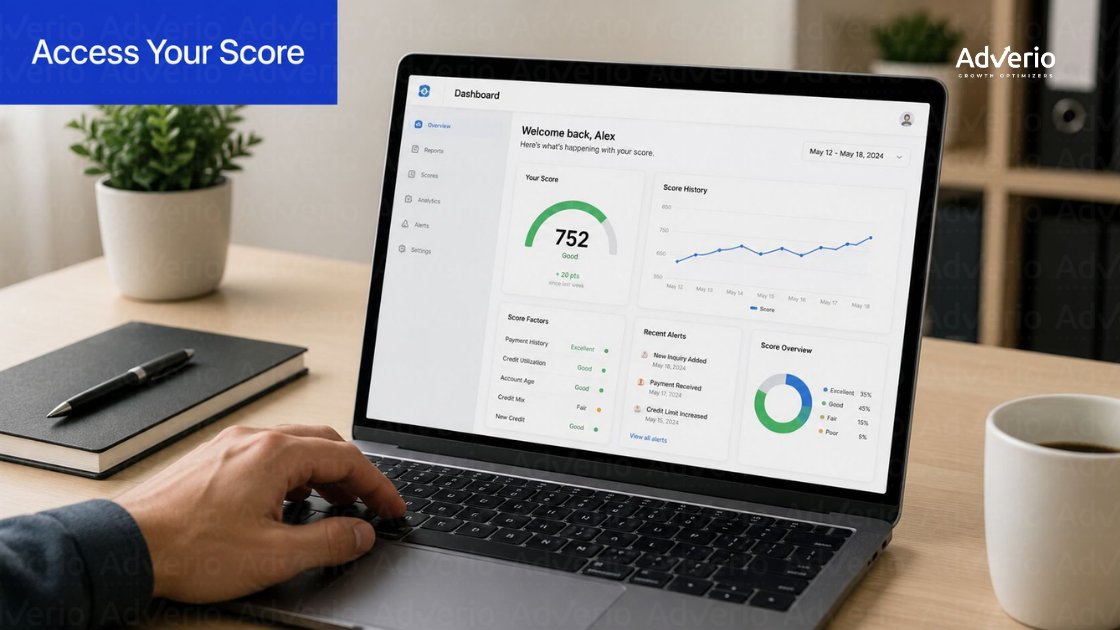
Do it in this order:
-
Log in to Seller Center.
-
Go to the listing quality or item quality area for live items.
-
Check the catalog-wide average first. That shows whether you have a localized SKU problem or a broader merchandising failure.
-
Open item-level details. Do not stay at the summary view.
-
Sort or filter for the SKUs that matter commercially, especially high-traffic, high-sales-potential, or Walmart Fulfilled items.
-
Export the list of flagged items and their missing content elements.
The export is the part that matters. A score is only a symptom. The gap details show the exact fields blocking search coverage, filtering, and conversion.
Start with the products already getting traffic. If those listings are suppressed by weak content inputs, every extra ad dollar becomes less efficient than it should be. Fix the page first, then scale spend.
If your team needs help clearing those blockers across the catalog, start with fix my walmart listings.
The Fix Priority Order: What to Address First
If your Walmart sales are flat, stop blaming bids first. Weak listings choke distribution before ads ever have a fair shot. Content Score is the gate. If the page is underbuilt, Walmart limits how often that item gets surfaced, filtered, and trusted. Then you pay to send traffic into a listing that was never set up to convert.
Fixes need to follow business impact, not creative preference. Start with the fields that affect indexation and category fit. Then fix the assets that shape click-through and conversion.
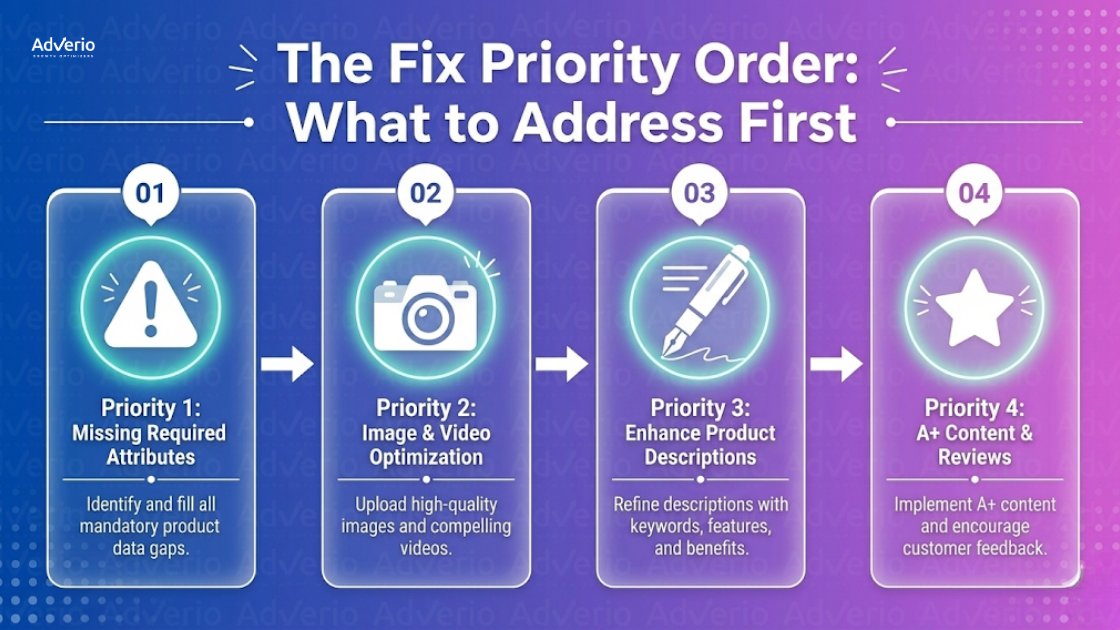
Priority 1 Missing required and recommended attributes
This is the first repair because structured data controls how Walmart understands the item.
If the product type is wrong or key attributes are blank, the listing gets matched to the wrong browse path, misses filters, and loses relevance on search queries that should have been easy wins. That is an algorithm problem, not a copy problem.
What to do:
-
Fix category mapping first: A bad item type poisons the whole listing.
-
Fill every required attribute: No blanks. No placeholders.
-
Complete recommended fields next: Recommended fields still influence discoverability, especially in filter-heavy categories.
-
Check variant consistency: Sizes, colors, counts, and dimensions need to line up across the family.
Priority 2 Images that remove shopper doubt
After attributes, fix the visual proof. Walmart does not reward lazy image sets, and shoppers do not convert on them either.
Your image stack should answer basic buying questions fast. What does it look like, how big is it, what problem does it solve, and what will arrive in the box. A weak main image hurts click-through. Thin secondary images hurt conversion after the click. Both problems get more expensive once ads are live.
What to fix:
-
Main image compliance: Clean crop, white background, no distracting elements.
-
Decision coverage: Show angle, scale, texture, packaging, and real use.
-
Asset quality: Use sharp images that hold up on zoom and mobile.
Priority 3 Description and on-page selling copy
Once structure and images are fixed, clean up the copy. This step matters, but it does not outrank attributes or images.
Descriptions should be original, specific, and useful. Generic copy copied from another channel does not help Walmart understand the item, and it does nothing to answer shopper objections. Write for the actual purchase decision. Clarify use case, materials, fit, compatibility, and what makes the item different from the next result in the grid.
Use the Walmart listing optimization guide if your team needs a tighter merchandising standard for titles, bullets, and descriptive copy.
Priority 4 Rich media and review proof
Rich media is the multiplier after the foundation is clean. Add it too early and you are decorating a listing that still has structural holes.
Video, comparison content, and stronger context images can improve conversion once the item is classified correctly and visually credible. Social proof matters here too. If the listing lacks enough reviews to reassure shoppers, fix that confidence gap directly, and use Walmart review syndication
Treat this sequence as a profit filter. Do not increase Walmart Connect spend on SKUs that still have attribute gaps, weak image coverage, or thin copy. Every dollar you push into a suppressed listing buys less visibility and converts worse after the click.
How to Monitor Content Score at Scale Across a Large Catalog
Large catalogs do not stay clean. They drift, break, and lose score every time a feed changes, a new SKU launches, or a team edits copy without fixing the underlying data.
Treat Content Score monitoring like bid management. It needs a cadence, an owner, and a trigger for action. If you only review scores during a quarterly cleanup, you are already late. Walmart has been throttling your organic visibility the whole time, and any ad dollars sent to those SKUs were working against that handicap.
Set up the process around business impact:
-
Review Content Score every week: Catch score drops after feed pushes, assortment updates, and catalog expansions.
-
Prioritize by revenue and ad spend: Start with hero SKUs, seasonal movers, and any item already receiving Walmart Connect budget.
-
Assign one accountable owner: Merchandising, feed ops, and media teams can contribute, but one person needs responsibility for fixing broken listings.
-
Track source-level failures: If scores keep falling on the same brands, categories, or item types, fix the feed logic or workflow causing the decline.
-
Create escalation rules: Any SKU below your acceptable threshold with active ad spend should move into a fix queue immediately.
Here is the blunt reality. A low Content Score is not a cosmetic problem. It is an algorithmic gate. If that gate is partially closed, Walmart is less likely to reward the listing with the organic exposure needed to make paid traffic efficient. Running ads before fixing that issue inflates your customer acquisition cost and caps the return on every click.
The catalog and media teams need one scoreboard. If they operate separately, the media team spends harder on pages the catalog team has left half-finished. That is how brands end up with flat sales, weak organic lift, and rising ad costs at the same time.
If your team cannot maintain that discipline across hundreds or thousands of SKUs, get help with Walmart account management. The important part is not the tool or the meeting cadence. The important part is forcing listing quality review to happen before more budget goes live.
How Adverio Manages Content Score Across Client Catalogs
Adverio treats Content Score as a spend gate inside weekly account operations. If a SKU is missing key content and still pulling Walmart Connect budget, it gets flagged for correction before more media pressure goes behind it. That prevents a common profit leak. Brands keep buying traffic for listings Walmart is less likely to reward with stronger organic visibility.
The operating model is simple. Catalog work, feed management, and media decisions sit in one workflow, the same operating model Adverio uses inside Amazon listing optimization and Amazon account management engagements, so the team can see which items are draining efficiency because the page is incomplete. The goal is not a prettier spreadsheet. The goal is to stop paying for clicks on listings that are still held back by weak content signals.
If your team does not have the bandwidth to run that process across a large catalog, get help with Walmart account management. The point is disciplined execution. Fix the listing first. Scale the budget after the page is ready to convert and compete.
Frequently Asked Questions
How long does Walmart take to reflect content score changes?
There is no fixed turnaround you can bank on. Walmart has to ingest the update, publish it, and then recalculate what the listing qualifies for. The only reliable process is to confirm the changes are live on the PDP, then check Seller Center again. Do not increase ad spend because your team submitted an edit. Increase it after the score updates.
Is Walmart Content Score different from Walmart Content Quality Score?
No. Teams use both names to describe the same listing-readiness signal. The label is irrelevant. What matters is whether the SKU clears the algorithmic gate Walmart uses to trust the page enough to rank and merchandise it properly.
Can a listing have a strong score and still sell poorly?
Yes. Content Score fixes one class of problem. It does not solve weak demand, bad pricing, thin margins, poor ratings, or an offer that loses on shipping speed. A high score gets the listing into better shape for visibility and conversion. It does not rescue a weak retail proposition.
Do recommended attributes really matter, or just required ones?
Recommended attributes matter because they reduce ambiguity. Walmart uses them to categorize the item more accurately and match it to the right filters and browse paths. Brands that leave them blank make the algorithm guess, and guessing usually costs discoverability.
Should I focus on content score before reviews and ads?
Yes. Fix Content Score first. Then layer on reviews and media.
Running ads to a listing that still has content gaps is a margin leak. You pay for traffic before the page has cleared the gate that affects visibility, relevance, and conversion potential. Reviews help. Ads help. Neither should be your first move if the listing is still incomplete.
If you need help finding the catalog problems that are suppressing rank, wasting media spend, and capping profit, book your Profit ROI Forecast. We work on exactly that problem across client catalogs.