



Most advice on Walmart gets this wrong. It treats 1P as the default “serious brand” move and 3P as the side door. That’s backwards for a lot of mature brands.
The question in Walmart 1P vs 3P isn’t which model sounds bigger. It’s which model gives you the control to protect margin, hold pricing, and grow without handing your brand to someone else’s retail agenda. If you choose the wrong path, you don’t just create operational friction. You create profit drag.
If your team is trying to decide whether to sell to Walmart or sell on Walmart, make the decision like an operator, not a spectator.
Walmart 1P is a wholesale model where Walmart buys your inventory, becomes the retailer of record, and controls retail price. Walmart 3P is a marketplace model where you sell direct to the shopper and keep control of pricing, inventory, and fulfillment. For most mature brands that care about margin and control, 3P is the stronger default. 1P fits broad-distribution or legacy wholesale lines where reach matters more than pricing power. Referral fees on 3P run 6% to 15% for most categories, up to 20% in a few, with no monthly subscription fee.
Before you commit to a model, Book Your ROI Forecast and see which Walmart path protects your margin.
| Decision Area | Walmart 1P | Walmart 3P |
|---|---|---|
| Commercial model | Wholesale relationship where Walmart is the retailer of record | Marketplace model where you sell direct to consumer on Walmart Marketplace |
| Pricing control | Walmart controls retail pricing | Seller controls pricing |
| Inventory control | Walmart controls retail inventory decisions after wholesale purchase | Seller controls inventory and fulfillment, unless using WFS |
| Margin structure | You receive a wholesale cost per unit | You keep the retail price you set minus referral fee and fulfillment costs |
| Data access | Simpler model, but less access to marketplace-level performance data | More control and access to marketplace tools, including item-level search queries and rank data, according to Walmart Seller Center documentation. |
| Fee structure | Wholesale economics | Referral fees run 6% to 15% for most categories, reaching up to 20% in a few, according to Walmart’s published marketplace fee schedule. |
The Billion-Dollar Question Your Brand Must Answer
The wrong Walmart model rarely shows up first as a growth problem. It shows up as lower margin, weaker pricing discipline, slower decisions, and less room to recover when performance slips.
That is why this decision belongs in a P&L conversation, not just an ecommerce or operations meeting.
Brands often pick 1P because it feels cleaner. Walmart sends purchase orders, takes the customer-facing burden, and gives the business a familiar wholesale structure. The hidden cost is loss of control in the places that decide long-term profit. Price. Promotion. Inventory flow. Visibility into what is driving sales.
Choose 1P without understanding those tradeoffs, and your brand can end up growing revenue while giving away the economics that made the channel attractive in the first place.
Walmart 1P vs 3P decides who holds the levers that protect profit. That includes retail pricing, contribution margin, replenishment risk, and access to the performance signals your team needs to fix problems early.
My recommendation is simple. Start with 3P as your default framework if your brand cares about margin quality and long-term control. It demands more operational discipline, but discipline is cheaper than surrendering pricing power and trying to buy it back later.
1P still fits some businesses. It can support broad distribution and reduce internal complexity. But mature brands should stop calling that simplification free. You usually pay for it through lower flexibility, weaker brand control, and slower response when Walmart’s priorities stop matching yours.
The strategic logic behind this decision mirrors what experienced operators already understand from the Amazon 1P vs 3P selling model guide. That post covers the foundational control and margin arguments in depth. What this guide adds is the Walmart-specific layer: how 1P Walmart creates downstream pricing tension with your Amazon Buy Box, why WFS changes the 3P calculus differently than FBA does, and how Walmart’s supplier portal dynamics differ from Amazon Vendor Central in ways that matter for your P&L.
Use one rule before you commit. If a model makes execution easier while reducing your control over price, inventory, or data, assume the margin penalty is real. Your job is to find where it will hit before Walmart finds it for you.
Walmart 1P vs 3P: The Models Decoded
Let’s strip the jargon out of this.
Walmart 1P means you operate as a vendor in a wholesale relationship. Walmart buys from you, Walmart becomes the retailer of record, and Walmart sells to the customer. You are supplying Walmart.
Walmart 3P means you sell through Walmart Marketplace in a direct-to-consumer model. You control pricing, inventory, and fulfillment unless you use Walmart Fulfillment Services. You are selling on Walmart, not to Walmart.
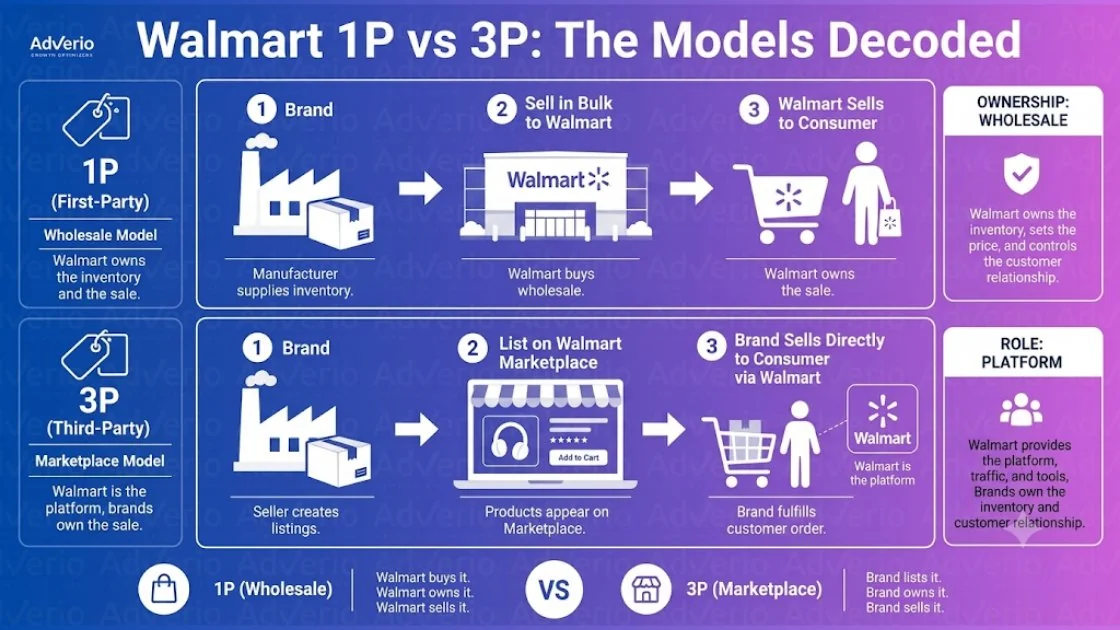
What 1P really means
1P is a wholesale business wearing ecommerce clothes.
That matters because wholesale logic follows you everywhere. Your commercial focus shifts toward buyer relationships, purchase order flow, and wholesale terms. Your brand can move volume, yes. But your influence over the customer-facing side of the business gets weaker the moment Walmart takes the wheel.
What 3P really means
3P is retail entrepreneurship inside Walmart’s ecosystem.
You own the listing strategy. You own the pricing posture. You own inventory decisions. You own the consequences too. That’s why 3P is better for brands that want to build a marketplace business instead of just participating in one.
The party that owns pricing and data usually owns the upside. That holds across every marketplace.
1P makes Walmart your customer. 3P makes Walmart your channel.
That’s not a small difference. That’s the whole game.
The Financial Battleground: Margins, Fees, and Pricing Control
Revenue can hide a bad decision. Margin usually exposes it.
That is the real fight in Walmart 1P vs 3P. In 1P, Walmart buys from you at a wholesale cost and keeps control of the retail price. In 3P, you sell at the retail price, then pay Walmart marketplace fees and your own fulfillment costs.
Financial breakdown
| Metric | 1P First-Party | 3P Third-Party |
|---|---|---|
| Revenue model | Wholesale payment from Walmart | Direct retail sale to customer |
| Retail price control | Walmart controls it | You control it |
| Margin upside | Capped by wholesale terms | Higher if your pricing and cost structure are disciplined |
| Cost visibility | Simpler on the surface | More line items, but better visibility |
| Main risk | Margin pressure you cannot easily correct | Profit erosion if operations and pricing are sloppy |
The expensive mistake is treating 1P as the safer financial model just because the math looks cleaner on a spreadsheet. Clean does not mean better.
If Walmart cuts retail price to stay competitive, your wholesale economics do not improve. Your brand still feels the fallout. And uniquely on Walmart, that price cut can pressure the Buy Box on your matching Amazon listing if Amazon’s price-matching logic picks up the lower Walmart shelf price. Suppose Amazon’s price-matching logic picks up the lower Walmart shelf price. That cross-channel bleed is the specific risk 1P Walmart creates that the Amazon 1P vs 3P decision does not. Under 3P, you hold the pricing lever and can protect both channels simultaneously.
3P gives you more expense lines, but it also gives you a margin steering wheel.
You can protect price floors, choose which SKUs deserve ad support, and stop subsidizing low-quality revenue. You can also decide whether a promotion drives profitable new customer acquisition or just burns margin to buy sales you would have won anyway. That is the second-order advantage mature brands care about. Better control at the SKU level usually produces better blended profit over time.
The fee structure matters, but the hidden cost structure matters more. Marketplace fees are visible. Price erosion is not. Bad promotional discipline is not. A bloated assortment that absorbs ad spend and fulfillment cost without earning its keep is not.
For a closer look at the direct cost layer, review Adverio’s Walmart fee analysis.
Returns belong in this financial conversation too. A model that looks profitable before returns can turn weak fast after reverse logistics, write-offs, and customer service labor. Brands that want to protect contribution margin should model return costs at the SKU level before finalizing which model fits each product line.
Use a simple test. Ask three questions.
-
Who controls final retail price?
-
Who absorbs fulfillment and return-related costs?
-
Who has the authority to improve margin when performance slips?
If your team cannot answer those questions in one meeting, your Walmart model is already costing you money.
My recommendation is blunt. Choose 3P if your brand has pricing discipline, margin guardrails, and operators who know how to run a marketplace business. Choose 1P only if you accept lower control in exchange for wholesale simplicity and are prepared for the downstream cost of that trade. Top-line volume makes bad decisions look respectable. Profit tells the truth.
Not sure where your Walmart model is leaking margin?
Book Your ROI Forecast and see the number before Walmart finds it for you.
The Operational Divide: Inventory, Fulfillment, and Returns
Operations is where bad model choices become expensive habits.
1P looks easier because Walmart handles the downstream retail motion. That surface-level simplicity is exactly why so many teams underestimate the hidden cost. Once inventory leaves your hands in a wholesale setup, your control over retail availability, merchandising readiness, and issue response drops hard.
Where 1P creates hidden exposure
With 1P, your team is no longer steering day-to-day marketplace execution. You’re reacting to it.
That creates a few predictable problems:
-
Ordering volatility can distort production and forecasting
-
Retail in-stock issues can hurt momentum while your team has limited recourse
-
Listing and returns visibility tends to be less actionable for brands that want to fix root causes fast
For mature brands, that’s not just an operations problem. It’s a profit timing problem.
Why 3P gives operators control they can actually use
With 3P, you own the moving parts. That means more work, but also better decision-making.
You decide whether to fulfill orders yourself or use Walmart Fulfillment Services. You decide how aggressively to place inventory. You decide when to protect stock on hero SKUs and when to narrow the assortment. If your ops team is strong, 3P lets you run Walmart like a business unit instead of a passive wholesale account.
A lot of brands pair 3P control with WFS to reduce the logistics burden without giving up pricing and assortment authority. That’s the smart middle ground. It preserves customer experience while keeping the commercial engine in your hands.
If your team is reworking post-purchase cost structure too, this is also where smarter returns handling matters. Brands with high return rates should audit return root causes at the SKU level before they compound into a margin problem.
The returns issue most teams miss
Returns aren’t just a service function. They are feedback.
In a 3P model, your team can see issues faster, connect them to listing clarity, packaging, or product fit, and act. In 1P, that feedback loop is much weaker. The more variants you sell, the more painful that blind spot becomes.
For brands building a serious omnichannel fulfillment plan, this is why scaling brands on Walmart effectively requires more than fast shipping. It requires control over the decisions that create or prevent operational waste.
Simple operations are only valuable if they also support good decisions. If they don’t, they’re just cleaner-looking problems.
The Data and Advertising Power Play
Walmart ad performance is usually framed as a media problem. It is a control problem.
A key distinction in Walmart 1P vs 3P is the quality of the feedback loop behind your decisions. In 3P, your team gets closer to search behavior, item performance, and ranking signals. In 1P, that loop is weaker. That difference changes how fast you can fix conversion issues, how accurately you can allocate spend, and how much wasted media your P&L absorbs before anyone notices.
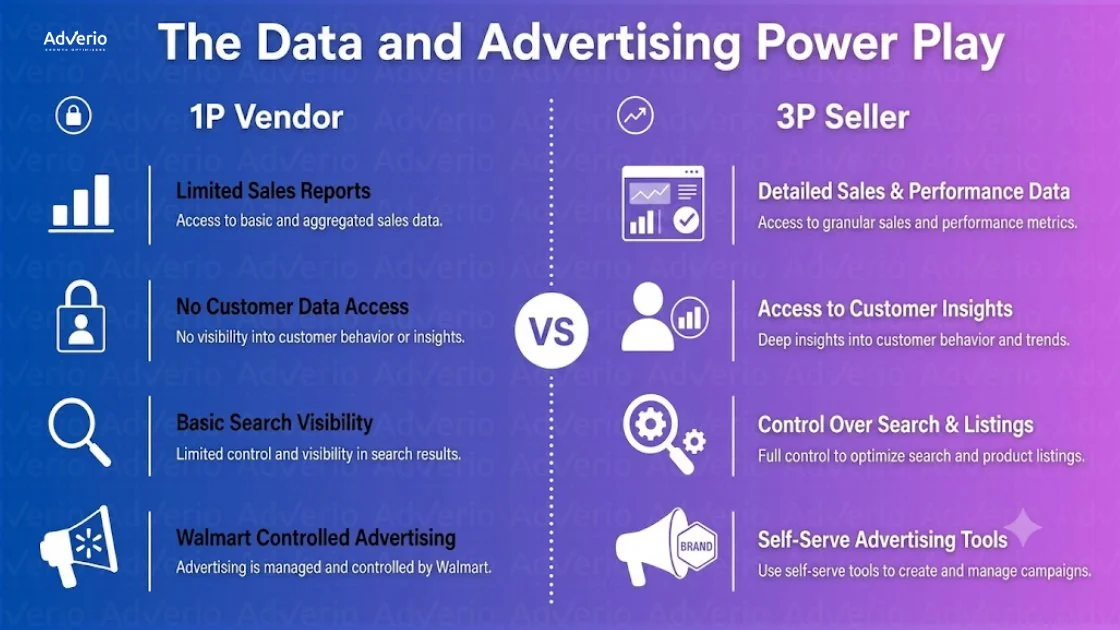
Why data quality changes profit, not just reporting
Brands that stay in 1P often underestimate the hidden cost of weaker marketplace visibility. They see sales. They do not see enough of the mechanics behind those sales.
That creates expensive habits. Teams keep spending on the wrong terms. They miss ranking declines until revenue slips. They treat low conversion like a traffic problem when the actual issue is content, pricing, or assortment. By the time the problem is obvious, margin has already been lost.
3P gives you a tighter operating system for paid growth because your team can connect signals to actions faster:
-
Search query visibility helps you see what shoppers want
-
Rank data shows where you are gaining or losing position
-
Item-level performance tells you which SKUs deserve budget and which ones are draining it
That matters because ad efficiency on Walmart is rarely fixed inside the ad console alone. It is fixed by aligning traffic with the right SKU, the right retail price, the right content, and the right inventory posture.
Why 3P usually builds a stronger advertising moat
Under 3P, media, merchandising, and pricing can work together. Under 1P, those functions are more fragmented, and fragmentation is expensive.
If your team sees a keyword converting well, it can shift budget, update content, adjust promotion strategy, and protect the listing before momentum disappears. That speed creates second-order gains. Better rank lowers your dependence on paid traffic. Better conversion makes every ad dollar work harder. Better SKU selection keeps budget away from low-margin items that look good in revenue reports but underperform in contribution profit.
Creative also gets better when your team owns the learning cycle. If your brand is testing stronger asset formats for sponsored and upper-funnel campaigns, Walmart media rewards iteration on creative just as Amazon does. Treat each campaign as a test with a clear performance threshold before scaling spend.
If you need a partner for Walmart PPC management, the right support should connect media decisions to pricing, content, and catalog economics, not treat Walmart like a generic retail media channel.
Better ad results come from better commercial control.
My recommendation is simple. If your brand wants to compound profit on Walmart, 3P is the stronger model for advertising. 1P can produce volume. 3P gives you a better chance to turn that volume into durable, measurable margin.
The Right Model for Your Brand Profile
There isn’t one right answer for every brand. There is a right answer for your operating model.
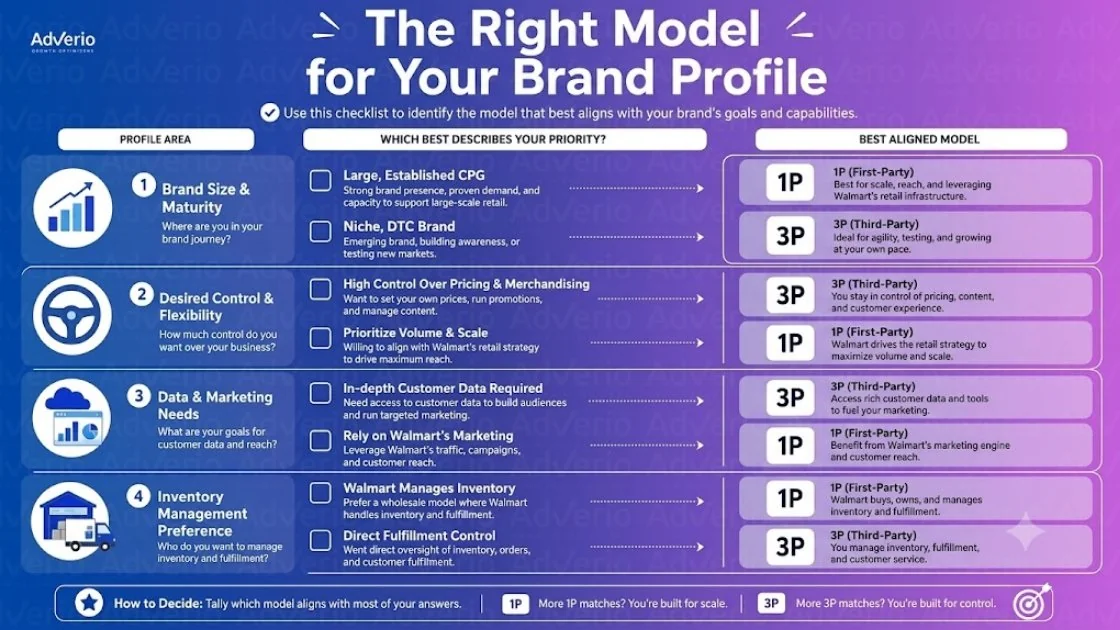
Decision matrix by brand type
| Brand profile | Better fit | Why |
|---|---|---|
| DTC brand entering Walmart | 3P | You need pricing control, brand consistency, and direct marketplace learning |
| Mid-market brand with margin pressure | 3P | Control matters more when every pricing move affects contribution profit |
| Legacy brand with existing wholesale infrastructure | 1P or hybrid leaning 3P for selected assortment | 1P may support scale, but 3P is stronger for margin-sensitive lines, tests, and brand control |
| PE-backed portfolio brand | 3P | You need cleaner levers for profitability, assortment decisions, and channel accountability |
| Brand with weak internal ops | 1P short term, 3P once operationally ready | 3P is better long term, but only if your team can execute it well |
My recommendation by scenario
For DTC challengers, 3P is the only serious answer. If you built your business on controlled pricing and brand presentation, handing that away on Walmart makes no sense.
For large CPG or legacy wholesale brands, 1P can still serve a purpose. But don’t let it become the only model because it feels familiar. Use 3P where you need control, cleaner testing, or better data.
For private equity-backed brands, I would push hard toward 3P unless there’s a compelling structural reason not to. Financial sponsors don’t pay for opacity. They pay for controllable growth.
A lot of brands reach this decision point right after they expand Amazon to Walmart. That’s when channel assumptions need to be challenged. Copy-pasting a retail model from one platform to another is lazy strategy.
The right model is the one that matches your profit structure, your team’s capabilities, and your tolerance for giving up control.
If you can operate 3P well, choose 3P. If you can’t, fix that capability gap fast. Because long term, control tends to win.
Stop Being a Vendor Start Owning Your Growth
This decision isn’t really about 1P versus 3P anymore.
It’s about whether you want to be a supplier managed by someone else’s priorities, or an operator who owns pricing, data, and the mechanics of growth. That’s the primary split.
1P can give you reach and simplicity. It can also leave your team reacting to decisions you didn’t make. 3P asks more from your business. Better inventory discipline. Better pricing strategy. Better retail media execution. Better accountability. But it gives you the one thing serious brands need if they want durable marketplace growth.
Control.
That’s why my recommendation is direct. If your team has the operational maturity to run Walmart well, build around 3P first. Add 1P only when it serves a specific strategic purpose. Not because it sounds bigger. Not because it feels easier. And definitely not because it’s what everyone else in your category has always done.
For brands that need outside support building that control layer, Adverio provides marketplace strategy, PPC, catalog management, and profit reporting across Walmart, Amazon, and Target, with a focus on margin and operational clarity rather than top-line vanity.
Your competitor doesn’t need you to make a terrible decision. They just need you to make a lazy one.
Choose the model that lets you see the business, steer the business, and defend the business.
Walmart 1P vs 3P: Frequently Asked Questions
What is the difference between Walmart 1P and 3P?
Walmart 1P is a wholesale model where Walmart buys your inventory and becomes the retailer of record, controlling price and the customer relationship. Walmart 3P is a marketplace model where you sell direct to the shopper and keep control of pricing, inventory, and fulfillment. In short: 1P makes Walmart your customer, 3P makes Walmart your channel.
Is Walmart 1P or 3P more profitable?
3P usually carries higher margin potential because you set the retail price and control your cost structure, while 1P caps your upside at wholesale terms. The tradeoff is that 3P only pays off with pricing discipline and clean operations. 1P looks simpler on a spreadsheet, but that simplicity often hides the margin you give up.
Do Walmart 3P sellers have to use Walmart Fulfillment Services?
No. WFS is optional. As a 3P seller you can fulfill orders yourself or use WFS to offload storage, packing, and shipping while keeping control of pricing and assortment. Many brands pair 3P with WFS to cut the logistics burden without surrendering commercial authority.
How much does Walmart charge 3P sellers in fees?
Walmart referral fees run 6% to 15% for most categories, reaching up to 20% in a few, according to Walmart’s published marketplace fee schedule. There are no monthly subscription fees. If you use WFS, fulfillment and storage costs apply on top of the referral fee.
Can a brand sell on Walmart 1P and 3P at the same time?
Yes. A hybrid model lets you run 1P for broad-distribution lines and 3P for margin-sensitive SKUs, tests, and items where pricing control matters most. The risk is channel conflict if the same SKU sells under both models with different price control. Decide which products belong in which lane before you commit, not after.
If you’re tired of trading margin for convenience, it’s time to pressure-test your Walmart model. Book Your ROI Forecast to see whether 1P, 3P, or a controlled hybrid fits your brand.