


Table of Contents
Most Walmart seller fees guides reduce the decision to one shortcut: compare the referral fee to Amazon, call the economics close enough, and approve the channel. That is how finance teams end up with revenue growth and weaker contribution margin.
A serious Walmart seller fees breakdown starts with the full cost stack. Referral fees are only the first cut. Fulfillment fees, storage, returns, seller-fulfilled shipping overhead, ad spend, and operational labor all sit below revenue. Ignore any one of them and your margin forecast is fiction.
This article is built for operators who care about profit, not vanity sales.
If you want a broader channel strategy view before you commit capital, work with an omnichannel growth partner that evaluates Walmart as part of your total marketplace portfolio, not as an isolated storefront.
How Walmart Marketplace Fees Are Structured
Walmart’s fee structure looks cheap only if you stop at the top line. That is exactly how brands approve unprofitable channel expansion.
The platform charges no monthly seller subscription and no product listing fee. Good. That lowers the cost of entry. It does not lower the cost of selling. Walmart takes its cut when units move, then your fulfillment method, inventory position, return rate, and service model decide whether the order produced real contribution dollars or just revenue.
That distinction matters in finance. Fixed platform overhead is low. Variable cost exposure is not. Walmart is built to look friendly to testing, but the primary question is whether each SKU can absorb the full cost stack after referral fees, fulfillment, shipping, storage, returns, and support.
What the fee stack actually looks like
| Cost Layer | Walmart Structure | CFO Take |
|---|---|---|
| Seller access | No subscription fee | Low cost to enter, no protection against bad unit economics |
| Listing products | No listing fee | Broad assortment is easy to upload, hard to make profitable |
| Core platform take | Referral fee on each sale | Margin gets taxed on every transaction |
| Fulfillment | Optional WFS fees | Outsourced operations can improve service levels, but they add a new cost layer |
| Inventory holding | Storage fees if using WFS | Slow inventory destroys margin quietly |
The right way to read this table is simple. Walmart has shifted cost from upfront commitment to operational performance. If your catalog turns fast, ships efficiently, and holds price, that can work in your favor. If your margins are thin, your packaging is bulky, or your replenishment is sloppy, the fee structure punishes you after launch, not before.
Treat Walmart as a contribution margin channel, not a revenue channel. Build the model at the SKU level. If a product cannot carry the platform take plus the operating cost stack, it does not belong in the assortment.
Walmart Referral Fees by Category
Referral fees matter, but they are rarely the reason a Walmart SKU wins or loses. They are the visible tax line. CFOs get in trouble when the team treats that line as the whole model.
Walmart charges a category-based referral fee only when an item sells. No annual seller fee. No listing fee. The practical range runs from 6% in select low-fee categories to 20% in Jewelry, according to Walmart’s published marketplace fee schedule (2026). Many core categories land in the 8% to 15% range, which means referral fees alone will not make a bad SKU good.
Walmart vs Amazon Referral Fee Comparison 2026
| Category | Walmart Referral Fee % | Amazon Referral Fee % | Notes |
|---|---|---|---|
| Low-fee categories | Lower-end category rates apply in select categories | Varies by category | Useful only if the SKU still holds contribution margin after fulfillment and returns |
| Grocery | Tiered by price point | Varies by category | Small price changes can move take rate and change unit economics |
| Many core categories | Mid-range category fees are common | Varies by category | Close enough that operational costs usually matter more than referral fee spread |
| Jewelry | Higher-end category rates apply | Varies by category | Requires strict gross margin discipline and return-rate control |
The operating rule is simple. Model referral fees at the SKU level, not the account level. A blended fee assumption hides margin leaks and gives weak products a free pass in forecasting.
Three recommendations:
-
Map category assignment before launch. If merchandising gets the category wrong, your expected take rate is wrong.
-
Stress-test price bands. Tiered categories can change economics fast when you move from one retail price threshold to another.
-
Use referral fee as the first filter, not the approval memo. The decision belongs in a full contribution margin model that includes fulfillment, shipping, storage, returns, ad spend, and support.
If your team is planning assortment, inventory placement, and service model at the same time, review these scaling strategies for Walmart before you approve expansion. That is how you avoid a revenue story that turns into a margin problem.
Walmart Fulfillment Services Fees
WFS is where Walmart stops looking “simple.”
If you want more predictable fulfillment economics, tighter service levels, and a cleaner operating model, WFS usually belongs in the plan. If you want to underprice the true cost of Walmart expansion, ignore it.
For the full fulfillment and inventory strategy before you push SKUs into the channel, the Walmart PPC and fulfillment strategy guide covers how media and operations connect once the fee model is approved.
WFS fulfillment fee by size tier
WFS adds a second cost layer on top of referral fees. For fulfillment fees by size and weight tier, use Walmart’s WFS Cost Estimator at marketplace.walmart.com/walmart-fulfillment-services-pricing/ to get current per-unit costs before forecasting. Storage rates are published and stable enough to model directly from the table above.
| Fee Type | Tier or Condition | Cost (verified April 2025) | Notes |
|---|---|---|---|
| WFS fulfillment | Standard tier, by weight and dimensions | Use WFS Cost Estimator at marketplace.walmart.com for per-unit calculation | Walmart claims rates average 15% less than most competitors, per Walmart first-party data Jan-Jun 2024 |
| WFS storage | Jan-Sep (standard) | $0.75 per cubic foot per month | Based on 30 days of storage |
| WFS storage | Oct-Dec, up to 30 days | $0.75 per cubic foot per month | Peak holiday period |
| WFS storage | Oct-Dec, beyond 30 days | Add $1.50 per cubic foot per month on top of base rate | Peak surcharge applies |
| WFS storage | Items stored more than 365 days | $2.25 per cubic foot per month | Effective June 9, 2025 |
| WFS setup | Signup or monthly subscription | No fee | No minimums or maximums on inventory |
WFS storage fees
This part is published and usable.
Walmart Fulfillment Services storage fees are $0.75 per cubic foot per month from January through September, according to Walmart’s Marketplace pricing page. During October through December, Walmart charges a base rate of $0.75 per cubic foot per month for items stored 30 days or less, plus an additional $1.50 per cubic foot per month surcharge for inventory stored more than 30 days, for an effective total of $2.25 per cubic foot per month during peak season.
Walmart also publishes a long-term storage rate of $2.25 per cubic foot per month for inventory held more than 365 days, effective June 9, 2025, according to Walmart’s published WFS fee schedule.
| Storage Condition | Published Cost |
|---|---|
| January through September | $0.75 per cubic foot per month |
| October through December, stored 30 days or less | $0.75 per cubic foot per month |
| October through December, inventory stored more than 30 days | Additional $1.50 per cubic foot per month |
| Inventory held more than 365 days (effective June 9, 2025) | $2.25 per cubic foot per month |
That pricing tells you exactly what Walmart wants. Fast turns. Controlled replenishment. No dead inventory.
WFS return processing fees
Return processing belongs in your model even when teams don’t want to deal with it. The verified data supplied for this article does not include Walmart’s exact return processing fee table, so don’t pretend precision you don’t have. Treat it as a variable that must be confirmed from current WFS pricing before you approve any category expansion.
If your margin only works when returns are ignored, your margin doesn’t work.
Seller-Fulfilled Shipping Costs on Walmart
Seller-fulfilled looks cheaper on spreadsheets built by operators who have never had to hit marketplace delivery expectations at scale.
You’re not just paying parcel cost. You’re paying for packing materials, labor, carrier variability, exception handling, and the service burden when a delivery goes sideways. On Amazon FBA, sellers offload that operational drag to Amazon. Walmart exposes it.
Where seller-fulfilled margin gets distorted
-
Delivery promise pressure drives faster shipping methods than finance expected.
-
Packaging and labor sit outside the Walmart invoice, so weak models forget them.
-
Customer service ownership moves back to your team when fulfillment isn’t outsourced.
-
Operational variance rises fast across a large multivariant catalog.
Seller-fulfilled can make sense for select SKUs. It is not a default assumption for a serious expansion case.
The Hidden Costs Most Brands Miss
Referral fees are the line item everyone sees. Margin gets lost in the lines finance leaves out.
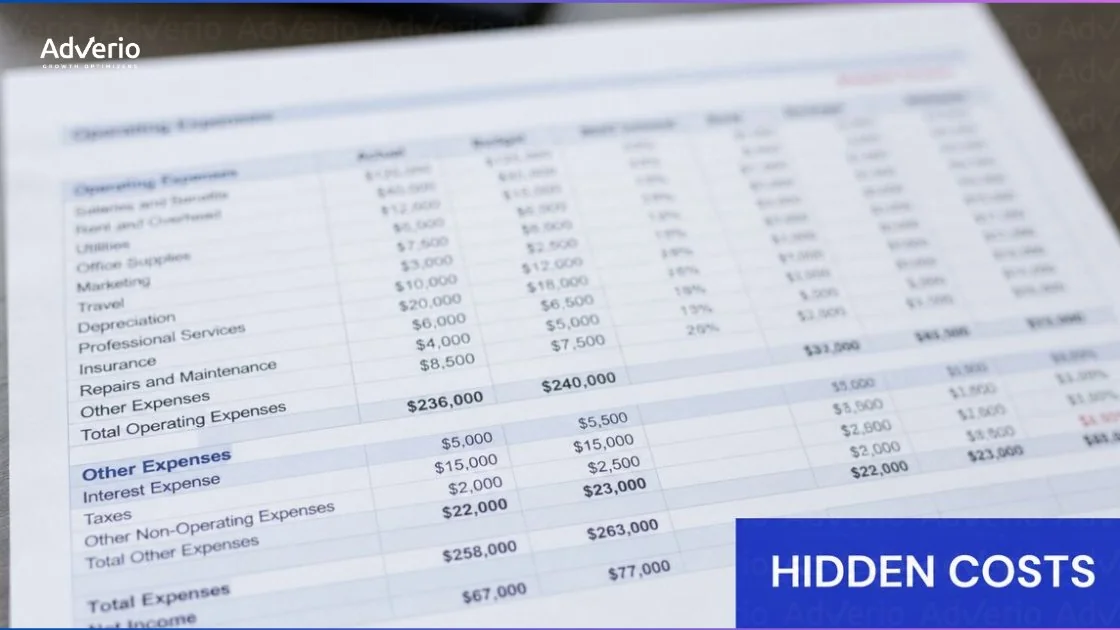
A Walmart P&L built on referral rate plus fulfillment fee is not a P&L. It is a revenue plan dressed up as a margin model. If you want a real expansion case, build contribution margin after returns, ad spend, operational overhead, and the extra work required to keep listings live, compliant, and in stock.
Four hidden costs that distort Walmart profitability
-
Returns and reverse logistics reduce contribution margin fast, especially in categories with higher defect risk, sizing issues, or remorse returns.
-
Launch-stage ad spend is a customer acquisition cost, not a discretionary test budget.
Treat it like a line item. If Walmart PPC management is part of the launch, put that spend in the model before the first PO.
-
Catalog, compliance, and integration work hits margin through agency fees, internal labor, feed management, and exception handling.
-
Retail readiness costs rise as volume grows. Forecasting, replenishment discipline, content maintenance, and chargeback prevention all consume operating dollars.
The mistake is simple. Brands underwrite Walmart on gross sales potential, then act surprised when contribution margin comes in thin.
Use a stricter framework. Start with net sales after expected returns. Subtract referral fees, fulfillment or shipping, ad spend, packaging, labor, software, and support costs. Then assign a realistic overhead load for marketplace management. If that number does not clear your hurdle rate, the channel is not ready, regardless of top-line demand.
Treat Walmart launch costs as market-entry CAC plus operating overhead. If the SKU cannot carry both, do not scale it.
Walmart vs Amazon Fees Side-by-Side Comparison
A clean side-by-side comparison is useful only if it admits one hard truth. Walmart’s lack of a subscription fee does not make the channel automatically cheaper. It makes the cost stack more dependent on category, fulfillment choice, inventory turn, and operational discipline. That’s why any serious Amazon vs Walmart vs Target decision needs total contribution logic, not fee cherry-picking.
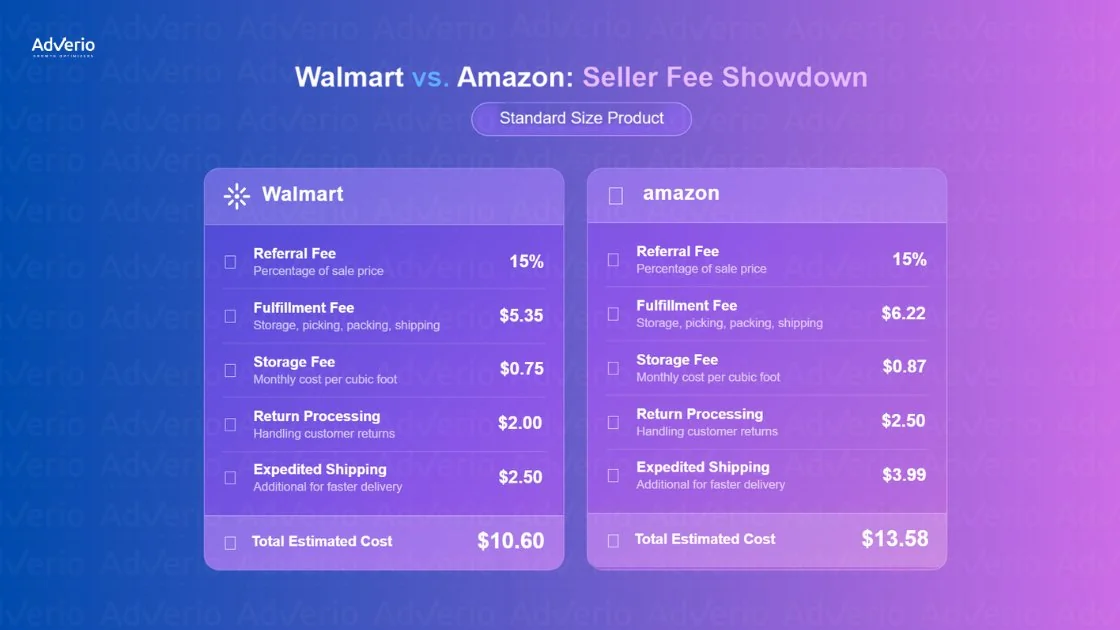
| Fee Type | Amazon FBA | Walmart WFS | Notes |
|---|---|---|---|
| Subscription fee | Monthly seller fee applies on Amazon professional plans | No subscription fee | Walmart lowers testing friction |
| Referral fee | Category-based | Category-based | Similar in concept, not always equal in impact |
| Fulfillment fee | FBA fee structure | WFS fee structure | Must be modeled by SKU |
| Storage fee | Storage applies | Storage applies | Walmart storage data is published in the section above |
| Return processing | Return-related costs may apply | Return-related costs may apply | Verify current category rules before forecast |
| Ad spend | Commonly required for scale | Commonly required for scale | Both platforms demand paid visibility |
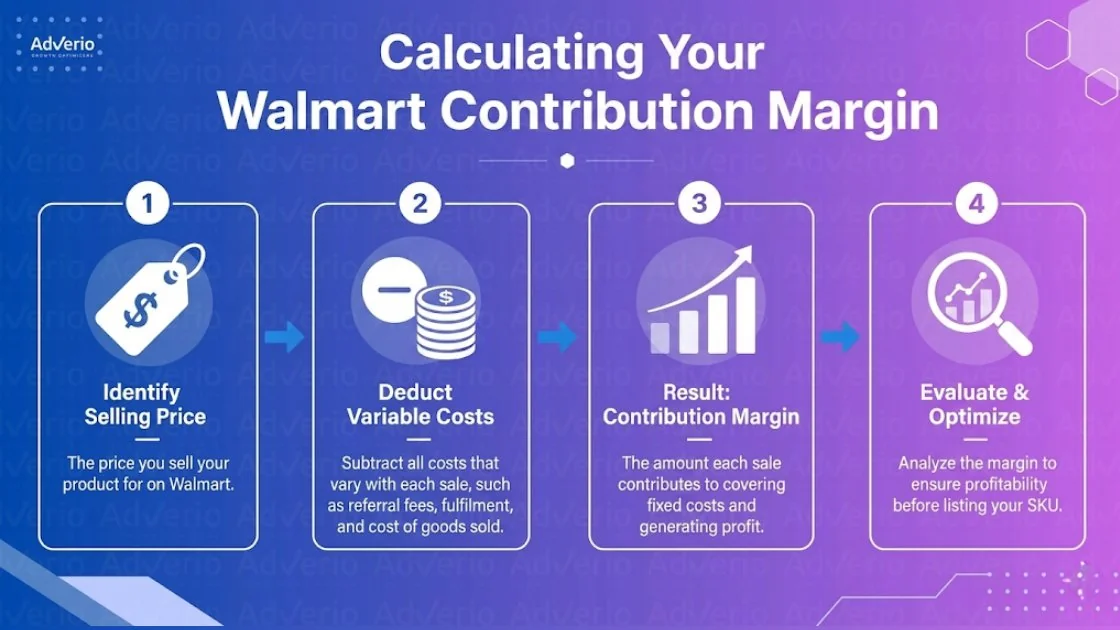
How to Calculate Walmart Contribution Margin Before You List
Revenue does not approve a Walmart launch. Contribution margin does.
If a SKU cannot survive Walmart’s full cost stack before you list it, it will not get healthier after ad spend, returns, and slower inventory turns show up.
Contribution Margin per Unit = Selling Price – Referral Fee – Fulfillment Cost – Storage Cost per Unit – Return Cost per Unit – Ad Spend per Unit
That is the pre-launch filter. Use it at the SKU level, not as a blended catalog average. A blended view hides weak items and gives finance false confidence.
Build the model in the right order
-
Use the street price you can hold
Start with the expected sell price after competitive pressure, not the list price from your planning sheet. Walmart gets ugly fast if your margin relies on perfect pricing discipline. -
Subtract the correct referral fee
Category classification changes profit immediately. A bad fee assumption can turn an acceptable SKU into a cash drain before fulfillment even enters the picture. -
Choose the fulfillment path you will really use at scale
If WFS is the likely operating model, build the case on WFS. Do not build a launch case on cheap seller-fulfilled assumptions and then switch to a more expensive path once volume arrives. -
Convert storage and holding cost into a per-unit burden
Fast-turn items can carry this cleanly. Slow-turn items cannot. The same fee schedule hits very differently depending on inventory velocity. -
Add return cost and ad cost as operating realities, not optional lines
Walmart growth usually requires paid visibility. Many categories also absorb enough return friction to matter. If either line is missing, the model is incomplete.
Here is the standard I recommend. Approve Walmart only when the SKU works after all variable marketplace costs and still leaves room to absorb channel volatility. If your margin disappears the moment CPC rises, price slips, or return rate worsens, you do not have a launch candidate. You have a forecasting problem.
A simple operating rule helps. Model a base case, a downside case, and a scale case. The base case uses your expected price, fee, fulfillment, and ad inputs. The downside case assumes weaker pricing and higher ad pressure. The scale case tests whether margin holds once you move into the fulfillment path and media levels required for real volume. CFOs should fund the SKU only if the downside case is still acceptable.
One more blunt recommendation. Run Walmart economics with WFS first. WFS gives cleaner forecasting and a more realistic view of what profitable scale demands. If the item only works with optimistic seller-fulfilled shipping inputs, reject the SKU or fix the offer before launch.
If your team needs one operating framework across retail, marketplace, and DTC, use this guide to omni-channel P&L construction. It gives finance and channel leaders one profit language instead of three incompatible spreadsheets.
How Adverio Models Walmart Profitability for Clients
Revenue projections do not approve a Walmart launch. Contribution margin does.
Adverio models Walmart at the SKU level because category averages hide bad decisions. We map each item to its expected selling price, referral fee, fulfillment path, shipping burden, ad requirement, return exposure, and operational overhead. Then we pressure-test the result against realistic downside assumptions before a client commits inventory, media, or headcount.
The point is simple. Decide whether Walmart adds profit or just adds work.
Large catalogs make this harder because weak SKUs can hide inside blended forecasts. A top-line plan can look attractive while a meaningful share of the catalog loses money after media and fulfillment. Our model strips that out fast. It shows which SKUs can carry acquisition costs, which ones need WFS to hold margin, and which ones should never be listed until pricing, packaging, or assortment changes.
We also separate launch economics from scale economics. A SKU may survive at low volume with modest ad support and then break once it needs sponsored visibility and tighter service levels to grow. That distinction matters to finance. Early sales are irrelevant if scaled contribution margin collapses.
If your team is still stitching together spreadsheets across marketplaces, you’re probably undercounting the hidden costs of split marketplace management.
Our recommendation is blunt. Fund Walmart expansion only for SKUs that remain acceptable after a real cost stack, not a referral-fee shortcut. That is how operators avoid buying unprofitable revenue.
Frequently Asked Questions
Does Walmart charge a monthly seller subscription fee?
No. Walmart does not charge a monthly marketplace subscription or a listing fee. That sounds attractive, but it also causes bad planning. Sellers fixate on the absence of a platform fee and ignore the full cost stack that decides whether Walmart adds contribution margin or drains it.
What are Walmart referral fees?
Referral fees are Walmart’s take rate on each sale, and they vary by product category. The fee can be modest in one category and materially higher in another, which means category mapping is a margin decision, not a catalog admin task. If finance signs off on Walmart using a blended fee assumption, expect distorted SKU economics.
Are WFS storage fees predictable enough for financial planning?
Yes, if you pair storage with turn assumptions. Storage rates are published, which makes WFS easier to forecast than many seller-fulfilled shipping models. The mistake is treating storage as a stand-alone line item. Slow inventory raises storage cost, ties up cash, and increases markdown risk at the same time.
Is seller-fulfilled cheaper than WFS?
Only if your operation is already built for low-error, low-cost parcel fulfillment. Seller-fulfilled economics often look better in a spreadsheet because teams omit pick-and-pack labor, packaging, customer service, claim exposure, and delivery variability. CFOs should compare contribution margin after actual operating burden, not just the visible freight line.
When should an Amazon brand expand to Walmart?
Expand after your priority SKUs clear a contribution margin test under realistic assumptions. Include referral fees, fulfillment method, storage, returns, ad spend, price compression risk, and the overhead required to run another marketplace well. Brands with niche, artisanal, or low-scale assortments should also sanity-check channel fit before they expand. If your catalog does not behave like mass retail, run the contribution margin model on your lowest-velocity SKUs first. If those do not clear the threshold, the assortment is not ready for Walmart, regardless of referral fee levels.
Read Next
If you’re building a broader expansion case, read these next:
-
Walmart listing optimization guide, listing standards before you scale the channel
If you want a real Walmart expansion answer, not a recycled fee summary, talk to Adverio. We model profit before you spend.