


Table of Contents
Most advice on Walmart and Vizio gets the headline right and the strategy wrong. Yes, Walmart now owns a serious CTV asset. No, that doesn’t mean your brand should throw money at connected TV and call it innovation.
The core issue is brutal and simple. If you can’t prove CTV drove new profit, you’re just funding expensive retargeting in a prettier format.
That’s why a smart Walmart Vizio CTV strategy starts with measurement discipline, not media excitement.
Get My Profit ROI Forecast
15-minute diagnostic call. No pitch deck.
If you’re also comparing CTV against other premium video channels, the market is moving aggressively toward performance-led video buying across every premium channel.
The brands that win won’t be the ones with the biggest video budget. They’ll be the ones that can separate attention from sales impact.
Your CTV Budget Is at Risk Without a Real Strategy
A lot of brands are treating the Walmart-Vizio deal like a shortcut to better advertising. It isn’t. It’s a sharper tool. Sharp tools help disciplined operators and punish sloppy ones.
The market is fixated on reach, screens, and shiny ad formats. That’s lazy thinking. Your finance team doesn’t care how elegant your CTV dashboard looks. They care whether media spend created incremental revenue or merely harvested demand that already existed.
The bad assumption killing CTV efficiency
The bad assumption is this. If a household saw your ad and later bought your product, the ad worked.
That’s not strategy. That’s correlation dressed up as attribution.
For years, CTV has had a credibility problem with serious operators because too many campaigns stop at exposure metrics, view-through narratives, and platform-reported success. Those metrics are easy to present and hard to trust. If your agency can’t tell you what portion of sales came from people who would not have bought otherwise, they are not managing growth. They are managing optics.
Most brands don’t have a CTV scale problem. They have a proof problem.
What a real Walmart Vizio CTV strategy demands
A real Walmart Vizio CTV strategy forces a tougher standard:
-
Target households with intent signals: Don’t buy broad awareness and pray.
-
Build creative for commerce behavior: Don’t recycle social assets and expect living-room performance.
-
Test for lift, not just attributed sales: If there’s no control logic, there is no decision-grade signal.
-
Protect margin while you scale: Revenue without proof is how ad budgets rot.
Inaction is expensive. But blind activation is worse. If you enter Walmart-Vizio without a framework for incrementality, your budget becomes a subsidy for existing demand and repeat buyers.
How the Walmart Vizio Partnership Actually Works
Walmart didn’t buy Vizio to get a nicer media story. It bought control. Control of inventory. Control of the operating environment. Control of the path between ad exposure and commerce.
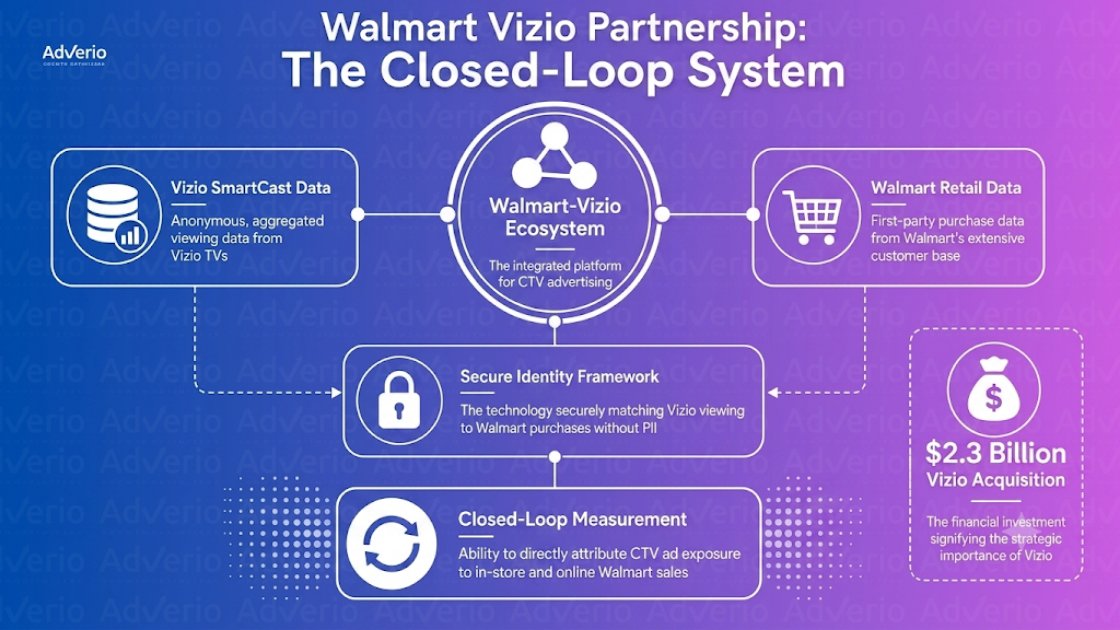
The closed-loop mechanism
The most important fact here is structural. Walmart’s $2.3 billion acquisition of Vizio created a secure identity framework that connects streaming engagement with retail interaction, and the beta phase on Vizio devices has already enabled audience targeting with the ability to measure sales outcomes on WatchFree+ and home screen ads, as reported by AdExchanger’s coverage of Vizio helping Walmart expand its CTV ad business.
That matters because most CTV buys break apart across too many hands. One company owns the content. Another owns the device. Another owns the checkout. Another tries to stitch the reporting together after the fact. You get fragmented signals and inflated confidence.
Walmart-Vizio works differently. Walmart can use verified purchase behavior to shape who sees ads on owned CTV surfaces. That creates a more direct path from audience design to exposure to retail outcome.
Why ownership changes the economics
Ownership isn’t a branding detail. It’s the operating advantage.
When the retailer controls key media inventory, the ad surface becomes more accountable. WatchFree+ and the Vizio home screen aren’t just distribution points. They’re measurable retail media real estate.
That gives Walmart a better shot at doing what most platforms still struggle to do:
| Component | Typical CTV setup | Walmart-Vizio setup |
|---|---|---|
| Audience signal | Often stitched from mixed sources | Verified Walmart purchase data |
| Inventory control | Fragmented across partners | Owned-and-operated Vizio surfaces |
| Retail outcome link | Often indirect | Designed to connect exposure and sales |
| Identity layer | Patchwork | Secure unified framework |
What brand leaders should take from this
This isn’t just a media feature update. It’s a change in bargaining power.
Brands that understand this can stop buying CTV like rented awareness and start treating it like measurable retail media. Brands that don’t will keep overpaying for broad household exposure and calling it full funnel sophistication.
If you want the broader operating context behind this shift, these Walmart advertising strategies help frame why some brands scale on Walmart while others stall.
The Business Case for a Walmart Vizio CTV Strategy
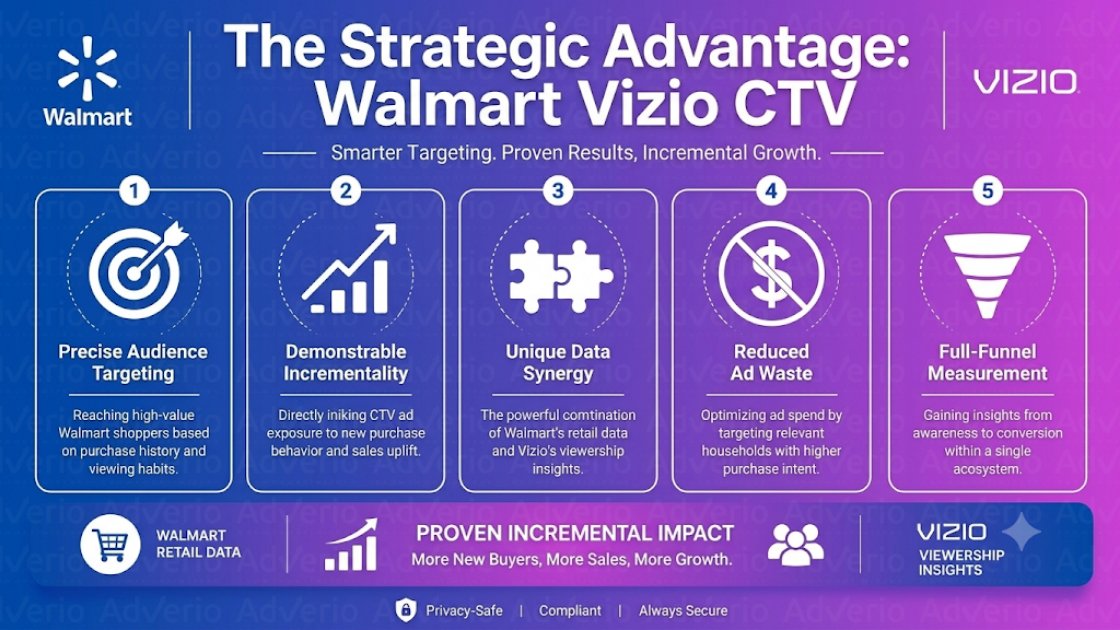
A Walmart Vizio CTV strategy earns budget only if it proves one thing: incremental profit. Everything else is presentation.
The business case is simple. Walmart now has a tighter link between media exposure and retail purchase behavior than standard CTV buys usually offer. That gives brands a better shot at testing whether CTV is creating new sales, shifting share from competitors, or just following demand that already existed. If your team treats that distinction as a reporting detail, you will fund waste and call it growth.
The value is better causal testing
Walmart has pointed to stronger purchase outcomes from CTV exposure, but the headline number is not the point. The point is whether your campaign caused net-new sales. As Marketing Dive’s analysis of Walmart Connect and retail media CTV convergence explains, retail media and CTV still face the same hard problem. Attribution is easier to produce than proof.
That should change how you evaluate the opportunity.
Ask questions your finance team would ask:
-
Did exposed households buy more than a valid control group?
-
Did CTV bring in new-to-brand buyers or just hit existing shoppers again?
-
Did sales lift hold after accounting for search, onsite media, promotions, and seasonality?
If those answers are weak, the campaign did not build your business. It rented a narrative.
Early adopters get an advantage that competitors cannot copy quickly
The first advantage is not reach. It is measurement discipline.
Brands that start testing early can build clean baselines by audience, SKU, region, and promotion window. They can see where CTV works, where it fails, and where frequency turns into waste. That historical learning matters more than creative novelty because it shapes future budget allocation with actual evidence.
Competitors can copy your audience categories. They cannot instantly copy a year of holdout tests, matched-market comparisons, and incrementality benchmarks.
The smart budget question is portfolio profit
Walmart Vizio should sit inside your broader retail media allocation, not beside it as an awareness experiment. You are deciding where the next dollar creates the highest marginal return across marketplaces, formats, and funnel stages.
That is why portfolio discipline matters. Cart.com’s breakdown of Amazon vs. Walmart vs. Target investment strategy offers a useful planning benchmark with a 70/20/10 split across Amazon, Walmart, and Target. Do not copy that mix blindly. Use it to force a harder question. Should Walmart Vizio CTV take budget from lower-yield prospecting, from branded search that would convert anyway, or from onsite media that is already near saturation?
Pick one. Test it. Cut the loser.
If your Walmart media team still treats CTV, search, and onsite display as separate silos, fix that first or get outside help to manage my ads on Walmart. The business case gets stronger only when CTV is measured against total retail profit, not against softer media KPIs.
Your Playbook for Launching a Walmart Vizio Campaign
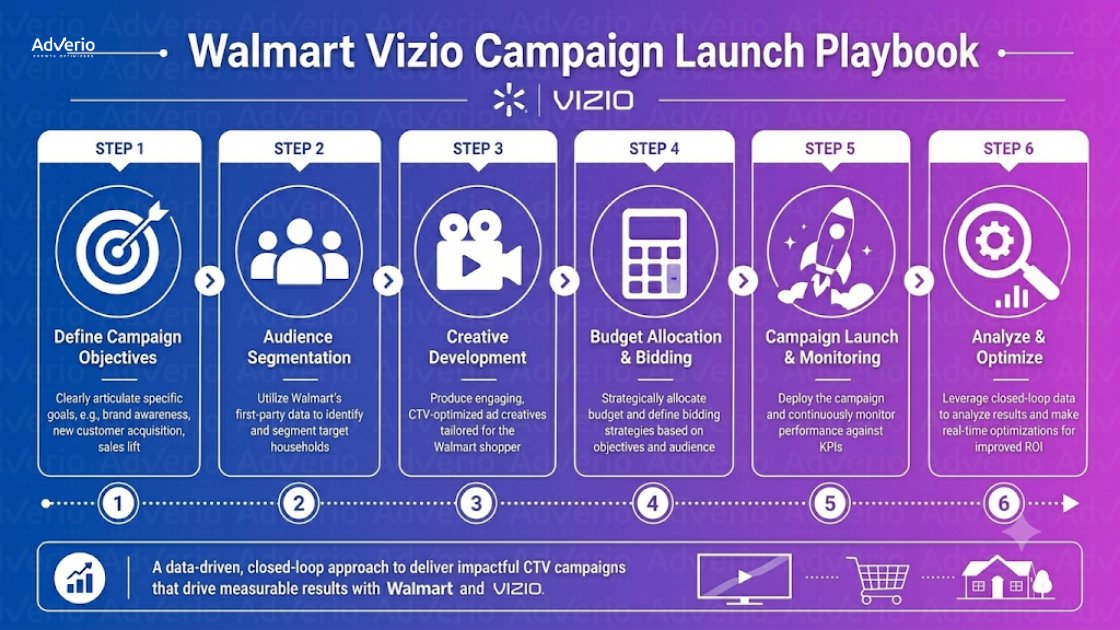
A Walmart Vizio campaign fails long before the first impression if you launch it without a measurement plan, a retail plan, and a clear profit thesis. Reach is easy to buy. Incremental sales are not.
Treat this launch like a controlled retail growth test. Your job is to find out whether CTV creates new demand from households that would not have purchased otherwise. If you cannot answer that, you are buying expensive storytelling and calling it performance.
Start with the metric your CFO would respect
Set the scorecard before you set the budget. If the team opens with completion rate, view-through rate, or broad attributed ROAS, stop the meeting and reset it.
Use a hard decision hierarchy:
-
Primary outcome: Incremental sales on promoted SKUs
-
Secondary outcome: New-to-brand household acquisition
-
Third signal: Retail velocity lift during the campaign window
That structure forces discipline. It also blocks a common CTV failure mode, giving credit to ads that merely touched buyers who were already going to convert.
Build audiences around purchase intent you can profit from
The point of Walmart Vizio is not broad demographic reach. The point is using commerce data to expose households where a sale can still be influenced.
Start with behavior-based segments that map to a real growth objective:
| Audience type | Why it matters | What to watch |
|---|---|---|
| Category purchasers | Captures shoppers already active in the aisle | Can overstate performance if demand was already present |
| Competitive brand purchasers | Gives you a shot at share gain | Creative has to show a real reason to switch |
| Lapsed brand buyers | Reopens demand from known households | Easy to subsidize repeat buying you would have gotten anyway |
| Complementary product buyers | Extends basket logic into adjacent demand | Works only when the product connection is obvious |
If your team needs someone to manage your Walmart ads, make that same operator own audience alignment across CTV, search, and onsite media. Split ownership creates fake wins, duplicated reach, and budget waste.
Book Your Profit ROI Forecast
15-minute diagnostic call. No pitch deck.
Use creative built to sell, not creative built to look polished
Cheap asset reuse kills CTV performance. A cut-down social video is not a CTV strategy. A pretty brand spot with no shopping logic is worse.
Your ad needs to do three jobs fast:
-
Show the problem or use case in the first few seconds
-
Make the product benefit obvious in a living-room context
-
Push one clear commerce action tied to Walmart
Interactive formats can help, but only if they match buyer intent. QR codes, pause ads, and shoppable placements are tools, not strategy. If the message is weak, interactivity just makes weak creative easier to ignore.
Use a simple rule. If the ad could run for any brand in your category with the logo swapped out, it will not change buying behavior.
Flight around retail conditions that can convert
Media timing should follow commerce readiness, not generic audience patterns. Launch only when the product page is conversion-ready, inventory is stable, pricing is competitive, and the offer is easy to understand.
Good campaign windows usually line up with:
-
Seasonal demand spikes
-
Promotional periods with real retail support
-
Assortment pushes that need awareness and action
-
Moments when store and online conversion friction is low
Do not run CTV into a broken retail path. If your PDP is weak, stock is unstable, or the offer changes mid-flight, your reporting will blur media impact with operational mistakes.
Treat the first flight like a profit trial
A serious first campaign answers a business question. It does not exist to “show up on TV.”
Use the opening flight to isolate three decisions:
-
Which audience segment produces the strongest sales response
-
Which creative angle drives action instead of passive recall
-
Which retail conditions support actual conversion after exposure
Keep the test design simple enough to defend. Hold variables steady where you can. Limit the number of creatives. Resist the urge to chase scale before you know what is working. Scale without proof just spreads waste faster.
That is the proper launch playbook. Build the campaign so you can prove it created new profit, not so the platform can claim another attributed sale.
Measuring True Incrementality Not Just Attribution
Attribution tells you who got credit. Incrementality tells you who created value. Those are not the same thing, and pretending they are is how brands waste CTV budget for quarters at a time.
Most reporting often falters on this point. A household sees an ad, buys later, and the platform claims victory. Maybe the ad mattered. Maybe it didn’t. Maybe that buyer was already headed to Walmart. If you don’t test against a clean counterfactual, your “proof” is just a polished guess.
What proper incrementality testing looks like
A serious test design needs a control condition. That can be geographic, household-based, or audience-split depending on operational constraints. The principle stays the same. One group gets exposure. A comparable group does not.
Then you compare outcomes that matter:
-
sales movement on promoted products
-
new-to-brand customer movement
-
retail behavior shifts after exposure
-
spillover into organic Walmart performance
The objective isn’t to produce flattering numbers. The objective is to isolate whether CTV caused additional behavior.
A workable operating framework
To view this from a practical angle:
| Test element | Exposed group | Control group |
|---|---|---|
| Audience eligibility | Same purchase logic | Same purchase logic |
| Media exposure | Walmart-Vizio CTV on | No Walmart-Vizio CTV |
| Retail conditions | Same pricing and supply where possible | Same pricing and supply where possible |
| Evaluation focus | Sales lift and buyer movement | Baseline behavior |
This isn’t glamorous. It’s finance-grade media discipline.
If your control group isn’t credible, your success story isn’t credible either.
Why standard ROAS underperforms as a decision tool
ROAS is useful, but incomplete. It rewards channels that harvest existing demand. It can make branded search look heroic. It can make retargeting look smarter than prospecting. In CTV, it can flatter campaigns that hit households already inclined to buy.
That’s why the core question isn’t “What sales got attributed?” It’s “What sales would have disappeared if the campaign never ran?”
If your team can’t answer that, don’t increase spend.
What to do with the result
When you find actual lift, scale the exact ingredients that caused it. Audience. creative. timing. retail support.
When lift is weak, don’t hide behind engagement metrics. Cut, redesign, or narrow the buy. A framework like Adverio on marketplace attribution becomes useful because CTV performance never lives in a vacuum. It interacts with onsite ads, search behavior, and marketplace conversion signals across the portfolio.
Common Pitfalls That Will Bleed Your CTV Budget
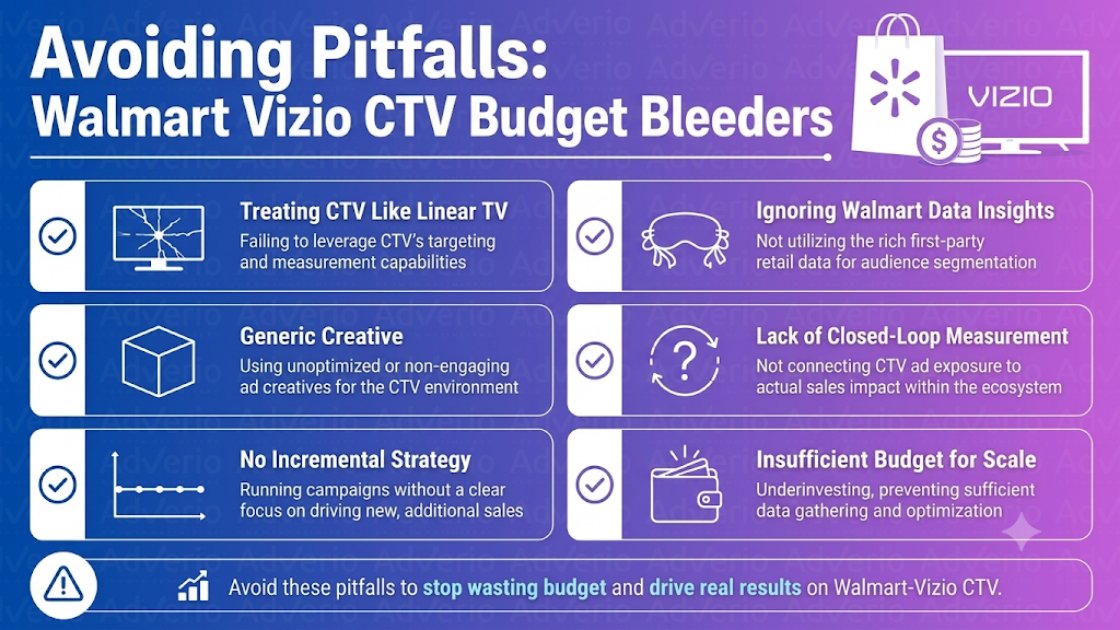
CTV does not forgive sloppy operators. Walmart and Vizio give you better access to households, better commerce signals, and better storytelling real estate. They do not give you proof of incremental profit by default. If you skip that discipline, you will pay premium CPMs to influence people who were already on their way to buy.
Weak teams still hide behind completion rates, view rates, and attribution dashboards. Those numbers can describe exposure. They do not prove that CTV created new buyers, larger baskets, or higher-margin revenue. As noted earlier, Walmart has highlighted strong viewing performance for some CTV campaigns. Fine. Attention is useful only if it changes what would have happened without the ad.
Five mistakes that keep showing up
-
Using creative built for Amazon, TikTok, or paid social: Living room screens punish tiny text, rushed edits, and product pages dressed up as ads. Build for distance, sound, and memory.
-
Treating engagement as success: High completion can still mean wasted spend if exposed households buy at the same rate as your holdout group.
-
Buying audiences without asking who was already likely to convert: If your targeting finds prior shoppers and high-intent households, CTV becomes expensive assisted conversion media.
-
Sending traffic into weak retail execution: Bad images, thin copy, poor comparison logic, and weak reviews kill the sale after the ad does its job.
-
Ignoring competitor capture: Your campaign can expand category interest while a cheaper, better-rated competitor wins the basket on Walmart.
The retail weakness that turns media into waste
A strong ad cannot rescue a weak product page. It only sends more expensive traffic into the same leak.
Smart operators fix the retail layer before they scale reach. These critical Walmart content optimization insights matter because conversion failure at the shelf level destroys the economics of every CTV impression you buy. If your PDP cannot close cold or lightly aware shoppers, your CTV campaign will overstate impact and underdeliver profit.
What disciplined brands do differently
Disciplined brands set kill rules before launch. They define what counts as incremental success, how long they will wait to see it, and what gets cut if lift does not appear. They also pressure-test audience logic, because the easiest way to fake CTV performance is to target households already captured by your brand, your retailer media, or your promo calendar.
They ask harder questions. Did CTV create net-new buyers? Did it shift share from competitors? Did it lift units after controlling for seasonality, pricing, and in-store support? If the answer is unclear, the budget stays constrained.
That is the standard. Anything lower is storytelling dressed up as measurement.
How Adverio Turns Walmart Vizio CTV Into Profit
You don’t need another agency obsessed with impressions. You need a partner that treats media like capital allocation. Adverio runs Walmart growth through a profit-first operating model built on proprietary systems such as the Growth Cultivator framework, Profit Pulse System, AMOS, GEAR, LQS, PPS, SKU Resurrection, and Brand Drain Reversal. The team works through dedicated strategy and operations pods, not generic account managers, and offers both Done-for-You and Done-with-You support. If you want to achieve Walmart Connect growth, this is the standard. Adverio also backs delivery with an ROI-focused model that includes a 40% refund clause.
Frequently Asked Questions
Is Walmart-Vizio CTV better than standard CTV buying
It can be, but only if you value retail-linked measurement over raw reach. The advantage isn’t that CTV suddenly became magical. The advantage is that Walmart owns more of the path from exposure to transaction than most media environments do.
Should endemic and non-endemic brands approach this the same way
No. Endemic brands usually have a cleaner path to retail action because the purchase can happen directly inside Walmart’s ecosystem. Non-endemic brands should be stricter about incrementality testing because proving causation is harder and the public case evidence is still thin.
What should I optimize first in a Walmart Vizio CTV strategy
Optimize for incremental sales logic first. Then refine audience design, creative fit, and retail readiness. Don’t start with view metrics unless your goal is to impress someone who doesn’t control your P&L.
Are shoppable formats enough to drive results
No. Shoppable formats reduce friction. They do not fix weak offers, poor creative, or bad audience logic. Convenience helps after strategy is sound, not before.
When should a brand avoid scaling Walmart-Vizio CTV
Avoid scaling when your Walmart retail foundation is unstable, your measurement design is weak, or your team is still judging success on attribution alone. That’s how a promising channel turns into budget leakage.
If your brand is serious about turning Walmart, Amazon, and Target into a profit engine instead of a reporting mess, talk to Adverio. The team helps established consumer brands break plateaus, tighten attribution, and build marketplace strategies that stand up to CFO scrutiny.
See My Walmart Profit Forecast
15-minute diagnostic call. No pitch deck.