


Table of Contents
Amazon strips your Buy Box. The default response is a price cut. That reflex is often wrong. It is specifically wrong when Amazon’s price-matching logic misidentifies the comparison target.
This guide covers the specific scenario the general Buy Box playbooks skip: how to tell whether Amazon matched your ASIN against the wrong external offer, what to do when the suppression is Amazon’s error rather than yours, and when challenging the match is more profitable than cutting price.
For the full Buy Box recovery process covering fulfillment, seller metrics, repricing guardrails, and monitoring systems, those live in the lost Buy Box recovery guide and the Buy Box algorithm guide. What follows here is the price matching diagnostic layer those guides do not cover in depth.
Before you touch price, you need to know whether the suppression is even your fault. Get My Profit ROI Forecast →
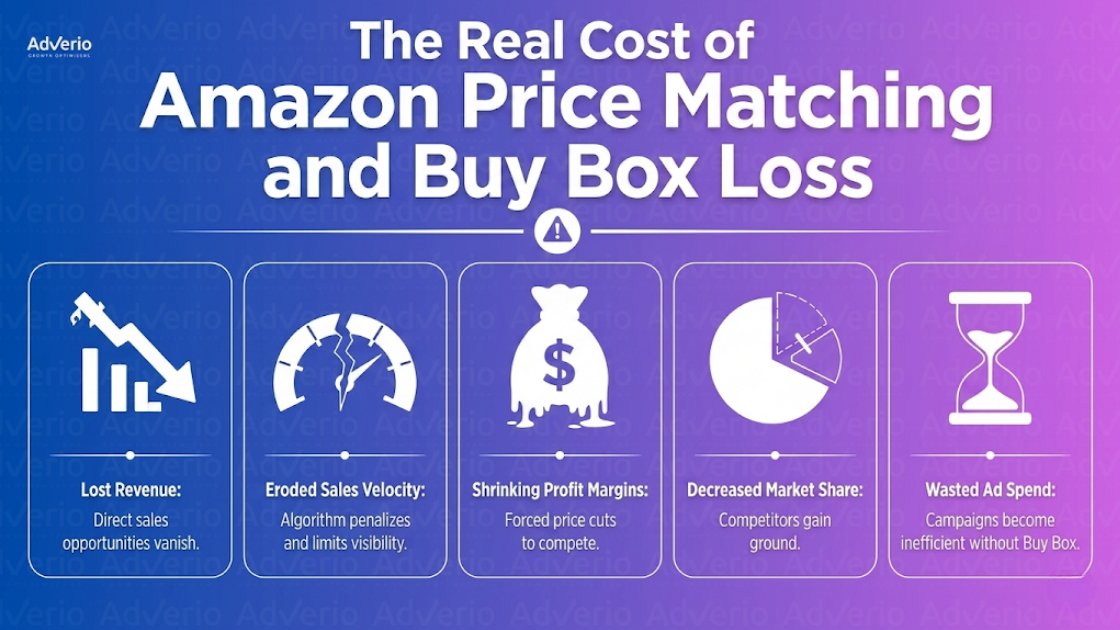
The Real Cost of Amazon Price Matching and Buy Box Loss
Your team logs in on Monday, sees the Buy Box missing, and the first reaction is a price cut. That reaction burns margin before you’ve proven Amazon’s comparison is even valid.
Amazon treats price parity as a trust issue. If it believes your offer is higher than a comparable external price, it can suppress the Buy Box and remove the main purchase path. GoAura’s Buy Box analysis reports that more than 80% of sales on multi-offer listings happen through the Buy Box in this Buy Box performance breakdown. That is where revenue concentrates.
Why a bad price match is worse than a legitimate one
When Amazon’s comparison logic is correct and your offer is genuinely higher than an equivalent external price, the path is clear: fix parity or reprice inside your margin floor. The full mechanics of that process live in the Buy Box recovery guide.
When Amazon’s comparison logic is wrong, matching the wrong pack, wrong variation, wrong merchant, or an offer that is not actually equivalent, cutting the price makes the error more expensive. You hand away margin, and the suppression does not resolve because the trigger was never your price.
That diagnostic failure is what this guide addresses.
The CFO view beats the catalog-manager view
A suppressed Buy Box changes the unit economics of the ASIN on day one. Lower volume hurts contribution margin. Reactive discounting hurts it again. If your team also absorbs bad fee assumptions, the ASIN can stay “active” while becoming less profitable every day.
Set a real price floor before you touch price. Use fully loaded economics, including fulfillment, storage, returns, shipping, and Amazon fees. Adverio’s FBA fee insights are useful for pressure-testing that floor. If the required recovery price sits below it, chasing the Buy Box is a transfer of profit from your brand to the market.
You also need evidence, not guesses. Teams that monitor external pricing signals continuously can catch parity breaks faster and separate real underpricing from bad comparison logic.
The core point is simple. Buy Box loss is expensive, but blind price matching is often more expensive. Diagnose the trigger first. Then decide whether recovery improves profit or just protects vanity metrics.
The Buy Box Loss Diagnostic Your Last Agency Skipped
The laziest advice in Amazon commerce is “lower your price.” That’s not a diagnosis. That’s surrender.
Chris McCabe and Leah McHugh of eCommerceChris have documented that Amazon’s own price-match logic can be wrong, including cases where Amazon misidentified pack sizes or matched against the wrong external offer. Including cases where Amazon misidentified pack sizes or matched against the wrong external offer. In those situations, the right first move is to audit Amazon’s comparison target, not slash pricing. Amazon’s price-matching algorithm errors affecting Buy Box eligibility have been documented by Chris McCabe and Leah McHugh of eCommerceChris, who analyzed erroneous product matches causing Buy Box loss in their Seller Performance Solutions series (2024).
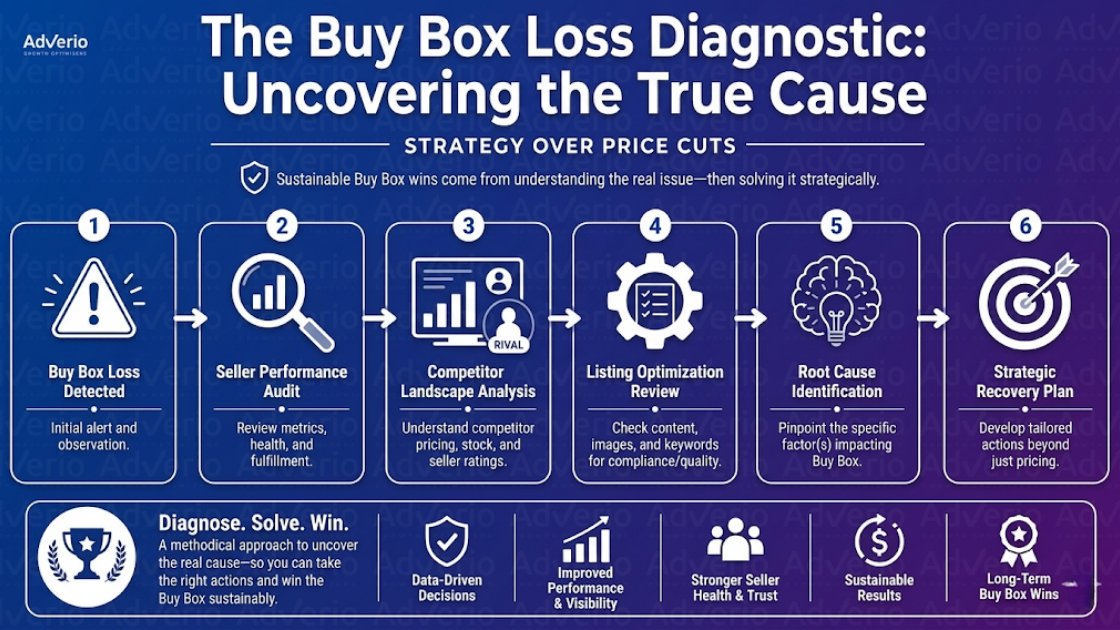
Four causes that look identical from the dashboard
From inside Seller Central, several different failures can produce the same symptom.
| Scenario | What it looks like | What to do |
|---|---|---|
| Amazon matched the wrong external product | Sudden suppression despite stable economics | Gather screenshots, pack-size proof, price-history evidence |
| Your own DTC or retail channel broke parity | Buy Box loss after a promo or markdown elsewhere | Fix cross-channel pricing immediately |
| Unauthorized seller or reseller undercut | Buy Box disappears while rogue offers show up | Enforce channel policy and seller controls |
| Offer quality or account-health issue | Suppression appears alongside operational deterioration | Audit fulfillment, defect risk, and tracking performance |
What to check before touching price
Start with the comparison target. If Amazon is matching the wrong pack, wrong variation, or wrong merchant listing, price cuts won’t solve anything. They’ll just make the error more expensive.
Then work down this list:
-
Seller metrics: Review order defect risk, shipment reliability, valid tracking, and inventory continuity. If those are weak, price is only part of the story.
-
Competitive offer context: Check whether the competing seller is Prime-capable, in stock, and stable.
-
Channel parity: Look at your own website, retail partners, couponing, and syndicated promotions.
-
Offer architecture: Confirm that your variation setup, pack count, and merchandising are clear enough that Amazon isn’t comparing the wrong thing.
Audit the comparison target before you audit your willingness to discount.
If you need to automate external offer checks across large catalogs, tools that help collect structured page data can speed up that work. A marketplace monitoring layer is useful when your team needs to validate what Amazon may be seeing across external listings.
For the Amazon-side review, Adverio’s Amazon account diagnosis is the type of operational audit brands should be doing before repricers start dragging margin through the floor.
A 3-Tiered Action Plan for Profitable Buy Box Recovery
Recovery works best when you stop treating every Buy Box loss like the same emergency. Some suppressions are wrong and should be challenged. Some need tactical repricing. Some are not worth chasing.
The three-tier framework below is specifically for price-matching scenarios. For general Buy Box recovery covering fulfillment, metrics, and repricing architecture, the how to win the Buy Box guide covers that in full.

Tier 1 Fix the bad suppression
If the trigger is false, don’t negotiate with fiction.
Build a case file with screenshots, product-detail comparisons, pack-size validation, and price-history evidence. Then push Seller Support with a specific explanation of the mismatch. Broad complaints go nowhere. Precise proof has a shot.
This matters most for bundled products, multipacks, and variation-heavy catalogs. Those are where Amazon’s matching logic tends to get messy.
Tier 2 Reprice with guardrails
If the suppression is legitimate, don’t let your repricer act like a distressed liquidator.
Use a hard floor. Then let the system move inside a controlled band. Your job is to preserve margin while remaining eligible, not to “win” against every lowball seller who’ll be out of stock tomorrow.
A better recovery sequence looks like this:
-
Set the floor first so no rule can undercut your required unit economics.
-
Use landed price logic rather than staring at item price alone.
-
Avoid reacting to temporary offers that aren’t durable.
-
Check FBA and Prime advantage before matching non-equivalent sellers.
Operator move: A repricer without a margin floor is just automated self-harm.
Your paid media plan should reflect the same logic. If pricing and ads are managed separately, you get one team buying traffic while another team kills contribution profit. This guide to Amazon PPC for established brands is relevant because Buy Box recovery and traffic efficiency have to be managed together.
Tier 3 Decide when not to chase
This is the part weak operators avoid.
If reclaiming the Buy Box requires you to break cross-channel pricing discipline, wreck contribution margin, or validate a bad external benchmark, you may be better off holding price. That’s not passivity. That’s capital allocation.
There are moments when losing the Buy Box is the cheaper loss.
Examples:
-
A rogue external markdown is temporary and likely to clear.
-
A reseller price is below what your economics can support.
-
A broad channel promo would create downstream parity chaos if matched on Amazon.
-
The ASIN still contributes strategically through brand presence while you fix the root issue.
That decision should be made by someone who owns profit, not just conversion rate.
If you run large catalogs, a system is particularly important. Adverio’s Profit Pulse Intelligence System consolidates pricing, ads, listings, and inventory into one profit view so teams can decide whether a Buy Box fight should be escalated, repriced, or deliberately ignored.
If you don’t have that view yet, your Buy Box decisions are running on guesswork. Book Your Profit ROI Forecast →
Using Ads and Listing Health to Rebuild Lost Momentum
You win the Buy Box back on Monday. By Friday, sales still look broken, TACoS is bloated, and competitors are feeding on the traffic you used to convert profitably.
That outcome is common after Buy Box loss. Amazon seller forum discussions on repeated suppression show the same pattern. Rank slips, conversion history weakens, and recovery starts to look like a relaunch, not a simple return to normal, That outcome is common after Buy Box loss. Rank slips, conversion history weakens, and recovery starts to look like a relaunch, not a simple return to normal.
Do not respond by flooding the account with spend. That is how brands turn a pricing problem into a margin problem.
Rebuild traffic with intent
Once the offer is buyable again, treat ads like a recovery tool, not a panic button. Put budget behind the terms that converted before the suppression. Defend branded search first. Then rebuild non-brand only where contribution still makes sense.
Focus on four things:
-
Re-establish conversion history on proven search terms
-
Defend branded queries so competitors do not steal demand you already paid to create
-
Retarget high-intent audiences if the audience pool is still large enough to matter
-
Track TACoS and contribution margin daily during the recovery period
Creative speed matters here because stale ads slow recovery. If your team needs fresh creative variations during recovery, prioritize the hero image and first bullet first since those have the fastest conversion impact.
Fix conversion leaks while traffic is limited
A weakened ASIN cannot afford a mediocre listing. Every click costs more when rank is down and conversion history is damaged.
Use the recovery window to clean up the page aggressively. Tighten the hero image. Remove bullet fluff. Make pack size and product differences obvious. Fix variation logic that confuses shoppers. Improve A+ flow so the page answers objections before the shopper bounces.
If your team needs to fix my Amazon listings, do it during recovery, not after the ad bill exposes the problem. Paid traffic only works if the page closes the sale.
Buy Box access gets you back in the game. Listing quality decides whether the traffic is worth buying.
Building a Resilient Pricing Strategy to Prevent Future Losses
Reactive pricing teams lose twice. First when Amazon suppresses the Buy Box. Then again when they “solve” it by teaching the market that their price integrity is optional.
The smarter move is to build a pricing architecture that prevents avoidable suppression in the first place.
Prosper Show contributors have raised a neglected strategic question: when should a brand not chase the Buy Box?
The harder but better decision is sometimes to hold price or temporarily accept Buy Box loss to protect margin and cross-channel pricing discipline.
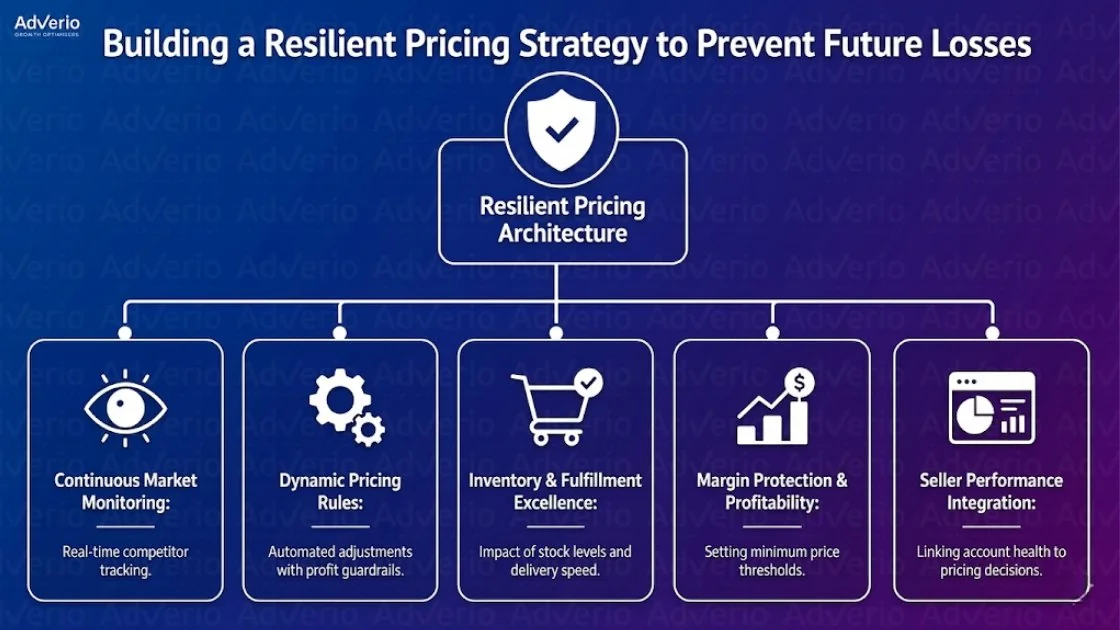
What resilient pricing actually looks like
A durable strategy usually includes these controls:
-
Parity discipline: Your Amazon, DTC, and retail pricing can’t tell three different stories.
-
Price floors: Every SKU needs an absolute minimum based on real economics.
-
Offer monitoring: Watch major external channels before Amazon reacts to them.
-
Seller governance: Uncontrolled reseller activity will keep blowing up your listings.
-
Operational quality: Inventory gaps and fulfillment weakness make pricing problems worse.
Build a system, not a reaction habit
The brands that keep their Buy Box position don’t rely on luck. They rely on monitoring, policy, and fast intervention.
For large catalogs, that often means connecting market data sources into a single workflow. If your team is evaluating infrastructure for offer and pricing visibility, the priority is connecting pricing, ads, listings, and inventory monitoring into a single workflow.
What matters is the operating model behind it. Someone needs clear ownership of these decisions:
| Decision area | Bad habit | Better standard |
|---|---|---|
| DTC promos | Launch discount first, ask questions later | Check Amazon parity impact before launch |
| Repricing | Match every lower offer | Match only inside margin guardrails |
| Seller control | Ignore gray-market drift | Enforce who can sell and at what conditions |
| Buy Box response | Chase by default | Decide based on profit and channel impact |
If your team can’t explain why a given ASIN should or should not chase the Buy Box, then pricing strategy is still running on instinct.
How Adverio Helps
Most teams lose margin during a Buy Box event because no one owns the trigger diagnosis. Adverio’s Profit Pulse Intelligence System consolidates pricing, ads, listings, and inventory into one profit view, so your team can tell within hours whether Amazon made a comparison error, your channel parity broke, or a reseller is dragging your floor. That diagnosis decides whether the right move is to challenge the suppression, reprice inside guardrails, or hold price and protect margin.
FAQs on Amazon Buy Box Loss
You lose the Buy Box at 10:00 a.m. By noon, someone on your team wants to cut price. That reflex burns margin fast. The first question is whether Amazon matched the right market signal. The second is whether winning the Buy Box at that lower price makes you more money.
Use the FAQ below to keep the response disciplined.
| Question | Answer |
|---|---|
| Does the lowest price always win the Buy Box? | No. Price is one input, not the whole decision. Fulfillment setup, seller performance, inventory position, and conversion history all affect who gets the sale. If your team still treats Buy Box loss as a pure pricing problem, go understand Amazon’s Buy Box algorithm before approving another discount. |
| Should I lower price the moment I lose the Buy Box? | No. Verify the comparison first. If Amazon matched against the wrong external offer, a price cut gives away margin and solves nothing. Even when the match is correct, you still need to confirm that recovering the Buy Box at that price produces more contribution profit, not just more units. |
| Can a suppressed Buy Box hurt ads? | Yes. Sponsored traffic performs worse when the purchase path breaks or the ASIN loses conversion momentum. You end up paying to push shoppers into a weaker offer state, which drags efficiency and slows rank recovery. |
| Can I choose not to chase the Buy Box? | Yes. You should make that call based on profit, not ego. If regaining the Buy Box means breaching your margin floor, training customers to wait for discounts, or creating channel conflict, hold the line and protect cash. |
| Where should my team start if this keeps happening? | Does the lowest price always win the Buy Box? No. Price is one input, not the whole decision. Fulfillment setup, seller performance, inventory position, and conversion history all affect who gets the sale. If your team still treats Buy Box loss as a pure pricing problem, understand Amazon’s Buy Box algorithm before approving another discount. |
Read Next
If your team cuts price every time Amazon price matching knocks you out of the Buy Box, you are handing margin to the market. You need a tighter diagnosis, firmer pricing controls, and a recovery process tied to profit. Adverio helps established brands connect pricing, ads, catalog health, and marketplace operations into one decision system. If you want to see where your Buy Box losses are really coming from and what they’re costing you, get My Profit ROI Forecast at adverio.io/roi