


Table of Contents
If your team is still treating the Amazon Buy Box algorithm like a price war, you’re losing margin and visibility to brands that figured this out already.
Brands still lose the Buy Box with strong feedback, healthy account metrics, and competitive pricing because Amazon no longer rewards the old playbook. In 2025 and 2026, delivery speed, price parity across channels, fulfillment consistency, and real-time trust signals carry more weight than many teams realize. Sellers who keep reacting with blunt price cuts protect nothing. They train the algorithm to expect lower margins while a faster, cleaner offer takes the sale.
A core problem is outdated thinking.
A lot of operators still assume the Buy Box goes to the cheapest acceptable seller. That model is obsolete. Amazon now evaluates whether your offer is the safest conversion decision at that moment. If your shipping promise slips, your inventory position looks shaky, or your product is cheaper somewhere else on the internet, your “good” metrics stop mattering fast.
That is why $5M–$50M brands with solid accounts still get blindsided. They are optimizing for yesterday’s Amazon while competitors are building systems that defend Buy Box share before it drops. If that sounds familiar, this is the framework that fixes it — and if you want a second opinion on your current exposure, Book Your ROI Forecast.
Your Buy Box Strategy Is Dangerously Outdated
The old mental model was simple. Lowest price wins. FBA helps. Watch your feedback. Done.
That model is obsolete.
Amazon doesn’t treat the Buy Box like a medal you earn once. It treats it like a live trust decision. If your share swings up and down, that usually isn’t random. It means your pricing logic, fulfillment setup, account health, or inventory discipline is unstable.
The Wrong Goal — and Why It Costs You
Too many operators chase Buy Box wins like they’re episodic events. That’s backwards.
For a well-run brand, Buy Box ownership should feel routine — not perfect, not permanent, but stable enough that a loss triggers investigation, not resignation.
What’s broken: Most teams monitor symptoms (lost the box) instead of the system (what caused it). Pricing drift, fulfillment gaps, and parity failures don’t announce themselves. They accumulate until a competitor with tighter operations takes your slot.
What to do instead: Build a defense system — not a reaction playbook. Price floors, inventory alerts, parity audits, and delivery checks should run continuously.
What to avoid: Sporadic repricing runs and weekly dashboard checks. That’s how you lose 30% Buy Box share before anyone notices.
Adverio POV: Buy Box stability is a governance problem, not a pricing problem. The brands that defend it most effectively are running tighter operational systems — not just better repricers.
Practical rule: If your team is surprised by Buy Box loss, your monitoring system is weak.
The sellers getting burned in 2026 are the ones still optimizing for a much older version of Amazon. They assume pricing is the main lever. They ignore delivery promises, parity signals, inventory risk, and weighted rotation.
That’s how margin gets sacrificed without fixing the actual issue.
What a modern operator should assume
Use this baseline instead:
-
Eligibility comes first: If your account health slips, you’re not competing. You’re watching.
-
Winning is shared, not absolute: Amazon rotates exposure across eligible sellers.
-
Fast, reliable fulfillment matters more than many realize: That’s not theory. It’s visible in how Prime-leaning offers continue to outperform.
-
Amazon looks outside Amazon: A cheaper price on your own site or another marketplace can create suppression risk.
-
Inventory errors are strategic failures: Stockouts don’t just hurt sales. They remove you from contention.
If your current process relies on sporadic repricing, reactive ops fixes, and a weekly glance at Seller Central, you don’t have a Buy Box strategy. You have drift.
How the Buy Box Algorithm Changed in 2025 and 2026
Amazon tightened the screws in 2025. Sellers who didn’t adapt paid for it in visibility.
According to Amazon Sellers Lawyer’s 2025 Buy Box analysis, Amazon’s Buy Box algorithm underwent a significant update in 2025, penalizing prices that exceed 5% above the lowest offer and putting greater weight on Valid Tracking Rate at a 95% minimum and fast delivery. That shift caused widespread visibility losses for sellers who failed to adjust.
Price stopped being the whole story
Price still matters. Anyone telling you otherwise is selling fantasy.
But Amazon now weighs price inside a broader customer experience model. That means a cheaper offer can still lose if delivery confidence, tracking quality, or fulfillment reliability lags. In practice, that hurts sellers who built their strategy around undercutting without upgrading operations.
This is why some brands lower price and still don’t recover Buy Box share. They’re pulling the wrong lever.
Delivery speed became a strategic variable
Amazon has been moving toward a customer-experience-first Buy Box for years. The 2025 update made that harder to ignore.
FBA keeps its structural edge because Amazon controls the delivery promise. High-performing FBM and SFP sellers can still compete, but they don’t get much room for sloppiness. If your promised delivery date slips, tracking quality falls, or response time drags, the algorithm reads that as risk.
When Amazon has to choose between a slightly cheaper offer and a more dependable one, it often prefers dependable.
That’s the fundamental shift. Reliability now acts like a ranking force, not just a compliance checkbox.
What’s different in 2026
The consequences are clearer now. Sellers have had time to see the pattern.
Teams that adapted built tighter pricing controls, cleaner fulfillment execution, and better operational visibility. Teams that didn’t are still blaming “Amazon volatility.” That’s lazy analysis.
Disciplined analytics are paramount. If your team wants a clearer operating view of offer health, pricing behavior, and marketplace shifts, use stronger Amazon analytics tools instead of relying on surface-level dashboard checks.
A modern Buy Box strategy in 2026 needs three things:
-
Competitive landed price discipline
-
Reliable delivery execution
-
Tighter parity control across channels
Anything less leaves your listing exposed.
Brands running with fragmented reporting and reactive ops are already behind. If you want to know exactly where your Buy Box exposure is leaking, get a full Amazon account management diagnostic before the next suppression event costs you more.
The Full Buy Box Factor List and How Amazon Weights Them
Amazon doesn’t run the Buy Box as a permanent winner-take-all system. It uses a weighted rotation model. According to Repricer’s explanation of the Buy Box, multiple eligible sellers can share the Buy Box, and sellers with stronger pricing, fulfillment, and performance receive a larger share of that rotation.
That single point changes how you should manage the channel.
You are not optimizing for a binary win. You are optimizing for a larger share of exposure, more often, with fewer interruptions.
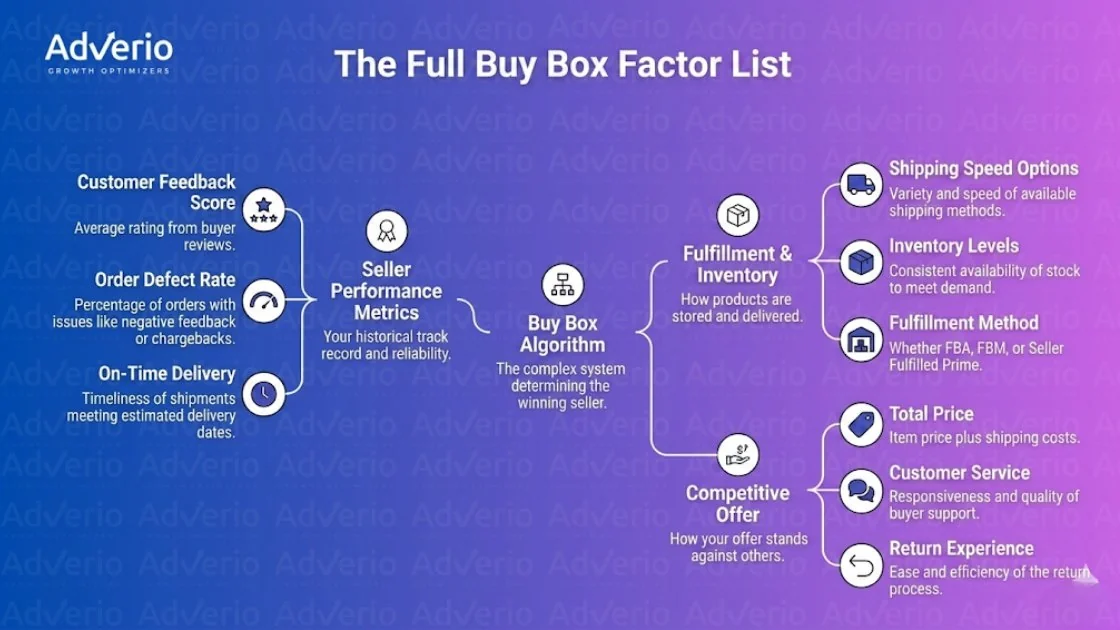
The factor hierarchy that actually matters
The cleanest way to think about the algorithm is in layers:
Layer one is offer competitiveness
Amazon looks at landed price, not just item price. Shipping, handling, and the total customer cost matter.
It also evaluates whether your price is competitive in context. Not just against the seller next to you, but against broader expectations.
Layer two is fulfillment confidence
FBA has an advantage because Amazon trusts its own network. Strong FBM can compete. Weak FBM usually can’t.
Speed, accurate delivery dates, and tracking quality all feed this layer.
Layer three is seller reliability
Performance history affects how much trust Amazon assigns to your offer.
That includes defect rates, shipping discipline, cancellations, customer feedback, and responsiveness. If your operation is messy, the algorithm sees it.
Amazon Buy Box ranking factors and how to influence them
| Factor | What It Measures | How to Influence It (Tactical Playbook) |
|---|---|---|
| Landed price | Total customer cost including item price and shipping | Build repricing rules around contribution margin, not panic. Watch total cost, not just shelf price. |
| Fulfillment method | Whether Amazon sees your delivery promise as reliable | Use FBA where it makes operational sense. If you stay FBM, tighten handling times, delivery estimates, and tracking compliance. |
| Delivery speed | How quickly the customer is likely to receive the item | Shorten operational lag. Reduce internal handoff delays. Audit regional shipping performance. |
| Valid tracking rate | Whether shipments include accurate tracking data | Eliminate carrier and feed errors. Validate tracking uploads daily. |
| Order defect rate | Combined signal of negative feedback, chargebacks, and claims | Fix root causes, not symptoms. Review damaged delivery issues, incorrect item sends, and support failures by SKU. |
| Late shipment rate | Whether orders leave on time | Align warehouse cutoff times to actual capacity. Stop overpromising during peaks. |
| Pre-fulfillment cancellation rate | How often orders are canceled before shipment | Improve inventory sync and oversell prevention. |
| Customer feedback score | Ongoing buyer satisfaction signal | Resolve operational failures that create poor feedback. Listing clarity and delivery execution both matter. |
| Inventory availability | Whether your offer is consistently in stock | Forecast at the SKU level. Build replenishment rules around risk, not intuition. |
| Customer response time | How quickly buyer issues are addressed | Keep response workflows tight and visible. Slow support creates trust drag. |
| Return experience | How painless the post-purchase experience feels | Reduce avoidable return causes through better listing accuracy and packaging. |
| External price competitiveness | Whether Amazon sees your offer as fairly priced relative to the broader market | Audit DTC, Walmart, and promo calendars so Amazon doesn’t detect a cheaper external offer first. |
Weighting is dynamic, not fixed
This is the part most guides oversimplify.
Amazon doesn’t publish a neat universal scorecard. The weighting shifts with category conditions, seller set, fulfillment confidence, and real-time offer context. That’s why a tactic that works on one ASIN can fail on another.
If your PDP is weak, you also create avoidable friction before the algorithm even gets a fair read on conversion performance. That’s why teams working on Buy Box share should also be optimizing your Product Detail Page instead of treating offer control and content quality as separate jobs.
For Amazon-specific merchandising work, a serious operator should also invest in Amazon listing optimization because conversion quality and operational quality reinforce each other.
Better metrics don’t just keep you eligible. They increase your share of the rotation.
The Eligibility Gate What Gets You Disqualified Before You Compete
The Buy Box is often decided before Amazon even starts comparing offers.
If your account health slips, you do not enter the actual contest. Price, ad spend, and polished listings cannot rescue an offer that fails Amazon’s baseline trust check.

Eligibility is a hard filter
A lot of sellers waste time debating fine-grained ranking factors while their account is barely eligible. That is sloppy strategy.
Amazon applies baseline performance thresholds before your offer gets serious Buy Box exposure. As noted earlier, falling outside those limits can push you out of contention fast. In the 2025 and 2026 environment, that matters even more because Amazon is rewarding operational certainty, fast delivery, and trust preservation over the old myth that the lowest price wins by default.
Professional selling status and product condition matter too. If you are not set up as a Professional seller or you are not offering inventory in the condition Amazon expects for standard Buy Box competition, your optimization work turns into a cosmetic exercise.
The disqualifiers are usually operational, not dramatic
Sellers rarely get blocked by one spectacular mistake. They get blocked by repeated operational misses that signal risk.
-
Inventory mismatch: Your listing shows stock that your warehouse cannot ship.
-
Slow order processing: Orders sit too long before they move into fulfillment.
-
Preventable cancellations: Bad sync logic, channel oversells, and weak forecasting create avoidable cancels.
-
Unresolved buyer issues: Complaints stack up, feedback worsens, and trust signals decay.
Account health failure has a direct consequence. Amazon stops treating your offer like a safe default purchase.
Seller feedback is part of that pattern. A streak of poor feedback usually points to a process failure, not a review problem. Teams dealing with recurring complaints should fix the root cause and tighten their Amazon negative seller feedback management process before those signals start affecting eligibility.
What disciplined operators do
Strong teams monitor the inputs, not just the headline metrics. They audit inventory sync, warehouse handoff times, cancellation causes, and complaint themes every week. They separate listing-caused issues from fulfillment-caused issues, then assign ownership fast.
That sounds boring. Good.
Boring operations win Buy Box share because Amazon trusts consistency. Sellers with “perfect” visible metrics still lose when delivery confidence or trust signals weaken behind the scenes. Sellers with unstable operations never even get the chance to compete.
The Price Parity Trap and External Pricing
A lot of brands think they’re pricing competitively because they’re looking only at Amazon.
That’s a mistake.
Amazon doesn’t just compare your offer to the other sellers on the listing. It also considers whether your product appears materially cheaper elsewhere. If it does, Amazon can suppress Buy Box visibility rather than reward your offer.
Why parity mistakes are so destructive
Amazon wants to protect customer trust. If buyers can find the same item at a lower price on your DTC site or another marketplace, Amazon may decide your current offer isn’t competitive enough for premium placement.
That creates a brutal outcome. Your listing can lose the clean “Add to Cart” path even when you thought your on-platform pricing was fine.
Promotion strategy often gets messy. Coupon timing, off-Amazon markdowns, and channel-specific pricing can create accidental parity violations. If your internal teams run promotions in silos, you create your own suppression risk. That’s one reason brands should get sharper about coupons versus Best Deals versus Lightning Deals on Amazon. Poor promo structure can distort your pricing signals across channels.
The uncomfortable truth about platform bias
There’s another problem most brands don’t want to say out loud. Amazon is not a neutral referee.
Empirical research found self-preferencing in the Buy Box algorithm, with Amazon’s own retail offers receiving an advantage over third-party sellers, according to this Buy Box analysis by Devesh Raval. If you’ve ever looked at your metrics and thought, “We did everything right, so why are we still losing,” that suspicion isn’t irrational.
That doesn’t mean the system is unwinnable. It means your strategy has to account for structural bias, not just textbook best practices.
What to do about it
Three rules:
-
Keep channel pricing aligned: Don’t let your own site undercut Amazon carelessly.
-
Audit promo calendars centrally: Marketplace, DTC, and retail promotions should not operate as separate planets.
-
Model suppression risk, not just margin: Brands running active Amazon DSP retargeting also need to account for how off-Amazon exposure can create parity signals Amazon reads as suppression risk.
The Buy Box doesn’t only reward competitiveness. It punishes inconsistency.
Building a Systematic Buy Box Defense
Reactive repricing is not a defense. It’s flinching.
A real Buy Box system is built across pricing, fulfillment, inventory, and support. If one of those breaks, your share becomes volatile. If two break at once, you start blaming the algorithm for problems your own operation created.
According to WebFX’s Buy Box overview, inventory availability acts as a hard gate, and stockouts immediately disqualify a seller from Buy Box rotation. That means forecasting and stock discipline belong in the same conversation as pricing.
Start with four control loops
Pricing control
Your repricer should protect margin while staying competitive on landed price. Blindly matching the floor is how brands train themselves into lower profit without securing stable Buy Box share.
Use rules. Set floors. Segment by ASIN economics. Treat price as a lever, not a reflex.
Fulfillment control
Decide where FBA is worth the structural advantage and where high-performance merchant fulfillment can hold the line.
If you rely on software or custom workflows to monitor offers, knowing where your data comes from — and where the blind spots are — matters more than the tool itself. Most brands don’t discover the gap until Buy Box share has already moved. A tighter Amazon listing optimization and fulfillment audit is usually the faster diagnostic. The point isn’t technical vanity. It’s knowing where your data comes from and where blind spots can creep in.
Inventory control
This is where most brands quietly bleed Buy Box share
You need SKU-level forecasting, replenishment discipline, and inventory synchronization that doesn’t drift. If your stock data is unreliable, your Buy Box share will always be fragile. Teams trying to tighten this area should prioritize stronger Amazon inventory management before they blame pricing.
Service control
Amazon watches post-purchase experience closely. Slow responses, unresolved issues, and sloppy return handling all erode trust.
That work isn’t glamorous. It wins anyway.
The practical defense stack
A disciplined team runs this checklist continuously:
-
Daily offer monitoring: Track Buy Box share swings by SKU, not just account-level snapshots.
-
Margin-based repricing rules: Set thresholds that preserve contribution instead of chasing every undercut.
-
Fulfillment audits: Review delivery promise accuracy, tracking integrity, and late-ship root causes.
-
Inventory exception reporting: Flag stockout risk before listings go dark.
-
Cross-channel parity checks: Catch DTC and marketplace price conflicts early.
-
Support response reviews: Keep customer message handling fast and consistent.
Defense beats recovery
Recovery is expensive. Prevention is cheaper.
Brands bleeding Buy Box share often discover the conversion damage only after reviewing their Amazon PPC management strategy — wasted spend on listings that weren’t even winning the box.
If you lose Buy Box share because of stockouts, feedback decay, or parity mistakes, getting it back takes time and operational cleanup.
Building a system that prevents those failures is the smarter move.
If you want a tactical breakdown focused specifically on execution, this guide on how to win Amazon Buy Box is a useful companion.
The strongest Buy Box strategy is the one your competitors can’t disrupt with a cheap undercut and a faster spreadsheet.
Stop Guessing How Adverio Outsmarts the Algorithm
Most brands are still reacting to what already happened.
That’s too slow.
The Buy Box isn’t static. Rotation shifts. Weighting changes. Suppression patterns tighten. If your team notices it late, you already paid for the lesson in lost visibility, weaker conversion, and wasted spend.
Adverio approaches Amazon the way operators should. As a system, not a channel tactic. That means watching pricing behavior, inventory health, fulfillment risk, listing friction, and media performance together instead of pretending they live in separate reports.
Strong account operators don’t just stare at symptoms. They trace causality.
That’s the difference between routine account maintenance and real marketplace management. If your internal team is stretched or your current partner is only handling fragments, the gap usually shows up first in unstable Buy Box share, then in margin pressure, then in plateaued growth. Brands that need tighter control should look at more robust Amazon account management instead of forcing disconnected tools and teams to solve a connected problem.
If the algorithm is penalizing your brand and your team can’t pinpoint why, that’s the gap Adverio closes. We trace Buy Box loss to its actual root — pricing signals, fulfillment risk, parity failures, or listing friction — and build the system to hold share at scale.
Frequently Asked Questions About the Buy Box Algorithm
Does the lowest price win the Buy Box
No. That’s the lazy answer, not the accurate one.
Amazon evaluates landed price, fulfillment reliability, seller performance, and operational trust signals. A cheaper offer can still lose if the total customer experience looks weaker.
Can multiple sellers win the Buy Box on the same ASIN
Yes.
Amazon uses weighted rotation among eligible sellers. Some sellers get a larger share of impressions because their overall offer quality is stronger. That’s why the goal is usually to increase share and stability, not expect permanent ownership.
Why did I lose the Buy Box even though my metrics look good
Because “good” in one area doesn’t cancel failure in another.
A seller can have solid feedback and still lose because of inventory inconsistency, weak delivery confidence, parity issues, or a stronger competing offer. In some cases, Amazon’s own retail presence may also create structural pressure.
Can I lose the Buy Box if I go out of stock briefly
Yes.
Inventory availability is a hard gate. If the item isn’t available, your offer can’t stay in rotation. Short stock interruptions can create longer visibility consequences if a competitor remains stable while you recover.
Does FBA guarantee Buy Box ownership
No.
FBA helps because it strengthens delivery trust and Prime eligibility, but it does not guarantee control. If your pricing drifts, your account health slips, or your parity signals break, FBA won’t save you.
What should I check first if Buy Box share drops suddenly
Start with the basics in this order:
-
Inventory status
-
Price changes and landed price
-
Delivery promise accuracy
-
Tracking and shipment performance
-
External pricing conflicts
-
Recent feedback or support issues
Most sudden losses come from operational drift, not mystery.
If your Amazon performance feels inconsistent, it probably is. And inconsistency gets punished. Adverio helps established Amazon brands find the hidden profit leaks behind Buy Box loss, margin erosion, and plateaued growth. If you want to know what’s breaking and what to fix first, Book Your ROI Forecast