


Most Amazon launches are built like a spending stunt. Big budget. Short runway. Temporary rank.
That playbook burns cash because it confuses paid visibility with organic strength. On a marketplace with more than 9.7 million sellers worldwide, about 1.9 million active sellers, and roughly $574.8 billion in 2023 net sales, according to Amazon’s Q4 2023 earnings release, your launch isn’t competing in a quiet niche. It’s fighting for position inside a brutally efficient search engine.
If your listing can’t convert and hold relevance after spending normalizes, your rank was rented, not earned.
Fix your Amazon listings before you buy another click
Stop guessing your launch ROI.
Get Your Profit ROI Forecast,15-minute diagnostic call. No pitch deck.
Sustainable Amazon launch rank comes from signal quality, not ad budget. Build click-through rate, conversion rate, review velocity, and sales consistency during launch so rank holds after spend normalizes. Spend accelerates these signals; it cannot replace them.
How to Build Organic Velocity Without Over-Relying on Ads
Table of Contents
Most advice on Amazon’s new product launch ranking is backwards. It treats launch as an ad budget problem. It isn’t. It’s a signal quality problem.
You can brute-force traffic for a few weeks. You can also watch that rank disappear the moment spend drops. That happens because Amazon doesn’t reward noise. It rewards proof. Proof that shoppers click your listing for the right searches. Proof that they convert. Proof that they trust the product enough to leave reviews. Proof that sales continue without constant life support.
The brands that keep ranking don’t win the launch. They build organic velocity. That means using launch spend to strengthen the exact signals that keep a product visible after the campaign cools off.
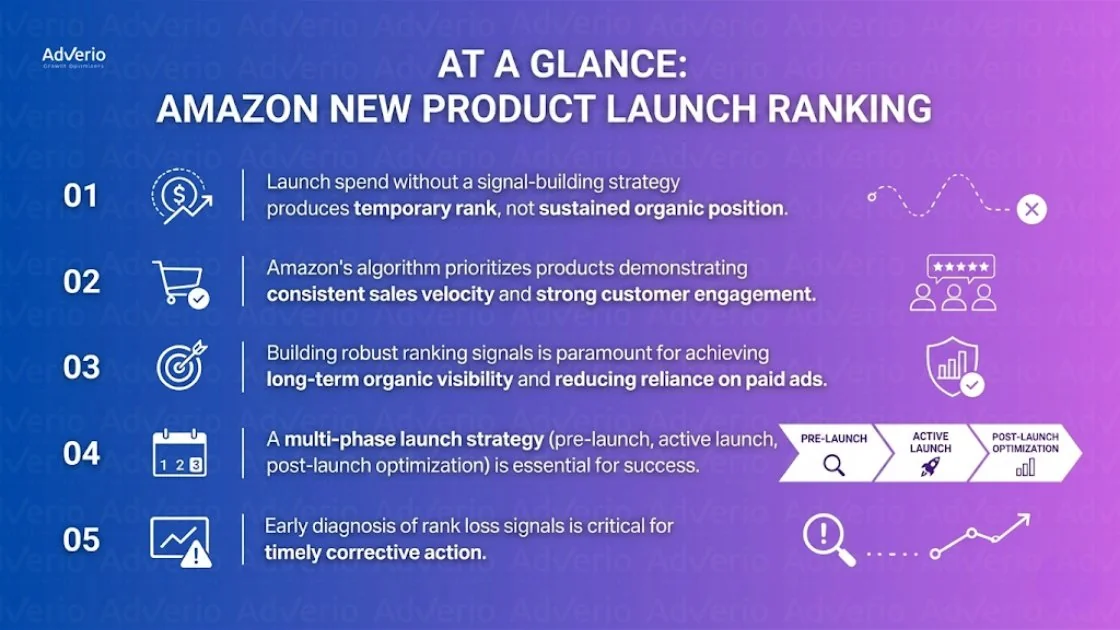
At a Glance
-
Launch spend without signal-building creates temporary rank. Once budget normalizes, weak listings slide.
-
Four signals matter most for sustained position. Search query coverage and click-through rate, conversion rate, review velocity, and steady sales consistency.
-
Pre-launch is where most brands lose money. If the listing is weak before traffic starts, the algorithm gets trained on poor conversion data.
-
Post-launch failure usually starts during launch. If you never built durable organic signals, rank drops are predictable.
-
Amazon new product launch ranking should be treated like a system. Not a promotion sprint.
-

Master amazon new product launch ranking: organic velocity 16
Why Most Product Launches Produce Temporary Rank
The standard Amazon launch playbook burns cash to manufacture momentum, then calls the drop in rank a post-launch problem. It is not a post-launch problem. It is a weak launch design.
A spend-heavy launch can force traffic, clicks, and orders for a few weeks. That does not mean the product earned its position. It means you paid for temporary visibility. Once discounts end, ad spend tightens, or aggressive bidding stops, Amazon re-sorts the results around listings that keep winning shopper behavior without subsidy.
That is why the discount-first model keeps disappointing operators. Momentum Commerce’s analysis of smaller-brand Amazon launches found that search visibility and strong ratings mattered more than discounting, and recommended brands avoid leaning on discounts and capture demand on high-volume, relevant keywords. The implication is clear. Rank sticks when your listing keeps generating strong shopper signals after the launch push fades.
A mistake is treating launch spend as the engine. It is only an accelerator. If the listing does not earn clicks, convert cleanly, pick up reviews at a healthy pace, and hold sales with some consistency, the launch teaches Amazon that demand was rented.
That is also why rising ad costs can hide a weak organic position. A product can show stable ad efficiency while organic rank gets softer underneath. Operators who are understanding rising TACoS with stable ROAS usually find the same root issue: paid traffic is propping up a listing that never built durable organic signals.
For a broader conversion lens beyond Amazon, review these expert insights for ecommerce growth. The principle carries over. More traffic does not fix weak conversion. It scales the weakness.
| Launch model | What happens during launch | What happens after spend normalizes |
|---|---|---|
| Spend-first launch | Traffic is pushed before the listing proves shopper demand | Rank fades because the underlying signals were never strong |
| Signal-first launch | Traffic is used to strengthen real shopper response | Rank has a better chance of holding because the listing earned its position |
The Four Ranking Signals Amazon Uses to Sustain Organic Position
Temporary rank comes from spend. Durable rank comes from signal strength.
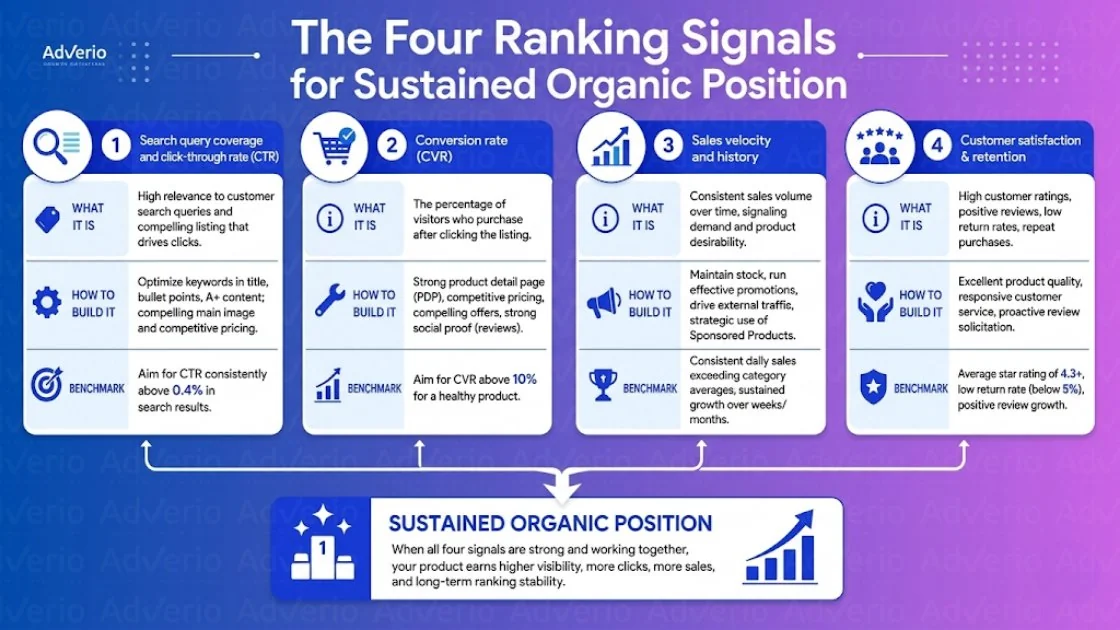
Amazon keeps organic position when a listing keeps sending the same message after the launch push ends. Shoppers click. Shoppers buy. Reviews accumulate. Sales stay steady. If one of those breaks, rank gets expensive to defend.
Signal 1: Search Query Coverage and Click-Through Rate
CTR starts before the click. Amazon has to index your listing for the right queries, then your result has to win attention against the products around it.
That puts pressure on four inputs first. Main image, title, price, and review profile. If impressions are there and clicks are weak, relevance is not your only problem. Merchandising is.
Start with the search result, not the detail page. Tighten the hero image. Put the primary term early in the title. Make the price and pack architecture easy to understand. If your click share is soft, fix that before increasing traffic. This guide on improving Amazon click-through rate covers the mechanics.
Signal 2: Conversion Rate Against Shopper Expectations
A launch can survive average CTR for a while. It cannot survive weak conversion.
If shoppers land and do not buy, Amazon gets a clear signal that the product did not satisfy intent. That is why conversion is one of the fastest ways to separate real demand from rented traffic. Gourmet Ads’ Amazon product launch strategies notes that new products should aim for roughly 10 to 15% conversion in the first month, and that early review accumulation also matters to launch performance. If you are below that range, stop blaming traffic volume. Fix the page.
The first fixes are usually obvious. Improve the image stack. Clarify the offer. Remove buyer hesitation in bullets and A plus content. Make sure the variation setup, coupon strategy, and review count do not create doubt. If you want a broader merchandising lens, these expert insights for ecommerce growth are worth reviewing.
| Signal | What weak performance usually means | What to fix first |
|---|---|---|
| CTR | Shoppers do not see enough reason to click | Main image, title, price |
| CVR | Shoppers do not see enough reason to buy | Content, offer, proof, objections |
Signal 3: Review velocity in the first 90 days
Reviews affect conversion fast, which means they affect rank fast.
A new listing with thin social proof struggles to hold organic gains because shoppers hesitate at the moment Amazon needs buying confidence. The answer is not aggressive review chasing. The answer is compliant review generation from day one through Vine, request-a-review workflows, and clean post-purchase operations.
Watch the pace, not just the total. Slow review growth usually shows up as lower conversion before it shows up as rank loss. By the time ads start carrying more of the load, the listing is already weaker than it looks.
Signal 4: Sales velocity consistency
Amazon trusts products that sell predictably.
That trust disappears when sales come in spikes, inventory goes out of stock, or demand gets concentrated into short bursts of discounted traffic. A listing does not need perfect daily volume. It needs enough consistency for Amazon to believe demand is real and repeatable.
Inventory control sits at the center of this signal. Stockouts reset momentum, break conversion patterns, and make rank harder to recover. If your replenishment process is loose, fix it before scaling harder. Here is how to stay in stock on Amazon.
This is the framework that matters during a launch. Build stronger CTR, stronger CVR, faster review accumulation, and steadier sales consistency. Ads can accelerate those signals. Ads cannot replace them.
See where your launch signals are leaking. Get Your Profit ROI Forecast.
The Launch Ranking Framework
Stop treating launch ranking like a budget contest. Brands that buy a short spike in position without improving click-through rate, conversion rate, review velocity, and sales consistency usually watch rank fade as soon as spend pulls back.
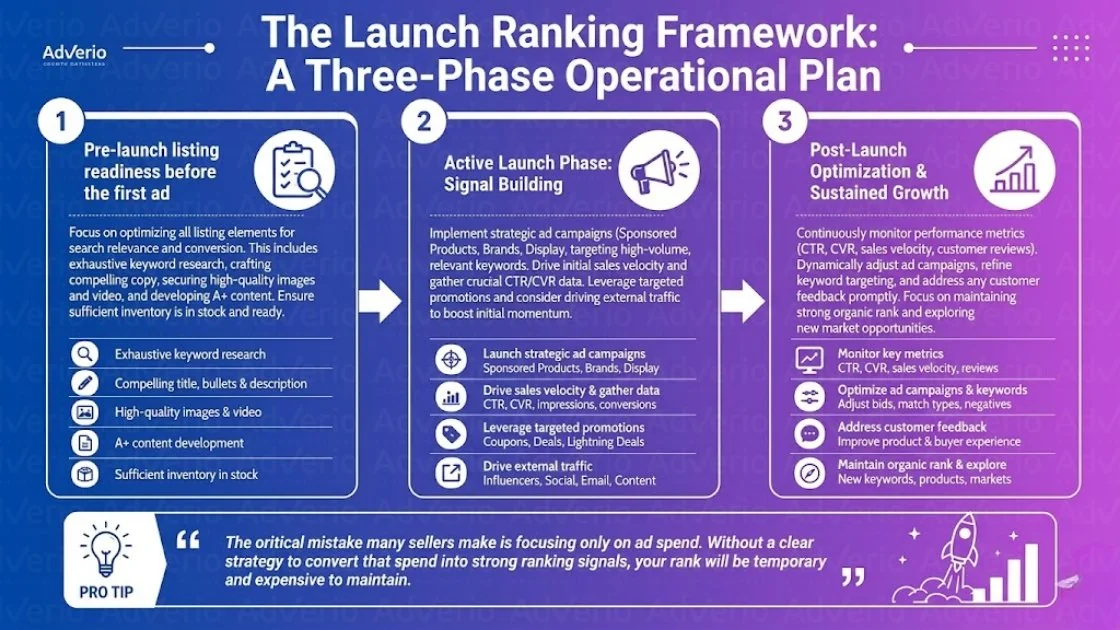
Pre-launch listing readiness before the first ad
The launch starts before traffic.
Set up a three-tier keyword map. Separate primary ranking terms, secondary relevance terms, and discovery terms. Then confirm indexing on the primary set before you push paid traffic. Brands that skip this waste money sending shoppers to a listing Amazon still does not confidently match to the target query.
Your pre-launch checklist should look like this:
-
Detail page quality is complete: The hero image, title, offer, and objection handling need to be finished before launch day, not fixed after bad data shows up.
-
Review systems are live: Enroll in Vine if eligible and turn on request-a-review workflows before the first orders land.
-
Inventory is protected: Launching with weak replenishment turns early momentum into a stockout problem.
-
Primary keywords are indexed: If the listing is not indexed for target terms, paid traffic cannot build durable rank.
| Pre-launch deliverable | What you measure |
|---|---|
| Indexed keyword set | Top terms show as indexed |
| PDP readiness | Listing content is complete and objection handling is clear |
| Review plan | Vine and review-request process are active |
| Inventory buffer | Sufficient stock is available to avoid interruption |
Check Brand Analytics before you scale. If your listing is converting below the category standard, fix the page and the offer first. Launch spend should validate relevance and conversion. It should not subsidize a weak product page.
Launch window building all four signals simultaneously
The job during the launch window is simple. Build signal density on a narrow set of terms that matter.
Start with Sponsored Products and stay tight. Put the budget behind a small group of primary keywords, then run discovery in parallel to find adjacent terms worth earning later. Broad reach feels productive, but it usually dilutes data and inflates spend before the listing has proved it can win.
Disciplined campaign structure matters at this stage. Your ad setup determines whether traffic sharpens Amazon’s confidence or just produces expensive noise.
This is where Amazon PPC management built for incrementality separates signal-building spend from budget you’re lighting on fire.
Watch the signal stack every day:
-
CTR: Low click-through rate points to weak images, weak titles, bad pricing, or keyword mismatch.
-
CVR: Traffic without orders means the offer or page is losing the sale.
-
Review velocity: Social proof needs to keep rising during the launch window, not stall after the first push.
-
Sales consistency: Daily order flow should stay stable enough for Amazon to trust demand.
Do not try to force rank on ten keywords at once. Win a few. Build conversion history. Expand only after those terms hold with less paid support.
Post-launch sustaining rank after the spend normalizes
This phase exposes whether the launch built real organic strength or rented placement.
Pull the search term report and cut hard. Keep the terms that convert. Reduce bids or pause terms that generate clicks without sales. Tighten winners into exact campaigns and measure what remains after spend softens. If rank disappears immediately, the launch was ad-supported, not signal-supported.
Post-launch work should include:
-
Term consolidation: Move proven search terms into tighter exact campaigns.
-
Conversion triage: Fix weak sessions-to-orders performance before sending more traffic.
-
Review follow-through: Keep review generation active so social proof keeps lifting conversion after the launch window.
-
Inventory discipline: Protect in-stock rates so demand patterns stay intact.
Use Adverio’s insights on Amazon rankings when you need to separate a relevance problem from a conversion problem. That distinction decides whether you should change targeting, fix the listing, or slow spend until the economics make sense.
How to Diagnose a Launch That Is Losing Rank
A launch loses rank for one reason. The organic signals stopped strengthening after the initial push.
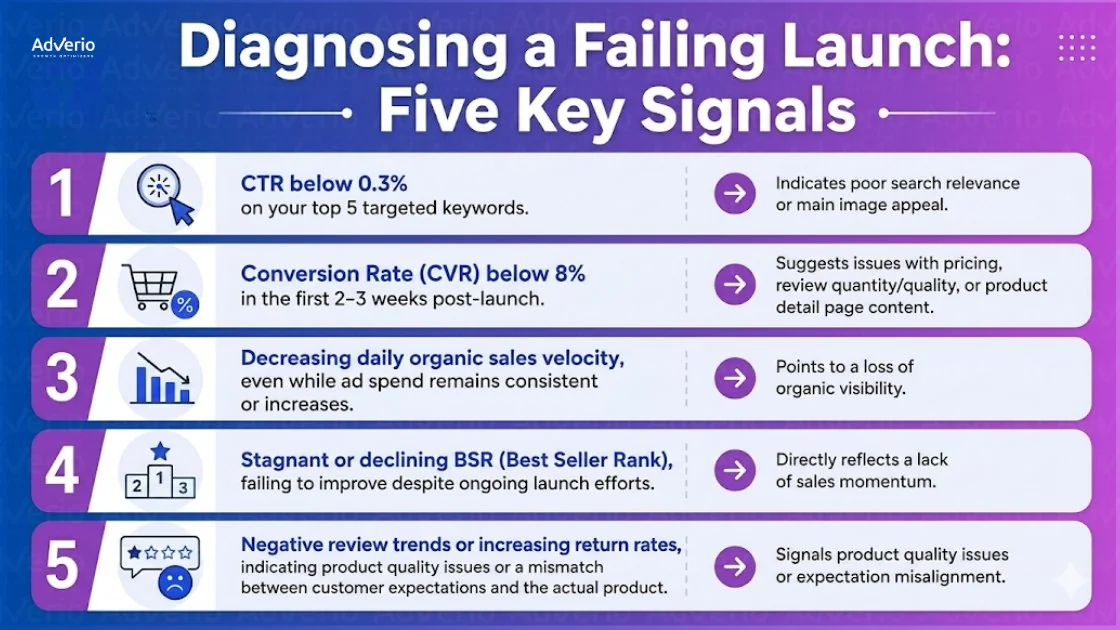
Do not treat a rank drop like a bidding problem. Diagnose it like a signal failure. Start with the term level, not the account level. Your job is to find which of the four sustaining signals broke first, then fix that point of failure before you spend another dollar.
Check these five areas:
-
CTR is weak on primary terms: The product is showing, but shoppers are not choosing it. Fix the main image, title clarity, price presentation, coupon visibility, or keyword targeting if the traffic is mismatched.
-
Conversion is soft after the click: Sessions are coming in, but orders are not. That usually means the offer is weak, the listing does not answer objections, or the traffic is broader than the product can convert.
-
Review velocity has slowed: A launch can survive thin review volume for a short window. It does not hold rank for long if social proof stalls while competitors keep adding fresh reviews.
-
Price has drifted out of position: If your price climbs without a clear value advantage, conversion drops fast. Amazon reads that drop as weaker demand.
-
Inventory or fulfillment has broken consistency: Stockouts, delayed delivery promises, and suppressed buy box coverage interrupt sales patterns. Rank loss follows.
Look at the sequence. If CTR is down first, fix click appeal. If CTR holds but conversion falls, fix the offer and listing. If both are stable but rank still slides, check review velocity and sales consistency. That is the difference between a launch that built real demand and one that rented visibility with ad spend.
If you need to separate a relevance issue from a conversion issue, separate the relevance break from the conversion break first. That diagnosis tells you whether to change targeting, rebuild the listing, adjust pricing, or address an operational break.
Weak rank is usually a signal problem. Ads just expose it faster.
How Adverio Structures Product Launches
Adverio structures launch around signal control, not ad spend. The goal is simple: build enough click-through rate, conversion rate, review velocity, and sales consistency that rank keeps holding after launch support tapers off.
If you need a team to run a full Amazon account management system, launch execution should sit inside one operating system. That means the listing is ready before traffic scales, indexing is checked before keyword expansion starts, review generation is built into the post-purchase flow, inventory coverage is protected, and performance is monitored daily so weak signals get fixed before rank slips.
That approach protects the margin.
A launch that depends on heavy spend without signal strength usually produces rented visibility. A launch built around signal quality has a better chance of turning paid momentum into organic position that lasts.
Frequently Asked Questions
How long does sustainable rank take on a new launch?
A stable launch usually takes shape over the first few months, not the first few days. The point isn’t a dramatic spike. The point is building rank that still holds after paid support is reduced.
Should I use discounts to force early ranking?
Use pricing strategically, not as the whole launch strategy. The stronger pattern from PMG was search visibility and star ratings, not discount dependency. Discounts can help conversion, but they won’t rescue weak relevance.
How many reviews should a new product target early?
Launch benchmarks suggest the first 10 reviews should ideally arrive within 30 days, with roughly 25 to 50 reviews pursued within 60 to 90 days in moderately competitive categories, based on earlier cited launch guidance.
What if traffic is rising but sales are flat?
Stop scaling traffic. Fix the listing. Images, offer quality, content depth, and social proof are usually the first places to look.
Does this framework work for premium products?
Yes. The mechanics stay the same. Premium products still need relevance, trust, and consistency. The difference is that your listing has to work harder to justify the price.
Read Next
If your launch playbook still depends on spending hard to force rank, fix the system, not the budget. The stronger model is signal-first: earn the click, convert the visit, build review momentum, and keep sales steady enough that rank holds when ad pressure drops.
As noted earlier, the supporting pieces matter. PPC structure, listing quality, and review generation all affect whether launch traffic turns into durable organic position or disappears the moment spend slows. Teams building content systems around search demand can also review this overview of an AI SEO agent.
Ad spend creates movement. Signal quality decides whether that movement sticks.
If you want a launch model built around profit, conversion quality, and search visibility that lasts, talk to Adverio.
Run an Adverio Profit ROI Forecast and get a sharper launch plan before your next SKU goes live.