


Table of Contents
Amazon doesn’t wait for your cash cycle to make sense. It takes fees, holds reserves, and pays on its own schedule while you fund inventory and ads in real time. That’s why Amazon cash flow management is not a bookkeeping issue. It’s an operating discipline issue that decides whether a 7 or 8 figure brand scales cleanly or stalls.
If your sales are rising and your bank balance still feels tight, nothing is broken. Your model is. The fix is to manage the float before it manages you.
Get My Profit ROI Forecast
15-minute diagnostic call. No pitch deck.
At a Glance Your Amazon Cash Flow Reality
Your brand can post healthy top-line numbers and still get squeezed by Amazon’s payout mechanics. That tension is built into the model. If your team is still planning inventory and ad spend off the current bank balance, you’re already behind.
For operators tightening controls across channels, clean marketplace accounting that separates settlement timing from revenue recognition is the starting point. Without it, marketplace complexity turns into decision-making noise.
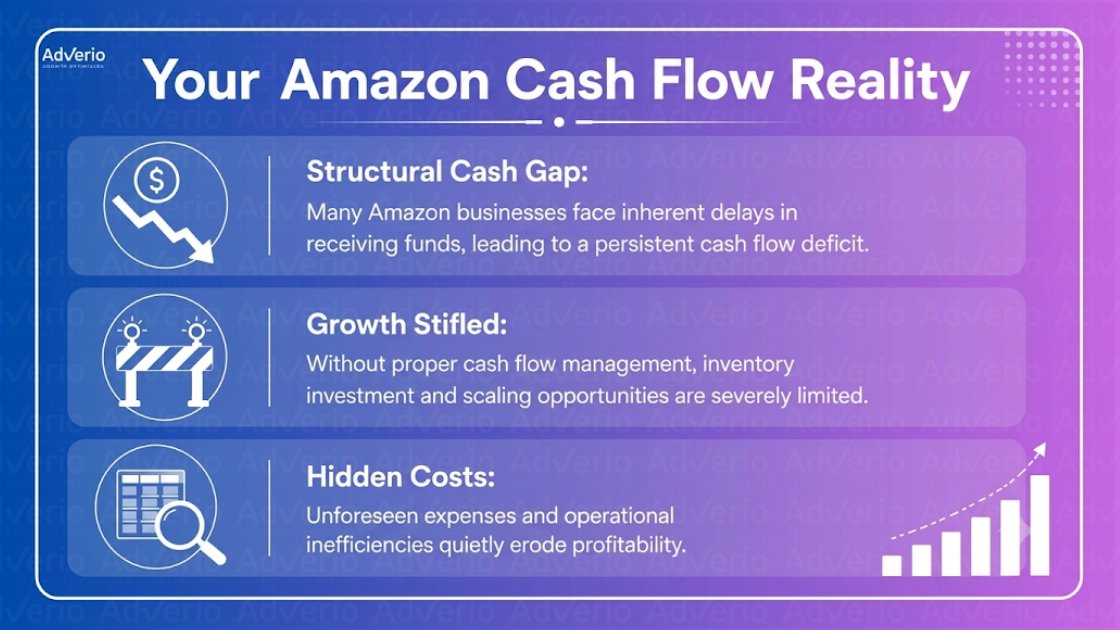
- The float is structural: Amazon’s settlement rhythm creates a built-in gap between daily spend and delayed cash receipt. For a $10M brand, that float is often $300K to $800K.
- Growth can make cash tighter: More sales often mean more inventory purchases, more ad spend, and more cash tied up before settlement lands.
- This is an operations problem: Strong finance leadership matters, but the day-to-day fix lives in inventory timing, fee visibility, reserve tracking, and disciplined planning.
- Your forecast matters more than your balance: Inventory buys should be planned against expected settlements, not the cash sitting in your account today.
- Fee blindness kills margin: If you don’t have a clear handle on deductions, reserves, and unit economics, start with Adverio on FBA fee analysis.
How Amazon’s Settlement Cycle Creates a Structural Cash Flow Gap
Amazon forces you to fund the business before it lets you collect the cash. That is the float. You spend every day on ads, inventory, freight, payroll, and software, while Amazon releases funds on a delayed cycle and can hold back more through reserves, disputes, and deferred transactions.
For a scaling brand, this is not an accounting inconvenience. It is an operating discipline test. Brands that fail it start reading growth as cash strength, then overcommit on inventory or ad spend, and get punished two weeks later when the settlement lands lighter than expected.
The settlement delay is only the first layer. Amazon can keep part of your balance in reserve to cover refunds, chargebacks, A-to-z claims, and other expected liabilities. Deferred transactions add another layer of distortion because booked sales and usable cash stop matching on the same timeline.
That is why finance teams get blindsided. Seller Central shows activity. The P&L shows revenue. The bank account shows less money than either report suggests. If your team still has to manually reconcile settlement reports, reserve changes, and deferred transaction timing, fix that process. Review Adverio’s Amazon reconciliation tips.
Visibility is the difference between control and panic.
The pattern is not unique to Amazon. Mike Danford, Co-owner and Chief Strategy Officer at Adverio, told Moneywise that on a marketplace, “you don’t get paid when the buyer pays. You get paid when the platform decides its risk has cleared enough to send the seller the money.”
Account risk makes the gap worse. If Amazon flags the account or imposes a hold, cash can stay trapped far longer than the normal settlement cycle. At that point, a healthy sales trend does nothing for liquidity. You still have to fund the operation while the cash sits inside Amazon.
| Cash flow pressure point | Why it hurts |
|---|---|
| Settlement delay | You pay operating costs before Amazon releases the related cash |
| Rolling reserve | Part of your balance stays unavailable even after sales are recorded |
| Deferred transactions | Reported sales and collectible cash land on different timelines |
| Fast growth | Inventory and ad spend rise before settlements catch up |
| Account holds | Cash can remain frozen while fixed costs keep hitting your bank account |
The mistake is treating this gap like bad luck. It is a system you have to model, monitor, and control. The brands that win on Amazon do not wait for settlements and hope. They plan around the float with precision.
The Float Calculation How Much Cash You Need to Fund Your Amazon Business
Amazon float is not a mystery. It is a math problem. If your team cannot calculate the cash gap between daily outflows and bi-weekly settlements, you are operating on hope, and hope is expensive.
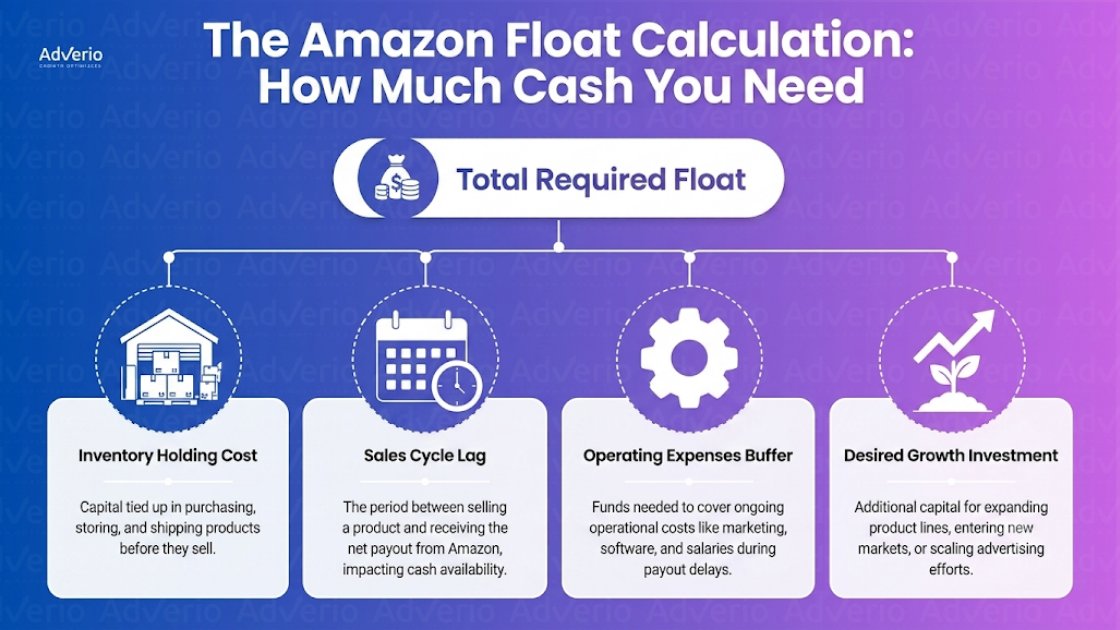
Start with one rule. Your business needs enough cash to fund the full operating gap before Amazon pays you. Strong operators track Cash Conversion Cycle closely and maintain a cash buffer covering at least 30 days of operating outflows instead of running the account at the edge.. They also review SKU contribution on a rolling basis, because any product with a negative contribution margin is not just a margin issue. It is a cash leak.
Inventory float
Inventory usually drives the largest gap.
You pay deposits, production invoices, freight, duties, prep, and inbound shipping before that inventory is available for sale. Then you wait again while units sell through and Amazon releases the related cash. Slow-moving inventory stretches the gap even further and traps capital in the least productive place possible.
Model inventory float as the number of days from supplier payment to settlement receipt on those units. Then attack it operationally. Better reorder points, tighter forecasting, and cleaner replenishment discipline reduce the float faster than financial gymnastics. If your team needs to tighten that process, start with how to stay in stock on Amazon.
Advertising float
Ad spend hits now. Settlement cash lands later.
That timing mismatch is why growth can starve a brand. A team can celebrate higher sales while the bank balance gets weaker every week. If spend is rising faster than available float capacity, your ad program is creating strain, not strength.
Set ad budgets based on cash timing, not revenue targets. Finance and media teams should review spend pacing against expected settlements every week. Anything less is sloppy management.
FBA fee float
FBA fees are easy to underestimate because they are deducted before cash hits your bank. The money never leaves the account directly, so weak operators treat it like an accounting detail. It is not. It reduces the exact cash you planned to use for payroll, inventory, and media.
The fix is disciplined SKU review. Products with weak contribution margin consume settlement cash even when sales look healthy.
If one ASIN grows fast with poor economics, it can pressure the entire account. Clean Amazon catalog management keeps SKU-level economics visible before they drain settlement cash.
Reserve float
Reserve balances deserve a permanent place in your model. Treating them as temporary noise is amateur finance.
Amazon withholds cash for refunds, claims, and account risk. That balance may appear in reports, but it is not spendable. Your forecast should assume a standing haircut to usable cash until Amazon proves otherwise.
| Float component | What to model |
|---|---|
| Inventory float | Days from supplier payment to Amazon settlement |
| Advertising float | Daily ad spend funded before payout receipt |
| FBA fee float | Cash lost to platform deductions before disbursement |
| Reserve float | Ongoing settlement cash held back and unavailable |
Use this table to build a simple float formula: average daily cash outflows multiplied by the days each component stays unrecovered. That number is your minimum operating float. Add buffer on top of it. Brands that skip the buffer are volunteering for stockouts, ad pullbacks, and bad financing decisions.
The Cash Flow Management Framework for 7-Figure Brands
Seven-figure Amazon brands do not have a cash flow problem. They have an operating discipline problem. The Amazon float is predictable. If your team keeps getting squeezed between daily spend and bi-weekly settlements, the model is broken.
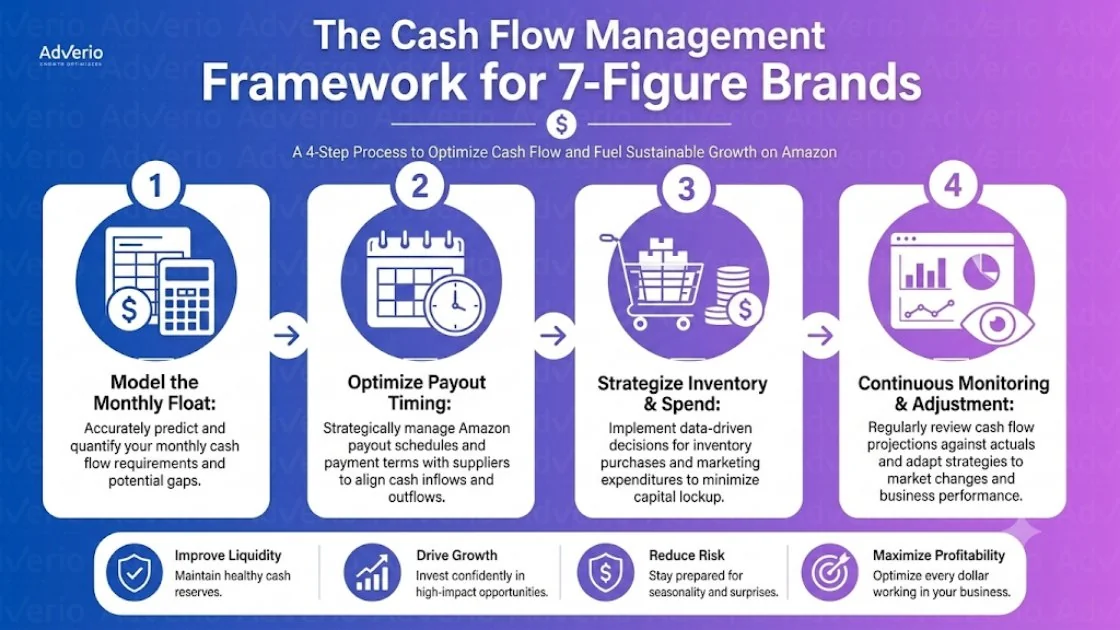
A 13-Week Rolling Cash Forecast is the benchmark for FBA cash flow management. A 13-week rolling forecast is the discipline that separates operators from gamblers. For a brand at $500K per month with 35% COGS, you are carrying $350K to $525K in inventory capital just to keep the machine running. That capital has to be planned, not assumed.
Step 1 Build a 13-week cash model around settlements, not revenue
Use weeks, not months. Revenue can flatter you while cash is already deteriorating.
Your forecast should map purchase orders, deposit dates, expected ship dates, FBA check-in timing, ad spend by week, reserve assumptions, reimbursement lag, and settlement receipts. Then force every major decision through that model. If an inventory buy, promo, or ad ramp creates a settlement gap you cannot fund, do not approve it.
This is how serious operators treat the Amazon float. They measure it, fund it, and control it.
Step 2 Match inventory commitments to payout timing
Inventory buys should follow cash availability, not optimism. The right question is not, “Can we afford this order today?” The right question is, “What settlements will fund this order over the next 30 to 45 days?”
That shift matters because your current bank balance is stale. It often reflects prior sell-through, not the cash reality of the next cycle. Teams that ignore this over-order on momentum, then cut ads or delay reorders a few weeks later because the float snapped shut.
Push suppliers for terms. Split deposits when possible. Move inbound decisions earlier if receiving delays are stretching the recovery window. Brands that grow Amazon brands profitably do not rely on heroic sales velocity to bail out poor purchasing discipline.
Step 3 Cap ad spend by cash recovery speed
Advertising is the fastest way to turn a manageable float into a crisis. Spend leaves daily. Amazon settles later. If contribution margin or sell-through slows, the cash gap widens immediately.
Set ad ceilings based on funded float capacity by category or ASIN group. Do not let media teams spend against top-line targets alone. A campaign can hit growth goals and still damage the business if it absorbs cash faster than inventory and settlements return it.
Tie ad approvals to three numbers. Expected payback window, post-fee contribution margin, and the effect on the next two settlement cycles.
Step 4 Put liquidity in place before you need it
Calm capital is cheap capital. Panic capital is expensive and usually arrives late.
Keep a reserve line or working capital facility available before the pressure hits. That line is not a substitute for margin discipline. It is protection against timing mismatches, reserve swings, delayed check-ins, and inventory opportunities that deserve a fast yes.
The brands that break at scale are rarely the brands with weak demand. They are the brands that let a controllable settlement gap dictate strategy. That is avoidable. Fix the operating model.
See the float modeled on your own numbers. Get My Profit ROI Forecast and stop planning off a stale bank balance.
Cash Flow Red Flags to Watch Weekly
Brands rarely fail because one huge thing broke. They fail because small cash warnings were ignored until options got expensive.
Use this weekly checklist. If two or more signals are flashing, fix the operating model fast. For a broader scorecard, keep this guide on Amazon profit drivers close to your reporting cadence.
| Metric | Threshold / Signal |
|---|---|
| Settlement disbursement | Declines for two consecutive cycles without a matching revenue decline |
| Inventory buys | Exceed the trailing four-week average settlement by more than 30% |
| Ad spend | Exceeds the trailing four-week settlement average by more than 40% |
| Reserve ratio | Reserve percentage of disbursement sits above 25% for two consecutive cycles |
| Float burden | Float exceeds 60 days of operating cost |
If your team needs more than a few minutes to answer what changed in reserve, old inventory, or losing SKUs, the data layer is the problem.
Financing Options for Amazon Cash Flow Gaps
Capital is a tool, not a rescue plan. Strong Amazon operators line up funding before the settlement gap turns into late POs, throttled ad spend, or stockouts.
Choose financing based on the job it needs to do.
| Option | Best fit | Limitation |
|---|---|---|
| Amazon Lending | Fast access if Amazon already offers it and your marketplace history is strong | Amazon decides availability, terms, and timing |
| Revenue-based financing | Useful if repayments track marketplace deposits | Total cost can get ugly, and cash gets tighter as deductions hit settlements |
| Traditional revolving credit | Better for recurring inventory and operating needs across multiple cycles | Underwriting takes longer and lenders want clean financials |
The smartest move often sits outside lender conversations. Fix payable timing first. Amazon itself benefits from negative working capital, collecting cash before many bills come due. Sellers can apply the same operating logic by negotiating 60 to 90 day supplier terms so vendor payables absorb part of the settlement delay.
That does not mean stretching every supplier blindly. It means matching payment terms to inventory turn, margin, and reorder cadence. If a SKU turns slowly, long terms will not save you. If a SKU turns fast and contributes margin, extended terms can reduce outside borrowing and lower financing cost.
Use debt for temporary timing gaps. Use supplier terms for structural float. Use both if the economics justify it.
If you’re evaluating bank debt, start with underwriting reality instead of marketing promises. Reviewing SBA 7(a) qualification criteria before approaching lenders gives a practical baseline so you can screen lenders quickly and avoid wasting weeks on a facility your brand will not qualify for.
How Adverio Models Cash Flow for Clients
Seven and eight figure brands do not fail because Amazon is unfair. They fail because nobody built a usable model for the float.
Adverio models cash flow at the operating level, where the problem lives. The view combines marketplace sales, ad spend, fees, inventory timing, and settlement behavior so leadership can see the cash gap before it turns into a scramble for working capital. That matters even more for brands selling across Amazon, Target, and Walmart, where each channel can distort the liquidity picture if reporting stays fragmented.
That single view sits inside our full Amazon account management system, where cash modeling becomes a standing operating number, not a monthly surprise.

The model is built to answer the questions operators should review every week. How much cash is tied up before the next Amazon disbursement. Which SKUs are creating a margin illusion but draining liquidity. How reserve changes, fee deductions, and ad spikes affect the next settlement, not just the monthly P&L.
That shift matters. Plenty of growth partners report ROAS and TACoS. Few connect those metrics to the actual funding burden created by Amazon’s two-week payout cycle. If your reporting stops at performance media, you are not managing cash flow. You are watching it happen.
For clients, the goal is simple. Turn the Amazon float from a recurring surprise into a planned operating number the business can fund, monitor, and reduce. That is how disciplined brands keep scaling while weaker operators keep blaming timing.
Frequently Asked Questions About Amazon Cash Flow
What is the biggest mistake brands make with Amazon cash flow management?
They plan spend off the current bank balance instead of the next settlement forecast. That makes old cash look like available cash. It isn’t. Your account balance reflects prior sales activity, not your real near-term liquidity.
How often should we update a cash forecast for Amazon?
Weekly. A rolling forecast is the right discipline because Amazon disbursements, reserve changes, fee deductions, and ad spend shifts can change quickly. If your team updates this monthly, you’re reacting too slowly.
Should inventory and operating cash sit in the same account?
No. Separate them. Inventory cash behaves differently from recurring operating expenses like software, shipping, storage, and payroll. Mixing them makes your true cash position harder to read and easier to mismanage.
How do I know whether a SKU is creating a cash problem?
Track contribution margin by SKU on a rolling basis. If a SKU flips negative, it burns cash every time it sells. Catch that within a week, not at month-end. Waiting turns a manageable issue into repeated damage.
Why don’t Seller Central reports match the P&L cleanly?
Because settlement timing, reserves, deferred transactions, refunds, and fee deductions don’t line up neatly with accounting periods. If your team is trying to reconcile marketplace activity with finance reporting, this breakdown on why your Seller Central reports and P&L never match is worth reviewing.
Read Next
Amazon cash flow problems do not start with a weak payout. They start with weak operating discipline. The brands that win on Amazon treat the float as a managed number with owners, rules, and weekly review. The brands that stall keep blaming the settlement cycle while spending daily like cash is already in the bank.
If you want tighter control, read next on the areas that usually fail first:
- Marketplace profit analysis — reporting discipline across channels
- Amazon contribution margin by ASIN — SKU-level margin review
- Amazon FBA fee breakdown — post-fee unit economics
- Amazon deferred transactions reconciliation — transaction reconciliation
Revenue does not protect cash. A brand can grow fast and still create a funding trap when ad spend, inventory purchases, and Amazon disbursements are misaligned. That is the operating discipline failure this entire article is built to prevent. The Amazon float is not an unavoidable crisis. It is an operational discipline problem, and disciplined operators fix it.
Adverio works with established brands to sharpen profit control, reduce settlement gaps, and build the operating model the float demands.
If you are serious about fixing the spend-settlement gap, Book Your Profit ROI Forecast