


Table of Contents
Stop losing margin to unauthorized sellers and broken distribution. This guide shows how to detect, control, and eliminate MAP violations before they erode your Buy Box, pricing power, and reseller trust.
Amazon doesn’t care about your MAP. It cares about conversion. If a lower price wins the sale, that’s what gets surfaced. If you keep waiting for the platform to care about your price floor, you are funding the next reseller who undercuts you.
That is the hard truth behind the map violation Amazon problems. This is not a pricing glitch. It’s what happens when your Amazon pricing strategy breaks under reseller pressure. It is a distribution control failure with direct impact on margin, Buy Box ownership, reseller trust, and brand equity.
If your authorized sellers are already complaining, the damage is already happening.
Amazon MAP violations occur when sellers list your product below your Minimum Advertised Price policy. Amazon does not enforce MAP; that is your responsibility. Brands without a MAP enforcement system bleed margin quietly through unauthorized seller activity.
A MAP violation doesn’t stay in one line item. One seller undercutting by $10 drags the advertised price floor, erodes Buy Box control, suppresses conversion rate, and trains the channel that undercutting has no consequence. By the time most brands act, the damage has already moved downstream into ad efficiency and organic rank.
We audit your MAP exposure, identify unauthorized seller patterns, and model the downstream margin impact before recommending a single enforcement action. No pitch deck. No commitment.
Your MAP Policy Is Your Problem, Not Amazon’s
MAP exists to protect the price your market sees. It helps you preserve margin, keep authorized partners aligned, and stop your product from looking like a commodity.
Amazon is built to reward price competition, not protect your margins.
Its marketplace structure does not recognize your MAP policy as something it should enforce. The platform is built around competitive pricing and Buy Box dynamics. Amazon’s own ecosystem makes below-MAP pricing easier, faster, and more visible than most brands want to admit.
What Amazon will and will not do
At a glance:
-
What MAP is: Your minimum advertised price policy for public pricing.
-
What Amazon will do: Let multiple sellers compete under one ASIN and reward strong offers on price and fulfillment.
-
What Amazon will not do: Enforce your MAP just because you have one.
-
Who enforces MAP: You do, through monitoring, seller communication, distributor governance, and escalation.
If you sell through both first-party and third-party channels, your operating model matters. The mechanics differ, which is why brands need to understand the Amazon 1P vs 3P selling model before they try to fix pricing breakdowns.
MAP enforcement is a governance issue
Most brands treat MAP like paperwork. That’s why it fails. That is too narrow.
A real MAP program is an enforcement system, not a document. It controls who gets the product, who keeps authorization, how fast violations are caught, and what happens after a seller breaks the rules. If your team only reacts when a retailer emails a screenshot, you do not have a system. You have a delay.
Key takeaway: MAP violations on Amazon rarely start on Amazon. They start upstream in distribution, then show up on Amazon where the damage becomes visible.
That is why brands that win this battle stop arguing with the symptom. They fix the supply path, identify unauthorized sellers quickly, and document every violation with enough evidence to act.
Waiting doesn’t just cost margin. It trains your entire channel to ignore your rules. It trains your resellers to stop trusting your enforcement. It teaches the market that your premium product is negotiable. And it tells rogue sellers your line is easy to exploit.
Why Amazon Will Never Enforce Your MAP Policy

Amazon is not confused about your MAP policy. It is uninterested in it.
That distinction matters. Most brands still think Brand Registry or support tickets will fix this. They won’t.
The platform is built to reward lower visible prices
Amazon’s structure complicates MAP enforcement because it does not recognize or enforce brand MAP policies. Sellers undercut in real time to capture the Featured Offer, which can drive up to 90% of sales via the Buy Box, according to Gray Falkon’s analysis of Amazon MAP enforcement and pricing reality.
That one fact explains a lot. If the reward for dropping price is control of most sales on the listing, sellers have a clear incentive to ignore your policy.
Brand Registry is not MAP enforcement
Brand Registry helps you control listings—not pricing. It does not turn Amazon into your pricing police. Brands that misunderstand this waste time filing the wrong reports and then wonder why nothing changes.
If your team still treats registration as a pricing shield, fix that gap first. These Amazon Brand Registry benefits matter, but direct MAP enforcement is not one of them.
Amazon also avoids acting like a brand regulator
There is another reason Amazon stays hands-off. MAP is your commercial policy with your sellers and distributors. Amazon operates the marketplace. It does not want to be the referee for every manufacturer’s pricing rules.
So when a seller goes below MAP, Amazon usually sees a lower market price, not a policy breach. Unless you can tie the issue to something Amazon governs, such as authenticity, listing misrepresentation, or another platform rule, you are on your own.
Customer price perception beats brand price discipline
Amazon optimizes for conversion. Low visible prices convert. That is the commercial logic that sits under nearly every frustrating MAP violation thread, escalation, and dead-end support case.
Hard truth: If your enforcement plan depends on Amazon agreeing with your pricing strategy, you do not have an enforcement plan.
Brands that control MAP stop expecting platform sympathy. They build monitoring, evidence collection, reseller governance, and escalation outside Amazon, then use Amazon tools only where they overlap with platform policies.
The 4 Real Sources of MAP Violations
Most MAP problems come from the same four failures. If you do not identify which one you have, your team will chase screenshots while the underlying problem persists.

Distributor oversupply and gray market inventory
This is where most brands lose control.
You give too much product to a distributor. That distributor unloads excess inventory. Product moves into side channels, brokers, liquidators, or cross-border paths. Soon an unfamiliar seller appears on your ASIN with enough stock to move the market.
This is not an Amazon problem first. It is a channel discipline problem first.
Watch for these signals:
-
Seller churn: New storefronts appear, disappear, then reappear under similar patterns.
-
Unexplained inventory depth: Small sellers somehow hold enough stock to sustain aggressive pricing.
-
Regional weirdness: Inventory appears to originate outside the market you intended.
If this is your issue, pricing notices alone will not solve it. You need distributor accountability, tighter allocation, and cleaner authorization rules.
Amazon Retail itself
A lot of guides ignore this because it is uncomfortable. They shouldn’t.
Amazon can be one of the hardest MAP violators to deal with because it can source product through wholesale relationships and price according to its own retail logic. When Amazon Retail drops price, compliant sellers get squeezed instantly.
This creates a brutal dynamic. Your authorized reseller follows policy, loses price competitiveness, then loses sales. Your unauthorized reseller follows the slide. The floor breaks.
Tip: When Amazon Retail is on the listing, separate “seller violation” from “supply path failure.” Amazon usually got product from somewhere.
Unauthorized resellers from wholesale channels
Many brands obsess over price and ignore seller identity. That is backwards.
Unauthorized sellers are often the primary source of price erosion. They also introduce listing risk—bad reviews, hijacked content, and trust breakdowns—which is where Amazon review removal becomes critical to protect brand perception and conversion. They buy from loose wholesale channels, diverted stock, closeouts, or unauthorized intermediaries. Once they list under your ASIN, they do not care about your reseller relationships or your positioning.
Product differentiation can help defensively. A smarter SKU differentiation strategy can reduce direct comparability and make unauthorized matching harder, especially in multi-variant catalogs.
Automated repricing tools
One seller drops. Another seller’s repricer reacts. A third seller’s software follows. Soon the listing sits below MAP and nobody claims intent.
That is why brands should stop treating every violation like a bad actor story. Some sellers are absolutely rogue. Others are lazy. Others turned on repricing logic without MAP controls.
Intent doesn’t matter. If your price drops, your margin is gone. Intent does not restore margin.
The loopholes most brands miss
The obvious violation is a public price below MAP. The more dangerous ones are less visible.
Emerging MAP violation types like coupons, Subscribe & Save, and unauthorized bundles evade detection because policies and monitoring tools often overlook Amazon-specific loopholes. Recent 2026 data highlighted by 42Signals’ guide to detecting MAP violations on Amazon notes policy gaps around Amazon coupons, multi-packs below per-unit MAP, and Subscribe & Save discounts of 5-15%.
A simple spot check misses that.
Most brands don’t know which problem they actually have. Use this to diagnose it fast:
| Source of violation | What it looks like | What usually fixes it |
|---|---|---|
| Distributor leakage | Unknown sellers with real inventory | Tighten supply and authorization controls |
| Amazon Retail | 1P offer undercuts the floor | Trace source, fix wholesale exposure |
| Unauthorized resellers | Repeat sellers ignore policy notices | Seller identification and escalation |
| Repricers and loopholes | Price looks fine until coupons, bundles, or S&S change effective price | Better policy language and effective-price monitoring |
If your MAP language only covers shelf price and ignores bundles, coupons, and subscription discounts, your policy is incomplete for Amazon.
MAP (Minimum Advertised Price) is the lowest price a brand allows its authorized resellers to advertise. It is a brand-set commercial policy. Not a law. Not an Amazon rule. Amazon will not enforce it for you. That means monitoring violations and taking corrective action falls entirely on your team. Here is what happens when you ignore it: unauthorized sellers undercut your price, your Buy Box win rate drops, your brand equity erodes, and the problem gets exponentially harder to fix as your catalog grows. MAP is not a legal formality. It is margin infrastructure.
What MAP Violations Actually Cost You
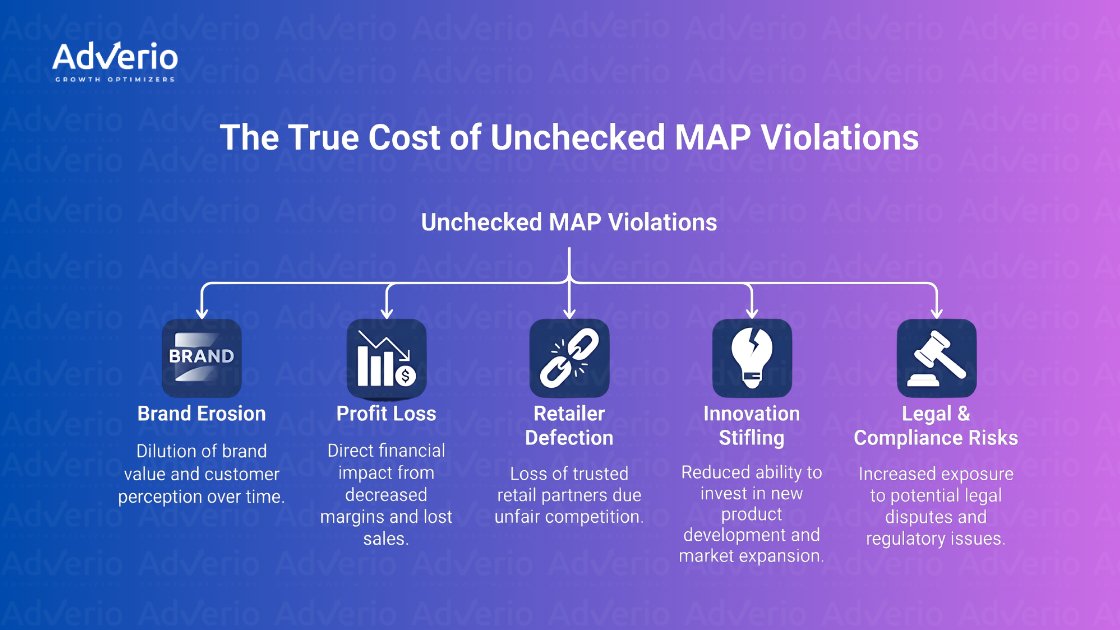
Most operators understate the damage because they look at the visible discount and stop there. The true loss is a cascade.
Buy Box erosion hits first
On Amazon, pricing pressure changes traffic ownership, not just margin per unit. Sellers often undercut in real time to capture the Featured Offer, and that Featured Offer can influence up to 90% of sales, based on Gray Falkon’s Amazon MAP enforcement analysis.
That means one below-MAP seller can affect who gets seen, who gets conversion, and who gets volume.
If you are already dealing with Buy Box instability, you should also diagnose the related causes behind a lost Buy Box on Amazon. MAP violations are often one of them, not the only one.
Your authorized resellers stop believing you
The second cost is channel trust.
Compliant partners notice when violators keep selling. They notice when Amazon Retail undercuts them. They notice when you send warnings but nothing changes. After enough of that, they do one of two things.
-
They match the lower price. Your policy unravels from inside the authorized network.
-
They walk. They stop prioritizing your line, reduce inventory commitment, or drop the relationship.
Both outcomes are expensive. One destroys pricing discipline. The other weakens the distribution.
The brand starts to look cheaper than it is
Premium positioning is fragile on Amazon.
A product that repeatedly appears discounted signals lower value, even when the product quality is unchanged. This is where strong Amazon listing optimization becomes critical to reinforce perceived value and conversion. That weakens conversion among shoppers who expect premium brands to hold price. It also creates confusion across channels when your DTC site, retail partners, and marketplace listings tell different pricing stories.
Your competitors do not need to beat your product if the marketplace teaches shoppers to doubt your value.
Margin collapse spreads beyond price
MAP breakdown rarely stays isolated.
You end up spending more to compensate for weaker organic control. Paid traffic gets less efficient when your listing economics are unstable. This is where Amazon PPC management tied to profitability — not just spend — becomes critical. Retail conflict consumes team time. Inventory planning becomes harder because seller mix changes unpredictably.
MAP governance is not a standalone task. It sits inside a broader Amazon account management operating model where seller control, distribution discipline, and catalog health are managed as one system.
There is also a spillover effect on branded search. If competitors are already pressing into your traffic, MAP violations make it easier for them to convert bargain-focused shoppers. This gets worse when you also have competitors bidding on your brand name on Amazon.
Key takeaway: MAP violations are not a small pricing annoyance. They distort traffic, partner trust, positioning, and ad efficiency at the same time.
That’s why brands that treat MAP as a legal task never fix it. The actual issue is commercial control.
If MAP violations are already affecting your Buy Box and margins, Book Your ROI Forecast and see exactly where pricing breakdowns are costing you profit.
The Only MAP Enforcement Framework That Actually Works
A workable MAP system needs four things. Detection. Documentation. Communication. Escalation. Miss one, and the rest get weaker fast.

Detect violations in real time
Manual checks are too slow for Amazon. By the time someone notices a screenshot in Slack, the seller has already rotated price, won the Buy Box, or disappeared.
Brands that deploy real-time monitoring and a systematic enforcement process see a 52% drop in repeat violations within 90 days, and professional warnings to good-faith sellers resolve 70-80% of cases without escalation, according to Prowebscraper’s guide to tracking MAP violations on Amazon.
Your monitoring stack should capture:
-
Seller identity
-
ASIN and variant
-
Displayed price
-
Effective price after coupon or promo where visible
-
Timestamp
-
Screenshot evidence
-
URL and marketplace
-
Repeat offense history
If your team uses scraping-based monitoring, understand the legalities of website scraping before you scale the process. That matters when you are collecting marketplace evidence systematically.
Build an evidence locker
Do not send vague emails saying a seller was “seen below MAP.”
Build a file that can survive pushback. That means screenshots, dates, seller names, ASINs, variant details, and a clear record of the policy threshold in effect at the time. Save every touchpoint.
This matters for two reasons. First, some sellers correct the issue only when they see you have proof. Second, repeated violations need a documented trail if you plan to cut off supply, terminate an authorized relationship, or hand the matter to counsel.
Tip: Evidence should be boring and complete. Emotional emails do not enforce policy. Clean records do.
Use tiered communication
Not every seller needs the same first move.
A sensible sequence looks like this:
-
First notice for likely good-faith sellers
Professional. Direct. Specific. Identify the ASIN, the observed advertised price, the MAP, and the required corrective action. -
Second notice for repeat behavior
Reference prior contact. State the consequence window clearly. -
Escalation notice
Trigger contractual consequences, distributor review, inventory hold, or counsel involvement.
A lot of brands sabotage themselves here. They either go too soft and get ignored, or go nuclear on the first contact and make resolution harder than it needs to be.
Enforcement without a governed escalation path creates two failure modes: sellers who learn your notices have no teeth, and brand relationships damaged by disproportionate responses. The brands that resolve MAP violations fastest are the ones with a documented escalation sequence tied to contractual consequences, not a series of one-off emails.
That governance layer is part of what Brand Drain Reversal builds. And it starts with knowing exactly which sellers are the highest-priority enforcement targets.
We identify your highest-risk unauthorized sellers and build the enforcement sequence around them first.
Report the right issue to Amazon
Do not report “MAP violation” and expect traction. Tie your case to something Amazon governs.
That can include:
-
Unauthorized seller patterns tied to authenticity concerns
-
Listing misrepresentation
-
Brand Registry issues
-
Marketplace policy breaches that overlap with the seller’s conduct
MAP itself is your policy. Amazon is more likely to act when the conduct intersects with its own rules.
Escalate upstream, not just outward
Many enforcement programs fail at this point.
If the same unauthorized sellers keep coming back, your issue is not seller communication anymore. It is supply. A distributor is overselling, a wholesale account is leaking, or your own channel controls are weak.
Your escalation ladder should include:
-
Authorized seller review
-
Distributor source tracing
-
Inventory restrictions
-
Purchase suspension
-
Relationship termination where contracts support it
That approach is much closer to Amazon account management that protects margin and control than price policing. It also aligns with how serious marketplace operators protect your brand on Amazon when reseller abuse starts affecting margin and control.
Put governance on a weekly operating cadence
A framework only works if someone owns it.
Use a weekly review to answer:
| Question | What to check |
|---|---|
| Where are violations concentrated | Seller, distributor, ASIN, or marketplace |
| Which offenders matter most | Revenue impact, Buy Box loss, repeat pattern |
| Which notices need escalation | No response, repeat offense, obvious bad faith |
| What supply path needs correction | Distributor, 1P source, wholesale leakage |
If your team can’t answer those in minutes, you don’t have control—you have chaos.
Book Your ROI Forecast at https://www.adverio.io/roi if you want the margin impact modeled before another quarter gets dragged down by reseller leakage.
Adverios Approach to Brand Protection and MAP Governance
Most agencies treat MAP like a side task. It is not. It sits inside catalog control, seller governance, paid efficiency, and margin recovery.
That is why a brand protection system on Amazon has to connect pricing intelligence with enforcement, operations, and profitability. One option in the market is Adverio’s COSMO framework, which ties marketplace management to broader account control rather than isolating MAP as a standalone complaint workflow.
What a real operating model looks like
The useful shift is this. Stop thinking “How do we get this seller to raise price?” Start thinking “How do we stop this seller from being able to hurt the listing again?”
That is where processes like Brand Drain Reversal, unauthorized seller enforcement, fulfillment fee leak auditing, and advertising waste extraction fit together. When a bad seller drags price down, the damage does not stay in one line item. It affects traffic quality, conversion economics, and channel confidence.
A premium skincare brand, Luminary Skin, implemented automated MAP monitoring and enforcement and saw a 71% reduction in MAP violations within 60 days, while restoring its product’s advertised price from $122 back to the $150 MAP, according to 42Signals’ MAP monitoring case study. That outcome matters because it shows what happens when monitoring and enforcement become operational, not occasional.
Governance beats cleanup
Some brands also need support outside marketplace data. If product leakage may involve account compromise, unauthorized channels, or broader exposure, adjacent monitoring ecosystems can matter. For example, a structured reseller program around digital risk monitoring can complement marketplace enforcement when brand abuse extends beyond pricing.
The bigger point is simple. MAP governance works when you combine seller identification, supply-path discipline, evidence, escalation, and profit analysis in one operating rhythm. Anything less becomes inbox management.
Traffic quality drops when price signals are inconsistent. Conversion economics break when buyers see your product at three different price points across three different sellers. Channel confidence collapses when authorized retailers stop investing in a brand they can’t win on margin.
That chain runs fast at scale. The diagnostic maps where your account is in that sequence right now, before you launch an enforcement program that addresses the symptom but not the structure underneath it.
We model the downstream margin cost of your current MAP exposure before building the enforcement architecture.
MAP Violation FAQs for Amazon Brands
What should you do when Amazon Retail is the MAP violator
Treat it as a sourcing and wholesale control problem first.
A common struggle for brands is enforcing MAP against Amazon’s own retail pricing, which frequently undercuts MAP and captures sales from compliant third-party sellers without repercussions, as discussed in this Amazon seller forum discussion on Amazon Retail undercutting MAP. The practical move is to trace how Amazon got inventory, review your wholesale terms, and tighten distributor exposure.
How do you handle international sellers on the US marketplace
Start with evidence and seller mapping. Then work backward to source.
Cross-border inventory and anonymous storefront behavior make this harder, but the logic stays the same. Document the offer, identify repeat patterns, and pressure the upstream channel that made the inventory available.
Does Brand Registry solve map violation amazon problems
No. It helps with listing control and some abuse issues. It does not enforce your MAP for you.
Use it as one tool in a broader enforcement stack. Do not confuse access with protection.
Should you focus on violators or on your distributors
Both, but in order.
Address active violators fast so the listing stops bleeding. Then fix the distribution path that allowed them to appear. If you only do the first part, the next seller arrives and the cycle starts again.
MAP violations are a governance failure before they are an enforcement problem. The brands that stop violations from compounding aren’t the ones with the toughest cease-and-desist templates — they’re the ones with channel architecture tight enough that undercutting has nowhere to start.
If your current enforcement strategy is reactive, triggered by a price drop you noticed rather than a monitoring system that caught it early, the leak is already running.
Free diagnostic. We audit your MAP exposure, unauthorized seller footprint, and channel architecture gaps before the next violation compounds.