


Table of Contents
Your Amazon tariff strategy decides which SKUs survive the cost shock and which ones drain margin.
A tariff hits your next shipment. The catalog still shows revenue, ad spend is still running, and the P&L can look stable for a few weeks. Then the full damage shows up. Contribution margin slips, weak SKUs turn negative, and cash gets trapped in products that no longer deserve budget.
Treating that as a pricing task is a mistake. Strong operators handle tariffs as SKU portfolio management. They review landed cost, fee structure, price ceiling, ad efficiency, and reorder logic at the ASIN level, then make fast decisions to protect profit.
Speed matters.
A blanket price increase usually creates a second problem. It protects a few SKUs, weakens conversion on others, and hides the products you should cut, repackage, source differently, or stop promoting. The right response is a structured four-part framework that ranks each SKU by profit risk and assigns the correct action.
If your team needs a clear operating model for that work, Adverio runs margin control across pricing, media, and catalog decisions. Get My Profit ROI Forecast.
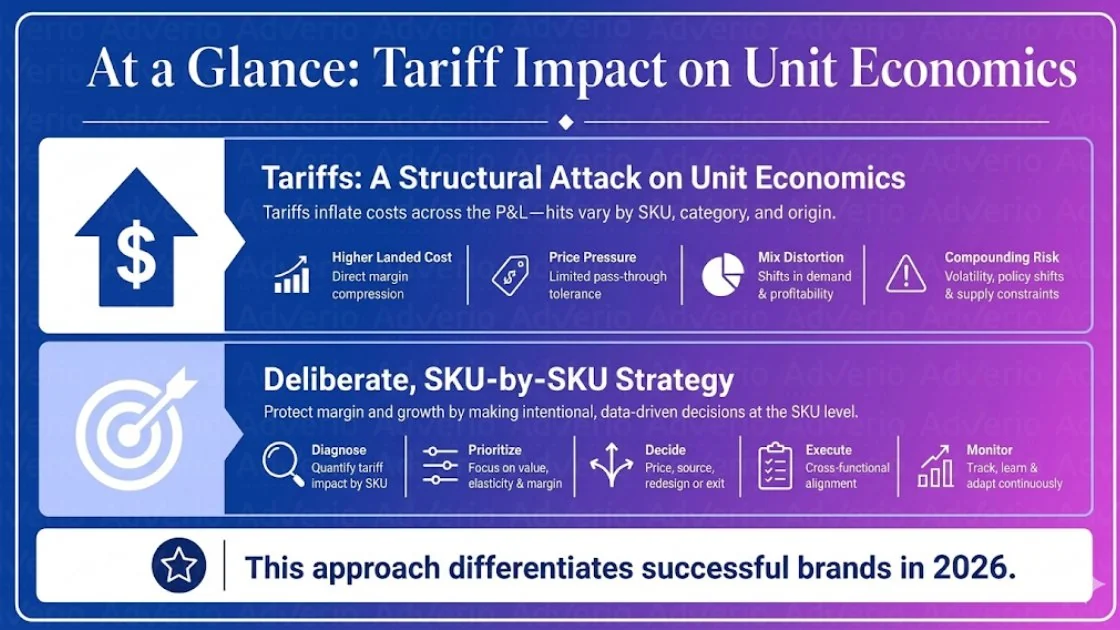
Most brands don’t need more commentary on tariffs. They need execution. That means finance, pricing, operations, and media all working from one margin model. That is the discipline Adverio is built around.
How Tariffs Are Affecting Amazon Seller Margins in 2026
Your team closes the month with flat revenue, steady TACoS, and no obvious sales collapse. Then, finance updates landed cost, and a third of the catalog is suddenly below target contribution margin. That is how tariff pressure shows up on Amazon in 2026. It hits the P&L before it shows up in topline reporting.
Tariffs now act like a direct tax on SKU economics. Recent tariff changes and tighter treatment of low-value imports have materially increased landed cost exposure for Amazon brands, especially those sourcing from China-linked supply chains, according to Link My Books’ 2025 seller cost analysis. If your catalog was built on thin contribution margins, that cost shift can turn a healthy ASIN into a cash drain fast.
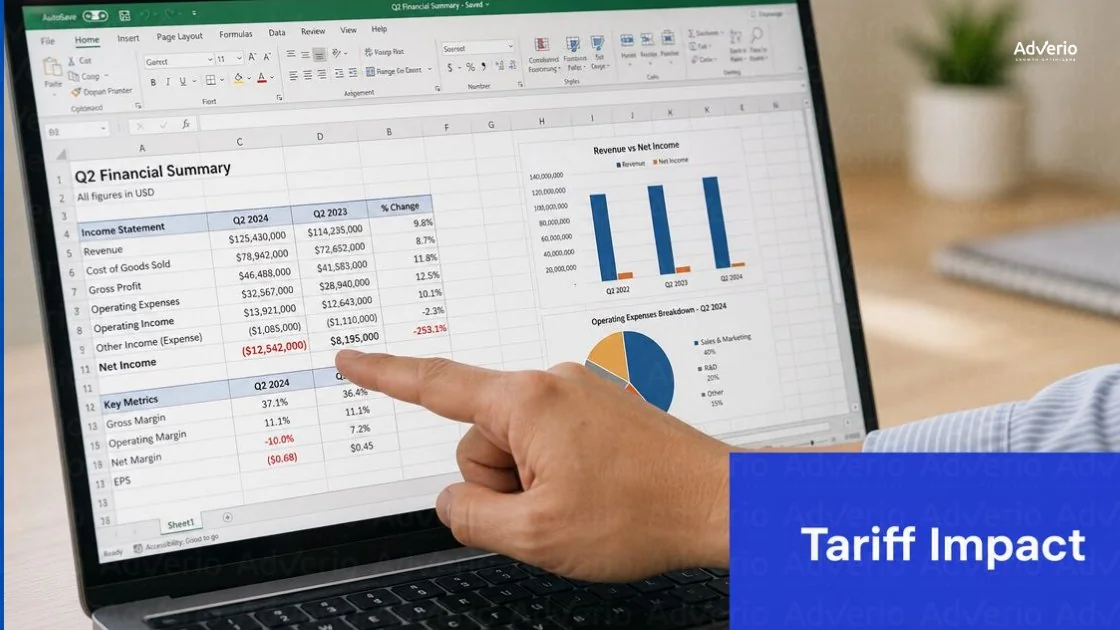
The mistake is treating this as a pricing problem alone. It is a portfolio management problem. Some SKUs can absorb a price increase. Some need packaging, sourcing, or promo changes. Some should lose ad support. Some should be exited. Strong operators make those calls at the ASIN level, because tariff exposure is never uniform across a catalog.
Many internal teams focus on lagging indicators like revenue, blended TACoS, and account-level performance after the damage is already in motion. That view hides where profit is breaking. A blended dashboard can look acceptable while a handful of tariff-exposed ASINs destroy margin dollars and consume inventory capital.
You need current cost inputs tied to each SKU, including fulfillment. A current breakdown of 2026 Amazon FBA fees lives in the
2026 FBA fee breakdown. Layer tariff-adjusted landed cost on top of those fee inputs. That gives you an accurate operating picture. Without that view, pricing decisions are guesswork and ad budgets keep flowing into products that no longer deserve demand.
Competitive monitoring matters too, but only in support of margin decisions. Category-level pricing and assortment data can help. Use that data to see how the category is reacting. Then make the call based on your own SKU-level contribution margin, not on blended sales trends or competitor panic.
The Tariff Impact Model: How to Run the Numbers by SKU
A CEO reviews the catalog, sees revenue holding, and assumes the tariff hit is manageable. Then the unit economics get rebuilt at the ASIN level. A small group of products is consuming most of the margin loss, tying up cash in inventory, and soaking up ad spend that no longer earns its keep. That is the critical task here. Treat tariffs as SKU portfolio triage, not a blanket pricing decision.
Build one operating table for every ASIN. Rank the catalog by gross profit dollars lost per unit and in total. Then make decisions in order of financial damage, not by gut feel, sales volume, or internal politics.
Use this table structure
| SKU | Pre-Tariff COGS | Tariff Rate % | Tariff Cost/Unit $ | Post-Tariff COGS | Pre-Tariff CM % | Post-Tariff CM % | Margin Impact $ |
|---|---|---|---|---|---|---|---|
| SKU A | |||||||
| SKU B | |||||||
| SKU C |
Keep it simple. The value comes from disciplined inputs and ruthless ranking, not from a fancy spreadsheet.
What to calculate for each SKU
-
Pre-tariff COGS: Your landed unit cost before the tariff increase.
-
Tariff cost per unit: The added duty burden allocated to each unit.
-
Post-tariff COGS: Your updated cost basis after tariff impact.
-
Contribution margin before and after: The metric that determines whether the SKU still merits inventory, advertising, and management attention.
-
Margin impact: The dollar decline in contribution profit so you can rank the damage across the catalog.
Add one more practical layer if you want this model to drive action. Include monthly unit volume and calculate total monthly margin dollars lost by SKU. A low-volume ASIN with a terrible margin profile may matter less than a high-volume ASIN losing a smaller amount per unit. You need both views.
That ranked output becomes your decision stack. The top tier needs immediate intervention. The middle tier needs controlled testing. The bottom tier can be monitored, not debated every week.
Pro Tip: Run the model before changing price. Brands that skip this step usually spread price increases too broadly, protect weak SKUs they should cut, and miss the few ASINs that are doing most of the profit damage.
Your file also needs to connect landed cost, FBA fees, and ad spend at the ASIN level. If those inputs sit in different reports, your team will keep funding demand on products that no longer clear your margin threshold.
The full contribution margin methodology including what healthy, marginal, and danger-zone margins look like by category lives in the Amazon contribution margin strategy guide. What this section adds is the tariff-specific layer: how to apply that model when landed cost has just moved materially and you need ranked triage decisions fast.
The Four-Lever Response Framework
A tariff shock is rarely a catalog-wide pricing problem. It is a portfolio management problem. Strong brands respond at the SKU level, because each product has a different combination of price elasticity, fulfillment burden, sourcing flexibility, and strategic value.
Amazon used that logic in its own vendor decisions during the last tariff cycle, prioritizing stronger economics and deprioritizing weaker ones, according to Amplifyy’s 2025 tariff analysis. Apply the same discipline to your catalog.
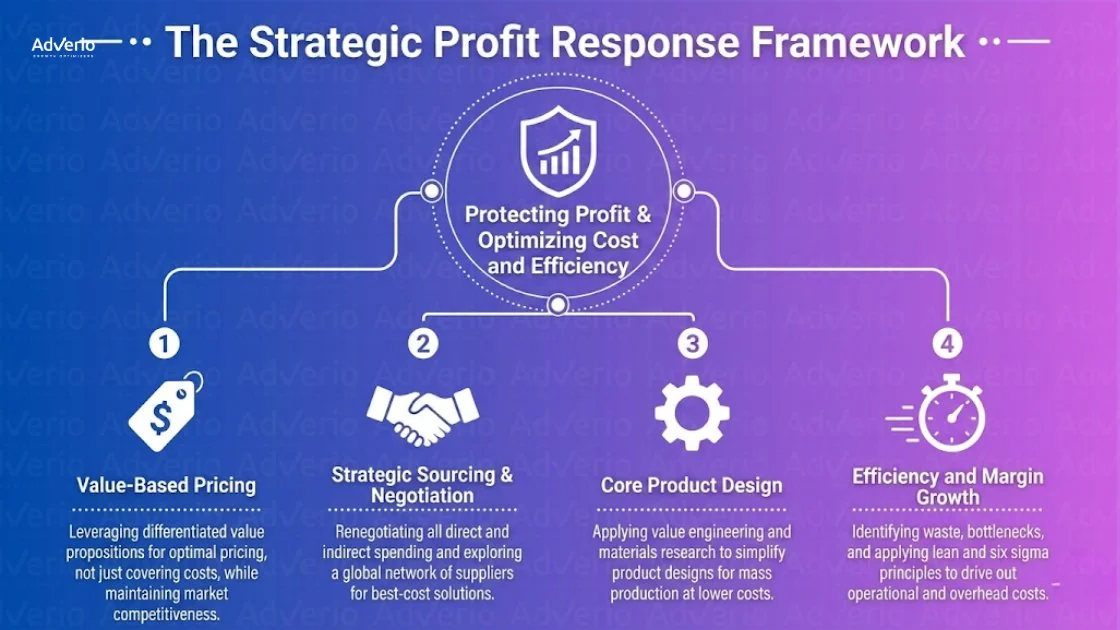
The four levers below are tariff-specific. The broader catalog governance framework, including how to set thresholds and run ongoing rationalization, is covered in the guides linked below. This framework focuses on what changes when tariffs are the trigger.
Lever 1: Price increase within MAP and market elasticity
Start with price because it changes unit economics immediately.
That does not mean broad increases across the catalog. It means selective repricing on SKUs that still have competitive headroom, healthy conversion resilience, and a clear role in the portfolio. The full pricing mechanics and MAP guardrails live in the Amazon pricing strategy guide. What this lever adds is the tariff-specific filter: raise price only where the margin recovery from the tariff cost justifies the conversion and rank risk.
A SKU that loses some velocity but gains more contribution dollars can still be a win. A SKU that loses rank, conversion, and ad efficiency at the same time is not.
Lever 2: Packaging and sizing to reduce per-unit cost
Many brands miss margin because packaging decisions sit in operations while pricing sits in ecommerce and finance. That split is expensive.
Review dimensions, weight, insert count, materials, and pack configuration. Small changes can lower fulfillment cost, improve margin absorption, or move a product into a healthier economic range. Multipacks can also work, especially when a higher selling price gives you more room to absorb tariff pressure and media cost.
It is not glamorous. It is one of the highest-margin moves you can make.
Run packaging review with operations, supply chain, and marketplace finance in the same discussion. If those teams work separately, margin fixes get missed.
Lever 3: Sourcing Diversification, What’s Viable and What’s Not
Sourcing changes matter, but only when the post-transition economics are better than the current problem.
Evaluate each SKU like an investment case. Can you move production without creating quality failures, longer lead times, tooling cost overruns, or inventory risk that wipes out the savings? If the answer is no, stop pretending the SKU has an easy sourcing fix.
Viable candidates usually have:
-
Transferable manufacturing processes
-
Manageable quality control requirements
-
Reasonable lead-time tolerance
-
Economics that still work after transition cost
Poor candidates tend to involve specialized production, fragile QA requirements, or tooling complexity that makes relocation slower and more expensive than leadership expects.
If concentration risk is part of the problem, broader marketplace expansion can also reduce dependence.
Lever 4: Catalog Rationalization, Which SKUs to Exit
Some SKUs should be cut. Do it early.
If a product cannot support a price move, cannot be repacked into better economics, and cannot be sourced more efficiently, it does not belong in the portfolio. Keeping it alive because it once sold well is how brands protect revenue while margin collapses underneath them.
Use clear exit criteria. If post-tariff contribution margin stays below your threshold and no realistic recovery path exists, set a wind-down plan. Reduce exposure, stop defending it with paid media, and redirect working capital to products that still earn the right to scale.
Bad SKUs do not become strategic because the team spent time building them. They become expensive because leadership refuses to shut them down.
For the full SKU exit methodology, including criteria, sequencing, and inventory wind-down playbook, that lives in the Amazon SKU rationalization strategy guide. The difference here is the trigger: tariff pressure forces these decisions faster and on a compressed timeline that the general rationalization guide does not address.
The four levers work best as a structured decision system. Reprice salvageable SKUs. Repack products with fixable cost structure. Resource sourcing changes only where transition math works. Exit the rest. That is how top-tier brands protect profit during tariff pressure.
How to Sequence the Response and Test Elasticity
A tariff hits on Monday. By Friday, the team has raised prices on half the catalog, cut bids across the board, started calling new factories, and argued over which SKUs to kill. That is a rushed portfolio reaction. It destroys signal.
Sequence matters because tariff response is not one pricing decision. It is SKU portfolio management. You need to know which products can absorb a price move, which ones need a cost fix, which ones should lose ad support, and which ones should leave the catalog.
Start with the SKUs creating the biggest dollar margin loss, not the loudest internal debate. Price is usually the first test because you can change it fast and read results quickly. Packaging reviews come next because they often improve unit economics without resetting the whole supply chain. Sourcing changes and exits should follow once you know which SKUs still deserve attention.
The sequence that makes sense
-
Run the SKU model
-
Rank SKUs by total profit at risk
-
Test price first on SKUs with room to recover margin
-
Review packaging, bundle structure, and size-tier implications
-
Reallocate media away from SKUs that fail post-tariff contribution thresholds
-
Make sourcing and exit decisions after short-term tests produce clean results
Step five gets missed all the time. Brands keep spending to preserve revenue volume while contribution margin collapses. Tariff-resistant profitability comes from per-ASIN profit tracking and budget reallocation, not topline defense. That is the discipline many Amazon teams skip.
Cutting or redirecting ad spend is often the fastest margin intervention after price. If an ASIN cannot clear your contribution target after tariff, fees, and media, stop forcing velocity through paid traffic.
Move that budget to SKUs that still convert profitably with disciplined Amazon PPC management.
If you need a team to operationalize that process across pricing, media, and catalog decisions,
Run an elasticity test before any major price move
Do not roll out a catalog-wide increase and hope the blended results look acceptable. Test SKU by SKU.
Use a defined test window. Change price on one target SKU or a tightly matched group. Hold the rest of the variables as steady as possible. Then measure conversion rate, unit session percentage, TACoS or ad efficiency, and organic rank movement before and after the change.
Keep the SKU at the new price if margin improves and demand remains healthy. If conversion drops hard enough to erase the gain, scale back the increase or move to a different lever. Sometimes the answer is simple. The SKU should keep the higher price with lower paid support. Sometimes the answer is harsher. The SKU no longer earns aggressive spend.
Practical rule: If a SKU needs paid media to cover up broken unit economics, remove budget first and reassess whether it belongs in the portfolio.
Optimism does not protect margin. Sequenced tests do.
How Adverio Manages Tariff Impact Across Client Catalogs
A tariff shock does not hit a catalog evenly. One SKU can absorb the cost. The next one turns unprofitable overnight. Treating the whole catalog the same is how brands protect revenue and lose margin.
Adverio runs tariff response as SKU portfolio management. The team updates landed cost inputs, recalculates contribution by ASIN, groups products by economic role, and ties pricing, media, and inventory decisions to profit thresholds. That gives leadership a working system instead of a reactive scramble every time costs move.
The point is speed and control. Strong SKUs keep support. Borderline SKUs get tested under tighter targets. Weak SKUs lose budget, get repositioned, or get cut.
If your team needs that discipline built into day-to-day execution, manage your Amazon account with Adverio.
Frequently Asked Questions
Should I stop advertising on tariff-affected products?
Not automatically. Check contribution margin first. If the SKU is still profitable, your ad targets may need to tighten rather than shut off entirely. If the SKU is now unprofitable, pausing or reallocating spend is the right move.
What should I do first tomorrow morning?
Pull your full catalog and update landed cost by SKU. Don’t start with pricing. Don’t start with ads. Start with the model.
What if competitors haven’t raised prices?
That doesn’t mean they’re more efficient. It may mean they haven’t done the math yet. Don’t copy someone else’s bad economics.
Is sourcing diversification always the answer?
No. It only works when the full economics, quality control, and transition effort make sense. Some products should be moved. Some should be redesigned. Some should be exited.
Can tariff response come from ad spend cuts instead of price increases?
Yes. In some cases, reducing spend on low-margin SKUs protects more profit than forcing a price increase that damages conversion and rank.
Read Next
-
Amazon contribution margin strategy — full ASIN-level margin methodology and thresholds
-
Amazon SKU rationalization strategy — catalog exit criteria and wind-down playbook
-
Amazon FBA fee breakdown 2026 — current fee inputs for the tariff model
References
Tariff response is a portfolio management decision at the SKU level. Brands that treat it like a broad pricing exercise usually protect revenue and lose profit. The better approach is disciplined catalog triage, contribution margin analysis, and clear sequencing across pricing, sourcing, promotion, and assortment.
Tariffs will show up in your P&L whether you act or not. If your catalog needs a profit-first response, Get My Profit ROI Forecast. We will map the SKUs worth defending, the ad spend worth keeping, and the margin leaks worth fixing before the quarter closes.