



Table of Contents
Losing the lost buy box amazon position is one of the fastest ways to kill conversions.
Sales dropped on a core ASIN. Ads are stable. Inventory looks fine.
That is where most brands make the wrong call.
This is not a traffic problem. This is a Buy Box failure—and it is quietly killing your conversions.
This is an emergency. When you lose the Buy Box, you do not just lose a placement. You lose the easiest path to purchase. On mobile, that usually means the winning offer gets the attention and everyone else gets buried.
If you are already seeing conversion softness, do not guess. Diagnose fast. Then fix the actual trigger.
Revenue Dropped? Check Buy Box Ownership First
Many teams discover Buy Box loss late.
They notice a sales dip, then a conversion dip, then weaker ad efficiency. By then, the damage is already moving through the account. Sales velocity slows. Organic rank softens. Competitors pick up the volume you should have held.
The financial risk is not small. The average Buy Box loss rate for brands on Amazon was 16% in the U.S. and 20% in the U.K. in Profitero’s study, meaning brands lost roughly one out of every five conversions on average. Even incremental drops in win rate led to daily sales losses of up to 21%, and over 80% of Amazon sales occur through the Buy Box (Profitero study).
Buy Box ownership directly controls revenue visibility.
What this usually looks like
A typical pattern shows up like this:
-
Sales fall first: You see a sudden drop on one ASIN or a group of related SKUs.
-
Ads look worse next: Sponsored Products keep spending, but conversion weakens.
-
The listing still appears live: That confuses teams into thinking the page is healthy.
-
The core issue is visibility at checkout: Your product is technically purchasable, but no longer the default option.
Key takeaway: If your revenue dipped unexpectedly on Amazon, check Buy Box ownership before you touch bids, budgets, or creative.
Why brands misdiagnose it
Most teams default to price. That is usually wrong
Sometimes price is part of the problem. Often it is not the root cause. Buy Box loss can come from delivery-speed issues, seller metrics, inventory instability, off-Amazon price parity problems, or unauthorized sellers dragging down the offer environment.
If delivery speed is part of the issue, this guide on how to fix Amazon Buy Box suppressed for delivery speed is one of the first places to look.
You need a root-cause process, not a panic discount.
If pricing decisions are still reactive, this breakdown of Amazon anchor pricing strategy shows how to control perception without destroying margin.
Deconstructing the Amazon Buy Box Algorithm in 2026
Stop thinking lowest price wins. That mindset destroys margin and often fails anyway.
Amazon does not reward the cheapest seller by default. It rewards the offer that looks most reliable, most competitive, and easiest for the customer to buy with confidence.
Most agencies treat Buy Box as a pricing problem. It is not. It is a system-level constraint across inventory, pricing, and conversion.

Four inputs are often underestimated
The modern Buy Box decision is usually driven by a cluster of signals, not one.
| Factor | What Amazon cares about | What brands get wrong |
|---|---|---|
| Landed price | Total customer cost, not just item price | They cut list price while ignoring parity and shipping |
| Fulfillment speed | Fast, predictable delivery | They assume FBM can compete without operational discipline |
| Seller performance | Low-defect, reliable execution | They ignore account health until suppression hits |
| Inventory depth | Confidence that the offer will stay live | They treat low stock as a planning issue, not a Buy Box issue |
Seller reliability can overpower a small price move
A lot of operators still underestimate how hard Amazon penalizes weak execution.
Over 80% of Amazon sales happen through the Buy Box. A seller’s Order Defect Rate is a major signal. Sellers with an ODR between 0.8% and 1.0% can see Buy Box share drop to 40-55%, while sellers at 0.3% or lower maintain 75-90% share (Megaficus analysis).
That should change how you think about recovery.
You do not win by being desperate. You win by being the most reliable offer in the stack.
Price matters, but parity matters more
Amazon is not only looking at the offer on the listing. It also cares whether your product appears cheaper elsewhere. That includes your own site, Walmart, Target, and marketplace resellers that break your pricing rules.
If your pricing strategy is still manual, you are behind. If your pricing strategy is still manual, you are behind. A serious Amazon dynamic pricing strategy built for margin protection should account for profit, shipping realities, and external parity risk
Practical rule: If your first move after Buy Box loss is a blanket price cut, you are treating a diagnostic problem like a coupon problem.
1P brands have a different blind spot
If you sell direct to Amazon as a vendor, your lens is different. You may be watching Lost Featured Offer data while missing traffic loss tied to suppression or availability issues elsewhere in the funnel.
That is why established brands need to read Buy Box health as an operating signal, not just a retail analytics metric.
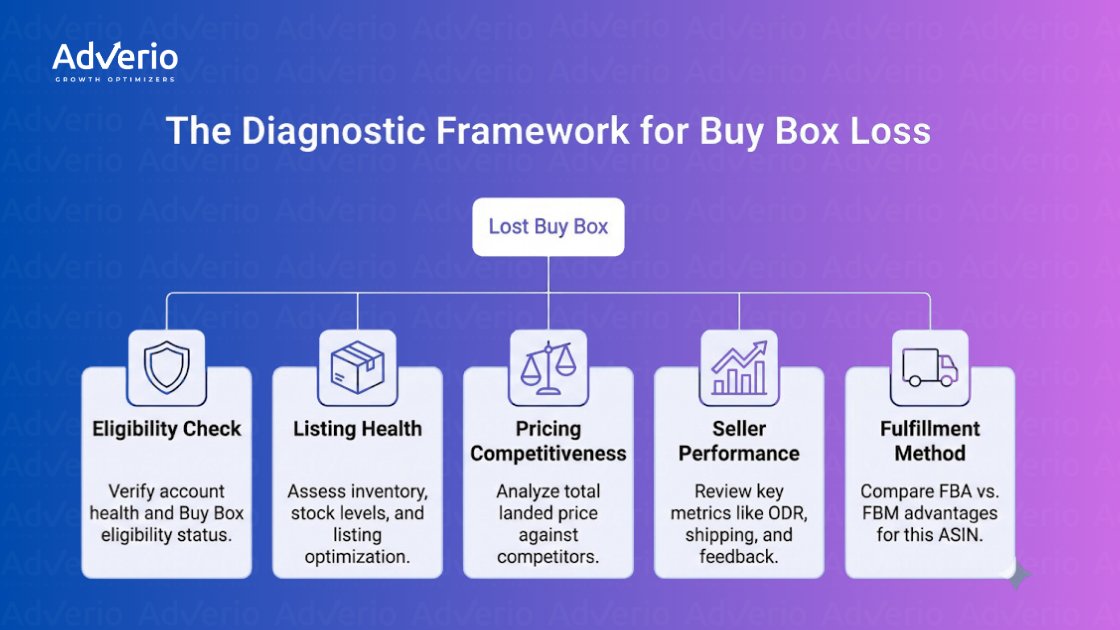
The Diagnostic Framework for Buy Box Loss
When the Buy Box disappears, most dashboards do a poor job explaining why. That is why brands rely on business intelligence systems to connect pricing, inventory, and conversion signals into one clear diagnostic view
You need a tight framework. Not endless report digging. Not internal debate. A clean checklist that isolates the trigger fast.
Root cause one is price parity
This is broader than “are we the cheapest on Amazon?”
It includes:
-
Off-Amazon pricing: Your SKU appears lower on Walmart, Target, your DTC site, or another retailer.
-
Marketplace leakage: A reseller or gray-market seller undercuts your intended price.
-
Shipping distortion: The total landed price looks worse even if the shelf price looks fine.
Price parity issues often trigger suppression without a neat warning. That is why teams think the listing “randomly” lost the box.
Root cause two is fulfillment and delivery speed
Fulfillment is not a secondary lever. It is often the deciding one.
Fulfillment method is the top Buy Box differentiator. Sellers using FBA or Seller Fulfilled Prime win the Buy Box 3-5 times more often than FBM sellers, even at the same price. Remedying stockouts and improving IPI can lead to 85% Buy Box recovery within 30 days (Repricer.com).
That means a “price problem” can be a speed problem.
Watch for these operational signals
-
Handling time changes: A small delay can make your offer less competitive.
-
Prime eligibility loss: If a key SKU slips out of Prime advantage, your Buy Box odds weaken.
-
Inbound friction: Receiving delays and replenishment gaps can destabilize an offer.
For teams trying to spot these patterns earlier, strong Amazon analytics tools are not optional. They are defensive infrastructure.
Root cause three is unauthorized sellers
Here, brand control breaks down.
Unauthorized sellers undercut your pricing, weaken parity, and create a messy offer stack. Even when they do not win permanently, they can destabilize the listing enough to trigger suppression or Buy Box churn.
This is especially ugly for brands with MAP policies that are weakly enforced or inconsistently policed across channels.
Tip: If unfamiliar sellers are showing up on your hero ASINs, treat it as a Buy Box problem immediately, not a legal problem for later.
Root cause four is seller metric slippage
Buy Box eligibility is fragile when account health slips.
That includes order defects, cancellations, late shipments, and customer-facing reliability issues. You may still be active. You may still be selling. But Amazon can still decide you are not the best default offer.
This is why account health should be reviewed as an operational KPI, not a compliance task.
Root cause five is inventory depth
Low stock changes how Amazon sees your reliability.
You might still be in stock today. But if your inventory position signals instability, Amazon may protect the customer experience by favoring another seller with deeper coverage.
Inventory depth also affects recovery. Once you lose share due to stockouts, clawing it back is rarely instant.
How to Pinpoint the Exact Cause in Under 15 Minutes
You do not need a long investigation to find the likely trigger. You need a disciplined sequence.
Run this audit in order. Do not skip around.
Minute one to three, check the listing itself
Go straight to the affected ASIN.
Look for suppression messaging, “See All Buying Options,” unexpected delivery promises, and any visible changes to pricing or shipping. Then manually check your SKU on your DTC site and other major channels.
You are looking for a parity conflict before you get lost in internal reports.
Minute four to six, review account health
Open Account Health in Seller Central and review defect-related signals.
The Order Defect Rate is the most punitive metric. An ODR over 1% can trigger immediate Buy Box suppression across listings. To diagnose it, review the 60-day breakdown of negative feedback, A-to-Z claims, and chargebacks in Account Health (SellerLogic).
If ODR is elevated, stop there. That is your fire.
Minute seven to nine, inspect shipping and cancellations
Now look for operational slippage.
Check whether late shipment rate, handling time, and pre-fulfillment cancellations changed recently. A small workflow problem can create a large Buy Box consequence.
Fast audit checklist
-
Late shipments: Review recent spikes or carrier-related issues.
-
Cancellations: Check whether inventory sync or oversells caused preventable cancels.
-
Response quality: Scan recent buyer communication and service problems.
-
Fulfillment status: Confirm the ASIN is still operating under the expected method.
Minute ten to twelve, check inventory depth
Open your inventory view and inspect warnings on the affected SKUs.
You want to know whether low stock, stranded inventory, inbound delays, or forecasting misses are weakening the offer. Strong Amazon inventory management systems act as Buy Box protection, not just supply chain support.
Minute thirteen to fifteen, inspect the offer environment
Go to the product detail page and the seller list.
If you see unfamiliar seller names, suspiciously low offers, or volatile pricing, your issue may be unauthorized competition, parity contamination, or both.
Shortcut: If the account is healthy and inventory is stable, the most likely culprits are parity conflicts, delivery competitiveness, or unauthorized sellers.
This process exposes the real constraint fast enough to act the same day.
The Fix Sequence A Prioritized Recovery Playbook
Once you identify the trigger, do not fix everything at once. That usually creates noise and wastes time.
Recovery works best in sequence.

First, clear account health fires
If ODR, cancellation issues, or policy flags are in play, deal with those first.
Nothing else matters if the account itself is sending poor reliability signals. Do not touch bids. Do not start with coupons. Clean the operational wound first.
This often means:
-
Removing the defect source: defective units, poor prep, service breakdowns
-
Resolving active cases: appeals, documentation, corrective actions
-
Correcting workflows: shipping SLAs, order handling, returns coordination
Second, restore price integrity
Brands usually make the wrong move at this point.
They slash price. Margin drops. Buy Box still does not stabilize.
A better sequence is:
-
Check external parity
-
Find unauthorized sellers
-
Enforce MAP where applicable
-
Use repricing logic that protects profit, not just share
Amid tariff-driven cost increases, dropping price is a losing strategy. Sellers are using appeals, off-platform price monitoring, and dynamic repricers that adapt to rising costs without sacrificing the Buy Box (Bellavix).
If your price image is getting wrecked by reseller leakage, solve that first.
Third, fix fulfillment and inventory reliability
Recovery becomes durable at this stage.
Tighten forecasting. Prevent stock gaps. Reduce handling-time drift. Make sure replenishment supports the ASINs that carry your volume and visibility.
A few strong operational habits matter more than a dozen reactive tactics:
-
Protect hero ASINs first: Do not spread inventory evenly if a few SKUs drive most of the damage when they lose Buy Box share.
-
Reduce avoidable delays: Review warehouse and carrier handoff problems.
-
Watch landed cost changes: Fee pressure can alter competitiveness even when list price stays unchanged.
Fourth, rebuild momentum with advertising
Ads should amplify recovery, not substitute for it. That only works when your Amazon PPC management is aligned with real conversion signals
Once pricing, eligibility, and fulfillment are stable again, use Sponsored Products and DSP strategically to restore sales velocity. A healthy listing with strong conversion support can regain traction faster than a listing left to “recover naturally.”
Recovery rule: Advertising can accelerate Buy Box stabilization after the root cause is fixed. It cannot rescue a broken offer by itself.
Fifth, install monitoring so this does not happen again
If your team found the issue only after sales dropped, your monitoring stack failed.
Buy Box defense should include daily checks on:
| Signal | What to monitor |
|---|---|
| Offer ownership | Featured Offer presence and churn |
| External parity | DTC, Walmart, Target, reseller pricing |
| Seller metrics | ODR, shipping, cancellations, feedback issues |
| Inventory | Low-stock risk, replenishment gaps, stranded units |
| Unauthorized sellers | New names, suspicious pricing, repeated undercutting |
That is how you stop treating Buy Box loss like a surprise.
Beyond Recovery How Adverio Defends Your Buy Box
Most brands manage Buy Box loss reactively. That is expensive.
The stronger model is continuous defense. You monitor the known failure points, catch drift early, and correct it before revenue slides. That includes price parity, inventory depth, shipping reliability, and reseller interference.
For 1P brands, this gets more nuanced. Lost Featured Offer data is useful, but incomplete. It can miss situations where the retail offer is technically in inventory while visibility is still compromised elsewhere. Teams that only watch one metric often think the listing is healthy when traffic is already weakening.
The same issue shows up with unauthorized sellers. If they are allowed to chip away at price integrity long enough, your Buy Box risk goes from occasional nuisance to constant instability. This is one reason many brands now automatically monitor competitor pricing changes instead of relying on manual spot checks and screenshots.
Operational oversight matters just as much as pricing oversight. Brands that want tighter control often work with specialized Amazon account management companies because Buy Box health sits at the intersection of catalog, ads, inventory, and channel control. It is not a single-team problem.
A disciplined defense model should do four things well:
-
Surface parity conflicts early: before Amazon reacts
-
Flag seller metric drift: before suppression spreads
-
Detect reseller damage: before MAP erosion resets the market
-
Connect inventory risk to conversion risk: before stock instability costs visibility
That is how you move from cleanup to control.
How Adverio Fixes Buy Box Loss at the Root
Most teams treat Buy Box loss like a pricing problem. It is not. It is a system failure across inventory, pricing, and conversion.
Adverio’s Growth Cultivator framework identifies the exact constraint—whether it is parity breakdown, fulfillment instability, or catalog issues—and fixes it at the source.
If your revenue dropped and you are still guessing why, you are already behind.
→ Explore Amazon Account Management Services
Frequently Asked Questions About Buy Box Loss
Can you lose the Buy Box even if your price is competitive
Yes. Price alone does not control the Buy Box. Fulfillment speed, seller metrics, inventory stability, and external price parity often override it.
Is Buy Box loss different for 1P and 3P brands
Yes.
3P sellers usually focus on Featured Offer Percentage, account health, shipping, and fulfillment competitiveness. 1P vendors often need to read Lost Featured Offer alongside availability and traffic signals, because one metric alone can hide the actual issue.
Should you pause ads when the Buy Box is gone
Usually, yes for the affected ASIN if the listing cannot convert normally.
There is no point buying traffic aggressively if the offer is not the default path to purchase. Fix the cause first. Then restore spend with intent.
How often should you check for Buy Box issues
Daily on priority ASINs.
If you only review weekly, you are giving away too much time. Buy Box loss compounds because it affects both conversion and momentum.
Are unauthorized sellers really a Buy Box problem
Absolutely.
They distort pricing, create parity problems, and weaken your control of the offer stack. If they are active on core listings, they are not just a channel annoyance. They are a revenue leak.
If your team is chasing symptoms instead of finding the underlying trigger, you need a tighter operating system. Adverio helps established brands diagnose Buy Box loss, protect margin, and regain control across Amazon, Walmart, and Target. If revenue has slipped and the cause is still unclear, Book Your ROI Forecast.