



Most Amazon brands get anchor pricing dangerously wrong. They slap an inflated ‘list price’ on a product, hope the strikthrough drives a few extra sales, and call it a day.
That’s not a strategy. It’s a race to the bottom that torches your margins and puts your entire listing at risk of algorithmic penalties. It’s time to shake things up.
Stop Burning Cash With Flawed Anchor Pricing
Table of Contents

The old-school approach of setting a high, arbitrary list price completely misses the point. It ignores the complex dance between perceived value, Buy Box algorithms, and your actual, long-term profitability.
Chasing that strikethrough is a classic vanity metric. This playbook is about something different. We’re not just trying to create a discount; we’re architecting a compelling value story that both Amazon’s A10 algorithm and your target customers can’t ignore. It’s time to build a powerful lever for sustainable, profit-driven growth.
The Real Cost of Bad Pricing Tactics
A poorly executed amazon anchor pricing strategy does more than just fail to convert—it actively hurts your brand. When Amazon’s algorithm catches an unsubstantiated “List Price” or “Was Price,” it can suppress your listing, causing your rank to plummet overnight.
This isn’t a theory. We’ve seen brands drop from page one to page seven for this exact reason.
The damage goes beyond the algorithm. Today’s shoppers are smart. They use price tracking tools and can spot a fake discount from a mile away. An inflated anchor price destroys trust, which is far more valuable than a few short-term sales.
You don’t get a second chance to build credibility with the algorithm or the customer. A flawed anchor price damages both simultaneously, turning a potential growth lever into a liability.
Shifting From Vanity Metrics to Value-Driven Pricing
Winning on Amazon demands a total shift in thinking. Instead of asking, “What’s the highest anchor price I can get away with?” the real question is, “What pricing structure best communicates my product’s value while maximizing profit?” Understanding how to achieve optimal pricing on Amazon means moving beyond simple tricks and building a holistic system.
This is where we move from guesswork to a data-backed methodology. It’s about grounding your reference price in verifiable sales history or a legitimate MSRP, then strategically using promotions like coupons and deals to create genuine perceived value. This approach protects your brand’s integrity, satisfies Amazon’s strict policies, and most importantly, protects your bottom line.
A lot of brands fall into the trap of chasing surface-level wins. Let’s break down the difference between that common, flawed approach and a truly strategic one.
From Vanity Metrics To Value-Driven Pricing
| Tactic | Common (Flawed) Approach | Adverio’s Strategic Approach |
|---|---|---|
| List Price (MSRP) | Set an arbitrarily high number to create a large strikethrough discount. | Ground the List Price in a verifiable MSRP or consistent off-Amazon pricing to build trust and comply with Amazon policy. |
| Coupons & Promotions | Run constant, deep discounts that train customers to never pay full price and erode brand value. | Use targeted, time-bound promotions to drive urgency, liquidate aging inventory, or boost rank for strategic keywords. |
| Metric Focus | Obsess over Conversion Rate (CVR) and a low ACoS, even if it means sacrificing margin. | Focus on profit-driven metrics like TACoS and Net Margin to ensure every pricing decision contributes to the bottom line. |
| Testing | Change prices randomly and hope for the best, with no clear data on what actually worked. | Implement structured A/B tests on price points and promo types to measure elasticity and find the true profit-maximizing price. |
This table isn’t just a comparison; it’s a roadmap. The “common approach” is a short-term game that almost always ends in margin compression and algorithmic penalties. Our strategic approach builds a resilient, profitable pricing foundation that can weather market changes and scale sustainably.
The Psychology Behind Why Anchor Prices Convert
Anchor pricing isn’t just some clever marketing tactic; it’s a direct line into your customer’s brain. The whole strategy hinges on a powerful cognitive bias known as anchoring. The moment a shopper sees a higher “list price” next to your lower sale price, their brain latches onto that first number as the benchmark for what the product should be worth.
Suddenly, your actual price isn’t just a number. It’s a fantastic deal. This mental shortcut works wonders because it takes the hard work out of the buying decision. Instead of trying to figure out a product’s real value, the customer’s brain defaults to a much simpler question: “How much am I saving?”
The Power of Perceived Value
Amazon’s entire platform is engineered to capitalize on this very principle to drive sales. They know that buying is an emotional decision people back up with logic later. The anchor price is the logic.
- Strikethrough Prices: This is the most obvious play. The crossed-out number ($99.99) next to the real price ($79.99) is a visual cue that screams “discount,” creating a sense of urgency and making the shopper feel smart.
- “Compare-At” Suggestions: You’ll often see Amazon display similar, higher-priced items on a product page. This isn’t random. It’s subtly anchoring the customer’s perception of a “normal” price in that category, which makes your offer look far more attractive.
- Tiered Product Variations: Ever see a “Good-Better-Best” set of options, like a single pack, a 3-pack, and a 5-pack? The highest-priced item acts as an anchor, making the middle option—usually the one you want to sell most—seem like the best value.
Once you get this, you can stop just randomly discounting products. You’re not just slashing prices; you’re building a story about value that walks the customer right to the “Add to Cart” button.
Turning Psychology into Profit
The real goal isn’t just to look cheaper; it’s to look like a better deal. When you master this, you can engineer pricing that feels irresistible. It’s a core piece of any serious Amazon anchor pricing strategy.
Why? Because Amazon’s A9 algorithm is built to reward one thing above all else: conversions. Listings that convert shoppers into buyers at a higher rate get better organic rankings and more visibility. A sharp anchor price is a direct lever you can pull to boost that conversion rate.
Your price tag is more than a number—it’s the most powerful piece of copy on your entire product detail page. It communicates value, urgency, and quality in a split second.
And this isn’t just theory. Amazon constantly shows a crossed-out “list price” next to the current price because it knows shoppers perceive a bigger saving. In fact, third-party analyses show that sellers using deliberate anchor or bundle strategies see average order value uplifts of 15–34%. Other data confirms that combining dynamic pricing with these psychological triggers can generate 15–25% more revenue than just setting a static price and hoping for the best.
Ultimately, mastering this psychology helps you build pricing that doesn’t just get clicks but actually increases what people spend. This is how you win on price without getting dragged into a race to the bottom that kills your margins. It’s about being smarter, not just cheaper—and turning your pricing from a defensive move into a powerful tool for growth.
Executing A Profit-First Anchor Pricing Playbook
Theory is great, but execution is what matters. A winning Amazon anchor pricing strategy isn’t just wishful thinking; it’s a deliberate, repeatable playbook that nails the balance between shopper psychology and your own profitability. It all starts with setting the right reference price—the foundation for everything else.
This isn’t about plucking a number from thin air. You have to establish a credible anchor that Amazon’s algorithm respects and shoppers find believable. Mess this up, and you’re looking at suppressed listings, penalties, and a total loss of trust with your customers.
Establishing A Credible Reference Price
Your anchor price has to be defensible. Amazon’s algorithm is constantly scraping pricing data, and if your “List Price” or “Was Price” doesn’t stand up to a sniff test, that beautiful strikethrough will disappear. Worse, Amazon might flag your listing for deceptive pricing.
To sidestep that landmine, ground your anchor in one of two verifiable sources:
- Manufacturer’s Suggested Retail Price (MSRP): This is the cleanest anchor, but it has to be legit. The MSRP needs to be the price the product is actually sold at across other retail channels. If you’re the brand owner, this is your official price.
- Validated Sales History (Was Price): Amazon can automatically generate a “Was Price” if the product has a solid, recent history of selling at a higher, consistent price. This means you need a period of steady sales at that anchor price before you introduce a lower, promotional price.
The cardinal rule is authenticity. An anchor price isn’t just a marketing trick; it’s a verifiable data point. Treat it like one, or the algorithm will treat your listing as untrustworthy, which can tank your hard-earned rank.
Tactical Execution Levers
Once your anchor is set in stone, it’s time to pull the levers that build perceived value and drive people to click “Add to Cart.” These aren’t just standalone tricks; they’re integrated parts of your overall strategy. Each serves a specific purpose, whether it’s creating urgency or boosting your average order value.
The goal is to guide the customer’s psychological journey, from seeing a high anchor price to making a purchase.
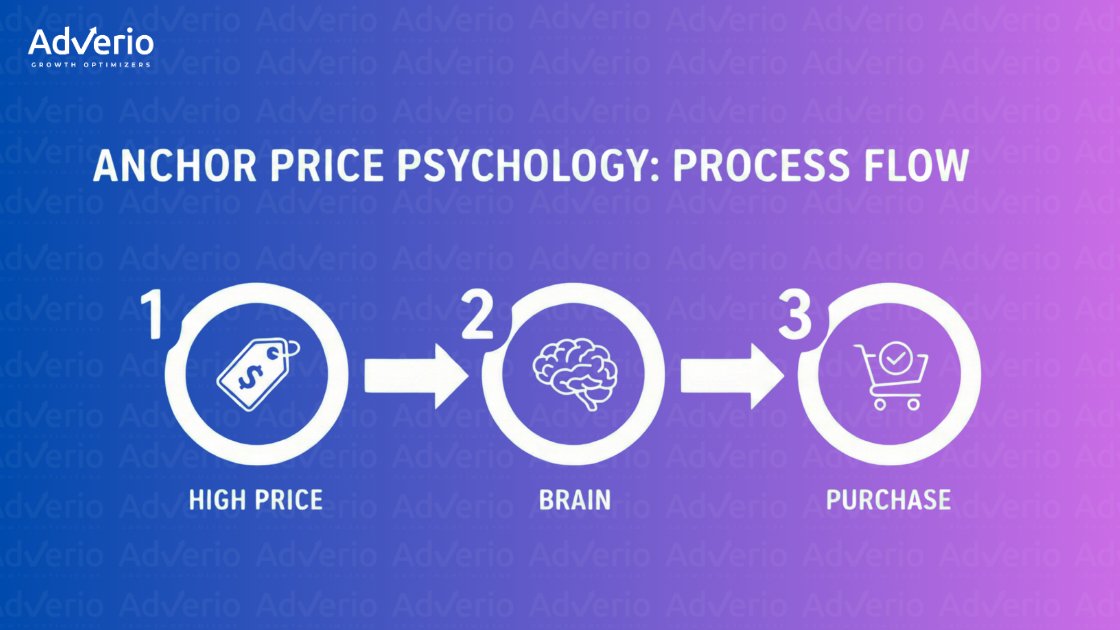
This flow shows how a strong anchor price frames the customer’s view of value, making the final purchase feel like a smart, logical decision.
Leveraging Coupons and Deals Strategically
Just slapping a random 20% off coupon on a listing is a fast way to kill your margins. Think of coupons and deals as surgical tools, not a sledgehammer.
- Coupons: That little green coupon badge is a massive visual cue that stops the scroll. Use them to target specific shopper segments, lift conversion rates on your highest-traffic listings, or to kickstart sales for a new product to build momentum.
- Lightning Deals: These are perfect for creating a short, intense burst of urgency. We use Lightning Deals to liquidate older inventory before long-term storage fees kick in or to get a rapid sales spike that can temporarily boost a product’s Best Sellers Rank (BSR).
The key is to use these promotions with a clear goal and not overdo it. Constant discounts just train customers to wait for a sale, which permanently devalues your product. Having a solid grasp of effective pricing models is critical here, as it helps you make choices that go beyond temporary promotions and support your brand’s long-term value.
Architecting Value with Bundles and Variations
Your product catalog itself is a powerful tool for anchoring. By structuring your variations and bundles smartly, you can create decoy options that make your main offer look like an absolute no-brainer.
Imagine you sell a product as a single unit, a 3-pack, and a 6-pack. The 6-pack, with its higher price, acts as an anchor. The single unit might look cheap on its own, but the value isn’t great. Suddenly, that 3-pack priced attractively in the middle becomes the obvious, irresistible choice, guiding the customer to a higher average order value.
This isn’t just about selling more units; it’s about controlling the customer’s decision-making process. Every pricing decision, from a single SKU to a complex bundle, has to tie back to its impact on your bottom line.
Integrating Pricing With Your Entire Growth Engine
An effective anchor price doesn’t exist in a vacuum. Setting a compelling price and then walking away is like building a high-performance engine and never connecting it to the wheels. To get real traction, your amazon anchor pricing strategy has to be wired into your entire marketplace growth engine.
This means you must connect the dots between your pricing, your advertising, and your listing optimization. Too many brands run PPC campaigns that drive expensive traffic to a listing with a weak or confusing price message. They’re effectively lighting their ad budget on fire. An integrated strategy is the only way to prevent this kind of disconnect.
This holistic framework is a core part of Adverio’s Growth Cultivator methodology. It’s how we turn a static price tag into a dynamic conversion driver that powers the entire system.
Aligning Advertising With Perceived Value
Your anchor price needs to be a central pillar of your ad creative and targeting. If your strategy is to position a product as a premium item with a significant, time-sensitive discount, your ads better tell that story.
This alignment has to happen across both PPC and DSP campaigns:
- PPC Targeting: Let your anchor price inform your keyword strategy. When a strong promotion is live, you can bid more aggressively on high-intent, bottom-of-funnel keywords because your conversion rates are likely to be higher. For example, a 30% off coupon backed by a solid anchor price justifies a higher bid on terms like “[product name] for sale.”
- DSP Audience Segmentation: Use Amazon DSP to build audiences of shoppers who viewed your product but didn’t pull the trigger. Retarget them with creative that explicitly calls out the value proposition—”Still thinking it over? Get it now for $49.99, was $69.99.” This reinforces the discount and creates real urgency.
This approach ensures you aren’t just buying clicks; you’re attracting qualified shoppers who are primed to respond to the value message you’ve so carefully constructed.
Reinforcing The Discount On Your Product Detail Page
Once a shopper clicks your ad, the product detail page has to immediately validate the promise of a great deal. This is where Conversion Rate Optimization (CRO) comes in. Your A+ Content and product descriptions need to tell the same value story as your pricing.
Your price creates the hook, but your listing content sets the anchor. If your A+ Content screams “budget product” while your anchor price suggests “premium deal,” that mismatch will absolutely kill your conversion rate.
Instead of just listing generic features, weave the value narrative directly into your copy. Use A+ Content modules to create comparison charts that stack your product (and its current price) against more expensive competitors. Rework your bullet points to highlight the premium features that justify the original anchor price, making the current sale price feel like an absolute steal. This integrated approach is a key part of our methodology for how to increase Amazon sales sustainably.
Winning The Buy Box With An Integrated Strategy
Ultimately, your anchor price has to work in concert with Amazon’s core mechanics—especially the Buy Box. A numeric anchor by itself doesn’t guarantee sales. In major markets, operational metrics show the Buy Box captures over 80% of purchases, and its algorithm weighs your landed price, fulfillment speed, and seller history heavily.
This means your anchored savings must translate into a competitive final price and reliable fulfillment to actually win the sale. This integration of pricing, operations, and advertising ensures every element works together, turning a simple discount into a powerful, cohesive growth driver.
Measuring The Metrics That Actually Matter
If you can’t measure your pricing strategy, you can’t manage it. But most brands are staring at the wrong numbers. Chasing a low Advertising Cost of Sales (ACoS) as your single source of truth is a classic case of Optimization Myopia—a tunnel-vision mistake that will lead your entire strategy astray.
An effective Amazon anchor pricing strategy isn’t about how cheap your ads run; it’s about how much total profit you bank. A low ACoS might look good on a superficial report, but it tells you nothing about your organic sales, market visibility, or your actual bottom line. It’s time to ditch the vanity metrics and focus on the KPIs that really drive profitability.
Key Performance Indicators Beyond ACoS
To get a real picture of your anchor pricing’s impact, you need a dashboard that balances ad efficiency with total business health. That means shifting your focus to a more complete set of metrics that tell the full story.
Here are the numbers you should actually be watching:
- Conversion Rate (CVR) Lift: This is the most direct signal that your anchor price is working. A solid anchor creates a value proposition so compelling it turns more browsers into buyers. Tracking CVR before and after a pricing change is the clearest way to see if your psychological trigger is firing correctly.
- Total Advertising Cost of Sale (TACoS): This is the cure for ACoS myopia. TACoS measures your total ad spend against your total revenue (paid and organic). A healthy, stable, or decreasing TACoS means your advertising is creating a “halo effect”—lifting organic sales and boosting overall profitability.
- Average Order Value (AOV): Is your anchor pricing encouraging shoppers to spend more? A well-executed bundle or a “Good-Better-Best” variation strategy shouldn’t just convert; it should also increase the average cart size, directly impacting your top-line revenue.
- Price Elasticity: This tells you how sensitive your sales are to price changes. Understanding elasticity helps you pinpoint that sweet spot where you maximize profit without killing your sales velocity. The only reliable way to measure this is with real-world testing.
Chasing ACoS is like trying to win a race by only looking at your fuel gauge. It’s an important dial, but it doesn’t tell you if you’re even on the right track. Profitability is the finish line, and TACoS is the GPS that gets you there.
Validating Your Hypotheses With A/B Testing
Gut feelings don’t drive profit; data does. Before you roll out a new anchor price across your entire catalog, you have to validate your assumptions with structured A/B tests. This is non-negotiable. It protects your sales velocity and makes sure your decisions are grounded in actual customer behavior.
For brands in Brand Registry, Amazon’s “Manage Your Experiments” tool is your best friend for testing different price points on the same ASIN.
Here’s a simple framework for setting up a clean pricing test:
- Isolate One Variable: Test one thing at a time. Period. If you’re testing a new price, your title, images, and A+ Content must remain identical for both the control and test versions. Any other changes will muddy your data.
- Define a Clear Hypothesis: State exactly what you expect to happen. For example: “Lowering the price from $29.99 to $27.99 while keeping the $39.99 anchor will increase CVR by 15% without hurting total daily profit.”
- Run for a Sufficient Duration: Don’t call a test after three days. Let it run for at least two full business cycles—typically 2-4 weeks—to smooth out daily spikes and dips and gather statistically significant data.
- Analyze the Right Metrics: At the end, don’t just glance at which version sold more units. Dive deeper. Analyze the CVR, AOV, and, most importantly, the gross profit generated by each variation. That’s your true winner.
This data-driven approach pulls emotion and guesswork out of your pricing strategy. It gives you the hard evidence you need to make confident, profit-focused decisions that consistently win.
Avoiding The Pitfalls That Erode Trust And Profit
Executing an anchor pricing strategy on Amazon is a high-stakes game. Get it right, and your conversion rate climbs. Get it wrong, and you don’t just lose a sale—you risk eroding the two pillars of your Amazon business: trust and profitability. The line between a sales lift and a catastrophic rank drop is razor-thin.
The most common and dangerous mistake we see is brands artificially inflating a list price just to create the illusion of a massive discount. This isn’t a clever tactic. It’s a direct violation of Amazon’s policies and a surefire way to get penalized.
The High Cost of Fake Discounts
Amazon’s algorithms don’t just look at today’s price. They’re constantly tracking your pricing history, and any sudden, unsupported inflation raises immediate red flags. The consequences are swift and severe.
- Suppressed Strikethrough Pricing: The algorithm can simply erase your strikethrough price, making that perceived value you worked to create vanish in an instant.
- Lost Buy Box Ownership: Inconsistent or deceptive pricing is a major strike against you in the Buy Box algorithm. Losing it means a competitor gets the sale, even on your own listing.
- Plummeting Organic Rank: A penalty for shady pricing can absolutely tank your organic visibility, making your product practically invisible to new shoppers.
A fabricated discount is a short-term gamble with long-term consequences. You might trick a few shoppers, but you can’t trick the algorithm. It will catch on, and the resulting penalty will wipe out any temporary gains.
How Pricing History Haunts Your Listing
This isn’t just a theoretical risk. The danger is real, especially around major events like Prime Day or Cyber Week when the temptation to show deeper discounts is highest. Amazon’s system is built to punish these tactics.
We’ve seen a seller try to raise a price by 30%, then immediately apply a “30% off” promotion. The result? Their listing fell from a prime spot on page one to the depths of page seven within 48 hours. You can explore this analysis on Amazon’s pricing strategies and their effects to see just how closely the platform monitors these moves.
This is why your anchor price must be grounded in reality—either a verifiable MSRP or a consistent, recent sales history. It isn’t just a best practice; it’s a non-negotiable rule for playing on Amazon’s turf. It’s the only way to maintain the algorithmic favor and customer credibility that separates winning brands from the ones that get delisted.
Frequently Asked Questions About Anchor Pricing
Here are some straight answers to the questions we get all the time about building a solid Amazon anchor pricing strategy.
How Does Amazon Actually Verify The List Price I Want To Use?
Amazon’s system isn’t just taking your word for it. It validates a “List Price” or “Was Price” by digging into your product’s recent sales history, both on its own platform and across other retail channels.
To get that coveted strikethrough, the price you’re referencing has to be one where you or other sellers have genuinely moved a substantial number of units recently. Trying to game the system by inventing a high list price just to create a phony discount is a fast track to trouble. Amazon will catch on, and you could see your strikethrough price disappear, your listing get suppressed, or even face account-level penalties.
Can I Use Anchor Pricing For a Brand New Product?
You can try, but it’s incredibly risky and rarely works. A new product has zero sales history, which means there’s no “Was Price” for Amazon’s algorithm to look back on and validate. The only path that’s technically compliant is to use a Manufacturer’s Suggested Retail Price (MSRP), but even that needs to be substantiated and accepted by Amazon.
A much smarter play for new launches is to forget the anchor price for now. Instead, focus on what really drives initial sales velocity: a sharp introductory price, eye-catching coupons, and a blitz of ad campaigns to build that crucial sales history.
Once you’ve established a consistent sales record at a higher price point, then you can strategically introduce a sale price. That creates a legitimate “Was Price” anchor that both customers and Amazon will recognize.
How Often Should I Be Testing Or Changing My Anchor Prices?
Whatever you do, avoid constant, chaotic price changes. That kind of behavior just confuses shoppers and spooks the A10 algorithm, which can really mess with your listing’s stability and organic rank.
Treat price testing like a structured experiment, not a daily tweak. Run A/B tests for at least 2-4 weeks at a time. That gives you a long enough window to collect real, meaningful data on how the changes affect your conversion rates, profit margins, and overall price elasticity. Big pricing moves should be intentional events, lined up with major promos like Prime Day or seasonal shifts in your market—not last-minute reactions. Credibility is everything.
Ready to move beyond guesswork and build a pricing strategy that actually drives profit? The team at Adverio uses a data-first approach to architect value propositions that win with both algorithms and customers.
Book Your ROI Forecast