



Proper Amazon inventory management is about more than just tracking stock. It’s the entire process of “keep-kill-optimize” by forecasting demand, replenishing products (keep), and meeting customer feedback (optimize) without stocking out or tying up all your cash in overstocked products that should be discontinued (killed).
Getting this right isn’t an operational chore—it’s profit protection.
The True Cost of an Amazon Stockout
Most brands with multiple other sales channels and marketplaces treat an Amazon stockout as a simple, temporary hiccup similar to what might be the case if they stockout on their own website. A few days of missed sales, then you’re back in business, right?
That’s an exponentially expensive assumption.
Going out of stock on the world’s biggest marketplace isn’t a temporary sales dip. It kicks off a domino effect of negative consequences that can take weeks, sometimes months, to fully reverse. Amazon’s algorithm doesn’t just pause your listing; it actively penalizes it, dismantling the sales momentum you’ve worked so hard to build.
This is why the true cost of an Amazon stockout is 3 to 12 times higher than the same thing happening on your own DTC site.
Why Amazon Stockouts Hurt More Than DTC Stockouts
A stockout on your own DTC site is a problem. A stockout on Amazon is a catastrophe. The damage on the marketplace is exponentially worse because you’re playing in a closed ecosystem where visibility and momentum are everything.
When your inventory hits zero, you’re not just losing the immediate sale. Here’s what’s really going on behind the scenes:
- Search Ranking Gets Hammered: Amazon’s A9 algorithm is a ruthless sales engine. If you can’t fulfill an order, you’re irrelevant. The penalty is swift and severe. Data shows a 1-day stockout can tank a top product’s rank by over 28%. After 3+ days, that rank can plummet by more than 80%. You’ve effectively vanished from page one.
- You Become Unreliable: Amazon backs brands they can count on, the ones that put them first. Any stockout and Amazon starts to see your listing as unreliable, torpedoing your credibility and weakening future visibility. Go out of stock again, and the impact is multiplicative. As the saying goes: Fool me once, shame on you; fool me twice, shame on me.
- Your Ad Flywheel Grinds to a Halt: Your PPC campaigns stop delivering, and DSP campaigns continue, Once you’re back in stock, you’re forced to spend more just to “re-train” the algorithm and claw your way back to your previous position, poisoning your campaign’s performance history.
- If You’re a Reseller, You Lose the Buy Box and Your Conversion Engine: A staggering 97% of all sales happen through the Buy Box. A stockout guarantees you lose it. Amazon will immediately start pointing those ready-to-buy shoppers toward your in-stock competitors.
On your DTC site, the damage is contained. You can take backorders, capture emails for notifications, and you don’t have an algorithm actively burying your products.
A stockout on Amazon isn’t a pause button. It’s a reset button you never wanted to press, forcing you into an expensive and generally avoidable recovery mission.
To get ahead, you need more advanced techniques. Using predictive modeling for demand forecasting is a non-negotiable part of a proactive strategy. It’s also tied directly to your pricing—understanding the hidden costs of stagnant pricing and the power of dynamic strategies is just as critical, because inventory and price both feed your profitability flywheel.
Why Stockouts on Subscribe & Save SKUs are Even More Damaging
If a standard stockout is a problem, letting a Subscribe & Save (SNS) hero SKU run dry is a five-alarm fire. This is where sloppy Amazon inventory management stops costing you revenue and starts actively destroying your most valuable asset: recurring customer LTV.
When you go OOS on an SNS-enabled item, Amazon doesn’t just pause the orders. It often cancels them outright after two stockouts, then helpfully suggests your now-stranded subscriber switch to a competitor.
Automatic Cancellations and Spiking Churn
Go OOS, and Amazon will either delay the subscription shipment or cancel it. This forces your customers—who are creatures of habit—to find a new brand. And many will.
This single event has a devastating ripple effect. Your subscription churn rate spikes, which is a massive red flag for Amazon’s algorithm. It starts to see your listing as unreliable, further torpedoing your credibility and further weakening future visibility. That stockout isn’t a one-time hit; it becomes an ongoing penalty.
A stockout on a Subscribe & Save product isn’t just a lost sale. It’s an invitation for Amazon to poach your recurring revenue base and hand it directly to your competitors.
The True Cost of a Lost Subscriber
A normal missed sale is an annoyance. Losing a subscriber is a major financial blow. The math is brutal. A typical Subscribe & Save customer represents 3 to 10 times the lifetime value of a one-time buyer.
When a hero SKU goes OOS, and a subscriber leaves, your lost sale isn’t $20—it’s $120–$200+ in future revenue, gone forever. Multiply that by thousands of subscribers, and you see the scale of the disaster.
Losing Your Earned Promotional Placements
Amazon rewards reliable SNS sellers with valuable real estate: prominent “Subscribe & Save” badges, placement in the “frequently repurchased” carousel, and brand recommendations. These are earned by proving high in-stock rates and low churn.
The moment a stockout shatters those signals, Amazon yanks those placements and gives them to a competitor who can keep up. Reclaiming that prime real estate is a slow, expensive grind.
For your most critical SKUs, an Amazon stockout is one of the most expensive operational mistakes you can make—and the damage is amplified by another 3-5x when subscriptions are involved.
Operationalize Smarter Amazon Inventory Planning
Theory is useless without execution. A profit-first inventory strategy isn’t about keeping everything in stock—it’s about ruthlessly protecting your most valuable assets. Stop firefighting and start proactively shielding your profit centers.
Segment SKUs: Heroes vs. Long-Tail
Not all SKUs are created equal. For most brands, and across the 250,000+ ASINs we currently manage, we see the 80/5 rule is in full effect: 5% of your products drive 80% of your revenue.
- Hero SKUs: The top 4-6% of your ASINs are generating roughly 80% of your revenue. They are the lifeblood of your business.
- Long-Tail SKUs: Everything else.
Losing a long-tail SKU for a week is an annoyance. Stocking out on a hero SKU for a day can fully offset months of growth, investment, and profit. This segmentation is the foundation for every inventory decision you make.
Prioritize Amazon Allocation and Use DTC as a Shock Absorber (where most brands get it wrong)
Your hero SKUs on Amazon must be “never stock out” products. The carrying cost of extra safety stock is pocket change compared to the catastrophic cost of a stockout.
When inventory gets tight, your DTC site—where you own the customer relationship—becomes your operational shock absorber. Let long-tail SKUs or your DTC channel feel the squeeze first. You can manage a DTC stockout with backorders and waitlists. On Amazon, the algorithm just sends your customers to your competitors.
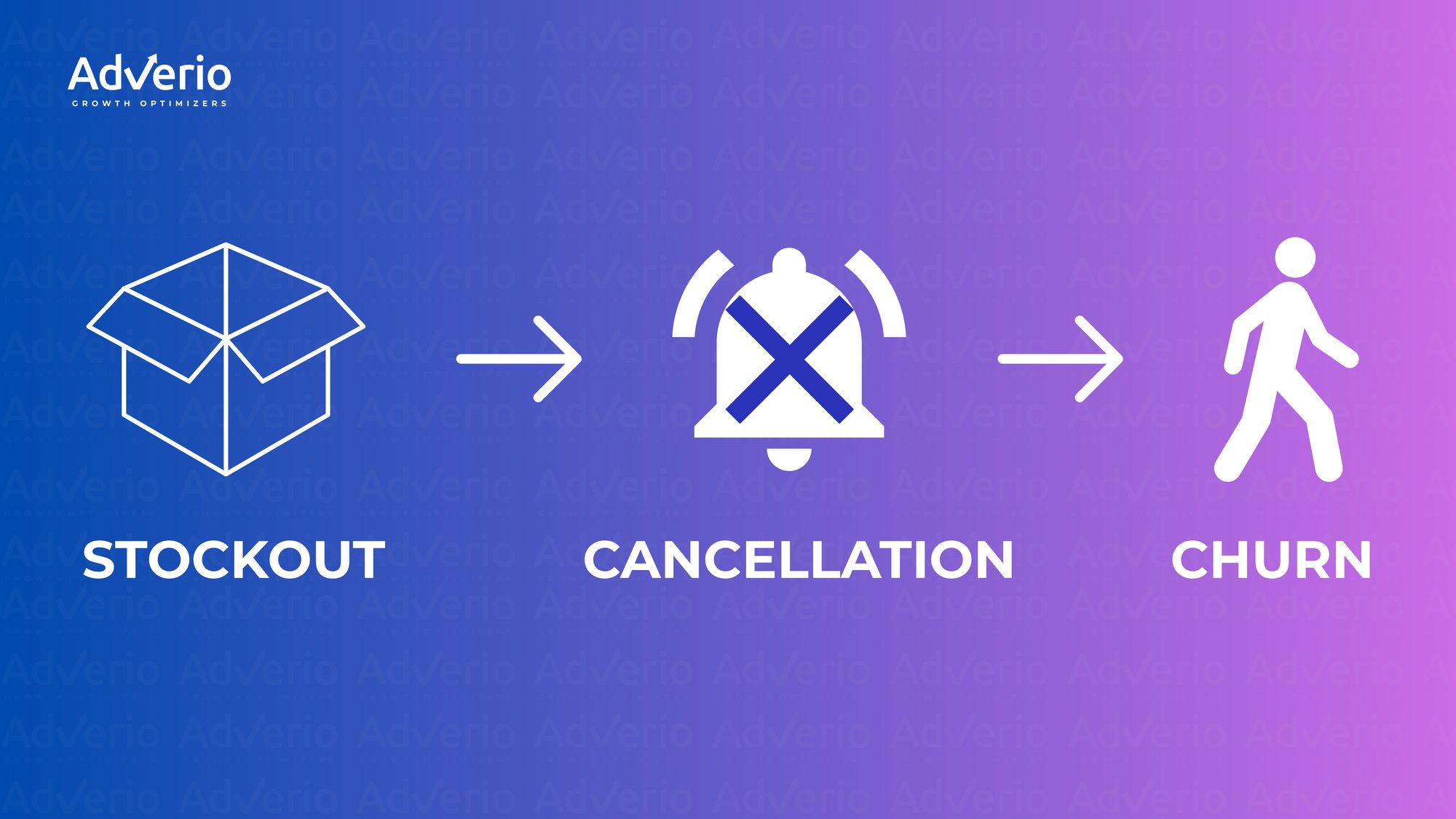
As you can see, a stockout isn’t a temporary pause; it directly triggers subscription cancellations and the permanent loss of high-LTV customers. This strategic allocation is about accepting a controllable, minor pain to avoid an uncontrollable, major one.
Set Your Inventory Rules in Stone
A strategy only works if it’s baked into your day-to-day operations.
- Set Aggressive Safety Stock Thresholds: Your hero SKUs on Amazon need significantly higher safety stock levels—think 45-60 days, not the standard 30.
- Establish Faster Reorder Triggers: The reorder point for hero ASINs must be set higher, kicking off replenishment actions much sooner to build a buffer against supply chain hiccups or FBA check-in delays.
- Create Clear Allocation Rules: Your team needs a simple, unbreakable rule: when inventory is constrained, the top 5% of Amazon ASINs get dibs. No exceptions.
An accurate forecast is the bedrock of any sound inventory plan. To prevent costly stockouts, you have to improve forecast accuracy continuously. Furthermore, a deep dive into utilizing SKU economics on Amazon can reveal which products truly deserve the “hero” designation based on net profitability, not just revenue.
By building your inventory strategy around protecting your most profitable assets first, you shift from a cost-center mindset to a profit-protection machine.
Mastering Your IPI Score and FBA Constraints
If you’re selling on Amazon, your Inventory Performance Index (IPI) score is a rule you can’t ignore. It’s Amazon’s credit score for your operational health.
A bad score triggers strict limits on how much inventory you can send to FBA. For a growing brand, hitting that wall is like trying to accelerate with the parking brake engaged. You have the demand, but Amazon won’t let you stock enough to meet it.

The Four Pillars of Your IPI Score
Your IPI score isn’t a black box. It’s a calculation based on four key metrics. Mastering Amazon inventory management means mastering these four things.
- Excess Inventory %: How much of your inventory is just sitting there, collecting dust and fees?
- FBA Sell-Through Rate: This proves you’re turning units into cash efficiently. A high rate is gold.
- Stranded Inventory %: Inventory stuck in FBA that isn’t tied to a buyable listing. It’s useless and tanks your score.
- FBA In-Stock Rate: Amazon wants you to keep popular ASINs in stock. Running out of bestsellers signals you can’t manage your supply chain.
Turning the IPI Score into a Competitive Advantage
Most sellers see the IPI score as a punishment. Smart operators treat it as a lever for growth. A consistently high score (above 400) unlocks more storage capacity, giving you a massive edge over disorganized competitors, especially during Q4.
The playbook is simple:
- Fix Stranded Inventory First: Go after these like they’re on fire. These are often easy wins that give you an immediate IPI boost.
- Liquidate Excess Inventory: Get ruthless. Create a removal order or run a steep lightning deal on anything that hasn’t sold in over 90 days.
- Obsess Over Sell-Through: Your ad spend, pricing, and replenishment schedule need to work in concert to keep your top products flying off the shelves. This is more critical than ever, so you must navigate Amazon’s 2024 low-inventory fee and other changes to protect your margins and your IPI.
Maintaining a high IPI score isn’t about appeasing Amazon. It’s about building a more efficient, profitable operation that the algorithm is forced to reward.
Stop Letting Stockouts Bleed You Dry
The takeaway is simple: stockouts aren’t a short-term headache. They’re a long-term wound that costs you market share, ad efficiency, and the recurring revenue that keeps your business healthy.
Protecting your top-performing ASINs—especially those with Subscribe & Save momentum—is one of the highest-leverage actions you can take. Shifting to a proactive approach to Amazon inventory management isn’t just “good operations”; it’s a core growth strategy.
If you’re sick of putting out inventory fires and want a system that protects your profits, it’s time to get serious.
The real cost of a stockout isn’t just the sales you lose today. It’s the market share, ranking, and customer LTV you give away for the next six months.
Want to bulletproof your top SKUs from Amazon stockouts? Book a free inventory strategy call, and we’ll show you how to set up a safety-stock system that protects your profits.