



Table of Contents
Stop treating traffic like gold. Treat it like dynamite, and conversion rate like the fuse.
Most e-commerce brands are already buying traffic. The problem isn’t traffic — it’s that your conversion system isn’t built to turn that traffic into profit.. That’s like lighting a bomb half-buried in sand, no explosion. If you want that traffic to convert into profit, you need a system that removes friction across your entire funnel — not just more visitors. You have to remove every ounce of friction standing between them and the checkout button.
Why Your Conversion Rate Is a Ticking Time Bomb
Your conversion rate isn’t just another KPI. It’s the pulse of your ecommerce profitability. Too many brands fall into the trap of “Optimization Myopia,” obsessing over top-line revenue or Advertising Cost of Sales (ACoS) while their profit margins slowly bleed out. This tunnel vision is a silent killer because it completely ignores how efficiently you’re turning ad spend into actual sales.
Chasing industry averages is a dead-end street. Knowing the benchmarks is fine, but your real focus needs to be on your own storefront, your own products, and your own customers.
Want to see exactly how much revenue you’re leaving on the table? Here’s what that looks like in real revenue impact: Book Your ROI Forecast, and we’ll show you the precise financial impact our approach can deliver for your brand.
Benchmarks Are a Starting Point, Not the Finish Line
Sure, you’ll see stats floating around that the average global ecommerce conversion rate is between 2.5% and 3%. But those numbers are all over the place. Food and beverage brands might hit 6.11%, while high-ticket luxury goods could hover around 1.19% because of the longer decision-making process. You can dig into more of these industry-specific numbers to get a general feel for where you are. (Discover more insights about ecommerce conversion rates on redstagfulfillment.com)
Here’s what actually matters: those are just reference points. What really matters is your context. A “good” conversion rate for you depends entirely on a few key factors:
-
Product Category: High-consideration items like furniture will never convert at the same rate as an impulse buy like a phone case.
-
Price Point: A $1,000 piece of equipment is a much bigger decision than a $20 t-shirt. Expect lower conversion rates.
-
Traffic Source: Someone coming from a targeted Google search is way more likely to buy than someone scrolling through Instagram.
The goal isn’t to hit some arbitrary number. It’s to figure out your baseline and then systematically improve it. Even tiny lifts can have a massive impact on your bottom line.
The difference between a 2% and 3% conversion rate isn’t a 1% increase; it’s a 50% increase in sales volume from the exact same amount of traffic. This is the lever that turns stagnant brands into market leaders.
The Real Impact of a 1% Conversion Rate Increase
It’s easy to dismiss a small percentage lift as insignificant, but the math tells a different story. Let’s look at how even a modest 1% bump in conversion rate (CR) can translate into serious revenue growth. This isn’t just a vanity metric; it’s a direct line to your profitability.
| Current Monthly Revenue | Current Conversion Rate | New Conversion Rate | Projected Monthly Revenue Growth |
|---|---|---|---|
| $250,000 | 1.5% | 2.5% | +$166,667 |
| $500,000 | 2.0% | 3.0% | +$250,000 |
| $1,000,000 | 2.5% | 3.5% | +$400,000 |
See the difference? We’re talking about hundreds of thousands of dollars in new revenue from the traffic you already have.
This is why we focus on conversion rate as a profit lever, not just a performance metric — because even small lifts compound across your entire revenue system.
Shifting your focus from chasing clicks to optimizing the entire customer journey is the first critical step. For a deeper dive, check out this practical guide on how to improve ecommerce conversion rates, which is packed with strategies specifically for the fashion industry. This kind of thinking sets the stage for the profit-focused tactics we’ll cover next, helping you move from just tracking numbers to actively building a more profitable business.
Conducting a Profit-Driven CRO Audit
Before you touch a single product title or ad campaign, you need an accurate diagnosis of what’s actually broken. Grabbing a generic CRO checklist off the internet is a surefire way to waste time on low-impact tweaks while your real profit leaks go ignored. A meaningful effort to improve your ecommerce conversion rate starts with a deep, profit-focused audit — this is exactly what our eCommerce CRO & Profit Audit is designed to uncover.
This is exactly what our eCommerce CRO & Profit Audit is designed to uncover.
This isn’t about guesswork; it’s about a methodical investigation into every stage of your customer’s journey. The goal is to get past surface-level metrics and find the root causes of underperformance. It’s a simple, powerful cycle: define what to look for, measure its impact, and then prioritize improvements.
We don’t call this just a “CRO audit.” We call it the Profit‑First CRO Loop, a relentless cycle of Diagnose → Fix → Validate.
This is the same system we use across multi-million dollar catalogs to identify where profit is leaking — and fix it fast.
-
Diagnose with hard data (listing quality, funnel leaks, checkout friction).
-
Fix only the highest-impact problems based on potential profit lift, not guesswork or gut feelings.
-
Validate with controlled A/B tests and measurement, so every change is an investment — not a gamble.
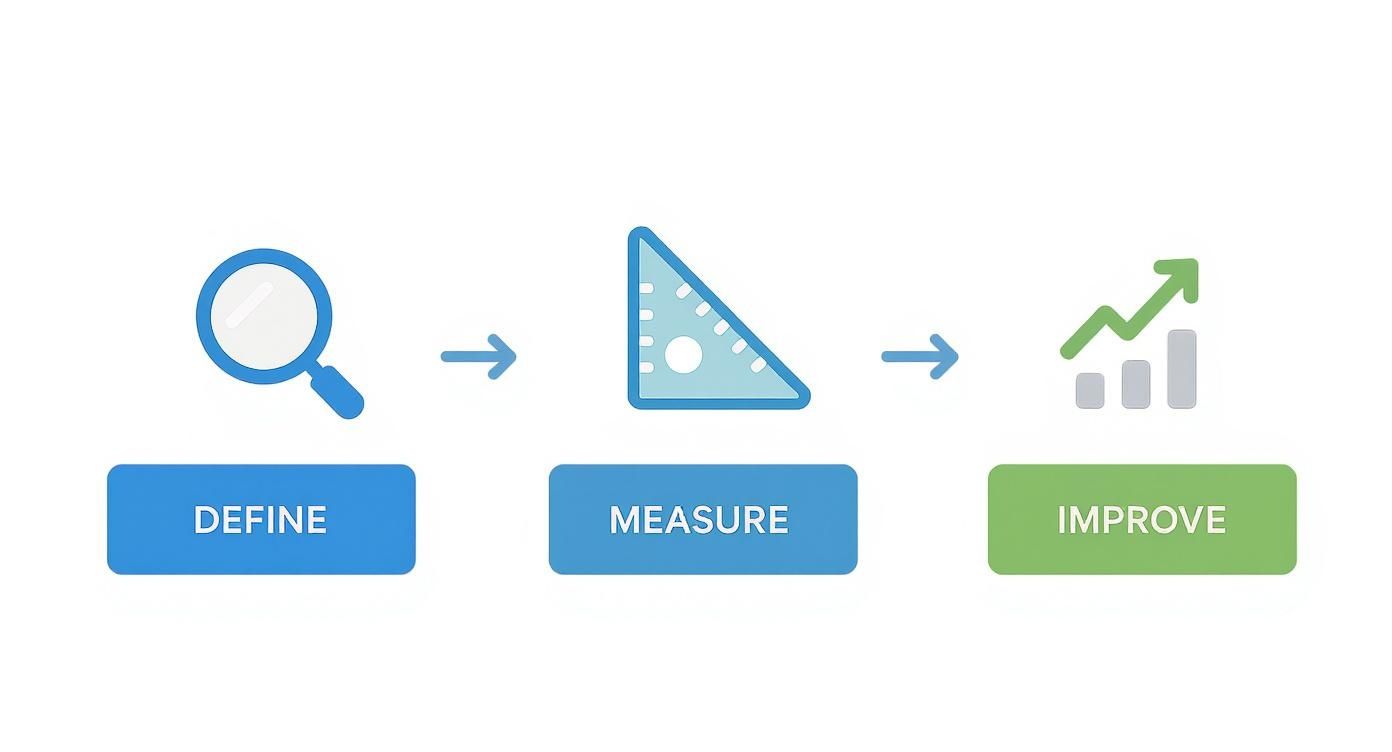
This process breaks down conversion optimization into its core parts—defining goals, measuring performance, and making data-backed improvements—creating a clear path to growth.
Diagnosing Performance Gaps with Precision
A proper audit starts by asking the right questions. Instead of just asking, “Why is my conversion rate low?” we dig deeper into specific performance indicators using our proprietary frameworks. This data-driven approach removes emotion and points directly to the highest-impact opportunities.
-
Listing Quality Score (LQS) Analysis: We assess every component of your product listings—from title character count and image resolution to the quality of your A+ Content. A low LQS on Walmart or a poorly optimized Amazon listing is a direct barrier to conversion.
-
Profit Pulse System (PPS) Scan: This system goes beyond simple sales data to identify where your profits are actually leaking. It analyzes SKU-level profitability against ad spend, returns, and fees, flagging products that look good on the revenue line but are actually profit-negative.
-
SKU Resurrection: We identify listings that were once top performers but have since declined. This helps us diagnose the cause—be it new competition, algorithm changes, or negative reviews—and builds a roadmap to get them back on track.
Identifying Key Conversion Challenges on Amazon
Our audits consistently demonstrate that underperformance is often due to a few significant issues rather than numerous minor ones. By concentrating your analysis on these common factors, you can develop a priority-driven action plan that yields quicker results.
-
A Breakdown in Trust: Consumers tend to be skeptical. The absence of clear trust indicators, such as an easily accessible returns policy, customer reviews, and secure payment badges, can cause hesitation at critical moments. Your audit should clearly identify where these trust elements are lacking, particularly during the checkout process.
-
Vague or Weak Value Propositions: Product pages, primarily images and videos, must immediately answer the question, “Why should I purchase this from you?” If your content merely lists features rather than benefits that speak to their pain points and your enhanced content appears as a dense block of text, your value proposition is ineffective. Customers need to perceive the value, not just the specifications.
By focusing on these two key areas, Amazon sellers can optimize their conversion rates effectively.
Optimizing Your Listings and Creative
Think of your product listing as your top digital salesperson. If your conversion rate is flat, it’s probably because this salesperson is underperforming—mumbling the pitch, showing blurry photos, and failing to close the deal. Real conversion growth happens when you move beyond basic keyword stuffing and start treating your creative like a science.
This is where you stop optimizing just for algorithms and start persuading actual humans.
High-performing brands rebuild listings based on customer intent, not keyword stuffing. Then, you rebuild them with a singular focus on the customer’s mindset. It’s about answering their unspoken questions, crushing their objections, and making the decision to buy feel both logical and inevitable.

From Features to Benefits in Your Copy
Most brands make the exact same mistake: they describe product features. A conversion-optimized listing translates those features into tangible benefits. Nobody buys a drill bit because they want a quarter-inch hole; they buy it to hang a family portrait. Your copy has to connect your product to your customer’s desired outcome.
Here’s a practical breakdown of how to reframe your copy:
-
Titles: Your title needs to do more than just list keywords. It has to grab attention and communicate the product’s main benefit in under two seconds. Instead of “Waterproof Hiking Boot, Size 10, Brown,” try something like “Men’s All-Weather Hiking Boot for Dry, Comfortable All-Day Treks.” The second version sells a solution, not just a product.
-
Bullet Points: This is your chance to handle objections before they even form in the shopper’s mind. Each bullet should hit a key benefit or solve a potential problem. Structure them to tell a quick story, starting with the most critical benefit and moving to supporting details.
-
A+ Content: Use this space for brand storytelling and visual persuasion. Show your product in action. Use lifestyle images that help the customer see themselves using it and benefiting from it. This is where you build an emotional connection that features and specs alone never could.
Using Data to Inform Creative Strategy
Your creative choices shouldn’t be based on guesswork. Advanced marketplace tools provide a treasure trove of data that can directly inform your listing optimization strategy, turning art into a calculated science.
A perfect example is Amazon’s Market Basket Analysis. This tool shows you what other products your customers frequently buy along with yours. If you sell yoga mats and discover customers often buy foam rollers at the same time, that’s a powerful insight. You can then feature that foam roller in your yoga mat’s A+ Content, creating a natural cross-sell that boosts Average Order Value (AOV) and conversions.
At Adverio, we systemize this with our Listing Quality Score (LQS) framework. It’s an internal audit that scores every single element of your listing—from image compliance on Walmart to keyword density in your Target title—against hundreds of data points. This ensures nothing is left to chance. To truly master this, you need a structured system for listing optimization — not guesswork. Our Amazon Listing Optimization service applies this at scale across your catalog.
Mastering Mobile-First Visual Storytelling
Most brands lose conversions on mobile not because of traffic volume, but because their messaging fails to communicate value fast enough. On a small screen, shoppers make split-second decisions — if your main image, title, and first impression don’t immediately establish trust and clarity, they scroll past without hesitation.
High-performing brands optimize mobile as a conversion environment, not just a responsive layout — prioritizing clarity, speed, and immediate value communication.
On a small screen, your main image and the first few lines of your title are doing 90% of the selling. If they don’t instantly communicate value and build trust, the shopper will scroll right past you.
Optimizing for mobile means your visuals must tell a story instantly. Your hero image needs to be clear, compelling, and immediately understandable. Use infographics in your secondary images to highlight key benefits without forcing someone to read dense text. Your A+ Content should use modular, easy-to-scan layouts that look great on a vertical screen. Every creative asset has to be designed with the mobile user’s short attention span in mind.
Driving High-Converting Traffic to Your Pages
A perfectly optimized listing is useless if the wrong people are seeing it. Driving traffic is easy—any agency can buy impressions. The real challenge is attracting profitable, high-intent traffic that’s ready to buy before they even click.
This means breaking away from the dangerous myth of ACoS-only optimization. Focusing just on ACoS is a classic case of Optimization Myopia; it might make your ad reports look clean, but it often sacrifices total sales and market share by ignoring the full customer journey. You end up winning small battles while losing the war for profit.
Moving Beyond Keywords to Audience Signals
This is where a full-funnel approach, combining high-performance PPC with advanced DSP capabilities, becomes a game-changer — this is how our Amazon DSP & PPC management service builds high-intent traffic pipelines.
Instead of only targeting a shopper searching for “hiking boots,” you can use DSP to reach audiences who have:
-
Recently browsed competitor boot brands.
-
Viewed hiking apparel in the last 30 days.
-
Purchased from your brand in the past but haven’t returned.
This allows you to build campaigns that guide customers from initial awareness all the way to purchase. You’re not just finding customers; you’re creating them by making sure the traffic hitting your newly optimized listings is already warm.
Architecting a Full-Funnel Advertising Strategy
Structuring your campaigns to match the customer journey is critical. A scattergun approach wastes money and sends low-intent traffic to your pages, torpedoing your conversion rate. A smarter structure aligns ad types with specific goals.
Top of Funnel (Awareness)
Use broad targeting and Sponsored Display ads to introduce your brand to new audiences. The goal here isn’t an immediate sale but to plant a seed and drive initial consideration. Think of it as opening the conversation.
Mid Funnel (Consideration)
This is where you retarget shoppers who have shown interest but haven’t converted. Use DSP to show them ads featuring different benefits or lifestyle imagery, pulling them back to your product page for a second look. You’re reminding them why they were interested in the first place.
Bottom of Funnel (Purchase)
Deploy highly targeted Sponsored Products campaigns for shoppers actively searching for your product or direct competitors. This is your closing argument, designed to capture the sale when purchase intent is at its absolute peak. This is how we structure campaigns inside our Amazon PPC management system to maximize profit — not just ACoS.
Your advertising shouldn’t just be an expense; it’s a strategic investment in steering the right customers to your digital doorstep. When your a
d strategy and your listing optimization work in tandem, you create a powerful conversion engine that drives profitable growth.
Retargeting to Recover Lost Sales
Even with a perfect strategy, not every visitor will convert on their first visit. Data from ConvertCart reveals that approximately 70.2% of online shopping carts are abandoned—a massive leak in potential revenue.
Smart retargeting is your tool for plugging that leak. By showing relevant ads to shoppers who added items to their cart but didn’t check out, you stay top-of-mind and give them a gentle nudge to complete their purchase. This approach is highly effective; channels like email marketing see conversion rates over 10.3% when used for targeted follow-ups.
Using Advanced Tactics and Measurement
Once your listings are solid and your traffic strategy is working, it’s time to hit the accelerator. Foundational fixes are great for plugging the most obvious leaks, but the advanced tactics are what separate the market leaders from everyone else. This is where you graduate from best practices and build a data-driven engine for continuous improvement.
Stop throwing changes at the wall to see what sticks. A structured approach to testing and measurement kills the guesswork. It allows you to build on your wins and learn from every single experiment—without tanking your sales velocity. The goal here is to create a feedback loop where every dollar you spend and every tweak you make delivers a measurable, incremental lift.

Implement a Systematic A/B Testing Program
A/B testing on marketplaces isn’t about fussing over button colors. Your product listing is your highest-leverage conversion asset. It’s a disciplined process for validating high-impact hypotheses around your pricing, creative, and copy. When you do it right, it’s the most powerful tool you have for figuring out exactly what drives customer behavior.
But a random approach can wreck your sales rank and velocity. A prioritized testing program is a must. We use a simple matrix to decide what to test first, focusing on changes that offer the highest potential impact for the lowest effort.
A/B Testing Priority Matrix for E-commerce
This framework helps you prioritize your tests to ensure you’re getting the biggest bang for your buck without wasting time on low-impact changes.
| Test Element | Potential Impact (High/Med/Low) | Implementation Effort (High/Med/Low) | Recommended Action |
|---|---|---|---|
| Main Product Image | High | Low | Test First: Swap in a new hero image focused on a different benefit or lifestyle context. |
| Product Title | High | Low | Test First: Alter the title to lead with a key benefit instead of a feature. |
| Pricing Strategy | High | Medium | Test Carefully: Experiment with a 5% price increase or decrease on a non-hero SKU. |
| A+ Content Layout | Medium | High | Test Later: Redesign a module to focus on visual storytelling versus text-heavy specs. |
Focusing on high-impact, low-effort tests first builds momentum and delivers quick wins you can build on.
For a deeper look, our guide on the art of split-testing on Amazon offers small tweaks that drive big results. The key is to isolate variables and measure outcomes methodically.
Uncover User Behavior with Heatmaps and Recordings
While direct A/B testing on marketplaces has its limits, tools like heatmaps and session recordings on your Brand Storefronts or DTC site give you invaluable qualitative data. These tools show you precisely where users are clicking, how far they scroll, and where they get stuck.
-
Heatmaps reveal “hot spots” of engagement, showing you which images or headlines grab the most attention.
-
Session Recordings are like watching over a shopper’s shoulder, exposing moments of friction or confusion in real-time.
This kind of intelligence is gold. It helps you form much stronger hypotheses for your next A/B test and diagnose user experience problems that quantitative data alone would never show you.
Deploy Strategic Promotions and Recapture Abandoned Carts
Even with a perfect user experience, not every shopper is going to convert on the first visit. Strategic promotions and cart abandonment tactics are your final line of defense. But your approach has to be tailored to the platform.
On Amazon, this might mean strategically timed coupons or Lightning Deals to create urgency. For DTC channels, it’s all about sophisticated cart abandonment email sequences that overcome last-minute objections with a compelling offer or a simple reminder.
The market has adapted to these strategies. Year-over-year trends show global e-commerce conversion rates holding steady between 2.4% and 3.0% from 2021 to 2025, despite massive shifts in shopping behavior. Slight upticks to around 2.7% globally are often credited to smarter personalization and frictionless checkout processes that cut down on abandonment. This stability really highlights how important these advanced tactics are for gaining a competitive edge.
Looking beyond LQ scores, cart flow, or A/B splits, the winners in 2025 are those who treat their store as a brand destination, not a transaction site. That means building trust, communicating identity, and creating an experience worth buying into.
Tactical CRO gets you conversions. Strategic brand building gets you loyalty, higher AOV, and lifetime customers. The conversion flywheel isn’t just about checkout ease; it’s about emotional connection and perceived value.
From Plateau to Peak Performance
You now have the playbook. You’ve seen the frameworks for auditing performance, sharpening creative, and pulling in high-intent shoppers. The real question is, what are you going to do with it?
Too many brands get stuck just tinkering. A new A/B test here, a tweaked product title there. Then they wonder why they’re still parked on a growth plateau. This kind of fragmented approach is a recipe for mediocrity. Breaking through means ditching the random tasks and building a unified growth engine.
Adopt a Strategic Growth Engine
Sustainable growth isn’t about finding a single silver bullet. It’s about building a system that nails excellence across the three core pillars of our Growth Cultivator framework:
-
Profit-Driven Catalog Optimization: This is your foundation. It means every single listing is meticulously tuned not just for algorithms, but for human psychology and—most importantly—for profit.
-
Intelligent Growth Marketing: Forget chasing vanity metrics like ACoS. A winning strategy combines high-performance PPC and advanced DSP to attract shoppers who are actually ready to buy, turning ad spend into a predictable revenue driver.
-
Holistic Marketplace CRO: This is the connective tissue. It’s a nonstop cycle of testing, measuring, and refining every single touchpoint to systematically lift performance and widen your competitive moat.
Stop operating like a vendor to your own business, just patching leaks as they appear. It’s time to become the architect of a comprehensive system designed for one thing: profitable scale.
This is where brands shift from reactive optimization to predictable revenue growth. We don’t just run campaigns; we build the engine that powers your growth.
Ready to see what that actually looks like for your brand? Let’s move past the theory and get to the numbers.
Book Your ROI Forecast, and our team will build a custom projection that details the precise financial impact our partnership can deliver.
Frequently Asked Questions
What Is a Realistic Conversion Rate Improvement to Expect?
Honestly, it depends entirely on where you’re starting. If a brand’s listings are a mess and there are obvious performance gaps, a 20-30% lift in the first 90 days after a serious audit and overhaul is totally achievable.
But for a more mature brand that’s already doing a lot of things right? A 5-10% lift is a massive win. That might sound small, but at scale, those incremental gains translate directly into serious profit growth.
The real goal isn’t hitting some magic number. It’s about creating a system for continuous, data-backed improvement. That’s why we build a custom ROI forecast from day one, setting realistic goals that actually line up with your financial targets.
How Is Marketplace CRO Different from DTC CRO?
When you’re running your own DTC site, you’re the captain of the ship. You control everything—the homepage, the product page layout, the entire checkout flow. You can A/B test pretty much anything you can dream up.
On marketplaces like Amazon or Walmart, you’re playing in their sandbox, by their rules. That means CRO isn’t about massive, site-wide changes. It’s about absolutely mastering the handful of elements you can control.
Success on these platforms comes down to deep, platform-specific expertise. You have to be an expert at:
-
Listing Quality: Nailing your titles, bullet points, A+ Content, and images.
-
Creative Strategy: Using your visuals to tell a compelling story and preemptively answer customer questions.
-
Pricing and Promotions: Knowing exactly when and how to use coupons and deals to drive sales without killing your margin.
-
Advertising Efficiency: Funneling high-intent traffic to your listings—shoppers who are ready to pull out their wallets.
-
Review Management: Building up that critical social proof that creates trust and closes the sale.
It’s a different game entirely. You’re trying to maximize your visibility and persuasive power within a crowded, algorithm-driven world.
How Long Does It Take to See CRO Results?
You can see the needle move on high-impact, quick-win changes within a few weeks. Fixing a suppressed listing, rolling out properly optimized A+ Content, or tweaking your main image can give you a near-instant bump in your session-to-conversion rates.
But let’s be clear: true conversion rate optimization is an ongoing process, not a one-and-done project.
A sustained, long-term lift in your conversion rate comes from a continuous cycle of auditing, implementing, testing, and refining. It’s about building a growth engine, not just completing a task.
Our dedicated strategy pods are built to manage this entire engine for you. We typically show a measurable ROI and a clear performance lift within the first quarter of our partnership.
Want to Know Where Your Conversion Rate Is Leaking?
We’ll break down exactly where your conversion rate — and profit — is leaking.
You’ll get a clear breakdown of what’s limiting your conversion rate, what it’s costing you, and how to fix it.