


Table of Contents
Most advice about the Amazon supply chain is weak. It treats logistics like back-office plumbing. That’s how brands stay average.
The truth is harsher. Amazon Supply Chain by Amazon is a ranking system, a conversion system, and a margin system disguised as fulfillment. If you sell on Amazon and you’re not using that system with intent, you’re feeding competitors who are faster, cleaner, and better stocked than you are.
That matters even more when your catalog is wide, your inventory bets are larger, and your ad dollars are working every day. Speed changes conversion. Placement changes delivery promise. Inventory discipline protects rank. Operations isn’t separate from growth. It is growth.
If your team is still treating supply chain decisions like warehouse admin, you’re already behind.
The inventory management mechanics, IPI scoring, sell-through optimization, stranded inventory fixes, and replenishment discipline, live in the Amazon inventory management guide.
The FBA fee structure and inbound placement cost model live in the FBA inbound placement fees guide. What this guide covers is the strategic layer above both: how Amazon Supply Chain by Amazon works as a ranking, conversion, and margin system, and how to command it with intent.
If you want to see where that’s costing you right now, run an Adverio Profit ROI Forecast before you read further.
Deconstructing the Amazon Supply Chain Architecture
Treat the supply chain as a fee line and you miss the point. It’s a market share machine.
Amazon didn’t build a cute convenience layer. Amazon’s logistics network has expanded to over 200 million square feet of warehouse space and more than 175 fulfillment centers in the United States alone, with hundreds more delivery stations and sortation centers globally, according to logistics tracking data compiled in 2026.
That footprint is the point. It gives Amazon the physical reach to stock, route, and deliver at a speed most brands can’t replicate on their own.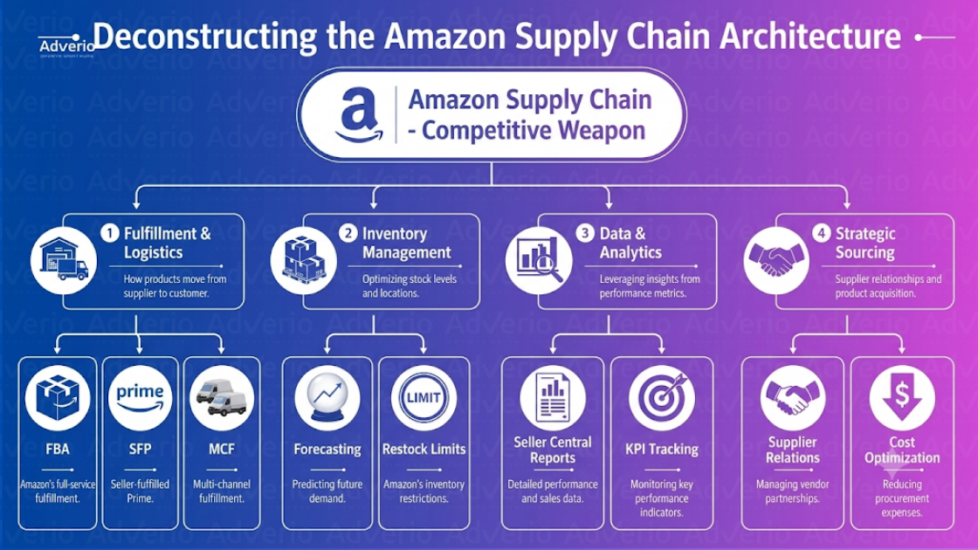
Why the architecture matters to your brand
The flashy part is delivery speed. The profitable part is what sits behind it.
Amazon’s supply chain achieves its 1-to-2-day Prime delivery window through a multi-tiered logistics setup that integrates sortation centers, AI-driven predictive inventory placement, and thousands of robotic units inside fulfillment centers, according to Amazon’s logistics and supply chain documentation. That means Amazon is not waiting for demand to happen. It’s trying to predict it before the click.
If your inventory is positioned well, you ride that machine. If it isn’t, you pay for your own sloppiness with slower delivery promises, weaker conversion, and wasted ad spend.
Practical rule: Your listing doesn’t compete only on keywords and reviews. It competes on operational readiness.
The four parts you can’t afford to ignore
| Pillar | What Amazon controls | What you must manage |
|---|---|---|
| Fulfillment | Storage, pick-pack-ship, routing speed | Inbound timing, replenishment discipline |
| Inventory placement | Where units sit relative to demand | Forecast accuracy, stock depth by ASIN |
| Data and analytics | Demand forecasting, warehousing logic | Interpreting inventory and profit signals |
| Strategic sourcing | Supplier and logistics economics | Cost control, lead times, reorder reliability |
A serious operator studies Amazon Supply Chain by Amazon the same way they study ad auctions. It changes what gets seen, what gets bought, and what stays profitable.
The brands that treat supply chain as a growth lever instead of back-office admin are the ones that compound advantage over time.
The mistake is thinking Amazon’s network is neutral. It isn’t. It rewards brands that feed it clean forecasts, healthy inventory flow, and operational discipline.
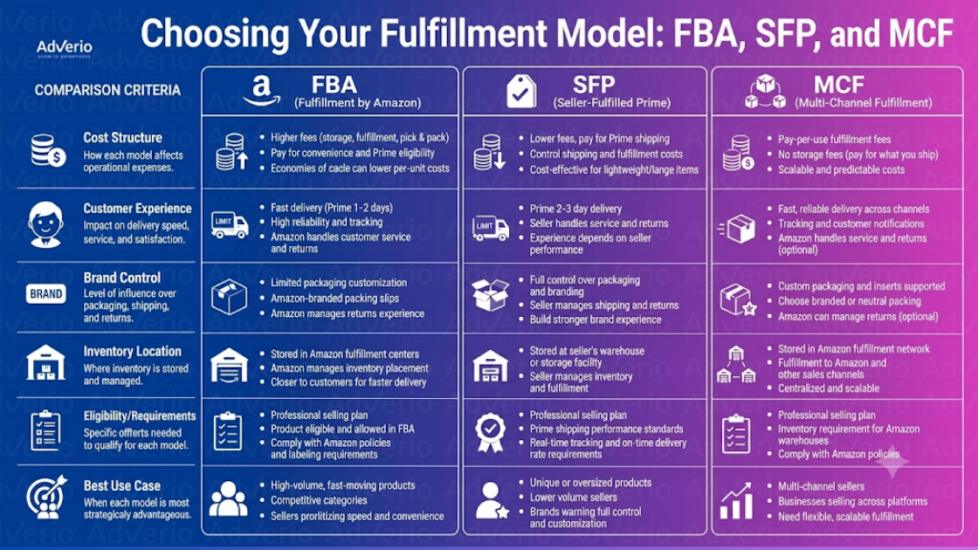
Choosing Your Fulfillment Model FBA SFP and MCF
Your fulfillment model is not an ops footnote. It decides who controls the customer experience, who absorbs complexity, and where your margin leaks.
Most established brands shouldn’t ask, “Which model is best?” They should ask, “Which model gives this catalog the best mix of speed, control, and contribution margin?”
FBA wins on scale but punishes lazy math
FBA is the obvious choice for many brands because Amazon handles storage, shipping, and customer-facing fulfillment at scale. That reduces operational drag and keeps you inside the Prime ecosystem. It also exposes you to fee pressure, storage inefficiency, and inbound mistakes that eat margin.
That’s why brands need a real guide for Amazon sellers on FBA fees before they expand assortment or push heavier inventory into FBA. Bad carton dimensions and poor velocity assumptions turn “convenience” into self-inflicted margin loss.
SFP gives control but demands operational maturity
Seller Fulfilled Prime looks attractive when packaging experience, warehouse control, or special handling matters. But SFP only works if your internal operation is tight. Not “pretty good.” Tight.
If your pick-pack-ship process slips, the customer doesn’t blame your warehouse. Amazon blames your account.
SFP is for brands that can execute like a logistics company, not brands that hope they can.
MCF can support channel expansion if you respect its trade-offs
Multi-Channel Fulfillment becomes interesting when your brand sells beyond Amazon and wants one pool of inventory to support broader fulfillment. That can reduce fragmentation. It can also create channel tension if your replenishment and routing logic are weak.
For brands dealing with prep complexity before inventory even reaches Amazon, outside specialists can be useful. Outside prep specialists can handle the labeling, bundling, and compliance work that creates inbound friction worth evaluating before scaling inbound volume.
Use a decision lens, not gut instinct
| Model | Best fit | Main advantage | Main risk |
|---|---|---|---|
| FBA | Fast-moving catalog, Prime-heavy strategy | Scale and speed | Fee creep and storage waste |
| SFP | Brands with strong internal fulfillment | More control | Operational failure risk |
| MCF | Multi-channel sellers needing fulfillment support | Broader inventory utility | Channel and inventory complexity |
The right answer for many brands is hybrid. Put hero ASINs into FBA. Keep selective SKUs in a controlled environment if packaging, margin, or operational logic demands it. Use MCF only when you’ve mapped the economics, not because it sounds efficient.
Weak operators pick one model and hope. Strong operators assign models by ASIN behavior, margin profile, and service requirement.
The Data and KPIs That Separate Winners from Losers
Revenue is a vanity metric when your inventory is choking, your fees are climbing, and your stock position is unstable. ACoS alone won’t save you either. That’s Optimization Myopia. It’s what happens when a brand obsesses over ad efficiency while the operational foundation collapses underneath it.

The KPI stack that actually matters
You need a tighter scoreboard. The full IPI, sell-through, and stranded inventory diagnostic lives in the Amazon inventory management guide. The metrics below are the strategic layer: how to connect operational signals to media and catalog decisions.
-
IPI and storage health: This tells you whether Amazon sees your inventory behavior as efficient or wasteful.
-
Sell-through rate: This exposes whether your stock is moving fast enough to justify its footprint.
-
Stranded inventory: Units that can’t sell are dead capital.
-
Regional stock levels: Inventory placement affects delivery speed and customer promise.
-
ASIN-level contribution margin: Revenue without margin is noise.
A brand that tracks only ad spend and sales is driving with the radio on and the windshield painted black.
Connect operations to financial truth
The operational layer and P&L layer have to talk. If they don’t, your team makes bad decisions faster.
| KPI | What it tells you | What to do with it |
|---|---|---|
| IPI | Inventory efficiency inside Amazon’s system | Trim slow movers, fix replenishment logic |
| Sell-through | How fast units convert to revenue | Adjust forecasts and reorder timing |
| Stranded inventory | What capital is stuck | Resolve listing, compliance, or catalog issues |
| Regional in-stock status | Where speed advantage exists or fails | Align replenishment and media support |
| Contribution margin by ASIN | Which products deserve scale | Cut spend on weak-unit-economics SKUs |
This is where understanding Amazon ad efficiency gets more useful when paired with operational data. PPC metrics on their own tell you how ads performed. They don’t tell you whether the ASIN should have been scaled in the first place.
The best Amazon operators don’t separate inventory health from marketing performance. They treat them as one control system.
If your dashboard can’t show inventory, advertising, catalog status, and profitability in one place, you don’t have visibility. You have fragments.
Common Supply Chain Pitfalls That Bleed Profit
The ugliest supply chain mistakes don’t look dramatic in the moment. They just keep draining money while teams stay busy and call it progress.
Stockouts don’t just lose sales
A hero ASIN going out of stock is not a pause button. It’s a self-inflicted ranking reset.
When inventory disappears, your ads become unstable, your organic momentum weakens, and your recovery costs more than prevention ever would. The fix is boring and brutal. Forecast earlier. Replenish sooner. Stop pretending your best-selling ASIN will “probably be fine.”
Overstock is just slower failure
Too much inventory feels safe. It isn’t. It ties up cash, invites storage pain, and lowers operational flexibility. Wide catalogs hide this damage fastest, which is why a disciplined large-catalog Amazon management approach pays for itself.
That’s why an intentional Amazon IPI strategy matters. High-performing brands don’t just avoid stockouts. They avoid dead weight. There’s a difference.
Returns and dimensions can destroy a good product
Some products don’t have a demand problem. They have a handling problem, a packaging problem, or a fee classification problem.
Watch for these warning signs:
-
Margin drift: Your sales stay stable but profit keeps narrowing.
-
Unexpected fee pressure: Dimensions, weight, or storage assumptions are off.
-
Return concentration: A few ASINs create a disproportionate operational mess.
-
Catalog bloat: Too many low-velocity variations clog the system.
| Pitfall | Early warning sign | Action |
|---|---|---|
| Stockout risk | Fast sales with thin weeks of cover | Build replenishment triggers by ASIN |
| Overstock | Slow sell-through and aging units | Cut inbound volume and clean the catalog |
| Fee creep | Margin compression without sales drop | Audit dimensions, prep, and packaging |
| Return drag | Repeated customer dissatisfaction patterns | Fix listing clarity, product expectations, packaging |
Bad supply chain habits rarely announce themselves. They show up later in lower margin, weaker rank, and cash tied up where it shouldn’t be.
The brands that win on Amazon don’t accept “small” operational leaks. They hunt them. Every week.
Not sure which leaks are draining your margin? A Profit ROI Forecast finds them and sizes them in dollars.
Advanced Strategies to Turn Logistics into a Weapon
Average operators react to inventory. The strong ones orchestrate it.
That shift changes everything. Once you tie logistics data to media execution, you stop wasting spend on SKUs that can’t support velocity and start using availability as a competitive edge.
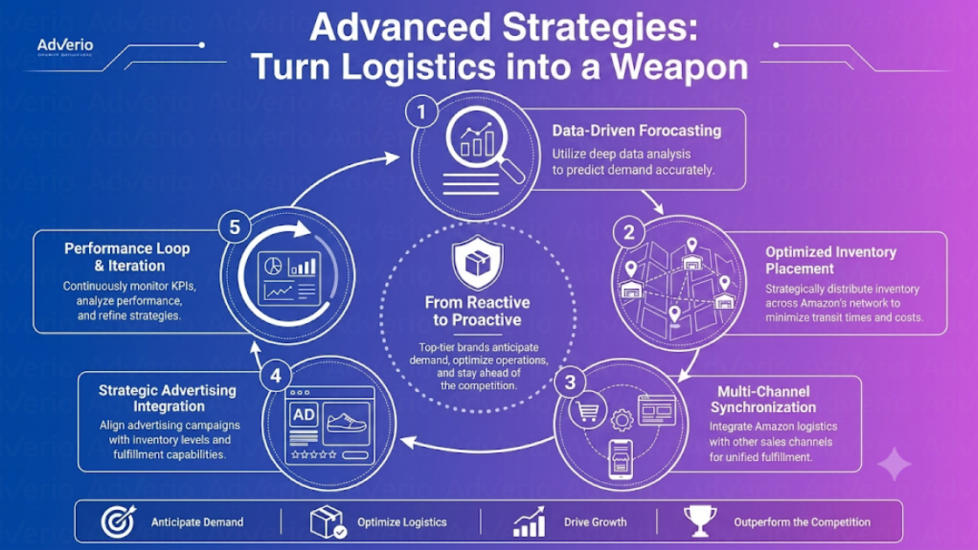
Sync media with stock reality
Do not keep funding aggressive PPC on low-stock SKUs. That’s not growth. That’s self-sabotage.
Coordinating bids against live stock health isn’t a campaign task, it’s a system. That’s the backbone of Adverio’s Amazon PPC management built for incrementality.
Run a simple operating rule set:
-
Protect hero ASINs first when weeks of cover tighten.
-
Reduce bids or pause campaigns for listings heading toward stock pressure.
-
Shift spend to healthy substitutes in the same category or variation family.
-
Rebuild velocity only after inventory normalizes.
This is how grown-up operators use supply chain data. Not as reporting. As decision control.
Use placement speed as a conversion advantage
Amazon’s last-mile innovation points to where the platform keeps heading.Amazon Prime Air delivers packages under 5 pounds within a 7.5-mile radius of its drone delivery centers, and the broader model uses AI to predict demand and pre-position inventory near likely buyers. You don’t need drones to benefit from that logic. You need inventory positioned where demand is likely to hit first.
That should influence how you launch, promote, and replenish.
Build a tighter execution loop
| Strategy | Why it works | What to do now |
|---|---|---|
| Inventory-based bid controls | Prevents wasted spend on fragile stock | Create bid rules tied to stock thresholds |
| Regional inventory awareness | Improves delivery promise where stock is close | Support high-availability zones first |
| Launch timing around inbound health | Avoids paid traffic hitting weak replenishment | Delay aggressive pushes until inventory lands |
| Event planning by operational readiness | Protects margin during peak periods | Align promos with confirmed capacity |
If you’re planning peak events, you need sharper timing than most brands use. The right question before any peak event is simple: can your operation support the demand you want to generate? If inventory, inbound timing, and fulfillment readiness are not confirmed before the campaign goes live, the event will cost more than it returns.
You also need to understand fee impact before pushing more units through the network. That’s where Adverio’s guide to Amazon FBA fees becomes operationally relevant, not theoretical.
Fast delivery is not just a customer perk. It’s a conversion asset you can amplify or waste.
The brands taking share aren’t always the ones with the loudest ads. They’re the ones whose inventory, availability, and promotion strategy agree with each other.
How Adverio Turns Your Supply Chain into a Growth Engine
Knowing the mechanics is easy. Running them across a multi-variant catalog without crushing margin frequently results in failure.
That failure usually looks familiar. PPC is managed in one silo. Catalog issues live somewhere else. Inventory risk shows up too late. DSP runs without operational context. Finance sees the damage after the fact. By then, the brand is paying for avoidable mistakes in storage, stockouts, wasted ad spend, and weak conversion.
Execution beats theory
The fix is not another dashboard no one trusts. The fix is a system.
Adverio builds around a Proprietary Growth Cultivator framework that ties catalog health, media performance, and operational decisions together. That includes the Three Strategic Pillars: Profit-Driven Catalog Optimization, Intelligent Growth Marketing, and Full-Funnel Marketplace Conversion Rate Optimization. The names matter less than the discipline behind them. Every lever gets pushed against profit, not vanity growth.
What serious brands should demand from a partner
You should expect more than ad management.
-
Profit-first control: Budget decisions should reflect margin reality, not channel ego.
-
Marketplace specialization: Amazon, Walmart, and Target require different operator muscles.
-
Real operational pods: Dedicated strategy and operations support beats generic account coverage. This is the spine of Adverio’s end-to-end Amazon account management.
-
Full-funnel reporting: Listings, PPC, DSP, operations, and BI should connect.
-
Clear service model: Some brands need Done-for-You. Others need Done-with-You.
Adverio’s internal systems are built for that operator standard. Profit Pulse System, AMOS, GEAR, LQS, PPS, SKU Resurrection, Brand Drain Reversal, and RegionRank are not decorative labels. They’re part of the IP stack used to diagnose profit leaks, recover stranded opportunities, and push stronger marketplace execution.
That matters for brands with large catalogs, softlines complexity, hardlines operational friction, and teams overwhelmed by DSP, AI listing management, compliance, or reseller disruption. If you’re already doing meaningful revenue and growth still feels messy, the issue usually isn’t effort. It’s system design.
The partner model that separates operators from vendors
A real growth partner behaves like a financial operator, not a media vendor.
That means:
| Need | Weak agency response | Strong operator response |
|---|---|---|
| Plateaued growth | Increase spend | Rework catalog, margin, and media mix |
| Low visibility | Send screenshots | Deliver unified reporting and action plans |
| Marketplace complexity | Hand-wave by platform | Deploy channel-specific specialists |
| Profit pressure | Chase top-line sales | Rebuild contribution economics |
Brands frustrated by black-box platforms or reseller chaos don’t need more abstraction. They need people who can own the mess and turn it into a system.
That’s the difference between generic service and Adverio.
Frequently Asked Questions
How do returns affect supply chain performance on Amazon
Returns don’t just dent revenue. They create operational drag, distort inventory visibility, and can keep units from becoming sellable again quickly. If a product has chronic return issues, don’t treat that as a customer service problem only. Audit listing clarity, packaging protection, product expectation setting, and ASIN-level economics.
Does supply chain performance affect Buy Box strength
Yes. Not in isolation, but poor fulfillment reliability, weak in-stock position, and inconsistent delivery promise make your offer less competitive. Amazon rewards operators that reduce friction for the customer. If your offer creates uncertainty, your listing becomes easier to displace.
What should a brand do with FBA removal decisions
Don’t default to removal because storage pressure makes you nervous. First separate temporary underperformance from structural underperformance. If the ASIN still has strategic value, fix the listing, review velocity, pricing, or media support before you pull units. Removal should be a calculated move, not a panic response.
Can Amazon’s international network support expansion
Yes, but expansion only works when you treat each market as an operating model, not a translation project. Product compliance, replenishment timing, local demand shape, and catalog structure all need to be evaluated before you spread inventory across more regions. Expansion without operational control is expensive cosplay.
What is the biggest mistake established brands make with Amazon Supply Chain by Amazon
They treat it like a fixed system instead of a controllable advantage. The brands that win don’t just send inventory into Amazon and hope for the best. They decide which ASINs deserve FBA speed, which need tighter stock rules, where media should accelerate demand, and where logistics should protect margin.
If your brand is stuck between growth and profitability, that’s usually not a traffic problem. It’s a coordination problem.
Adverio helps established brands turn marketplace chaos into a profit system across Amazon, Target, and Walmart. If your catalog is wide, your margins are under pressure, or your team is buried in PPC, DSP, listing, and operational complexity, stop guessing.
15-minute diagnostic call. No pitch deck.