


Table of Contents
Most advice on Amazon DSP incrementality testing is too soft. It treats “lift” like proof. It isn’t.
If your agency is still reporting attributed sales, post-view conversions, and blended ROAS without a clean control group, you’re not measuring growth. You’re measuring how efficiently Amazon helped you re-label demand that may have happened anyway. That’s not strategy. That’s margin erosion with prettier dashboards.
The brands that win on Amazon don’t just buy reach. They prove profit contribution.
The foundational incrementality framework, holdout testing, pause tests, branded search cannibalization analysis, and how to judge whether any campaign creates net-new demand, lives in the Amazon incrementality measurement guide. What this guide adds is the DSP-specific testing layer: the four test types available inside Amazon’s ad stack, how to calculate statistical significance before you run a test, and how to isolate halo sales in AMC.
They separate causal impact from cannibalized organic sales, branded search capture, and retargeting noise. That’s where Amazon DSP incrementality testing stops being a reporting exercise and starts functioning as a financial control system.
If your current setup can’t tell your CFO what DSP added, you have a measurement problem. Get your Profit ROI Forecast. 15-minute diagnostic call. No pitch deck.
Amazon DSP incrementality testing proves whether DSP ads created net-new profit or just recaptured demand you already owned. Run an RCT, geo-lift, or PSA holdout with a clean control group and a 95% confidence threshold set before launch. Read the exposed-versus-control gap, subtract media cost, and check halo sales on non-advertised SKUs in AMC. The result is a capital allocation decision, not a dashboard.
Why Your DSP ‘Lift’ Is Likely Cannibalization
A lot of brands celebrate DSP “sales lift” far too early. They see attributed revenue rise and assume the campaign created net-new demand. In plenty of cases, it didn’t. It just intercepted shoppers who were already moving toward purchase.
That is the trap. You obsess over the visible metric and ignore the financial reality underneath it. The broader pattern of how optimization myopia shows up across Sponsored Products, branded search, and DSP is covered in the Amazon incrementality measurement guide. This guide zeroes in on the DSP-specific version: how DSP attribution manufactures the illusion of lift while cannibalizing organic and paid demand you already owned.
A low ACoS can still be bad. A healthy ROAS can still be misleading. A DSP campaign that “performed” can still be stealing credit from organic rank, branded PPC, or repeat purchase behavior.
The dashboard usually hides the real question
The key question isn’t whether DSP influenced a sale. It’s whether that sale would have happened without the ad.
That distinction matters because the majority of brands still measure DSP success without verifying real incrementality, which means wasted budget on cannibalized sales instead of true growth. If you’re in that bucket, your reporting may be rewarding spend that protects vanity metrics while hurting contribution margin.
Halo sales are where weak operators lose the plot
Most content on this topic talks about sales lift as if it’s one clean number. It’s not. The biggest blind spot is halo sales, meaning incremental sales on non-advertised products.
Amazon doesn’t publish an official formula for halo sales, and halo isn’t a standard campaign console column. You have to estimate it through Amazon Marketing Cloud analyses that connect ad exposure to downstream purchases across products. That means the team running your tests needs more than console familiarity. They need AMC fluency and enough SQL capability to separate direct attribution from halo-driven expansion.
Practical rule: If your team can’t explain how they’re isolating non-advertised product impact in AMC, they’re not doing serious incrementality work.
That’s why blunt channel decisions based on surface reporting are dangerous. Before you decide where DSP belongs in your funnel, get clear on causality first. If you need the broader media context, this Amazon DSP vs PPC guide is a useful companion.
What profit-focused brands do differently
They assume the reported number is guilty until proven innocent.
They ask:
-
Would these shoppers have converted anyway
-
Did DSP expand demand or just recapture it
-
Did non-advertised SKUs benefit
-
Did total profit improve after media cost, not just attributed revenue
If you don’t force those questions, Amazon DSP incrementality testing turns into theater. Your competitors would love that. It leaves you spending harder while they spend smarter.
The Three Methodologies for Real Incrementality Testing
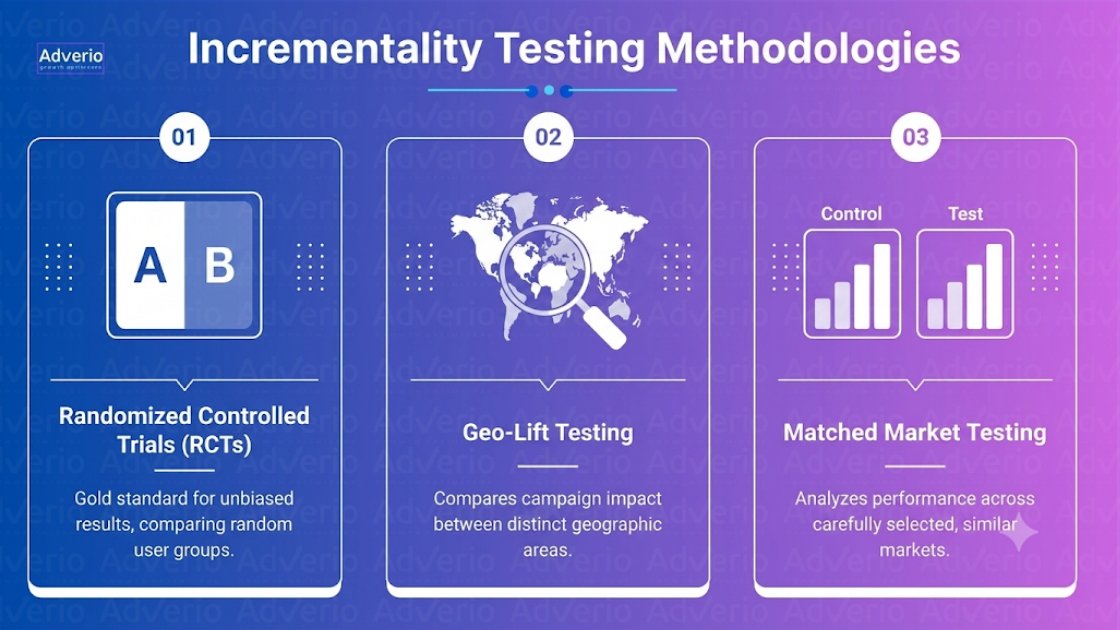
There isn’t one universal test design. There are three practical routes, and each one answers a different business question. Pick the wrong methodology and you’ll get fuzzy conclusions dressed up as certainty.
Randomized control trials
If you want the cleanest causal read, start here.
A proper RCT withhold design puts a matched test group into ad exposure and explicitly excludes the control group. The causal lift formula is (Test Conversion Rate – Control Conversion Rate) / Control Conversion Rate, and the test should hit a minimum 95% confidence level with enough statistical power locked in before launch.
This is the gold standard because randomization reduces bias. It’s also the first method I’d recommend when a brand wants to answer a tight question, such as whether one audience segment, creative type, or DSP tactic causes additional conversion.
Geo-lift testing
Geo tests make sense when audience-level holdouts are difficult or when your business operates with meaningful regional variation.
Instead of splitting people, you split markets. One set gets the campaign. A comparable set doesn’t. Then you compare performance movement across those regions while controlling for obvious distortions like promotional timing and stock issues.
Geo-lift isn’t as clean as a strong RCT. It’s still useful when retail operations, internal approvals, or platform limitations make user-level holdouts awkward.
PSA or ghost ad holdouts
This is the pragmatic middle ground when you need cleaner media isolation without shutting off the test architecture completely.
The withheld audience receives a neutral placeholder exposure, or a “ghost” equivalent, so you preserve comparability while reducing contamination from delivery mechanics. It’s operationally more complex, but often better than pretending a standard campaign split is enough.
Good methodology doesn’t just measure lift. It protects the conclusion from your own setup.
Incrementality test methodologies compared
| Methodology | Best For | Pros | Cons |
|---|---|---|---|
| RCT | Precise causal measurement at audience level | Cleanest read on causal lift, strongest internal credibility | Requires disciplined holdouts, identity control, and enough scale |
| Geo-lift | Regional campaigns or operationally constrained teams | Useful when user-level splits are hard to implement | More exposed to market noise and local distortions |
| PSA or ghost ad holdouts | Media delivery environments where pure holdout design is messy | Better isolation than loose campaign comparisons | Harder execution and analysis |
How to choose without wasting a quarter
Use this filter:
-
Choose RCT when leadership wants hard proof and you can enforce audience withholding.
-
Choose geo-lift when regional rollout structure is already part of the business.
-
Choose holdout variants when platform mechanics or audience overlap make simple splits unreliable.
If your current partner can’t explain that choice clearly, they’re guessing. And guessing with DSP budgets is expensive. For a more complete view of how serious operators structure measurement to maximize Amazon ROI, start there before you launch the first test.
Designing an Ironclad Test for Statistical Proof
Bad test design is worse than no test. No test leaves you uncertain. A bad test makes you confident for the wrong reason.
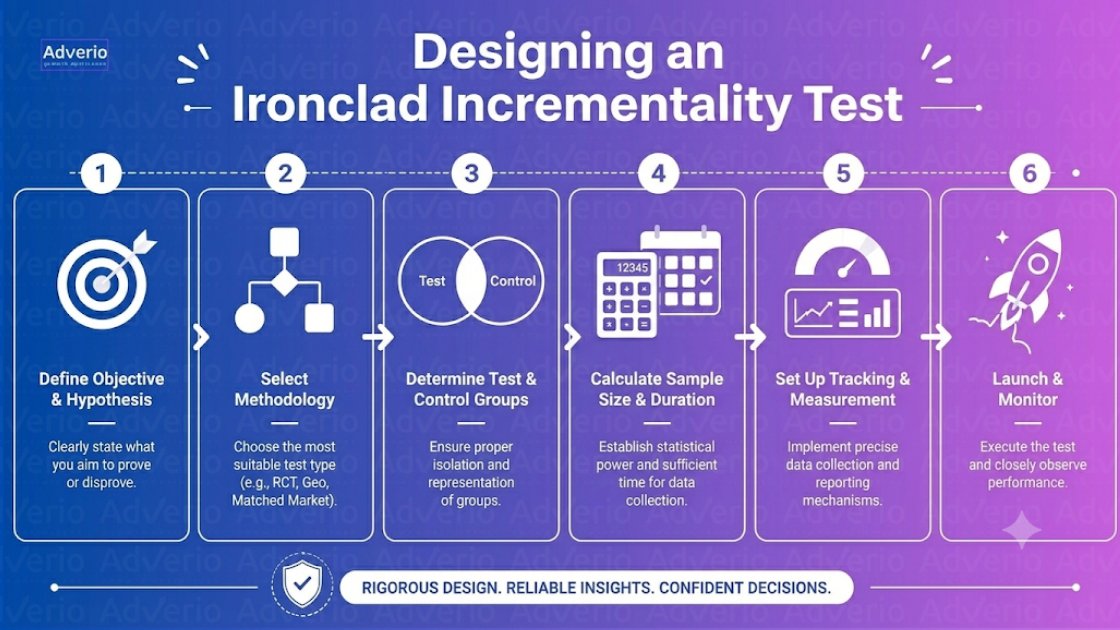
Start with a narrow business hypothesis
“Does DSP work?” is not a hypothesis. It’s a lazy prompt.
A useful hypothesis sounds more like this: a specific audience, format, or sequence will create more conversion than the same audience left unexposed. The tighter the question, the cleaner the read. Loose questions produce vague findings and weak budget decisions.
That matters because retail media incrementality testing only becomes actionable when the design establishes 95% confidence levels and sufficient statistical power before the campaign begins, while using enough duration and sample size to capture representative performance, as outlined in this retail media incrementality analysis.
Build the control before you build the campaign
A common approach involves obsessing over media setup and treating the control group as an afterthought. That’s backwards.
Your control group has one job. It must behave like the test group would have behaved without exposure. If it’s contaminated by overlap, inconsistent identity resolution, or spillover from other channels, the entire experiment starts lying to you.
Use a checklist like this before launch:
-
Audience integrity: Test and control need to be matched closely enough that the ad is the main meaningful difference.
-
Channel discipline: Don’t let overlapping media touch the holdout audience.
-
Operational consistency: Pricing, inventory, coupons, and listing health must stay stable enough to avoid false lift.
The fastest way to ruin an incrementality test is to treat holdouts like a technical detail. They are the experiment.
Duration and power are not optional
Amazon DSP incrementality testing fails all the time because brands want quick answers from thin data.
You need enough time to capture the actual purchase cycle and enough observations to distinguish signal from noise. If your category has delayed conversion behavior, a short test will under-read impact. If your sample is too small, random variation will look meaningful when it isn’t.
Here’s the practical structure I’d use:
-
Define the commercial question
Tie it to a decision you’re willing to make. Budget shift. Audience expansion. Creative change. If no decision depends on the test, don’t run it. -
Set the confidence standard before launch
Don’t lower the bar after weak results show up. The threshold exists to stop self-deception. -
Estimate sample needs
If projected volume won’t support a credible read, delay the test or simplify the design. -
Protect against seasonality
Keep major promos, pricing shocks, and inventory disruptions away from the read window if possible.
Don’t confuse this with split testing
Brands often blur incrementality testing and creative or listing experimentation. Different jobs. Different logic.
Your Amazon A/B testing framework can improve conversion assets inside the funnel. Incrementality testing answers whether the media itself caused additional business impact. Smart teams run both. Weak teams mash them together and wonder why the conclusion doesn’t hold up in the boardroom.
Technical Execution in Amazon DSP and AMC
The usual breaking point for strategy arrives not because the idea is wrong, but because the setup is sloppy.
The core workflow is simple on paper. Define the audience in Amazon DSP. Withhold the control cleanly. Run the campaign long enough to produce usable signal. Then use Amazon Marketing Cloud to inspect what happened across touchpoints and downstream purchases.
Why AMC changed the standard
In 2025, AMC introduced Customer Path Reporting, which lets brands trace and quantify shopper touchpoints from first impression through conversion, according to this AMC incrementality breakdown. That matters because it pushes the conversation past vague influence and into observable shopper paths.
There’s a budget reality operators skip at their own expense. Thin spend produces thin signal. If your test can’t move enough volume to register a measurable gap between exposed and control, you can’t separate effect from noise. Size the spend to the read you need before launch, not after.
How I’d set the test up
First, build your audience logic in DSP with the control framework decided in advance. Don’t improvise holdouts inside active trafficking. That’s how contamination sneaks in.
Second, structure campaigns and line items so the exposure logic is clean. Keep audience definitions distinct. Keep creative intent consistent. Don’t mix exploratory targeting with your core test cell if you want interpretable output.
Third, configure AMC reporting before launch. Customer Path Reporting gives you a stronger view of sequence and downstream behavior, but only if the campaign architecture makes that path analyzable.
For teams that want a broader operator view on how to maximize revenue with Amazon DSP, that resource is worth reviewing alongside the platform documentation.
Where operators usually need help
The hard part isn’t clicking the setup. It’s maintaining consistency between media design and analytical design.
That’s where workflow systems matter. Some teams lock in naming conventions, audience governance rules, and reporting logic at the account level before trafficking begins. Adverio, for example, uses AMOS to keep campaign structure, diagnostics, and performance monitoring aligned with the test plan. That’s useful when multiple people touch DSP and AMC, because broken naming and sloppy trafficking can destroy the analysis before it starts.
If you’re refining the execution layer itself, this guide on optimizing Amazon DSP campaigns is relevant.
From Raw Data to Profit Impact The Art of Analysis
Once the test ends, the focus often turns to the lift number. That’s the least interesting part.
The core job is connecting causal impact to profit. Did the exposed group buy more than the control group in a way that justified the spend? Did the campaign expand demand across the rest of the catalog? Did upper-funnel media create downstream value that direct attribution would have missed?
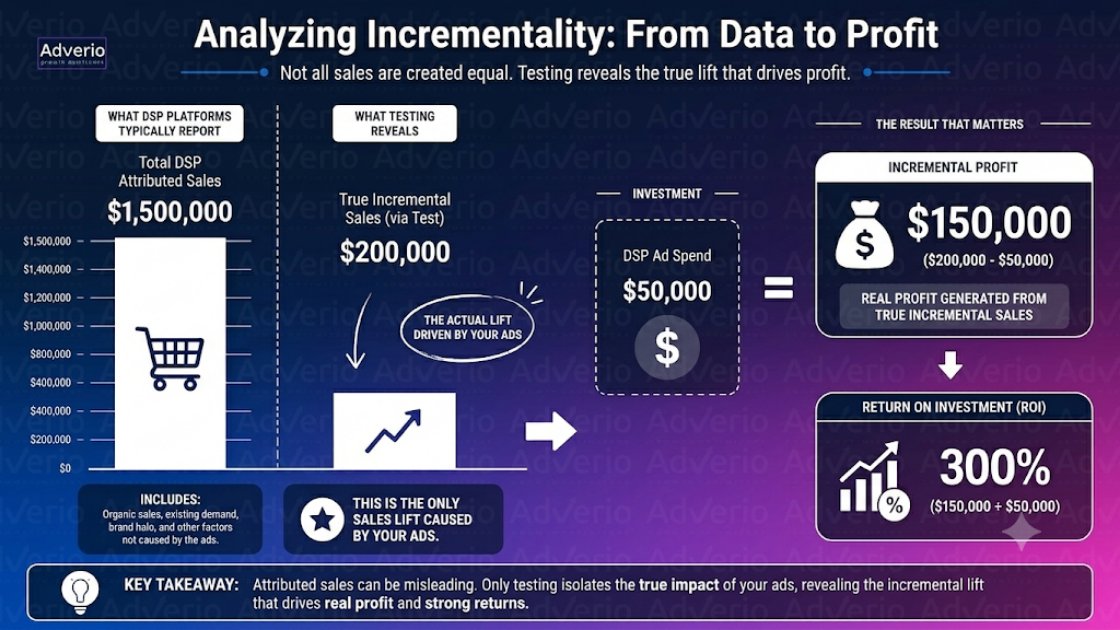
Read the result like a finance team, not a media team
Start with the exposed-versus-control gap. That gives you the causal effect. Then subtract media cost and inspect what happened across advertised and non-advertised products.
Halo analysis becomes relevant again. A campaign can look average on direct product attribution and still be valuable if it drives incremental purchases on adjacent ASINs. AMC is the tool that lets you test that theory instead of hand-waving about “brand impact.”
If you can’t connect DSP exposure to total catalog profit, you’re still evaluating media in fragments.
Cross-channel inventory makes the analysis more interesting
Starting in Q4 2025, Amazon DSP customers gained programmatic access to Netflix premium ad inventory across 11 major markets, and Amazon positioned that expansion as part of broader incrementality measurement across its ecosystem and beyond, as described in this. Amazon DSP now reaches well past Amazon-owned placements, including premium streaming inventory. That shift matters for one reason: your read on profit contribution can no longer stay trapped inside a single placement type.
That matters because serious analysis can no longer stay trapped inside one placement type. If awareness media, streaming video, and conversion media all sit inside the same measurement ecosystem, your read on profit contribution gets stronger. You can stop arguing about channel credit and start asking which combinations move the business forward.
What to bring back to leadership
Don’t present a DSP report. Present a capital allocation recommendation.
Use analysis to answer:
-
Should this audience get more budget
-
Did upper-funnel inventory create incremental sales or just noise
-
Which products gained indirect value
-
Where should you cut spend immediately
That’s how Amazon DSP incrementality testing becomes useful. It gives you evidence for scaling, trimming, or restructuring spend based on business impact. If your reporting stack still struggles to translate channel output into profit decisions, the right focus is optimizing Amazon brand profitability, not adding another vanity dashboard.
Common Test-Breaking Mistakes and How to Avoid Them
Most failed incrementality programs don’t fail because DSP “doesn’t work.” They fail because the test was compromised before the first impression served.
The usual offenders
-
Contaminated control groups
Your holdout sees other media, gets hit by overlapping audiences, or leaks across identity pools. Now your control isn’t a control. -
Weak budget commitment
Brands want conclusive answers from tiny spend. Then they blame the method when the data is inconclusive. -
Testing through pricing chaos
If promotions, coupons, or stock swings hit one group differently, you’re not measuring advertising. You’re measuring operational noise. -
Short read windows
Some teams stop the test the second they see movement. That’s how random variation gets promoted into “insight.” -
Console-only analysis
If you skip AMC and rely on basic reporting, you miss pathing nuance, halo behavior, and a lot of the causal story.
The fix is discipline, not more dashboards
A serious process protects the test before it protects the KPI.
That means writing the hypothesis first, locking the control logic early, validating budget sufficiency, and making sure the analysis plan exists before launch. It also means being willing to accept a result you don’t like. A null result is still valuable if it stops waste.
Smart operators don’t use incrementality tests to prove they were right. They use them to stop paying for illusions.
If your team is stuck between black-box automation, agency reporting theater, and internal resource constraints, treat incrementality as a profit protection system. Because that’s what it is. Every unproven DSP dollar is a claim on your margin until the data clears it.
How Adverio runs incrementality as a profit control
Most teams treat DSP as a reporting line. We treat it as a financial control system. Before a dollar moves, the hypothesis, control logic, and confidence threshold are locked. AMOS keeps campaign structure, naming, and reporting aligned so the analysis survives contact with real trafficking.
Then we read the result like a finance team. Exposed versus control, minus media cost, across advertised and non-advertised SKUs. You leave with a budget decision: scale it, trim it, or kill it. If you want that read on your own spend, see our Amazon DSP management approach.
Amazon DSP incrementality testing FAQs
How long should an incrementality test run?
Long enough to cover your full purchase cycle and gather enough observations to clear the noise floor. Categories with delayed conversion need longer windows. Stopping early turns random movement into a false “insight.”What confidence level should I require?
Set a minimum 95% confidence level with sufficient statistical power before launch. Decide the bar first. Lowering it after weak results is how teams talk themselves into spend.What are halo sales and why do they matter?
Halo sales are incremental purchases on products you did not advertise. Amazon publishes no formula and no console column for them. You estimate them in AMC by connecting ad exposure to downstream purchases across the catalog.Is incrementality testing the same as A/B testing?
No. A/B testing improves a conversion asset inside the funnel. Incrementality testing answers whether the media itself caused additional business impact. Different jobs, different logic. Strong teams run both.If your brand is spending on Amazon DSP without hard proof of incremental profit, you’re taking measurement risk you don’t need to take. Adverio helps established marketplace brands build profit-first testing frameworks across Amazon, Walmart, and Target, with strategy, media execution, and business intelligence tied to ROI decisions. If you want a clearer read on what your ads contribute, See what your DSP spend is really worth. 15-minute diagnostic call. No pitch deck.