


Table of Contents
Rising CPCs expose weak ad formats fast. If you’re still pushing most of your Amazon budget through Sponsored Products while ignoring video, you’re choosing a colder click and a weaker conversion path.
Amazon built Sponsored Brands Video to win attention in search, not decorate it. The format appears in desktop and mobile shopping results, and Amazon says those creatives are designed to increase visibility and drive brand awareness there, with an optimal length of 15 to 30 seconds and a technical range of 6 to 45 seconds (Acadia coverage of Amazon guidance). That matters because search on Amazon is now an attention market first and a bid market second.
If you already run Sponsored Products, your Amazon Sponsored Brands Video strategy isn’t a nice-to-have. It’s one of the cleanest ways to improve click quality before the shopper ever reaches your detail page.
If you need the full Sponsored Brands setup guide covering ad types, store spotlight, and product collection formats, that lives in the Sponsored Brands complete guide. What this guide covers is the financial control layer: how to use SBV specifically as a margin protection tool in high-CPC environments, what creative actually works in search, and how to measure whether video is creating incremental demand or just shifting attribution.
Get My Profit ROI Forecast
15-minute diagnostic call. No pitch deck.
At a Glance
At a Glance: Amazon Sponsored Brands Video strategy
-
SBV wins attention before the click. A shopper who watches product motion is more qualified than a shopper who taps a static ad.
-
Creative’s importance is often underestimated. Weak video wastes strong keywords. Strong video can rescue expensive auctions.
-
Amazon’s own guidance is blunt. Show the product within the first 2 seconds and the product function within the first 5 seconds to maximize recall and engagement (Amazon Advertising).
-
ROAS alone is a bad scoreboard. The key question is whether video is creating demand, defending branded search, or just shifting attribution.
-
SBV belongs inside a system. If you need the broader architecture, pair this with a complete Amazon advertising strategy guide.

Amazon sponsored brands video strategy: higher-quality clicks 25
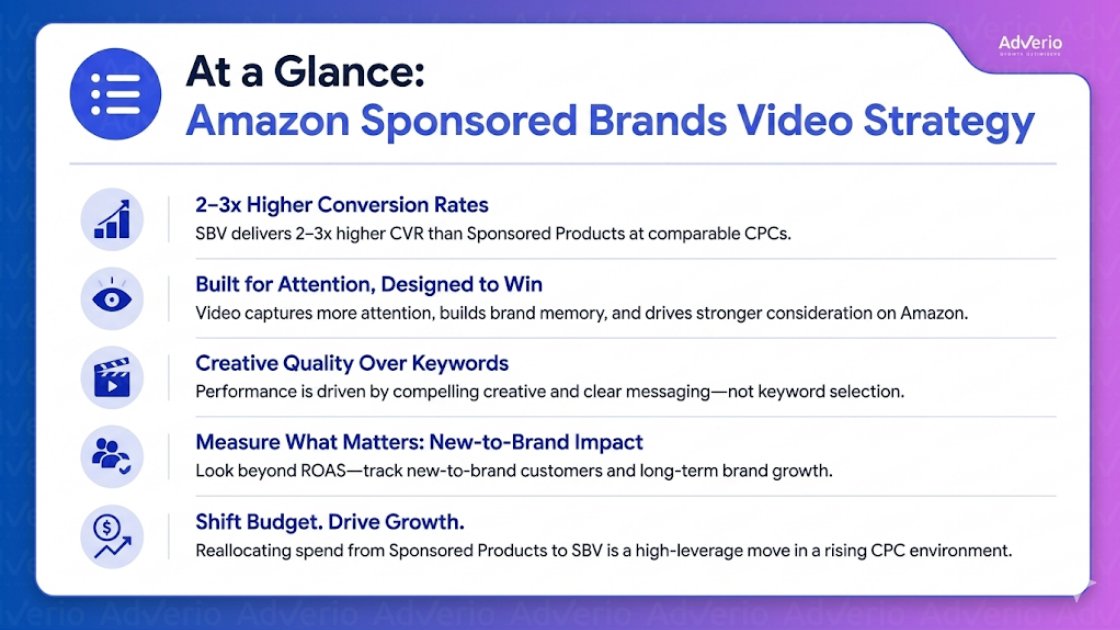
The bottom line is simple. In a high-CPC market, every click needs to arrive with more intent. SBV does that better than static search ads because it pre-frames the value proposition before the shopper lands.
Why Sponsored Brands Video Outperforms Sponsored Products on Conversion
Sponsored Brands Video wins because it charges less for wasted curiosity.
Sponsored Products often pay for clicks from shoppers who still need the product explained. SBV handles part of that work before the landing page ever loads. The shopper sees the product in use, understands the core benefit, and self-qualifies. In a high-CPC category, that shift is margin protection, not a creative preference.
Across Adverio managed accounts, branded Sponsored Brands Video outperforms static placements on click-through, and non-branded video shows the same pattern. The pre-click education is doing the work. The takeaway is simple. SBV usually improves click quality before it improves any dashboard metric. That matters more than raw traffic volume because cheap clicks are irrelevant if the product page must rebuild intent from zero.
| Format | Shopper behavior before click | Likely click quality |
|---|---|---|
| Sponsored Products | Sees image, title, price, rating | Broader, less filtered traffic |
| Sponsored Brands Video | Sees product in motion and core use case | Higher-intent, better-qualified traffic |
The conversion advantage starts before the click, but it does not end there. Better pre-click education reduces bounce risk, shortens evaluation time, and gives your PDP a narrower job. If your listing still has to explain what the product is, who it is for, and why it costs more, the ad failed upstream. That is why SBV works best alongside disciplined Amazon listing optimization and a strong guide to Amazon conversion for brands. Use the ad to screen and persuade. Use the PDP to confirm and close.
This is the strategic point many brands miss. SBV is not just a higher-engagement placement. It is an attention filter inside search. In categories where CPC inflation keeps squeezing contribution margin, filtering out low-intent clicks is often more valuable than buying more of them.
Creative quality decides whether you get that benefit. A weak video burns premium search real estate and instead shifts spend away from Sponsored Products. A clear product demo gives the shopper enough evidence to choose you faster. If your team needs a faster production workflow, prioritize getting the first three seconds right before committing to full production. A rough cut that shows the product in use immediately will outperform a polished brand reel that buries the product.
Static ads can still harvest demand. SBV creates and sharpens it. That is why it so often converts better.
The SBV Creative Framework: What Works and What Does Not
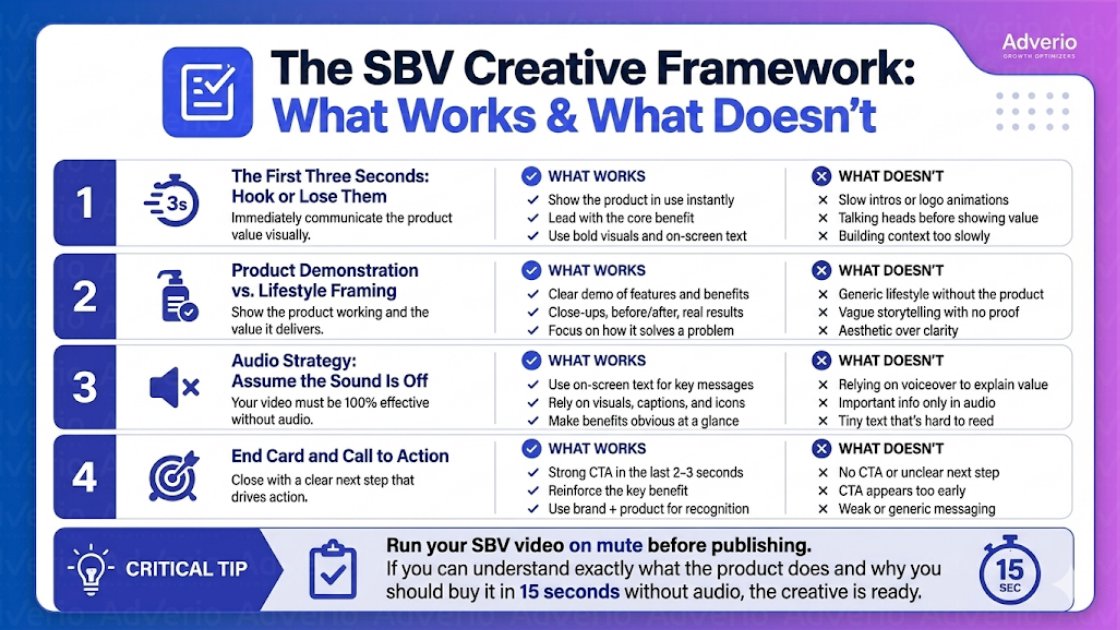
Creative decides whether Sponsored Brands Video lowers your effective cost to acquire a customer or just steals budget from Sponsored Products. Treat it like a search asset built to pre-qualify the click, and margin improves. Treat it like a brand reel, and you pay premium CPCs for unqualified traffic.
The First Three Seconds: Hook or Lose Them
Search is a low-patience environment. Your video has one job at the start: show the product and show the use case fast. If a shopper has to wait to understand what they are looking at, you already lost the attention auction.
Lead with visible proof. Show the mess getting cleaned, the texture getting revealed, the pain point getting solved, or the product being used in the exact context that drives purchase. Skip logo animations, cinematic buildup, abstract lifestyle shots, and any opening frame that hides the item.
That discipline matters financially. Every weak opening increases the odds of a low-intent click or no click at all. In a high-CPC category, both outcomes are expensive.
Product demonstration vs lifestyle framing
The right opening angle depends on what the shopper needs to believe before they click.
| Product type | Better opening bias | Why |
|---|---|---|
| Functional products | Demonstration | The shopper wants proof fast |
| Aspirational products | Lifestyle framing | The shopper wants outcome and context |
| Premium or differentiated products | Demonstration plus outcome | You need to justify the price premium before the PDP |
Functional categories reward clarity. Show performance on screen, not claims about performance. Tools, cleaning, kitchen, supplements, and industrial products usually win with obvious utility first.
Aspirational categories still need discipline. Beauty, apparel, wellness, and home decor can open with context, but the context has to sell the result, not just the vibe. If the shopper cannot identify the product, the benefit, and the intended user quickly, the creative is wasting paid search inventory.
Creative consistency also matters. Your video sets an expectation that your listing has to confirm, so teams running SBV should tighten their visual system across the PDP and follow best practices for optimizing Amazon listings with photography.
If your internal team is stuck on production speed, prototype the concept with a rough cut first. Validate the hook and product clarity before committing to final production.
Audio Strategy: Assume the Sound Is Off
Build for mute first.
On-screen text should communicate the main benefit immediately. Captions should support the message, not carry the entire sale. Music can improve pace. Voiceover can add polish. Neither should be required to understand the product.
A simple standard works: watch the ad once on mute. If the value proposition is still obvious, the creative is usable. If the product only makes sense with narration, the ad is under-explaining the offer and overcharging you for curiosity clicks.
End card and call to action
Most end cards waste the highest-intent moment in the ad. Use those final frames to close the information gap, not decorate it.
Keep the end card focused on three elements only:
-
Product name
-
Primary benefit
-
Clear next step
Do not stack six features, three badges, and a generic slogan into the last second. Search shoppers do not reward clutter. One clear reason to click beats a crowded frame every time.
What fails is predictable. Slow intros. Tiny mobile text. Before-and-after sequences that hide the actual product. Edits that depend on audio. End cards full of filler. What works is just as predictable: immediate product visibility, visible proof, readable text, one dominant claim, and a closing frame that gives the shopper a reason to act now.
The SBV Campaign Structure
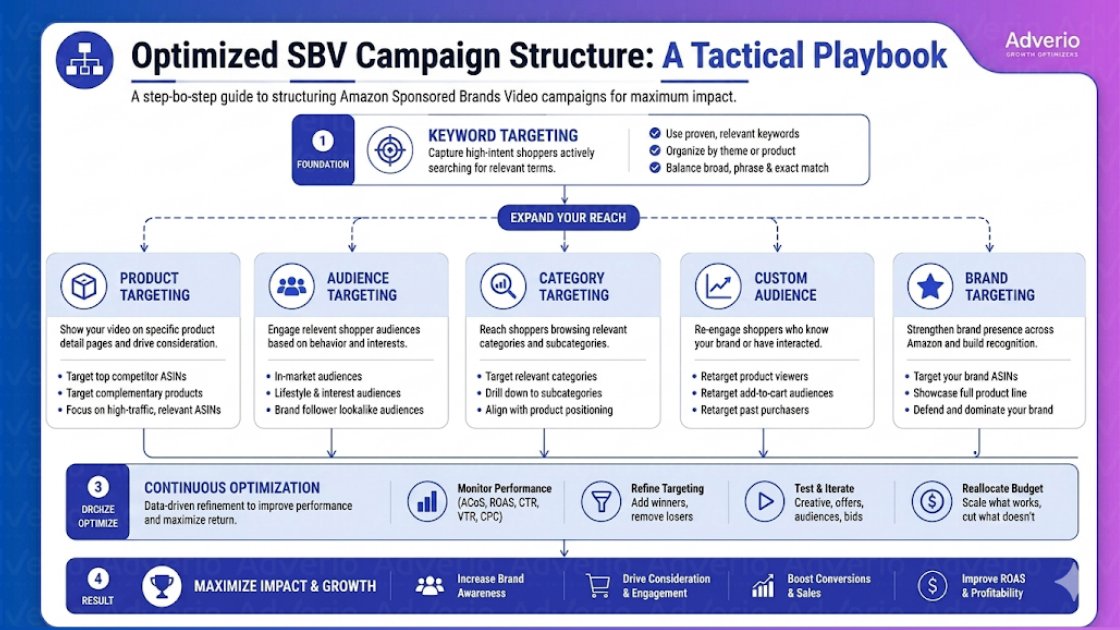
Creative gets attention. Structure decides whether that attention turns into efficient scale.
Keyword targeting for SBV
Start with the same high-intent search terms that already matter in Sponsored Products. Then loosen the guardrails slightly where the creative is strong. Video can pre-qualify the click better than static ads, so you can often tolerate broader discovery without the same level of waste.
A simple operating model works well:
| Campaign layer | Targeting intent | Purpose |
|---|---|---|
| Core exact | Highest intent terms | Capture proven demand |
| Expansion | Broader but relevant terms | Find new efficient queries |
| Brand defense | Branded terms | Own your brand narrative |
Don’t dump every keyword into one campaign. You need visibility by intent bucket or you’ll never know which creative is doing real work.
ASIN targeting for SBV
Brands often get aggressive. If your product solves a clear pain point better than the category leader, a good video on competitor traffic is a serious interception tool.
The shopper is already evaluating options. That’s the perfect time to show how your product works, what problem it fixes, and why it deserves consideration. On some catalogs, this can be one of the cleanest conquesting plays inside the entire Amazon ad stack.
Budget allocation between SBV and SP
Don’t overcomplicate the first move. Carve out a dedicated test budget from search, then reallocate based on conversion quality and incrementality signals.
A practical structure looks like this:
| Budget decision | Recommended approach |
|---|---|
| Initial SBV allocation | Start with a meaningful carved-out share of search budget |
| Expansion trigger | Increase when conversion quality and incrementality improve |
| Pullback trigger | Reduce when video only harvests branded demand without lift |
Campaign architecture matters here as much as bidding. If your account is a mess, no format will save it. This is why disciplined brands obsess over PPC structure for profit governance.
Get My Profit ROI Forecast
15-minute diagnostic call. No pitch deck.
How to Measure SBV Performance Correctly
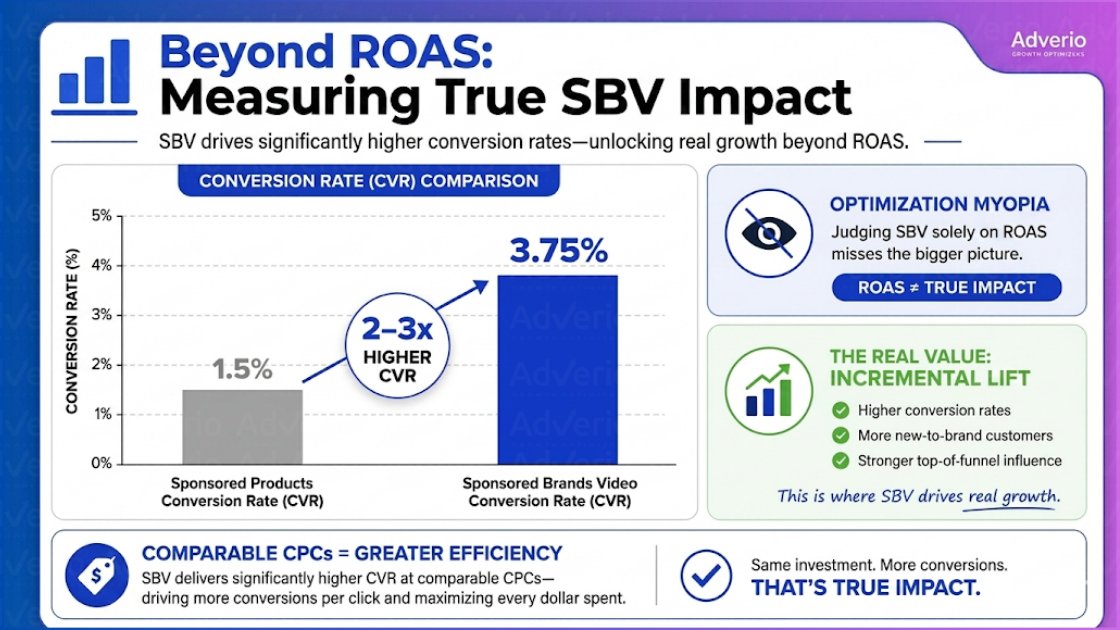
SBV should be judged on profit protection, demand creation, and attention capture. Standalone ROAS misses all three.
In a high-CPC account, the important question is simple. Does video bring in customers your static ads would not have won, or is it just taking credit for demand already in motion? If you cannot answer that, you are optimizing reports instead of margin.
Use a scorecard that separates incremental value from recycled attribution:
| Metric lens | What it tells you |
|---|---|
| New-to-brand contribution | Whether SBV is pulling in shoppers who were not already searching for you |
| Branded search halo | Whether video exposure drives more branded queries later |
| Detail page conversion impact | Whether SBV traffic lands warmer and converts more efficiently after the click |
| Organic rank movement | Whether stronger engagement helps support broader search visibility |
SBV often wins on attention before it wins on attribution. A shopper sees the product in motion, understands the use case faster, skips low-intent clicks, and returns later through branded search or organic. If your measurement model only rewards the last click, you will underfund the format that is reducing wasted spend upstream.
Experienced operators get this wrong when they read a healthy ROAS line and stop there. That is how brands starve the one format that can lower effective customer acquisition cost in an expensive auction.
Ask harder questions:
-
Is SBV growing branded search volume after exposure?
-
Is SBV traffic converting better on the detail page than comparable SP traffic?
-
Is SBV expanding category reach, or just harvesting existing brand demand?
-
Is total search efficiency improving at the portfolio level, not just inside the SBV campaign view?
Good reporting ties SBV to account-wide business impact. Campaign metrics matter, but they are not the finish line.
If you want a cleaner operating model for that analysis, use Adverio’s guide to incrementality.
How to Scale SBV Without Cannibalizing SP
Most leadership teams ask the wrong question. They ask whether SBV will cannibalize Sponsored Products. They should ask which format produces the stronger profit outcome for the same search real estate.
Strategic cannibalization is not a problem. Wasteful duplication is. If SBV converts better on a keyword cluster or conquest set, budget should move there. That’s not channel conflict. That’s capital allocation.
Use a simple workflow:
-
Identify overlap: Find targets where SP and SBV are competing for the same demand.
-
Compare business impact: Look beyond campaign purity and inspect total sales efficiency, branded lift, and page conversion quality.
-
Reallocate deliberately: Shift spend away from weaker static placements when the video format is clearly carrying the better click.
Keep Sponsored Products active where they still do useful work. Just don’t protect them out of habit. If you’re trying to optimize Amazon ad spend for brands, portfolio logic beats platform superstition.
How Adverio Builds SBV Strategy
The framework above isn’t theory. It’s how Adverio builds search video systems for brands that care about profit, not vanity metrics. The team connects creative rules, targeting logic, and incrementality measurement into one operating model, then folds SBV into full Amazon account management so it aligns with catalog economics and broader marketplace strategy. If your current setup is trapped in ACoS reporting and fragmented execution, that’s a management problem, not a media problem.
15-minute diagnostic call. No pitch deck.
Amazon Sponsored Brands Video FAQs
What video length should I use for Sponsored Brands Video?
Keep it short. For most brands, 15 to 30 seconds is the right operating range, and shorter often wins because search attention is brutally limited. If your product value is not obvious in the first few seconds, you are paying premium CPCs for low-intent clicks and weaker margin.
Can I reuse social media video ads on Amazon?
Usually no. Social creative is built to entertain or build mood. SBV has to sell fast in a search environment where the shopper is already comparing options. Recut anything you reuse so the product appears immediately, the benefit is clear without sound, and the message matches purchase intent instead of brand storytelling.
What matters more in SBV, targeting or creative?
Creative decides whether expensive traffic converts. Strong targeting can get you the impression. It cannot fix a weak opening, a hidden product, or a vague value proposition. Start with sharper creative, then optimize targeting.
Should I judge SBV on ROAS alone?
No. ROAS is too narrow for a format that can improve click quality, capture attention before the detail page, and create lift that shows up elsewhere in the account. Measure SBV against contribution margin, branded search movement, and incremental revenue, or you will cut spend that is helping profit.
Where does Sponsored Brands Video fit in the funnel?
SBV sits between demand capture and demand shaping. It reaches shoppers with active intent, but it also changes who earns the click by winning more attention in the search results. That makes it useful for category conquesting, branded defense, and margin protection when Sponsored Products CPCs get crowded.
Read Next
If you’re building a serious Amazon Sponsored Brands Video strategy, don’t isolate it from the rest of your media system.
-
Review the Amazon PPC management approach behind cleaner execution
If your Amazon ad account is paying premium CPCs for average click quality, that’s a margin leak. Adverio helps established brands fix it with profit-first Amazon advertising strategy, creative that converts, and measurement that goes beyond dashboard theater.