



Table of Contents
Amazon didn’t change a billing setting. It changed your working capital model.
If you funded Sponsored Products, Sponsored Brands, and Sponsored Display on a credit card, that float was underpinning your growth. Now it isn’t. The brands that treat this like admin work will feel it in bank balance, campaign continuity, and margin pressure. The brands that treat it like a finance event will keep rank, keep velocity, and keep control.
At a Glance Your Amazon Cash Flow Crisis
A funding shift like this can break a healthy P&L if you ignore cash timing. Brands that relied on ad card float now have less operating cash available the moment Amazon settles funds.
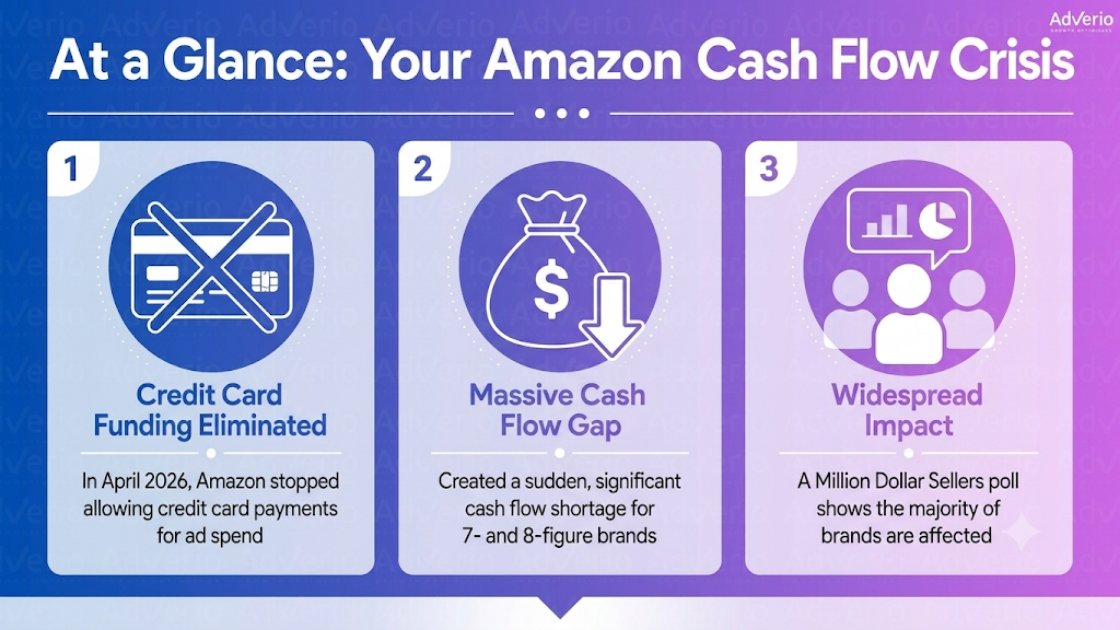
This is the core issue behind Amazon advertising payment changes cash flow. The fundamental problem is not billing administration. It is a structural cash flow crisis. Your ad engine is now drawing directly from the same cash pool that covers inventory, payroll, freight, and margin protection.
Treat this like a minor payments update and you will make the wrong decisions fast. You will cut spend to protect cash, lose visibility, slow sales velocity, and tighten cash even further. That is how brands create a self-inflicted liquidity squeeze.
At a glance, the situation is simple:
-
Your ad funding cycle changed: ad costs now reduce the cash available from operations before money reaches your bank account.
-
This is a treasury problem: cash timing, reserve levels, and disbursement planning now matter as much as campaign efficiency.
-
Cutting spend first is a rank-loss decision: it may relieve pressure this week, but it hands placement and momentum to competitors.
-
The only rational response is a financial framework: quantify the gap, protect rank-producing spend, and rebuild the operating model around tighter cash conversion.
-
Apply the Amazon-specific controls in the Amazon cash flow management guide before this billing change compounds into a margin problem.
Bottom line: if ad spend used to ride on card float, your growth machine now runs on working capital discipline. Brands that fail to adjust will feel the hit in bank balance, rank stability, and valuation quality.
What Amazon Changed and When
Amazon originally scheduled this payment change for April 15, 2026, but delayed it to August 1, 2026 after significant seller pushback. For the subset of accounts that used a credit card as their primary ad payment method, charges will stop riding on that card and come out of seller proceeds before disbursement on that date. Amazon has confirmed this applies to a small portion of advertisers. The majority already pay through proceeds deduction.
That date matters because it changed timing, not just payment rails. If you are using card float and rewards to subsidize acquisition, that support is set to vanish when Amazon switches the default funding method on August 1, 2026.
Amazon also offered a one-time $2,500 advertising credit to some affected advertisers during the transition. Use it for what it is. Temporary relief. It does not restore the working capital buffer your business was relying on.
The practical effect is straightforward:
-
Funding source changed: ad spend is deducted from proceeds for impacted accounts.
-
Disbursements shrink before they reach your bank: the cash arrives net of advertising costs.
-
Card benefits disappear: rewards, statement timing, and float no longer offset part of your ad spend economics.
For operators who built monthly planning around card cycles, this is a financing reset. If you need context on how card economics used to help absorb spend, this guide to lowering credit card interchange fees is useful background.
One more point. This policy exposes messy accounting fast. If your team cannot reconcile ad deductions cleanly against Amazon disbursements, you will misread margin, cash position, and funding capacity. Fix that before you touch bids or budgets, and regain financial clarity for Amazon brands.
Get My Profit ROI Forecast
15-minute diagnostic call. No pitch deck.
Why This Is a Cash Flow Event Not a Billing Change
At scale, brands don’t get hurt by billing mechanics. They get hurt when working capital disappears faster than finance adjusts.
Treating this as a billing update is a serious mistake. Amazon changed the funding order, but the actual impact sits on your balance sheet. Cash that used to stay available for inventory, payroll, and reserve coverage now gets absorbed by ads before it ever reaches your bank. That is a capital allocation problem.
The float was financing, not convenience
Your ad card was never just a payment tool. It was a short-term financing layer.
Spend hit throughout the month. Your card statement closed later. Cash left the business after that. That timing gap gave your sales proceeds time to catch up and protected liquidity during heavy acquisition periods. If you want background on the economics behind card processing, this guide to lowering credit card interchange fees gives useful context. The larger issue here is still timing, not fee percentage.
Once Amazon deducts ad spend from proceeds, that buffer is gone.
Amazon turned ad funding into a self-financed growth model
The old system let many brands grow first and settle the cash impact later. The new system forces you to fund growth from your own operating cash in real time. That changes how you set budgets, how you forecast liquidity, and how aggressively you can defend rank.
This is why operators who say, “we’ll just keep spending and watch it closely,” get blindsided. Spend can remain profitable on paper while still creating a cash shortfall that slows reorders, compresses safety stock, and triggers bad decisions across the business.
You did not lose convenience. You lost a financing layer.
The operational mistake that kills margin
Many brands respond at the campaign level. They trim bids, pause non-brand, or cut testing. That is the wrong sequence.
First fix the funding model. Then adjust media. If you cut spend before you quantify the cash requirement, you risk damaging rank to solve a treasury problem. That is a treasury problem solved with the wrong lever.
Use Adverio’s cash flow strategies to rebuild the timing model between ad deductions, settlement delays, inventory purchases, and reserve needs. That is the only rational way to protect growth without letting Amazon’s payment change dictate your ceiling.
How Much Cash Gap the Payment Change Creates
The cash gap is large enough to break a healthy brand.
Use a simple baseline. Start with 1.5 times monthly ad spend as the added working capital requirement. If your settlements are tight, inventory turns are slow, or reserves are already thin, use 2 times. That is the amount of cash you now need available to keep funding ads at the same level without starving the rest of the business.
Here is what that looks like in practice.
Estimated cash gap from Amazon ad payment change
| Monthly Ad Spend | Previous Cash Requirement with Float | New Cash Requirement No Float | Additional Cash Gap |
|---|---|---|---|
| $20,000 | Lower due to card float | Higher due to proceeds deduction | Approximately $30,000 to $40,000 |
| $40,000 | Lower due to card float | Higher due to proceeds deduction | Approximately $60,000 to $80,000 |
| $75,000 | Lower due to card float | Higher due to proceeds deduction | Approximately $112,500 to $150,000 |
| $100,000 | Lower due to card float | Higher due to proceeds deduction | Approximately $150,000 to $200,000 |
| $150,000 | Lower due to card float | Higher due to proceeds deduction | Approximately $225,000 to $300,000 |
A brand spending $100,000 a month on Amazon ads should assume it needs an extra $150,000 to $200,000 of liquidity. Not projected profit. Not inventory on the water. Cash.
That number gets dangerous fast because ad deductions now hit the same operating pool that covers POs, freight, payroll, and reserve pressure. If you miss this, you will misread profitable growth as stable growth. It is not stable if the bank balance cannot support the timing.
What to do with this table
Bring this table into your next finance review and pressure test it against three items. Your reorder calendar. Your current cash reserve. Your customer acquisition cost payback.
If your payback model assumes flexibility that no longer exists, your margin story is inflated and your budget is wrong.
Use the baseline first. Then decide whether your business belongs at the high end of the range. Brands with longer inventory cycles, larger catalog swings, or weaker cash controls should plan against the higher figure now. Waiting for the shortfall to show up in the account is a treasury mistake that usually gets fixed by cutting spend too late.
The Five-Part Cash Flow Adaptation Framework
Panic isn’t a strategy. Ad cuts aren’t a strategy either. They’re usually an expensive delay tactic.
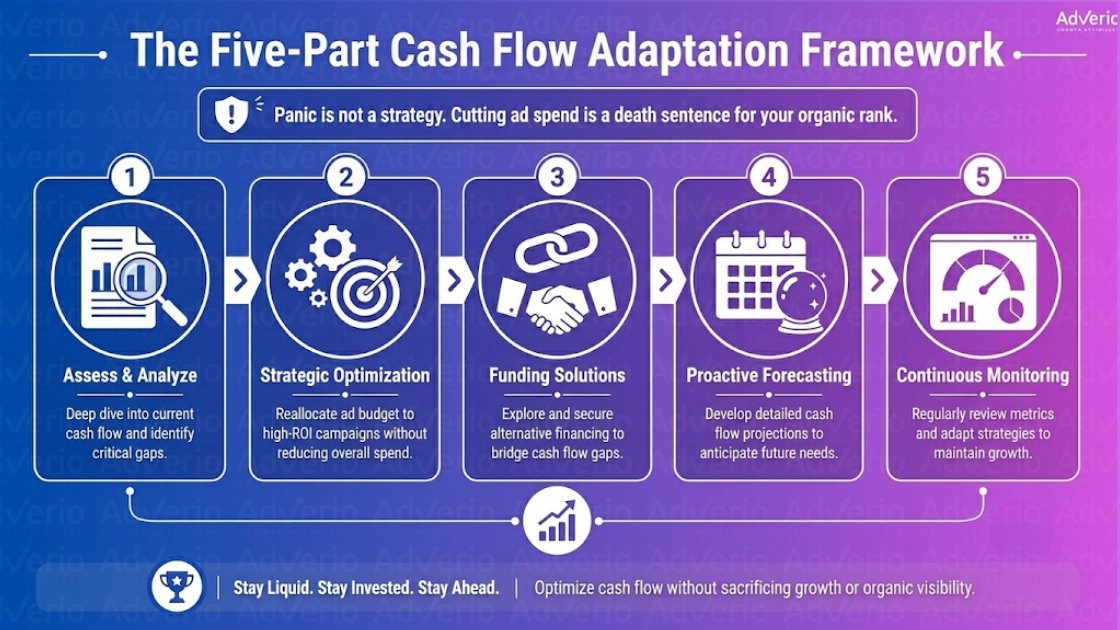
Step 1 Calculate your actual cash gap from the payment change
Pull your trailing average monthly ad spend. Multiply it by the baseline working-capital factor already noted above. Then compare that figure against free operating cash after inventory commitments and reserve needs.
Don’t use optimism here. Use cleared cash. If the gap exists on paper now, it will exist in the bank account later.
Step 2 Identify which campaigns can be deferred without rank damage
All ad spend is not equal.
Protect the campaigns that support search visibility and conversion momentum. Be far more skeptical of spend that looks active but doesn’t defend rank or move profitable demand. For many brands, branded search can tolerate tighter controls. Upper-funnel prospecting often has more room for temporary restraint than core rank-driving campaigns.
Use that distinction to reduce pressure without gutting your engine.
-
Keep core Sponsored Products protected: These campaigns often carry the highest visibility risk if disrupted.
-
Review prospecting and exploratory budgets: They can be useful, but they’re usually easier to defer than core rank defense.
-
Challenge low-clarity spend: If you can’t explain the contribution, it shouldn’t survive a cash squeeze.
Step 3 Restructure ad spend timing around settlement forecast
Your new float has to come from operational timing.
Map settlement timing against ad funding needs and rebuild the cadence so ad balances are topped up immediately after disbursements. The goal is simple. Make settlements fund the next wave of advertising as directly as possible.
Calculate your Amazon Advertising balance top-up schedule from expected disbursements, not from habit. Habit is what left brands exposed.
This won’t recreate the old card cycle perfectly. It will make your cash movement more intentional and far less fragile.
Step 4 Establish a financing facility before the gap hits
A financing option arranged before stress is a tool. A financing option arranged during stress is damage control.
If your cash gap is material, secure a line or revenue-based facility before you’re forced to use it. That gives you negotiating power, continuity insurance, and room to preserve rank while you adjust operating cash flow.
The key point is sequence. Set up access first. Decide whether to draw later.
Step 5 Negotiate payment terms with suppliers to free working capital
A lot of brands look at ad funding and ignore supplier terms. That’s a mistake.
If Amazon pulls cash forward, you need to push another obligation back where possible. Ask major suppliers for temporary term extensions or adjusted deposit timing. Long-term vendors often prefer a reasonable restructure over an unstable customer.
This step matters because it frees cash without forcing ad disruption.
What Happens to Rank and Visibility If You Cut Spend
Cutting ad spend to protect cash often destroys more value than it saves.
On Amazon, rank is funded. Visibility is rented daily. If your ads retreat, competitors buy the traffic, collect the conversion data, and strengthen their organic position while your listings lose sales velocity. That is not a temporary dip. It is a self-inflicted ranking slide that gets harder and more expensive to reverse.

A significant mistake is treating ad cuts like a simple expense decision. They are a cash flow triage decision with revenue consequences. Once impressions fall on your highest-intent terms, click share drops. Then unit sales soften. Then organic rank weakens because the listing is no longer getting the same volume of demand signals. By the time finance sees the damage in the P&L, the market has already moved.
That is why broad budget cuts are reckless. Cut waste fast. Protect the campaigns that hold branded defense, category-level visibility, and your highest-converting non-brand terms. Those campaigns are not discretionary. They are the funding mechanism behind search presence.
As noted earlier, brands with a heavy ad-spend-to-earnings mix are exposed first under the new payment structure. The wrong response is to slash spend evenly across the account. Equal cuts punish profitable campaigns and weak campaigns at the same time. That approach saves cash today and burns rank tomorrow.
Adverio’s view is simple. This is not a billing tweak. It is a structural cash flow crisis, and your ad budget has to be managed like working capital. Brands that rebuild funding around rank protection keep momentum. Brands that cut blindly lose placement, lose velocity, and then pay more later to recover what they gave away.
Financing Options Specifically for Amazon Ad Spend
If operational fixes still leave a funding gap, finance the ad float on purpose. Treat this like working capital allocation, not a last-minute scramble to keep campaigns live.
Amazon’s invoice option is the first thing to check if you are being pushed off cards. It can extend payment timing versus immediate card settlement, which matters when ad spend is now pulling cash forward. Confirm eligibility inside your account and model the payment terms against your inventory cycle before you switch.
Amazon Lending is the next filter. If Amazon offers it, review it first because underwriting is tied to marketplace performance and the money is built for sellers, not generic small-business use. It will not solve a broken margin structure, but it can cover a timing mismatch.
Revenue-based financing can work for brands with consistent top-line velocity and enough gross margin to absorb the cost. Traditional revolving credit is slower to set up, but it is usually the better long-term answer if you need a repeatable funding layer for ads, inventory, and seasonal spikes.
One rule is absolute. Do not fund Amazon ads with personal credit or random short-term debt. That decision turns a platform policy change into a balance sheet problem.
If you need a team that can tie ad funding, margin control, and media execution together, the standard to look for is a growth partner that governs profit, not just bids. Get My Profit ROI Forecast
How Adverio Is Helping Clients Navigate the Payment Change
This is where a bids-and-ACoS operating model runs out of room. A funding shock sits above the campaign layer, and it has to be managed there.
Adverio operates as a growth partner across the full P&L, not just the ad account. Its framework spans Amazon, Walmart, and Target, and it combines catalog control, conversion work, PPC, DSP, and financial discipline under one roof. The firm’s proprietary systems, including Profit Pulse Intelligence System, AMOS, GEAR, LQS, SKU Resurrection, and Brand Drain Reversal, are built to identify where profit exists and where spend is just noise.
The proof matters. HemRid achieved +173% revenue growth and +414% profit increase in 9 months by breaking a 17-month revenue plateau, which created more reinvestment capacity for the brand, according to Adverio’s HemRid case study. Across Adverio’s client portfolio, the firm reports average profit growth of +288.6% and median revenue growth of +57.5%, with increases ranging from 99% to 1,424%, as shown on the Adverio website. If you need a team to manage your Amazon account at this standard, Book Your ROI Forecast.
If this payment change just punched a hole in your working capital plan, waiting is a financial error. Book Your ROI Forecast with Adverio. Get a profit-first view of what to protect, what to cut, and how to keep Amazon, Walmart, and Target growth moving without sacrificing cash control.