


Table of Contents
Amazon’s AI is about to commoditize basic campaign management. That is the part too many operators still miss.
The market is flooded with commentary about smarter bidding, faster optimization, and cleaner workflows. None of that creates an edge by itself. If every seller gets the same native automation, then automation stops being strategy. It becomes table stakes.
That’s the essential truth about automated Amazon campaigns in 2026. If you need a breakdown of the specific AI tools Amazon has built into Seller Central and how each one affects catalog visibility, that lives in the Amazon AI tools guide.
What this guide covers is the operating layer above the tools: how to command automation with a profit-first framework so the machine works for your margins instead of Amazon’s adoption goals.
Amazon is flattening execution quality across the market while widening the gap between brands with sharp operating discipline and brands that hand the machine a budget and hope for efficiency.
The winners will supply better inputs than their competitors can. First-party demand signals. SKU-level margin thresholds. Creative that reflects the buying stage, not internal brand theory. Rules that tell the system where profit exists and where it does not.
Amazon’s defaults are built to increase adoption of Amazon’s ad stack. Your job is to increase profit. Those are not the same objective.
Smart operators already see the opening. Native AI creates blind spots around contribution margin, inventory pressure, customer quality, and incrementality. Those blind spots are where the advantage now lives. If you own stronger data and force automation to operate inside a profit-first framework, you turn Amazon’s leveler into your weapon.
That is the standard Adverio applies. Use Amazon’s automation. Do not trust it with strategy.
Before you hand automation more budget, find out where it’s already leaking margin.
Get My Profit ROI Forecast
15-minute diagnostic. No pitch deck.
Introduction
Amazon advertising in 2026 is no longer a manual discipline with AI bolted on. It’s an AI environment where human operators set the rules, the priorities, and the guardrails. That changes the job. It also exposes weak strategy fast.
Most brands still ask the wrong question. They ask whether Amazon’s AI can run campaigns. It can. The key question is whether those campaigns are driving profitable growth or just cleaner-looking dashboard metrics.
That distinction matters because native automation is built to increase speed, coverage, and adoption inside Amazon’s ad stack. Your finance team doesn’t care about any of that unless it improves contribution margin, inventory efficiency, and customer quality.
Amazon’s AI can make decisions faster than your team. It can’t decide which parts of your demand are worth buying unless you tell it.
A serious operator should treat automation like capital allocation. You don’t hand it the whole budget and hope for discipline. You define where it can attack, where it should defend, and where it should stay out completely.
Here’s the hard truth. If your team is still treating PPC as a keyword management function, you’re already behind.
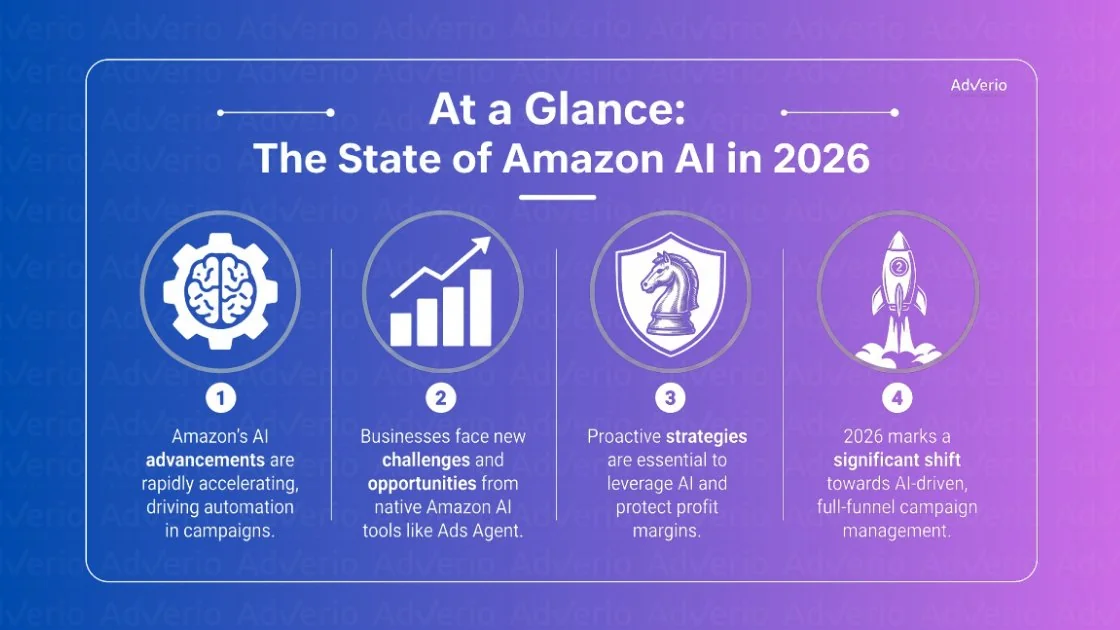
At a Glance: The State of Amazon AI in 2026
-
AI is now the default layer in Amazon advertising. This isn’t an optional add-on anymore. Campaign management is moving toward native, embedded automation.
-
Native tools reduce workload. They do not replace strategy. The brands with sharper inputs will get more from the same automation stack.
-
Profit control sits above bidding logic. Inventory risk, SKU margin, customer quality, and portfolio rules should shape what AI is allowed to scale.
-
Full-funnel coordination matters more than keyword tinkering. Sponsored Ads in isolation won’t carry growth if your audience strategy is weak.
-
The competitive edge is moving into data quality and operating discipline. That’s where brands separate themselves from the sea of sameness.

Amazon automated campaigns ai 2026: your profit guide 25
A lot of teams will confuse access with advantage. They’ll have the same native tools, similar prompt-driven workflows, and the same broad optimization playbook. That’s not differentiation. That’s standardization.
If you’re sorting through tool stacks, reporting layers, and execution systems, review Adverio’s top Amazon tools with one filter in mind. Does the tool help you make better profit decisions, or does it just help you make more ad decisions?
The New Battlefield: Amazon’s Native AI vs Your Bottom Line
Amazon’s native ad stack got more aggressive in 2026. That matters because the automation isn’t sitting on the edge anymore. It’s moving into the core workflow.
Amazon unveiled Ads Agent at unBoxed 2025 and rolled it out in beta in Q1 2026 to automate campaign setup and bid adjustments. Early beta testers reported 30 to 40 percent time savings and 12 to 18 percent ACoS improvement (NovaData on Amazon’s Ads Agent). Amazon also replaced the old Seller Central interface with a Canvas experience and evolved Seller Assistant, formerly Project Amelia, from a support chatbot into a semi-autonomous co-pilot, moving campaign management toward execution instead of static reporting (SupplyKick on 2026 Amazon marketplace trends).

That sounds like progress. It is. It also creates a dangerous illusion that better execution equals better strategy.
What native AI does well
Native AI is good at compressing the time between insight and action. It can handle repetitive management work that used to eat up skilled operator time.
Short version:
| Native AI strength | Practical impact |
|---|---|
| Campaign setup automation | Faster launch velocity |
| Bid adjustment automation | Quicker response to performance shifts |
| Natural-language workflows | Less friction for in-console execution |
| Data summarization | Faster interpretation for busy teams |
That clears operational drag. It clears operational sludge out of the system.
Where brands get trapped
The failure point is Optimization Myopia. Teams become obsessed with campaign-level efficiency while ignoring total business performance. ACoS improves, but the wrong ASINs get budget. Search coverage gets narrower. New customer acquisition weakens. Organic momentum stalls. Margin gets hit somewhere outside the ad dashboard.
Cleaner ACoS isn’t a win if your account is quietly shifting spend into low-quality demand or starving strategic products.
When every brand uses similar automation against the same auctions, native AI starts leveling the field. It standardizes good-enough execution. That pushes real advantage somewhere else.
That “somewhere else” is strategic context:
-
Margin context which SKUs can absorb more spend and which can’t
-
Inventory context which products should be protected, throttled, or held back
-
Portfolio context which categories deserve customer acquisition investment
-
Conversion context which listing weaknesses are suppressing paid efficiency
That’s also why campaign automation without retail readiness is a bad bet. If your PDPs are weak, automation just buys traffic more efficiently into a conversion problem. Your paid system can’t outperform a broken retail experience. That’s why operators who care about financial outcomes need a stronger retail foundation, including
Adverio’s Amazon listing optimization strategy.
The sea of sameness problem
The ugly version of 2026 is simple. Everyone gets faster. Few get smarter.
Brands that hand control to native AI with no portfolio logic above it will converge toward the same behavior. Same keyword clusters. Same bid patterns. Same budget reactions. Same race to defend dashboard optics while profit quality gets ignored.
That’s not automation leadership. That’s commoditized media buying.
The Adverio Playbook for AI Powered Campaigns
The answer isn’t to reject automation. That would be stupid. The answer is to command it with a tighter operating system.
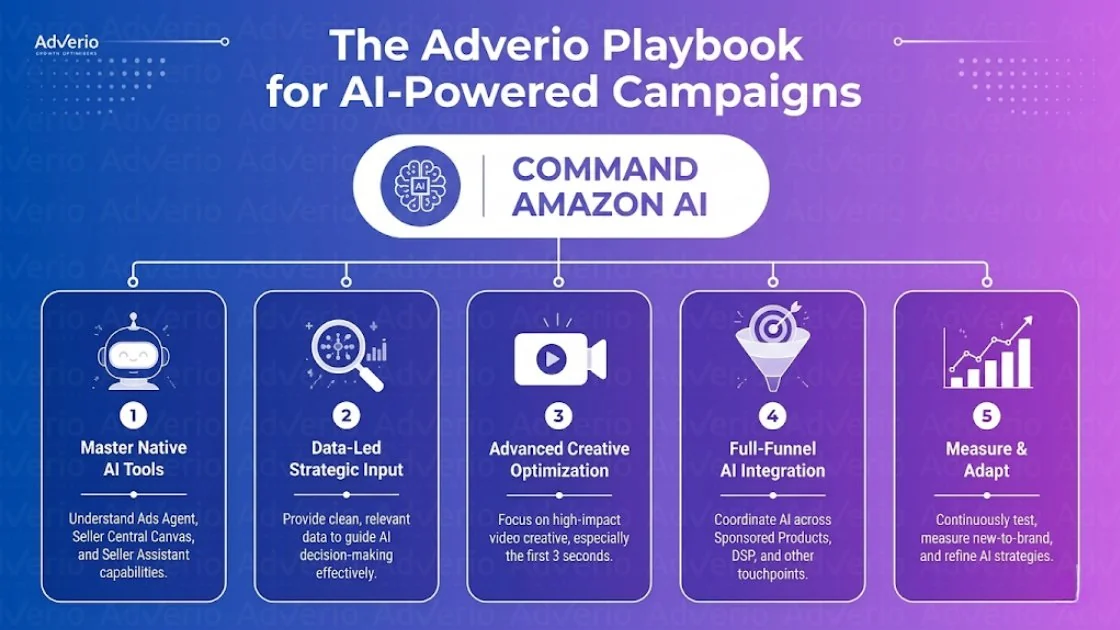
The strongest 2026 campaign systems use always-on optimization loops that ingest performance, inventory, and profitability signals together, then prevent wasted spend by negating non-converting terms and rebalancing bids when stockouts or price changes alter conversion probability (The AI Journal on how AI is reshaping Amazon PPC in 2026). That’s the model to beat. Not static rules. Not weekly cleanup.
Audit for profit leaks first
Before AI gets more control, it needs better instructions. A proper audit should find where spend is mathematically misallocated, not just where keywords look inefficient.
That means checking:
-
SKU economics first where margin is too thin to support aggressive acquisition
-
Inventory constraints next where low stock should trigger defense, not scale
-
Catalog friction where weak content or variant confusion drags conversion
-
Portfolio overlap where campaigns are cannibalizing each other
Most brands skip this and wonder why “smart” automation keeps making dumb business decisions.
Build bidding rules around margin
Native bidding systems react to ad signals. Serious operators add business signals on top.
A profit-first bidding model should decide:
| Decision area | What the AI should know |
|---|---|
| High-margin winners | Permission to push harder |
| Low-margin traffic magnets | Tight efficiency controls |
| Seasonal or inventory-risk SKUs | Bid restraint or pacing limits |
| Hero products with strong LTV potential | Controlled acquisition bias |
A profit-first PPC framework matters more than another dashboard. The campaign structure has to reflect business intent, not just ad taxonomy. If your current account is organized for convenience instead of control, fix it with a profit-first PPC framework.
Use AI in creative, but don’t let it write the strategy
AI is useful for testing angles, surfaces, and variations. It is not qualified to decide your market position.
Creative direction still needs a human answer to three questions:
-
Which SKU should attract new demand
-
Which message matches the customer’s buying stage
-
Which claim can convert without damaging brand perception or margin
Practical rule: Let AI generate variants. Let operators choose the narrative and the business objective.
That separation matters because automation loves what’s easy to measure. It doesn’t naturally prioritize what’s strategically valuable.
Measure incrementality, not dashboard vanity
Platform metrics can’t be the final judge. The whole point of AI-run campaigns is to make execution faster. Fine. But speed without measurement discipline just accelerates waste.
Watch for signs that your system is over-optimizing for the short term:
-
Branded dependence where efficiency looks strong because demand already existed
-
ASIN concentration where a few products absorb budget at the expense of portfolio growth
-
Retargeting inflation where conversion claims look good but acquisition quality is weak
-
Organic suppression where paid wins are not lifting broader market position
You need a wider performance view than ACoS alone. The brands that get this right tie campaign action to incrementality, portfolio movement, and contribution economics. That’s why the right reference point isn’t one trick or one automation layer. It’s a complete Amazon advertising strategy built around profit, not dashboard optics.
If your ACoS looks clean but profit isn’t moving, that gap is exactly what we map.
Get My Profit ROI Forecast
15-minute diagnostic. No pitch deck.
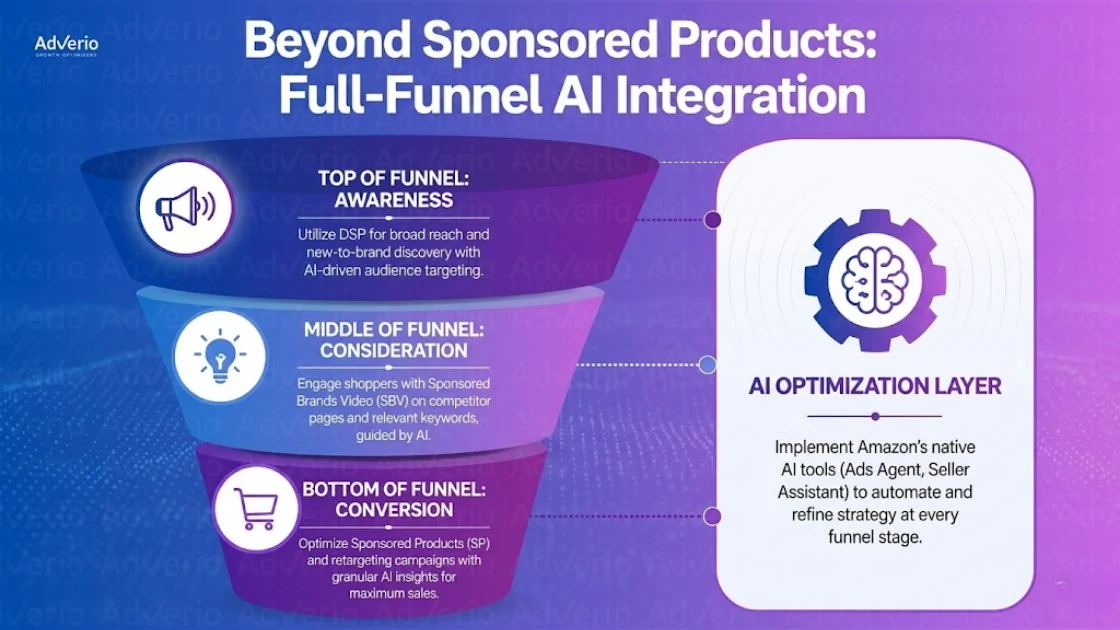
Beyond Sponsored Products DSP Audiences and Full Funnel AI
Most Amazon advertisers still over-focus on Sponsored Products because it feels measurable, familiar, and close to conversion. That mindset is expensive. It narrows growth to the bottom of the funnel and leaves audience shaping to chance.
The strategic question in 2026 is not whether AI can run campaigns. It is which profitable demand segments you let it scale. Amazon’s recent unBoxed announcements pushed toward audience-based logic and tighter DSP coordination, including an ads data manager that feeds first-party data into Amazon DSP and AMC, which makes high-LTV product selection and persona definition more valuable, not less (Retail Dive on Amazon’s unBoxed AI and DSP announcements).
Why siloed PPC loses
If Sponsored Products are doing all the work, your account is leaning too hard on in-market demand. That usually means one of two things:
-
You’re harvesting shoppers after competitors helped create the demand.
-
You’re paying more and more to convert the same demand pool.
Neither is a serious growth strategy.
A stronger system connects audience development with conversion capture. DSP can shape awareness and consideration. Sponsored Ads can close. AMC can help define who belongs in each stage. AI can then optimize against a better funnel instead of spinning inside a keyword silo.
What full-funnel control looks like
A disciplined full-funnel setup should answer these questions:
| Funnel stage | Strategic question |
|---|---|
| Awareness | Which audiences are worth introducing to the brand |
| Consideration | Which products and messages move them closer to purchase |
| Conversion | Which search and retargeting paths close profitably |
If those decisions aren’t explicit, AI will default to what it sees most clearly. Short-term conversion signals. That’s convenient for the machine. It’s weak for the business.
Strong Amazon operators don’t ask AI to find more clicks. They tell it which audiences deserve more budget.
That’s why DSP can’t sit in a separate team, a separate dashboard, or a separate budget philosophy. If you’re not coordinating audience strategy with retail economics, you’re underusing the stack. For a more direct view on media allocation and audience planning, look at optimizing your Amazon DSP spend.
Operationalizing Your 2026 AI Strategy at Scale
Ambitious plans typically perish. Not in strategy. In execution load.
A modern Amazon AI program touches campaign architecture, audience logic, inventory signals, retail readiness, creative testing, and reporting discipline. Most in-house teams don’t lack intelligence. They lack bandwidth. The work compounds fast, especially across multiple brands, marketplaces, or large variant catalogs.
Two ways to install the capability
Some brands should keep execution internal and upgrade the operating system around it. Others should stop pretending they have the time and hand over the machine.
The practical split looks like this:
-
Done-with-You for brands with an internal team that needs structure, better diagnostics, and a profit-first decision layer
-
Done-for-You for brands that need outside operators to run the full engine across media, catalog, and growth planning
Neither model works if leadership still treats Amazon like a channel that can be managed with partial attention.
What teams miss when they build this alone
Internal teams often underestimate the content burden around AI-led advertising. Faster campaign cycles require faster asset production, cleaner testing workflows, and more responsive iteration. If your team is trying to keep pace with video and creative demand, standardize a production workflow before creative volume becomes a bottleneck. Faster cycles require cleaner testing templates, not more tools.
That still doesn’t solve strategic coordination. It just removes one bottleneck.
The deeper issue is operating cadence. AI rewards brands that can feed it cleaner decisions, faster. If your team is stuck in weekly meetings, stale exports, and siloed accountability, your competitor with tighter execution is going to outmove you.
Inaction is your competitor’s best friend. Amazon’s AI won’t wait for your org chart to catch up.
How Adverio Turns AI Automation into Profit Growth
Amazon’s native AI is flattening mediocre operators. That is good news for brands willing to run a stricter system.
Adverio turns automation into a profit engine by putting business rules ahead of platform convenience. The model ties media decisions to margin, inventory position, customer value, and catalog priorities, so Amazon’s automation works inside your economics instead of overriding them.
That gap matters. Competitors using the same default AI features end up bidding from the same signals, chasing the same traffic, and reporting the same shallow wins. Adverio changes the inputs. Better first-party data, tighter SKU selection, and clear profit thresholds create advantages Amazon cannot standardize across every advertiser.
The operating model covers PPC, DSP, creative, and catalog execution. Brands that need speed can hand over execution. Brands with capable internal teams can keep control and use Adverio for strategy, diagnostics, and decision rules. Both paths aim at the same outcome: profitable growth, not busier dashboards.
Book the diagnostic call if leadership wants a clear answer on where AI is helping, where it is draining margin, and what to change first.
15-minute diagnostic call. No pitch deck.
FAQs About Amazon’s AI Advertising
Will Amazon’s AI make my PPC manager obsolete?
No. It changes the job. Manual bid work becomes less important. Strategic judgment becomes more important. Someone still has to decide which SKUs deserve budget, which audiences matter, and which profit rules the system should follow.
How is this different from using a black-box tech platform?
Black-box tools usually optimize against their internal logic and limited visibility. A stronger model gives you transparency, custom rules, and measurement tied to business outcomes rather than software convenience.
What’s the first step my brand should take?
Run a full audit before adding more automation. You need to identify profit leaks, catalog issues, weak SKU economics, and measurement gaps first. Otherwise you’ll just automate bad decisions faster.
Should we focus only on Sponsored Products in 2026?
No. Sponsored Products still matter, but a search-only approach is too narrow. Audience building, DSP coordination, and better segmentation are now part of serious Amazon growth strategy.
What should leadership ask before approving more AI-driven spend?
Ask which demand segments the system is allowed to scale, how inventory and margin signals are informing decisions, and whether reporting can separate efficient spend from incremental growth.
If your Amazon team is moving faster but not getting more profitable, the system is broken. Adverio helps brands install a profit-first operating model for Amazon advertising so automation serves the business instead of distorting it.
Book Your Profit ROI Forecast and get a sharper answer than another dashboard can give you.