



Table of Contents
Your agency sends a report celebrating a 4.0 ROAS. Finance looks at the P&L and asks why profit is getting tighter. Both teams think they’re right. That’s the problem.
In the Amazon ROAS vs TACoS debate, most brands are staring at the wrong scoreboard. ROAS tells you whether a campaign looks efficient. TACoS tells you whether your business is getting healthier or more addicted to paid traffic. If those two conversations aren’t aligned, you’re not optimizing. You’re drifting.
| Metric | Formula | What it measures | Best use | Biggest blind spot |
|---|---|---|---|---|
| ROAS | Ad Revenue ÷ Ad Spend | Revenue generated per ad dollar | Tactical campaign decisions | Ignores organic sales and total business health |
| TACoS | (Ad Spend ÷ Total Sales) × 100% | Ad spend as a share of total revenue | Long-term profitability and organic momentum | Less useful for keyword-level bid decisions |
| ACoS | Inverse of ROAS | Cost as a percentage of ad-attributed sales | Spend control inside campaign management | Still doesn’t show total revenue impact |
A quick reality check:
-
Lead with TACoS if you care about margin, organic growth, and enterprise value.
-
Use ROAS second for tactical optimization inside the ad account.
-
Watch both together because one without the other creates blind spots.
If your reporting still starts and ends with ROAS, you’re probably managing ads. Not profit.
The Metric Civil War in Your P&L
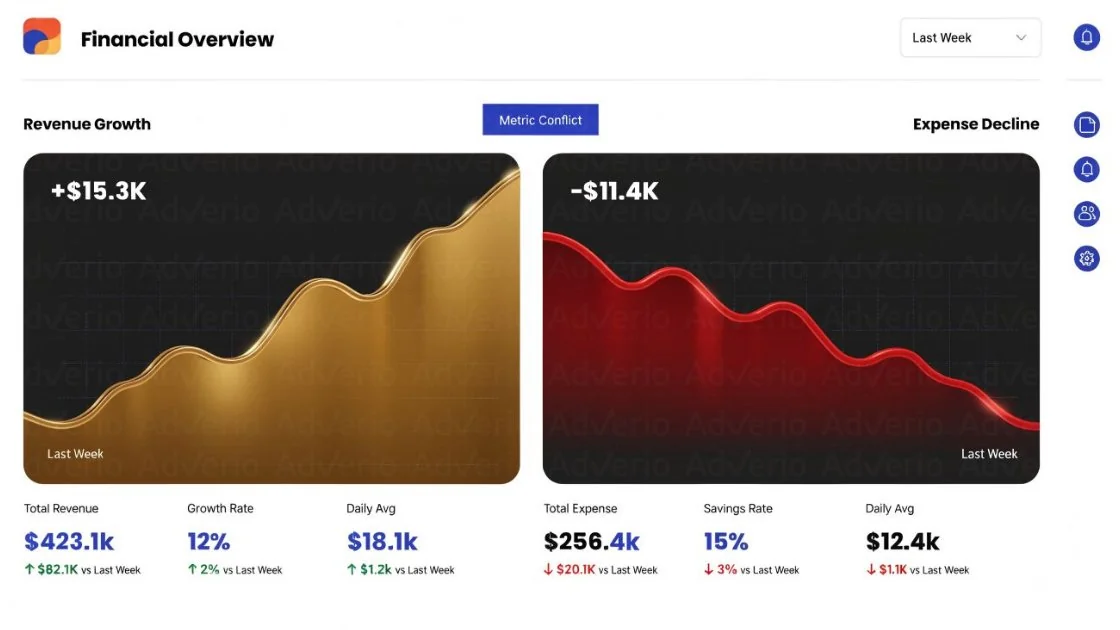
The fight usually starts the same way. Marketing points to a healthy-looking ad report. Finance points to shrinking contribution margin. Leadership gets stuck in the middle, trying to reconcile two versions of success that don’t align.
That confusion gets expensive fast.
Amazon’s advertising business is measured in the tens of billions annually, and the majority of product searches still start on Amazon — which is exactly why brands investing in Amazon PPC management and Amazon DSP need to measure what that spend is actually doing to their margin, not just their attributed revenue.
Why brands get trapped
ROAS is simple. It’s easy to report. It flatters agencies and internal teams because it makes ad performance look neat and controllable.
TACoS is messier. It forces you to confront what’s happening outside the ad console. Organic sales. Ranking strength. Brand dependency on paid traffic. Margin compression. That’s why so many teams avoid leading with it.
Practical rule: If your ad report looks strong while your business feels weaker, your reporting model is broken.
This is what I call optimization myopia. Teams squeeze campaigns for prettier efficiency metrics while the business loses the thing that actually matters, durable revenue that doesn’t require constant ad life support.
What the disagreement is really about
This isn’t a semantics issue. It’s a management issue.
-
Marketing is usually defending attributed performance. They want proof that ad dollars generated sales.
-
Finance is usually defending total profitability. They want proof that those sales were worth the spend.
-
Leadership needs one operating view. Without it, every growth decision turns into an argument.
The hard truth is simple. A campaign can be efficient and still be strategically bad for the business. If that sounds extreme, look at brands that overinvest in branded search, underinvest in discovery, and slowly lose their organic footing. Their ROAS can look clean right up until the business starts paying more just to hold the same revenue line.
That’s why the amazon roas vs tacos conversation matters. One metric helps you steer campaigns. The other helps you steer the company.
If you need a clean view of which metric should govern your growth decisions, Book Your ROI Forecast.
What ROAS Actually Measures And What It Hides
ROAS is the easiest metric in Amazon advertising to understand, and the easiest one to misuse.
The formula is simple. Ad Revenue ÷ Ad Spend. Spend $100 on ads and generate $400 in attributed sales, and your ROAS is 4.0, meaning you produced $4 in revenue for every $1 spent. If you want a clean refresher on the math, this breakdown of the return on ad spend formula is useful.
What ROAS does well
ROAS is a tactical metric. It’s good for campaign-level decision-making.
Use it when you need to compare:
-
Keyword efficiency
-
Creative performance
-
Campaign types
-
ASIN-level ad allocation
If one campaign is generating stronger attributed revenue per ad dollar than another, ROAS helps you spot that fast. That’s useful. It just isn’t enough.
ROAS is mathematically clean and strategically incomplete
ROAS and ACoS are inverse relationships.
A 25% ACoS converts directly to a ROAS of 4.0, which makes the math straightforward — but the strategy is not.
Here’s where experienced operators get burned. They understand the formula, but they mistake mathematical clarity for business clarity.
High ROAS doesn’t automatically mean healthy growth. It often means you found a pocket of easy attribution.
A lot of teams boost ROAS by leaning too hard on branded traffic. That can make reports look excellent while doing almost nothing to expand category share. If you want a sharper lens on that trap, Adverio’s breakdown of branded vs non-branded Amazon ads is worth reading.
What ROAS hides
ROAS doesn’t answer any of these questions:
| Question | Does ROAS answer it |
|---|---|
| Are organic sales growing? | No |
| Are ads improving organic rank? | No |
| Is paid traffic replacing sales you would have gotten anyway? | No |
| Is total margin improving? | No |
| Are you building a stronger brand or just buying conversions? | No |
This is why brands get fooled by “good” ad performance. They optimize toward what the platform attributes, not what the business keeps.
There’s another trap. Teams trying to improve ACoS or ROAS by cutting bids too aggressively can reduce visibility and kill the ranking momentum that lowers long-term TACoS. That’s not optimization. That’s short-term cosmetic cleanup with long-term damage attached.
ROAS belongs in your dashboard. It just doesn’t belong in the driver’s seat.
Why TACoS Reveals Your True Business Health
TACoS forces a tougher question. Not “Did the ad drive a sale?” but “Is advertising making the whole business stronger?”
The formula is Ad Spend ÷ Total Sales, usually expressed as a percentage. Unlike ROAS, TACoS includes both ad-attributed and organic revenue in the denominator. That changes the conversation immediately.
TACoS measures dependency
A healthy brand uses advertising to create momentum beyond the click. Better ranking. More reviews. Better conversion velocity. Stronger brand recall. More organic sales.
TACoS shows whether that’s happening.
If your TACoS is moving down or holding flat while sales scale, advertising is doing its job. It’s not just harvesting demand. It’s helping create durable revenue. If TACoS rises while total business health gets shakier, paid media is becoming a crutch.
TACoS is the metric your finance team trusts because it maps much closer to how the business actually earns money.
The launch-to-maturity pattern that matters
There’s a reason advanced operators watch TACoS as a trend line, not a vanity score. Case study data shows a brand can launch with a 40% ACoS and 20% TACoS, then see TACoS decline to 10% while ACoS improves to 30% as ads lift rankings and organic sales become the primary revenue driver (Unicorn Innovations).
That pattern matters more than a single “good” ROAS snapshot because it proves the ad investment built equity instead of just renting traffic.
TACoS also exposes operational problems
A rising TACoS doesn’t always mean your campaigns are bad. Sometimes your ads are trying to compensate for weak conversion.
Common culprits include:
-
Broken listing fundamentals like weak titles, bad main images, or thin A+ content
-
Catalog confusion where variants compete poorly or don’t convert cleanly
-
Weak organic relevance that keeps forcing paid traffic to do all the work
If that sounds familiar, the answer usually isn’t “optimize bids harder.” It’s fixing your Amazon listings with a more disciplined approach to Amazon listing optimization.
The metric that belongs on the executive dashboard
ROAS helps your media buyer. TACoS helps your leadership team.
That’s the difference.
One tells you whether a campaign returned attributed revenue. The other tells you whether your brand is becoming more efficient as a business. For established sellers, that’s the only question worth obsessing over.
When ROAS and TACoS Tell Conflicting Stories
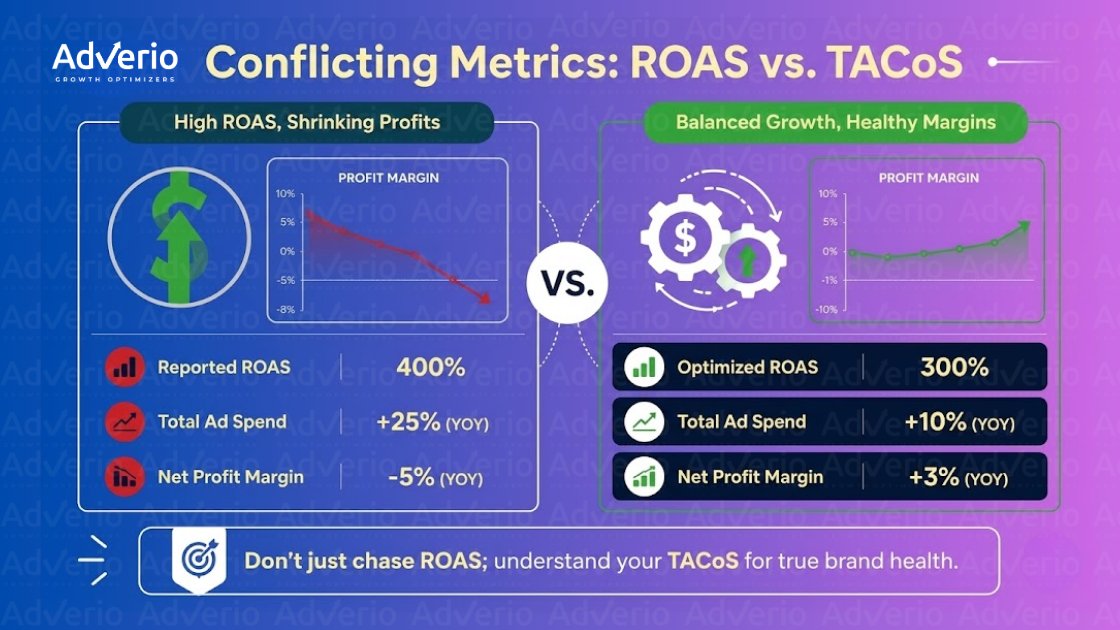
Most confusion often begins at this point. The metrics don’t disagree because one is wrong. They disagree because they’re measuring different things.
Scenario one high ROAS and rising TACoS
This is the trap.
Your campaigns look efficient on paper. They convert well. Attribution looks strong. But the business is getting more dependent on paid traffic to hold revenue.
That usually means organic sales are not keeping pace. Maybe they’re flat. Maybe they’re slipping. Either way, your ad account is carrying too much of the load.
What it usually signals
-
Branded search is doing too much work
-
Non-branded discovery has weakened
-
Organic rank is softening
-
Paid traffic is replacing, not amplifying, demand
Strong ROAS with rising TACoS is not a win. It’s a warning.
Scenario two stable ROAS and declining TACoS
This is what mature growth should look like.
Campaign efficiency remains controlled, but total ad spend becomes a smaller share of total sales because organic revenue is expanding. That means your advertising is creating downstream value beyond immediate attribution.
A lot of brands miss this because they’re too busy trying to squeeze one more point of efficiency out of the ad account. That’s a mistake. A stable ROAS paired with lower TACoS usually means your flywheel is working.
Scenario three declining ROAS and rising TACoS
This is the ugly one.
Your campaigns are getting less efficient and the broader business isn’t absorbing the damage through stronger organic sales. Every dollar works harder and returns less. That’s not a bidding issue alone. It’s usually a signal that your offer, conversion, category position, or visibility has deteriorated.
Here’s a clean way to read the combinations:
| ROAS trend | TACoS trend | What it means | What to do next |
|---|---|---|---|
| High or improving | Rising | Paid efficiency looks good, but ad dependency is increasing | Audit organic rank, branded mix, and category acquisition |
| Stable | Declining | Ads are supporting organic lift and healthier total revenue | Protect winning campaigns and keep building rank |
| Declining | Rising | Both campaign efficiency and business health are weakening | Diagnose listing, pricing, competition, and inventory issues first |
The missing layer most teams ignore
The primary job isn’t just reading the metrics. It’s separating incrementality from attribution. Those aren’t the same thing.
A sale can be attributed to an ad without being incremental. That’s why brands need a stronger view of Amazon incrementality measurement. If you skip that layer, you’ll overcredit paid media for revenue your brand might have captured anyway.
When teams finally understand this, the amazon roas vs tacos debate gets much simpler. ROAS explains ad efficiency. TACoS explains business impact. Incrementality tells you whether the ad created net new value in the first place.
The Dangerous Scenario Good ROAS Hiding A Dying Brand
The most dangerous Amazon account isn’t the one with ugly reports. It’s the one with flattering reports and weakening fundamentals.
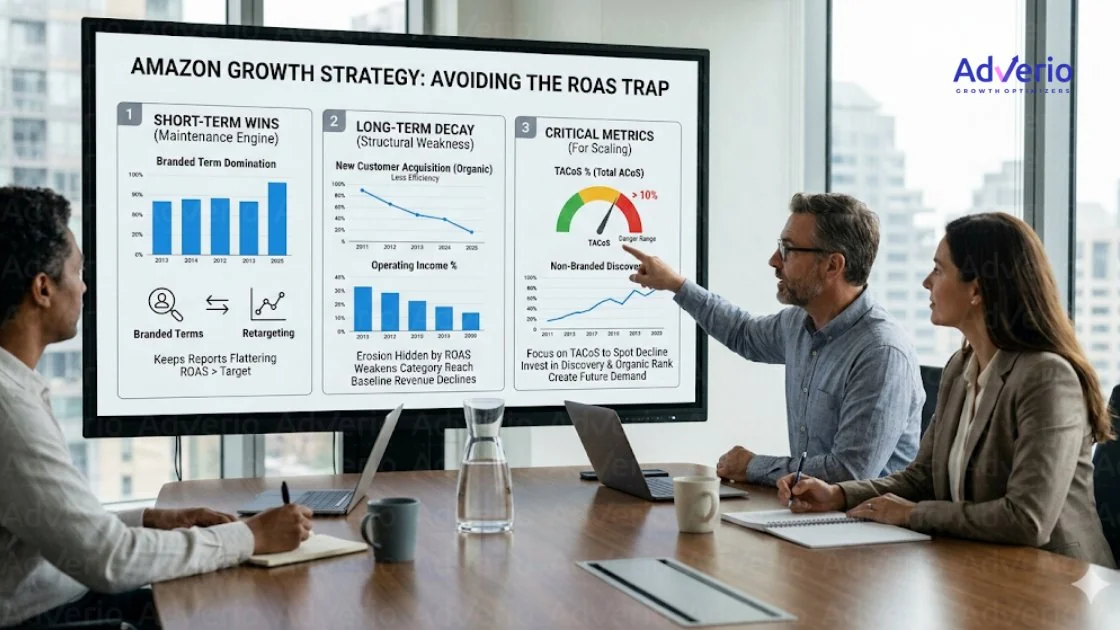
That usually happens when a team gets paid, praised, or promoted for hitting a ROAS target above everything else. Once that incentive gets locked in, behavior follows. Discovery gets cut. Prospecting gets trimmed. Brand defense and retargeting take over. The account looks cleaner. The business gets weaker.
How the decay starts
Teams chasing ROAS usually make three moves:
-
They overfavor branded terms because branded traffic converts well and keeps attributed efficiency high.
-
They slash non-branded discovery because it looks less efficient in the short term.
-
They focus on bottom-funnel traffic because it produces cleaner reports with less volatility.
Those moves can make the ad account look smart. They also reduce new customer acquisition and weaken category reach.
What breaks underneath
You don’t see the damage immediately. That’s why this trap works.
Your organic rank for non-branded queries starts to soften. Competitors occupy more top-of-funnel real estate. Your baseline revenue gets less resilient. Over time, you have to spend more just to keep the same output.
That’s when leadership starts asking the right question. Not “What’s our ROAS?” but “What happened to operating income?” If your team needs a cleaner finance lens for that conversation, this explanation of What Is Operating Income helps connect ad choices to actual business performance.
A high ROAS can hide a brand that has stopped creating future demand.
The pattern to watch
If your account only looks healthy when branded traffic is carrying the numbers, you don’t have a scaling engine. You have a maintenance engine.
That distinction matters. Maintenance engines preserve what the brand already earned. Scaling engines create more of it. Brands that confuse the two slowly hand market share to competitors who are still investing in visibility, ranking, and new-customer acquisition.
This is why TACoS matters so much in the amazon roas vs tacos conversation. It catches the structural decline that ROAS often misses. By the time ROAS finally deteriorates, the underlying erosion has usually been happening for a while.
The Adverio Framework For Unified Metric Optimization
The fix is not to abandon ROAS. The fix is to stop letting ROAS act like your strategy.
A serious operating model uses ROAS, ACoS, and TACoS together. Each metric has a job. ROAS handles campaign efficiency. ACoS controls spend at the attributed-sales layer. TACoS governs whether the business is gaining strength or getting more dependent on ads.

What unified optimization actually looks like
Most reporting stacks are fragmented. Ad data lives in one place. Organic sales live somewhere else. Inventory pressure, margin reality, and catalog quality sit in separate spreadsheets. That setup guarantees bad decisions because nobody sees the full tradeoff.
A better model ties together:
-
Ad efficiency signals from PPC and DSP
-
Organic sales movement at the ASIN and catalog level
-
Margin thresholds tied to real break-even logic
-
Inventory context so spend decisions don’t outrun operational reality
-
Listing quality inputs that explain why ad traffic converts or fails
This is the only way to make sense of conflicting metrics without defaulting to opinion.
Why one dashboard is not enough
A dashboard doesn’t solve anything if the operating logic behind it is weak.
What matters is decision sequencing. Tactical questions should be answered with ROAS and ACoS. Strategic questions should be governed by TACoS. Portfolio questions should account for margin, inventory, and organic share together.
That’s the kind of thinking behind a structured growth model like Adverio’s COSMO framework, where media, conversion, and marketplace operations aren’t treated as separate silos.
If your team reports ROAS to marketing and margin to finance without connecting them, you don’t have reporting. You have internal politics.
The operating rhythm that works
Brands need different cadences for different metrics.
| Metric | Best cadence | Primary owner | Purpose |
|---|---|---|---|
| ROAS | Weekly | Media team | Bids, budgets, campaign allocation |
| ACoS | Weekly | Media team | Cost control on attributed sales |
| TACoS | Monthly and quarterly | Leadership and finance with marketing | Business health, organic lift, paid dependency |
That structure stops teams from making tactical decisions with strategic metrics, or worse, strategic decisions with vanity metrics.
When this system is set up correctly, the amazon roas vs tacos debate disappears. You stop asking which metric is “better” and start using each metric for the right job.
How Adverio Turns Insights Into Profit Growth
Insight without action is just cleaner reporting.
What matters is what you do when TACoS starts moving the wrong way. A rising TACoS should trigger diagnosis, not random bid edits. Sometimes the issue is ad efficiency. Sometimes it’s weak conversion. Sometimes pricing is choking demand. Sometimes catalog structure is sabotaging performance.
The response has to match the cause
If TACoS rises, the smart move depends on what’s underneath:
-
If conversion is weak, fix creative, main image, A+ content, and listing clarity.
-
If price perception is the blocker, tighten your position with a sharper pricing and offer structure.
-
If organic momentum is slipping, support top-of-funnel recovery through stronger prospecting and visibility work.
-
If catalog inefficiency is the problem, clean up variants, suppressed assets, and deadweight SKUs.
Brands that need this kind of coordinated execution across ads, catalog, and content typically benefit from a full Amazon account management model — not a single-service vendor. Full-funnel marketplace operators separate themselves from PPC-only shops.
They don’t assume every profit problem starts in bids and ends in keywords.
Why TACoS-first action changes outcomes
A TACoS-first model forces teams to solve the actual bottleneck.
If the ad account is strong but the listing is weak, fix the listing. If brand traffic is masking poor category acquisition, rebuild discovery. If pricing is out of step, resolve that before spending more to brute-force conversion.
That’s how meaningful profit recovery happens. Not from prettier screenshots. From coordinated action across media, content, catalog, and operations.
For a concrete example of what that can look like, Adverio documents a case where Pet House lowered Amazon TACoS to 10.4 percent in 4 months.
What this means for your team
If your current partner only talks in ROAS, they’re probably managing ad attribution instead of business performance.
You need a model that answers harder questions. What’s causing paid dependency? Which products are building organic lift? Which campaigns are additive? Which operational changes will lower TACoS without strangling growth?
That’s the level where profit gets managed.
Frequently Asked Questions
What is a good TACoS on Amazon
There isn’t one universal “good” TACoS. The better question is whether TACoS is declining, stable, or rising over time. A launch-stage product can justify a higher TACoS because the goal is ranking and review accumulation. A mature product should show tighter control and stronger organic support.
The trend matters more than a single snapshot.
Can you have a high ROAS and a low TACoS
Yes. That’s a strong position for a mature brand. It means campaigns are efficient and total ad spend is a relatively small share of overall revenue because organic sales are doing real work.
That’s the outcome most established brands should want.
How often should I check ROAS vs TACoS
Check ROAS weekly for tactical changes inside the ad account. Check TACoS monthly and quarterly to judge whether your total business is getting healthier or more paid-dependent.
Looking at TACoS too often can create noise. Looking at it too rarely creates surprises.
Which metric should leadership care about most
Leadership should care most about TACoS, because it ties more directly to total revenue quality and margin pressure. Media teams should still manage ROAS, but leadership shouldn’t confuse ad efficiency with business health.
Why do agencies love ROAS so much
Because it’s easy to report and easy to defend. ROAS makes campaign performance look clean, even when the wider business is getting weaker. That doesn’t make it useless. It makes it incomplete.
If your team is still arguing about whether ROAS or TACoS matters more, you don’t need another dashboard. You need a profit lens. Adverio helps established marketplace brands connect ad efficiency, organic growth, and margin reality so growth stops looking good only in reports. If you want clarity on what is driving your Amazon performance,