


Table of Contents
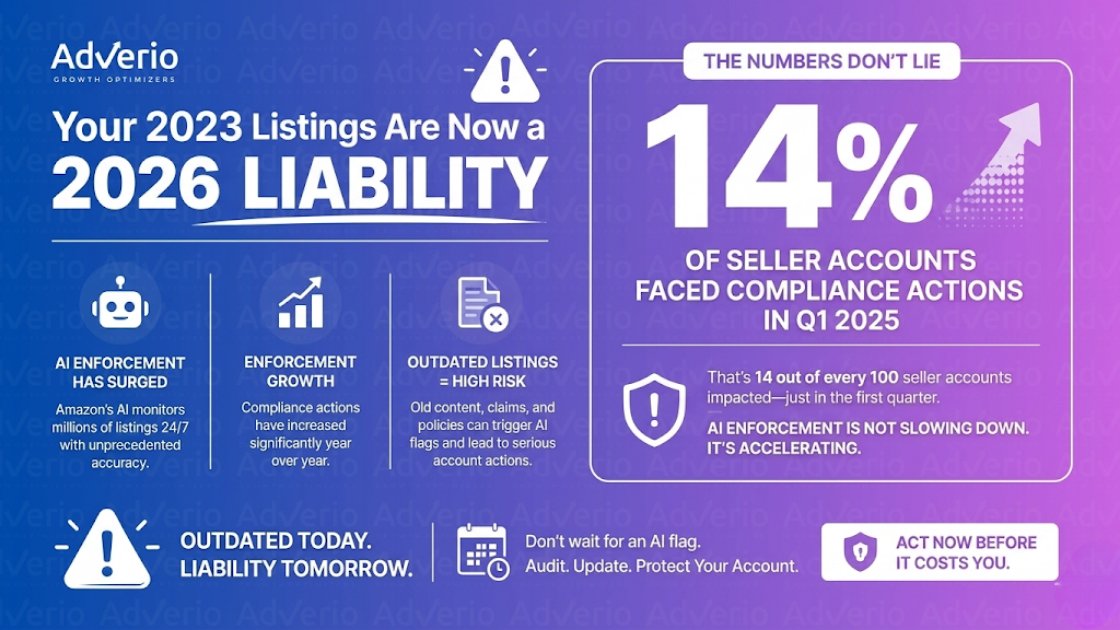
If your catalog still runs on listing copy approved in 2023, you’re exposed. Amazon’s enforcement is faster, stricter, and more operationally tied to fulfillment than it used to be. Starting January 1, 2026, Amazon will stop offering FBA prep and item labeling services in the U.S., which shifts prep, labeling, and inbound compliance responsibility to sellers and their logistics partners, raising the cost of listing and shipment mismatches into a direct fulfillment risk, as noted in Amazon’s FBA prep services 2026 change.
If you’re treating compliance as a quarterly cleanup task, you’re already late. This is a revenue protection issue.
15-minute diagnostic call. No pitch deck.
Your 2023 Listings Are Now a 2026 Liability
Most brands still assume old compliant content is safe until Amazon tells them otherwise. Bad assumption. In 2026, old listing assets can become the trigger.
Amazon has tightened compliance on both the physical and digital side of the catalog. Product-page assets now function as compliance evidence in some cases, and inbound mistakes hit harder because sellers own more of the prep and labeling burden. That means your title, bullets, images, documentation, and shipment data have to agree with each other. If they don’t, the risk isn’t abstract. It shows up in suppressed listings, blocked shipments, and account-level enforcement.
Brands with large catalogs need to stop thinking about this as a content problem. It’s a control problem. If you need the broader operational layer behind this, start with Amazon listing optimization, then tighten the compliance workflow around it.
At a Glance
-
Legacy content is a real risk: Listing copy and assets that passed review in earlier years may conflict with current category rules, image requirements, or documentation standards.
-
Compliance now affects fulfillment directly: Amazon’s end to U.S. FBA prep and labeling services on January 1, 2026 shifts more execution risk to sellers and 3PLs, according to this summary of the policy change.
-
Images are now evidence: Amazon’s 2026 guidance requires packaging-side images with visible warnings, safety information, and ingredient or material details in relevant cases.
-
Third-party verification is expanding: Some regulated products now require approved TIC testing or report verification instead of seller self-attestation.
-
Audit revenue-driving ASINs first: Your top sellers deserve first review because they carry the largest downside if Amazon suppresses them.
The executive takeaway is simple. Amazon listing compliance 2026 is no longer a backend paperwork exercise. It’s a frontline financial control.
How Amazon’s Automated Compliance Enforcement Works in 2026
Amazon’s enforcement now runs as a continuous automated check across listing data, images, documentation, and operational metadata — it isn’t waiting for a manual review queue to catch up. It checks whether your catalog record matches current policy expectations, then acts.
The key shift is that compliance evidence isn’t confined to uploaded certificates anymore. In 2026, Amazon has expanded documentation requirements across categories — including test reports, manuals, warranty files, and labeling details in applicable cases, as described in Amazon’s current product compliance guidance on Seller Central, summarized in this 2026 Amazon product compliance guide. That same guidance describes a packaging-image requirement where sellers upload all sides plus visible warning labels, safety information, usage instructions, and ingredient or material lists.
What that means in practice
| Enforcement layer | What Amazon checks | Why brands get caught |
|---|---|---|
| Listing copy | Claims, wording, category fit | Old bullets and descriptions stay live too long |
| Images | Packaging sides, warnings, ingredients | Creative teams treat images as marketing only |
| Documents | Certifications, test reports, manuals | Files exist, but aren’t current or mapped to ASINs |
| Operations | Handling time and inbound accuracy | Catalog data doesn’t match the physical product |
Amazon also said that, starting June 29, 2026, sellers must set accurate handling times for seller-fulfilled SKUs, which reinforces that policy enforcement now extends beyond content into operational metadata in the same 2026 compliance guidance.
If your team uses automation for content generation, feed updates, or merchandising support, treat tool governance as part of compliance. Convenience isn’t a defense. Brands working on voice and discovery workflows should apply the same scrutiny to Alexa for Shopping listing optimization, because structured data errors travel fast across surfaces.
The expensive mistake is assuming Amazon separates marketing data from compliance data. In 2026, it doesn’t.
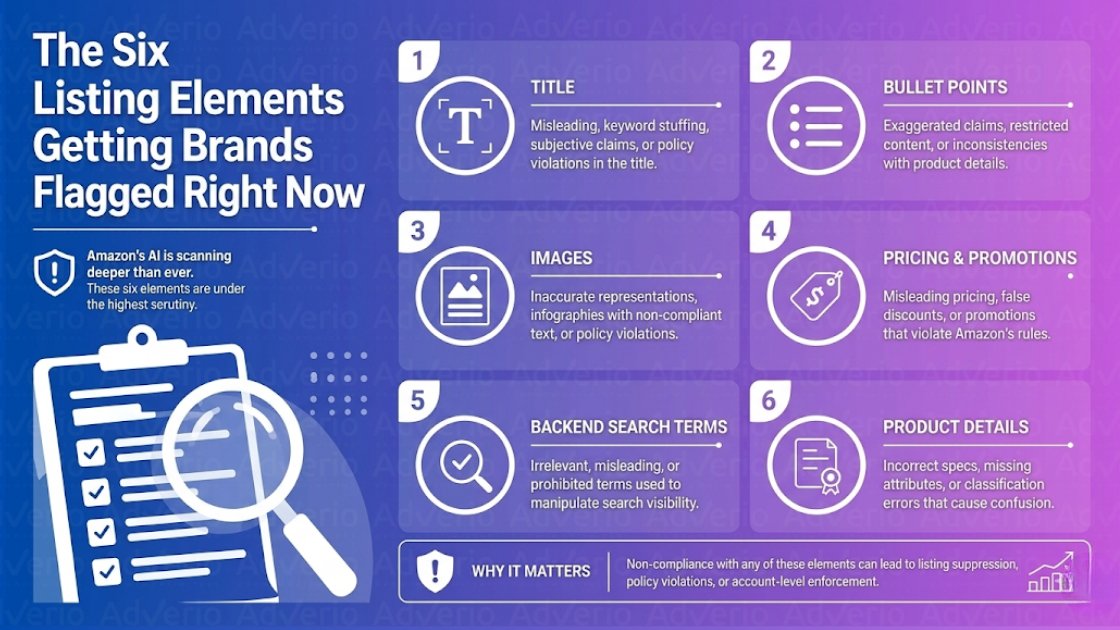
The Six Listing Elements Getting Brands Flagged Right Now
Brands with large catalogs routinely discover compliance gaps during audits — title, image, and document mismatches are among the most common suppression triggers, based on Adverio’s catalog audit data across managed accounts. They audit for obvious restricted products and miss the ordinary listing fields that create extraordinary risk.
Element 1 Prohibited health claims and unsubstantiated efficacy language
Health-adjacent copy is the fastest way to turn an old listing into a compliance event. The danger words are usually sitting in bullets, A+ modules, and image overlays. Terms that imply a product treats, prevents, or cures a condition attract scrutiny. So do “supports” claims when paired with a specific condition.
Audit action: Search your catalog exports for condition-based language and force every claim through a substantiation review. If the product isn’t cleared for that type of claim, remove it.
Pro Tip: Pull your listings in a spreadsheet and search for the words “relieves”, “reduces”, “treats”, “prevents”, “supports”, and “improves” followed by any health condition. If you find them in bullets or descriptions on a non-approved health product, update the language before Amazon’s system flags it.
Element 2 Missing required safety certifications for your category
The year 2026 reveals more stringent requirements. Some categories no longer accept seller self-attestation. For clothing storage units, Amazon now requires testing or test-report verification from an approved TIC organization against standards such as 16 CFR Part 1261 or ASTM F2057-23, plus lead-in-paint and formaldehyde checks where applicable, for products meeting threshold criteria including at least 27 inches in height, 30 pounds in mass, and 3.2 cubic feet of enclosed storage volume, according to Amazon’s 2026 clothing storage unit policy discussion.
Audit action: Pull every ASIN in regulated or borderline-regulated classes and verify whether Amazon now requires approved third-party TIC evidence. If your process still relies on supplier assurances or internal declarations, rebuild it now.
Element 3 Keyword stuffing in title and bullets
A lot of “SEO” work from prior years aged badly. Repetitive root terms, stacked modifiers, and awkward title construction don’t just reduce readability. They create policy and content-quality risk.
Audit action: Review titles and bullets for repeated keyword roots, redundant descriptors, and unnatural phrase chains. If the copy sounds written for a crawler instead of a customer, rewrite it. Clean language is safer language.
If your catalog has years of layered edits from agencies, resellers, and internal teams, you don’t need another patch. You need to fix my Amazon listings at the system level.
Element 4 Restricted content in images and packaging visuals
Images now do double duty. They sell the item and, in many categories, act as compliance artifacts. Amazon’s 2026 guidance requires packaging-side images that show visible warning labels, safety information, usage instructions, and ingredient or material lists, as described in the earlier 2026 compliance guidance source.
Audit action: Stop approving image sets that show only polished front-facing renders. Add a packaging compliance image review to your creative workflow. If the physical product has warnings or ingredient details, your image stack should reflect that where required.
| Image issue | Why it gets risky | Fix |
|---|---|---|
| Missing packaging sides | Amazon can’t verify disclosure elements | Upload full packaging views where required |
| Hidden warnings | Safety info isn’t visible | Re-shoot or redesign packaging images |
| Missing ingredient or material list | Product page conflicts with pack copy | Align image, PDP, and physical packaging |
Element 5 Supplier documentation and authenticity signals
Amazon doesn’t care that your supplier is “trusted.” It cares whether your documentation is current, complete, and acceptable for the category. This is especially painful when the listing has never had a problem before and then gets reviewed under tighter rules.
Audit action: Map every high-priority ASIN to its source documents. That includes invoices, testing records, declarations, manuals, warranty files, and any category-specific certifications. If your ops team can’t produce the packet quickly, you don’t have control.
Element 6 Review manipulation patterns in listing language
This one is avoidable and still common. Promotional language that references star ratings, review volume, or review superiority can create unnecessary exposure. Review strategy belongs in customer experience and merchandising. It doesn’t belong in risky copy.
There’s also a catalog architecture angle now. Amazon announced on January 7, 2026, that reviews will no longer be shared across variations with functional differences, including Flavor, Ingredients, or Formulation differences, with a phased rollout running from February 12 through May 31, 2026. Brands that used parent-child structures to pool reviews across different formulations or ingredient variants will see those reviews separated, raising the stakes for catalog architecture decisions, especially when ingredient sensitivity differs across child ASINs. Compliance and variation strategy now need to be planned together — especially when formulation or ingredient differences across child ASINs directly affect which reviews carry over and which reset to zero.
Audit action: Remove review-referencing language from titles, bullets, A+, and image text. Then review parent-child structures where ingredient or formulation differences could create policy friction.
The Listing Compliance Audit Process
You don’t fix this with random spot checks. You fix it with an operating cadence.
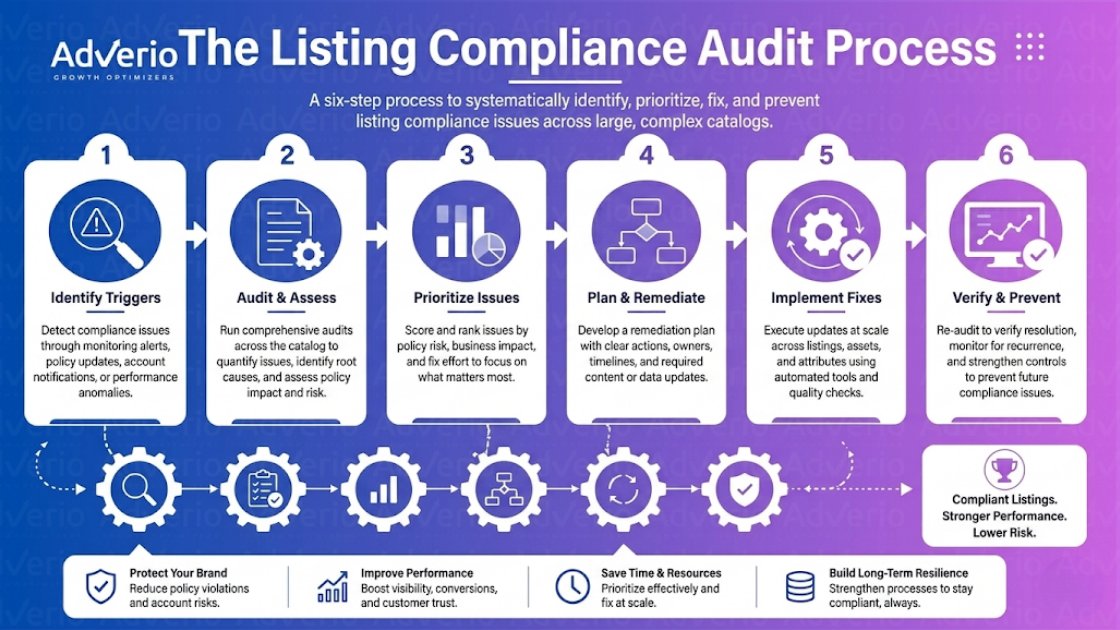
Here’s the workflow I recommend for established catalogs:
-
Pull your top revenue ASINs first: Start with the products that matter most to margin and sales continuity.
-
Run a listing-quality pass: Use Amazon’s native checks and your own catalog review process to identify obvious weak points.
-
Flag copy, image, and document mismatches: Don’t review these in separate silos. A compliant claim with a non-compliant image is still a problem.
-
Cross-check current category requirements: Regulated categories need extra scrutiny because the evidence standard is moving upward.
-
Verify packaging-image requirements: Amazon’s 2026 guidance requires sellers to upload all packaging sides with visible warning labels, safety information, and ingredient lists in relevant scenarios, turning imagery into formal evidence, as summarized in this Amazon compliance guidance review.
-
Resubmit and monitor status changes: Compliance isn’t finished when content is updated. It’s finished when the ASIN is stable.
A strong compliance workflow looks a lot like enterprise risk management. A strong compliance workflow looks a lot like enterprise risk management. You need defined owners, evidence retention, version control, and escalation paths. Treat every ASIN as a record you can defend, not a listing you set and forget. The same audit that fixes compliance also lifts listing performance. Run them as one workflow, not two.
Good audit teams don’t ask, “Is the listing live?” They ask, “Can we defend every field, every image, and every document tied to this ASIN?”
How to Prioritize Which Listings to Audit First
Audit by revenue exposure. Not by gut feel.
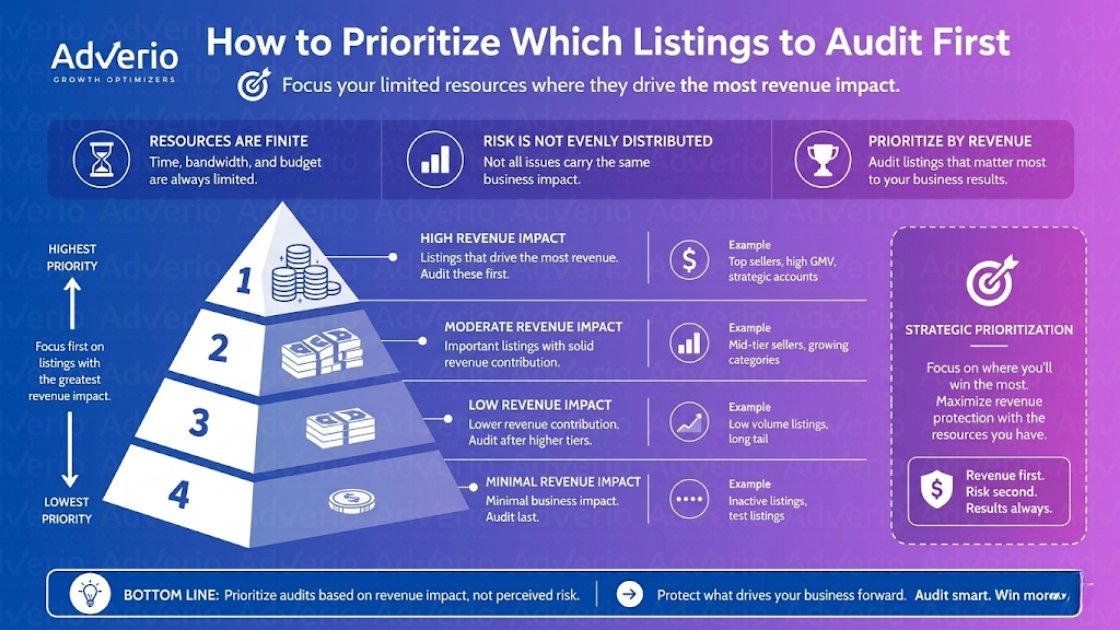
A messy low-volume ASIN can wait behind a clean-looking bestseller. Why? Because the financial downside isn’t equal. If a top-selling ASIN gets suppressed, the revenue hit is immediate, and the operational cleanup usually spreads into media efficiency, ranking loss, and forecast noise.
Use a simple triage model:
| Priority tier | What goes in it | What to do |
|---|---|---|
| Tier 1 | Best sellers and hero variants | Audit immediately |
| Tier 2 | Regulated categories and seasonal movers | Audit next |
| Tier 3 | Long-tail catalog | Clean up after core protection is done |
If your team needs a practical framework for this kind of catalog triage, start with Adverio’s guide for Amazon brands.
How Adverio Manages Listing Compliance Across Catalogs
Large catalogs break when compliance lives in disconnected teams. One group writes copy. Another manages images. Ops owns docs. Nobody owns the whole ASIN. That’s how suppression risk builds.
One option is to centralize review through a single account workflow. For example,
brands that need someone to manage their Amazon account often pair catalog review, creative checks, and operational documentation in one control layer so listing edits, packaging evidence, and category requirements stay aligned. That’s the right model if your internal team is already stretched.
Amazon Listing Compliance FAQs
How is a listing suppression different from an account suspension?
A listing suppression affects one ASIN or a set of ASINs. An account suspension affects your ability to operate the seller account more broadly. The first is a catalog-level interruption. The second is an account-level crisis. If you’re already in the second scenario, the Amazon account suspension recovery guide is the more urgent playbook.
What documents should I keep ready for 2026 compliance reviews?
Keep category-specific test reports, declarations, manuals, warranty files, invoices, packaging images, and any required third-party verification records organized by ASIN. For supplements, Amazon’s 2026 policy requires proof of cGMP compliance from an Amazon-accepted third-party certification body, with a typical 90-day submission window after notice, according to this supplements policy update summary.
Can Brand Registry protect me from compliance flags?
No. Brand Registry helps with control, content ownership, and brand protection, but it doesn’t override category rules or documentation requirements. It does make it easier to standardize assets and reduce unauthorized edits. That’s one reason many brands prioritize Amazon Brand Registry benefits before scaling catalog complexity.
What should I do after Amazon flags a listing?
Move fast and work from evidence. Identify the exact content, image, or document issue. Correct the root cause. Save the before-and-after record. If Amazon requires a formal appeal, write it around cause, correction, and prevention. If your team needs a template and structure, use this guide on
How to write an Amazon Plan of Action
Does review strategy affect compliance risk in 2026?
Yes. Not because reviews themselves are bad, but because brands often mix review language into listing copy or build fragile parent-child structures around variation strategy. Keep merchandising claims clean and separate from review messaging. If you’re rebuilding catalog architecture, align it with your Amazon review velocity strategy so growth tactics don’t create compliance drag.
Read Next
Amazon won’t slow down its enforcement because your team is busy. If your catalog is large, old, or spread across multiple operators, compliance drift is already happening. Adverio helps brands tighten listing controls before suppression turns into lost sales. Get My Profit ROI Forecast. 15-minute diagnostic call. No pitch deck.
References
-
Amazon clothing storage unit policy discussion on third-party verification
-
Amazon supplements update 2026 and cGMP certification requirements