



Table of Contents
Most $5M–$50M Amazon brands are losing margin on a problem they’ve already paid to fix.
They run listing audits. They rewrite bullets. They swap images. Then they push more spend into ads — and watch conversion stay flat. The issue isn’t effort. It’s sequence. If your detail page is broken, more traffic just accelerates the leak. An Amazon listing quality check doesn’t tell you what’s incomplete — it tells you what each flaw is costing you and which fix to make first.
If you’re running a catalog of 100+ SKUs, a generic checklist is a liability. You need a triage system that ties listing weaknesses to revenue loss. That’s the difference between content cleanup and profit recovery.
Ready to see exactly where your listings are bleeding margin?
A Listing Audit Tells You What’s Wrong. A Quality Check Tells You What It Costs.
A listing audit is administrative work. It creates a tidy list of defects and gives teams the false comfort of progress. That is how brands keep spending on traffic while weak detail pages keep wasting it.
A quality check does the job an operator needs. It ties each flaw to lost conversion, lower revenue per session, or margin pressure. If a problem cannot be connected to financial impact, it goes to the bottom of the queue.
That standard forces better decisions. A missing secondary image might be harmless on one ASIN and expensive on another. A clumsy mobile title, a confusing variation setup, or a stale review profile can drag conversion hard enough to turn profitable traffic into expensive noise. The point is not to fix everything. The point is to stop the bleeding first.
Practical rule: Prioritize issues that hurt traffic quality, increase buying friction, or reduce margin. Everything else is cleanup.
Amazon has already pushed sellers in this direction. Seller Central now frames listing improvement around sales impact, not simple completeness. Good operators should do the same, then go further by assigning a hard business cost to each weakness instead of treating every defect as equally urgent.
If your catalog is spread across multiple systems, that operational mess will keep undermining listing improvements. Content breaks, attributes go missing, and updates stall. Teams dealing with that problem need a clean catalog management process first — not more content sprints. Adverio’s Amazon catalog management system is built for exactly this.
If you still want a checklist, get a detailed Amazon listing audit covering titles, bullets, images, A+ content, and indexing gaps. Then stop there and you will still miss the key question. What is each flaw costing you right now?
That question is the whole point of Adverio’s framework. An audit gives you observations. A quality check gives you a recovery plan.
Dissecting Conversion DNA: The Four LQS Components
A listing does not fail as a whole. It fails in specific places, and each weak point drains revenue in a different way.
That is why a real amazon listing quality check needs a scoring model, not a generic audit worksheet. You need to measure the parts of the page that influence buying behavior, weight them properly, and tie weak performance to likely conversion loss. The four components are Copy, Media, Reviews, and Offer. Together they show what the shopper understands, what they trust, and what blocks the sale.
At the center of this framework is LQS, a score out of 10 calculated from a maximum of 65.75 points across four components: Copy or LCS (26.00), Media or LMS (23.00), Reviews or LRS (12.00), and Offer or LOS (4.75). The formula is LQS = (earned/65.75) x 10. A score below 6 usually means the listing is working against conversion.
For the scoring logic behind each component, review Adverio’s proprietary Listing Quality Score (LQS).
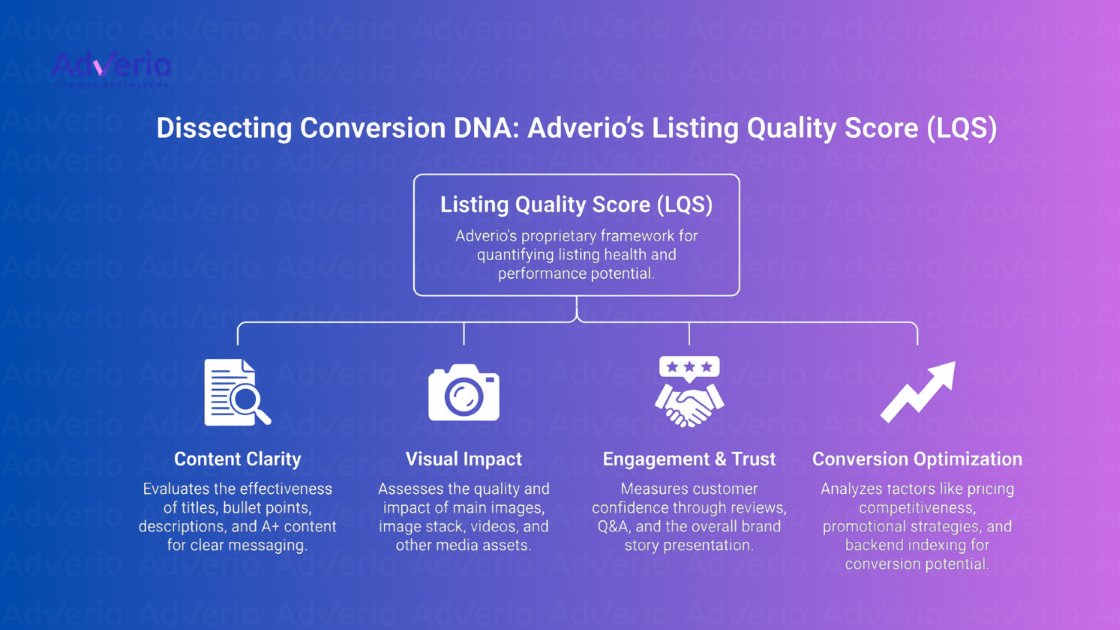
Copy LCS
Copy carries the most weight because it does two jobs at once. It helps Amazon understand relevance, and it helps shoppers decide whether the product fits their need.
Weak copy is expensive. Brands stuff titles with terms they want indexed, then wonder why mobile shoppers bounce. Bullets often repeat the same claim five ways and leave the actual buying questions unanswered. A+ content looks polished but says nothing useful. That is not optimization. It is conversion drag.
Score copy against three checks first:
-
Title clarity: Does the title identify the product fast, lead with terms that matter, and still read cleanly?
-
Bullet usefulness: Do the bullets give distinct reasons to buy, or are they padded with repetitive claims?
-
Description depth: Does the description or A+ content remove doubt, address objections, and explain fit?
Poor copy usually breaks one of two ways. It is either too thin to persuade, or too bloated to communicate.
The best bullets answer hesitation before the shopper has to ask.
Media LMS
Media determines whether the shopper keeps going. If the visual stack is weak, the rest of the page never gets a fair chance.
A lot of catalog teams confuse acceptable assets with persuasive assets. That mistake costs money. A compliant main image can still disappear in search results. Seven gallery images can still fail to explain the product. A video can exist and still do nothing to improve conversion.
Check media in layers:
| Media element | What to check | What usually goes wrong |
|---|---|---|
| Main image | Fast product recognition, clean framing, obvious variant | Product blends into the search page |
| Image stack | Benefit progression, feature proof, scale, use case | Redundant angles with no selling sequence |
| Video | Product demo, motion clarity, decision support | Video exists but adds no buying context |
Good media does not just decorate the listing. It reduces cognitive load. If the product needs explanation, your images and video should handle that work before the shopper reaches the third bullet.
Reviews LRS
Reviews are your trust layer. Without trust, traffic gets expensive fast.
The goal is not to obsess over star count in isolation. The core question is whether the review profile supports the promise your listing makes. Volume matters. Recency matters. Sentiment patterns matter. Negative reviews matter most when they expose a mismatch between what the page claims and what the product delivers.
Score reviews with three questions:
-
Is the review volume strong enough for the category?
-
Do recent reviews confirm the product promise or undermine it?
-
Do repeated complaints reveal content gaps you should fix on-page?
A smart review read should reshape your listing. If buyers repeatedly praise durability, fit, softness, ease of use, or setup speed, bring that language into your bullets and media. If they repeatedly complain about sizing confusion, color mismatch, or misleading expectations, your page is creating preventable friction.
When negative reviews expose a consistent content gap — sizing confusion, misleading claims, missing use-case context — that’s your page creating preventable friction. Fix the listing before you attempt to manage the review. Adverio’s Amazon review removal and protection services address the trust layer directly.
Offer LOS
Offer has the smallest weight in the score, but it still decides whether interest turns into checkout.
Weak operators lose margin while pretending the problem is copy. It usually is not. If the price feels disconnected from the page, if fulfillment weakens trust, or if variation logic confuses the shopper, conversion drops even when the content looks polished.
Offer quality usually breaks in three places:
-
Price context: The price can be justified, but the page has to make the value obvious.
-
Badge eligibility: Fulfillment speed and reliability influence purchase confidence.
-
Variation structure: Bad parent-child logic creates hesitation and abandoned sessions.
Trying to patch offer friction with better wording is a waste of time. If the customer has to solve a variant puzzle or second-guess the value, the listing is not ready to convert.
Each of these four components affects revenue differently. Copy drives understanding. Media builds conviction. Reviews reduce perceived risk. Offer removes buying friction. Score them separately, attach a financial cost to each flaw, and you stop treating every issue as equally urgent. That is the difference between a checklist and a quality check.
How to Manually Diagnose Listing Health Using Seller Central
Seller Central is enough to spot listing decay. It is not enough to tell you what that decay is costing you.
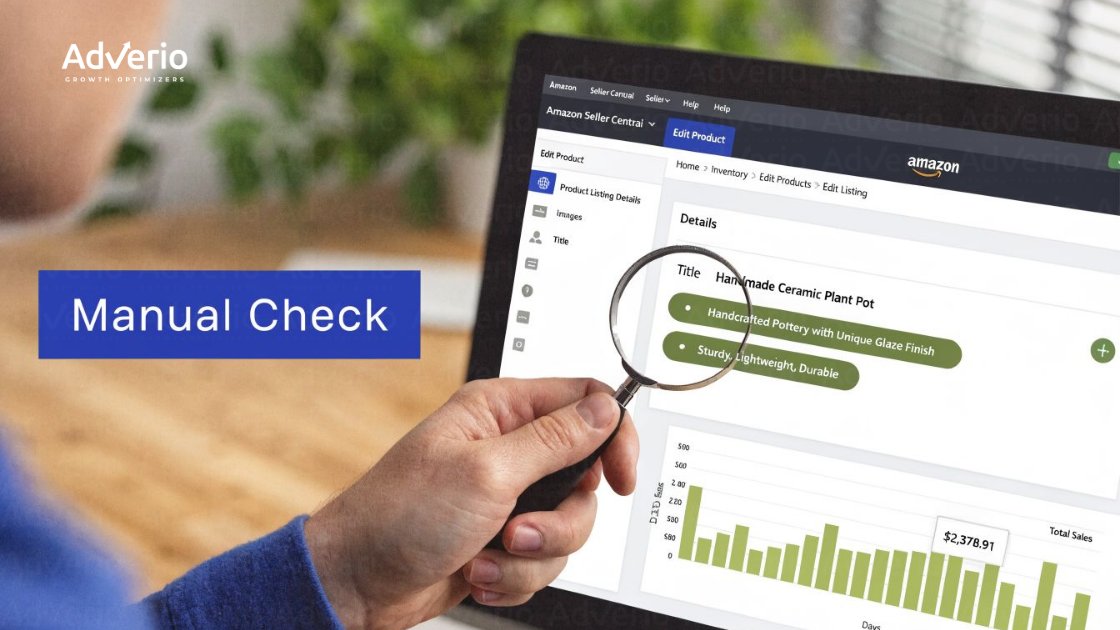
Start with Amazon’s Listing Quality Dashboard under Inventory. It flags issues across the catalog and ranks them using recent page-view and sales-potential signals. That makes it useful for triage. It does not replace a quality check, because Amazon highlights missing pieces, not the full profit impact of weak positioning, poor media sequencing, or review-driven trust loss.
Start with the dashboard and sort by revenue exposure
Sort the dashboard by the ASINs getting the most traffic first. Ignore internal opinions. A low-volume SKU with messy bullets is a minor annoyance. A high-traffic ASIN with weak attributes is a cash leak.
Treat red and yellow alerts as a shortlist, not a to-do list. They usually point to missing or weak titles, bullets, images, identifiers, brand details, fulfillment data, and category-specific fields. Amazon surfaces them because they affect discoverability and buying confidence. Your job is to decide which flaws are suppressing sales.
Pull category templates and inspect the backend
Download the category template or flat file for the product type, then compare it against the live listing. In doing so, lazy catalog management gets exposed.
A lot of brands stop at required fields and call the listing “done.” That is sloppy. Amazon evaluates completeness and structure well beyond the minimum. Backend attributes like material, size, color, intended use, and compatibility often influence indexing, filtering, and suppression risk. If those fields are thin or inconsistent, the listing can lose visibility before a shopper even reaches the page. This explanation of IDQ Score and listing quality methodology gives useful context on how Amazon evaluates listing data quality.
Check categorization and variation logic
Review browse nodes, item type keywords, and parent-child relationships. Then verify that every child ASIN reflects the variation logic a shopper expects.
Bad categorization creates hidden ranking problems. Bad variation structure creates hesitation at the point of purchase. If a shopper clicks into a color family and sees mismatched sizes, broken swatches, or irrelevant child products, conversion drops fast. Copy will not save a structurally broken catalog.
If your team underuses native diagnostics, this episode on overlooked Amazon Seller Central tools for PPC growth is a practical place to sharpen the process.
Review the front end like a buyer with no patience
Open the PDP on mobile first, then desktop. Judge it hard.
-
Title: Does the first screen explain the product fast?
-
Bullets: Does each bullet add a new reason to buy?
-
Images: Does every image answer a buying question or overcome an objection?
-
A+ content: Does it clarify differences, use cases, and value, or just fill space?
-
Reviews: Do negative reviews expose a product problem, a positioning problem, or both?
Manual diagnosis is good for triage and bad for prioritization at scale. It is slow, subjective, and disconnected from money. That is why a standard listing audit keeps teams busy without making them efficient. A real amazon listing quality check goes one step further. It assigns financial weight to each flaw so you can fix the issues that recover revenue first.
Creating Your Prioritization Matrix: Fix What Matters First
If you’ve got 200 SKUs, you don’t need more recommendations. You need a queue.
A serious amazon listing quality check ends with prioritization. Otherwise your team burns weeks rewriting low-traffic ASINs while top sellers keep leaking conversion.
Third-party analysis from Thunderbit reports that listing quality correlates with rank, that scores above 90 are associated with top 10% category rankings, and that brands often see a 35% conversion uplift after tool-guided optimizations, according to Thunderbit’s Amazon Listing Quality Checker. That’s exactly why prioritization matters. The upside exists, but only if you fix the right pages in the right order.
Use a simple impact versus effort model
Define impact by likely conversion improvement multiplied by traffic importance. Define effort by how much creative, operational, and cross-team work is required.
Then sort every fix into one of four buckets.
| Category | Description | Example Actions |
|---|---|---|
| Quick Wins | High impact, low effort | Add missing attributes, correct variation data, replace weak main image, rewrite unclear bullets |
| Major Projects | High impact, high effort | Full image stack rebuild, video creation, A+ redesign, parent-child catalog restructuring |
| Fill-Ins | Low impact, low effort | Tighten description language, improve secondary image labels, small backend attribute cleanup |
| Time Sinks | Low impact, high effort | Reworking low-traffic ASINs, cosmetic changes with no conversion logic, rewriting already functional copy |
Decision filter: Fix the floor first. Don’t chase elegance on listings that still have obvious trust or clarity problems.
Your KPI framework matters here. If your team only watches ad efficiency, they’ll prioritize the wrong work. Listing fixes should be judged against conversion, sales mix, and margin impact, not content completion rates. This guide to Amazon KPIs that actually matter gives you the right lens.
The matrix forces discipline. That’s the point.
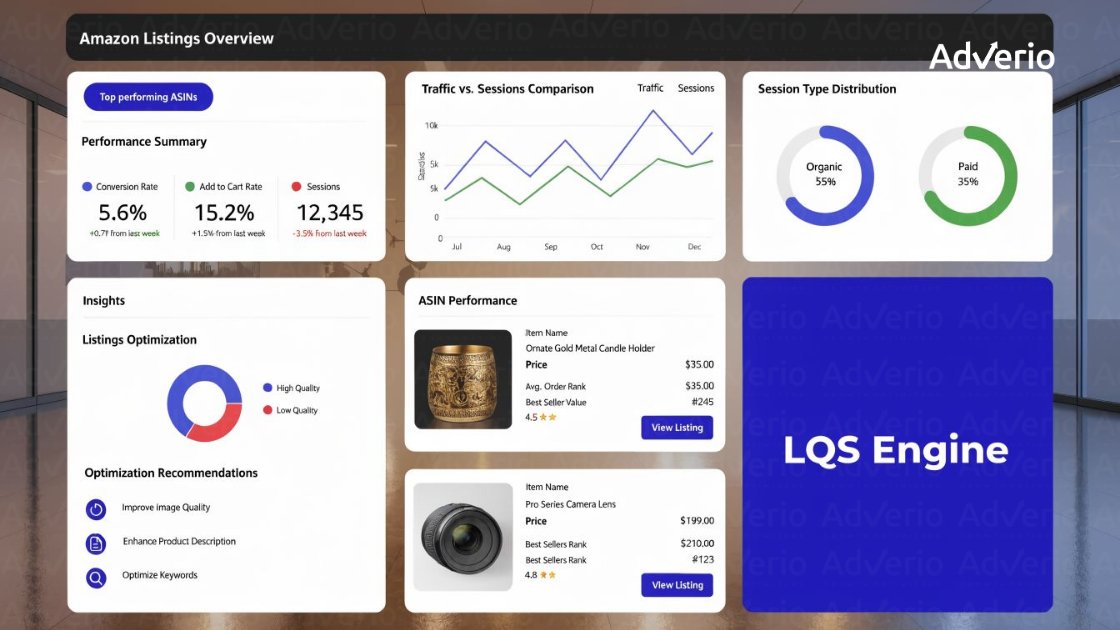
From Diagnosis to Domination: Adverio’s LQS Growth Engine
Manual review is useful. It’s also limited.
It can tell you a listing looks weak. It usually can’t tell you how that weakness connects to downstream performance across conversion rate, sales quality, and TACoS over time. That gap is where most listing tools stop being useful.
That limitation is well documented. The major weakness in most listing quality tools is the lack of quantitative tracking for changes and their downstream effect on metrics like conversion rate and TACoS. They give you a score, but not the longitudinal analysis or testing framework to prove financial impact, as noted in this analysis of listing quality tool gaps and ROI tracking.
That’s where a more mature system changes the conversation. Instead of scoring a page once and moving on, the model needs two layers:
-
Human perception score: How the listing reads and sells to a shopper
-
Machine perception score: How Amazon interprets the content, structure, and compliance signals
In Adverio’s framework, the human-side score is LQS. The machine-side layer is AACR. On top of that sit separate AI analysis layers such as Rufus Analysis, Cosmo Optimization, and Compliance Analysis. That’s how you stop treating listing optimization like copy editing and start treating it like conversion engineering.
The operating model also matters. Some teams need it done for them. Others need a done-with-you process their internal ecommerce team can plug into. If you’re trying to clean up a large catalog, connect listing changes to media and PPC, and keep improvements from drifting, a service built around Amazon listing optimization is the practical next step.
One structured quality check process cited for Mary Maxim reported CTR +125% and USP +120% after the workflow was applied. The point isn’t the headline. The point is that disciplined scoring, prioritization, and execution beat random edits every time.
Stop running audits that don’t move numbers. Adverio’s Amazon listing optimization system connects LQS scoring, media, and PPC into one profit view — so every fix you make earns its place.
Frequently Asked Questions About Amazon Listing Quality
How often should you run an amazon listing quality check
Run a formal quality check every month on your top ASINs. Run another one after any meaningful change: new images, rewritten bullets, merged variations, price shifts, conversion drops, or review patterns that expose a mismatch between the page and the product.
Treat this like margin control, not housekeeping. High-traffic ASINs can waste real money fast. Low-traffic listings can wait unless they support a strategic category, carry strong margin, or have a clear operational issue.
Is a listing quality check only about content
No. Brands lose money when they reduce listing quality to copy and creative.
A real quality check scores the full sales environment: offer structure, review credibility, category placement, backend attributes, variation setup, image order, mobile readability, and content clarity. A checklist audit tells you what looks off. A quality check tells you which flaw is suppressing conversion and how much that flaw is likely costing you. That difference matters because not every defect deserves immediate work.
Should you fix listings before increasing PPC spend
Yes, in most cases.
If the listing is weak, more traffic just buys you more bounced sessions, more wasted clicks, and a worse blended ACoS. Paid traffic does not rescue a bad page. It exposes it. Fix the pages already getting meaningful traffic first, then push spend into listings that can convert.
Can you score listings without paid software
Yes. Seller Central, category templates, review mining, search term reports, and mobile checks are enough to catch a lot.
Manual review breaks down when you need consistency across a big catalog or need to connect listing defects to revenue loss. That is the whole point of a quality check. You are not trying to produce another opinionated audit. You are trying to rank fixes by financial impact so the team stops spending hours polishing low-value details.
Do Amazon, Walmart, and Target require the same quality standard
No. The standard is profit, but the execution changes by marketplace.
Amazon rewards clean attribute data, strong relevance signals, and smart variation structure. Walmart and Target care about different content formats, operational constraints, and merchandising rules. Copy-pasting one version everywhere is lazy. It usually produces average conversion everywhere too.
Where should operators go if they need broader marketplace guidance
Teams managing listings, ads, retail readiness, and channel differences need one place for practical answers. Adverio’s marketplace operations FAQ library covers the questions operators run into when execution gets messy.
If your catalog has traffic but not enough conversion, you don’t have an ad problem first. You have a diagnosis problem. Adverio’s full Amazon account management system connects listing quality, media, reviews, offer structure, and performance data into one profit view — so you stop fixing random details and start recovering the margin you’re already losing.