


Table of Contents
A lot of brands still think compliance is a legal cleanup task. It’s not. It’s a revenue protection system.
On Amazon, stale content becomes operational debt. That matters because a Storefront is no longer just a branding page. Amazon’s own guidance says new-to-brand shoppers who visited a Brand Store were 62.7% more likely to purchase than shoppers who didn’t visit one, which means your storefront and your listings now work together as a conversion path, not separate assets (Amazon Brand Stores best practices). If your catalog is outdated, that path breaks fast.
If you’re serious about Amazon listing optimization, compliance has to sit inside your broader Amazon storefront strategy, not beside it.
15-minute diagnostic call. No pitch deck.
Your Amazon Listings Are a Ticking Time Bomb
Amazon does not need a human reviewer to hurt your revenue now. Its 2026 enforcement systems can flag stale copy, outdated claims, and legacy images across a mature catalog long before your team notices a drop.
Suppressed listings disproportionately affect established, high-catalog brands, not reckless new sellers. Catalog age and content volume create the exposure: the more ASINs published between 2021 and 2023 and left unaudited, the higher the policy risk surface. The risk sits in content published in 2021 through 2023, then left untouched while teams focused on media spend, inventory turns, and contribution margin. Those older pages were written for a different policy environment. They are now being judged by newer automated standards.
That gap is expensive.
A strong Amazon storefront strategy increases exposure to whatever sits underneath it. If your Store routes more shoppers into pages with risky bullets, non-compliant image text, or unsupported product claims, you are paying to send traffic into avoidable failure points. Better merchandising does not protect weak listing foundations. It scales their consequences.
Treat the Store and the catalog as one operating system. If the Store gets regular updates but the linked ASINs keep old content, you create a polished front door attached to unstable product pages. That is exactly how established brands lose conversion rate, ad efficiency, and buy box momentum without a clear warning.
Start with the pages your storefront pushes hardest. Check every destination for old benefit language, medical or performance claims, image overlays, comparison wording, and hidden variation-level issues. Then understand your Amazon account state before Amazon’s systems do it for you.
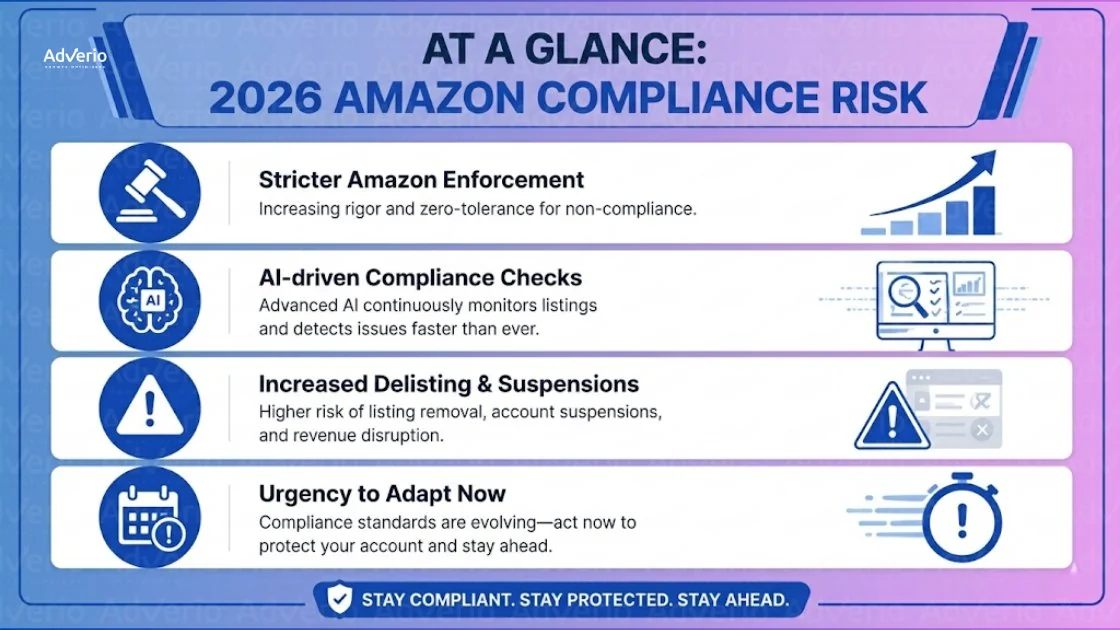
At a Glance The 2026 Compliance Risk
Amazon can suppress a listing before your team sees a conversion drop. For established brands, the biggest exposure usually sits in catalog content written in 2021 through 2023 and never re-audited for current AI review standards.
-
Legacy listing content is the primary risk: Old bullets, outdated claims, and image text from 2021 through 2023 are being re-evaluated under stricter automated checks.
-
Amazon’s enforcement speed creates a response gap: The system can flag, suppress, or limit visibility before brand teams catch the problem in routine catalog reviews.
-
Store traffic amplifies weak pages: A better storefront strategy sends more shoppers into whatever product detail pages are linked, including pages with hidden compliance exposure.
-
Revenue concentration should set audit order: Start with high-sales ASINs, top Store destinations, and parent listings with many child variations.
-
Measurement discipline matters: Track traffic source quality, not just clicks. Pair storefront performance with catalog risk signals so you can see which pages are driving sales and which pages are creating avoidable exposure.
-
Attribution quality affects compliance decisions: Cleaner tracking helps operators spot weak traffic paths and revenue loss faster. Tighten your attribution infrastructure if your reporting still depends on messy client-side data.

Mastering your amazon storefront strategy: 2026 compliance 20
You need a clear read on current exposure before you touch creative, traffic allocation, or Store routing. Start with suppression signals, policy warnings, stranded variations, and content quality issues across the catalog, and understand your Amazon account state.
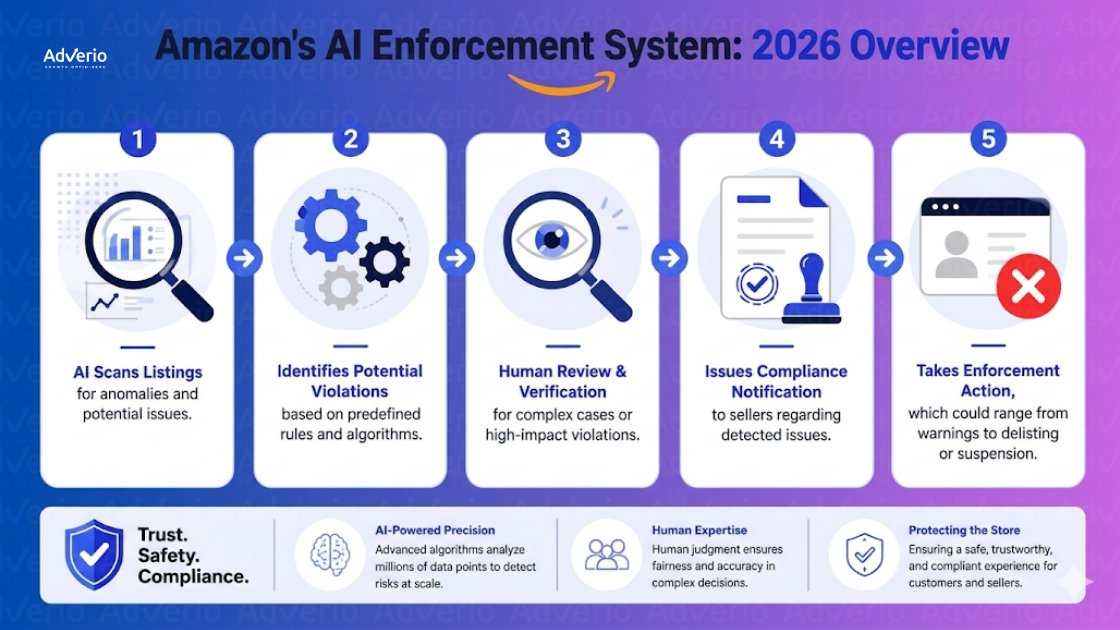
How Amazon’s AI Enforcement System Works in 2026
Amazon now evaluates listing quality and policy risk across the full shopping path, not as isolated pages. That shift creates a serious problem for established brands. Catalog content written in 2021 through 2023 often still reflects older claim language, older image conventions, and older merchandising logic. The AI systems reviewing that content do not care when it was written. They score what is live now.
Store architecture still matters because it controls exposure. Amazon’s creative specs show that shoppable images can feature up to 6 products with interactive points, turning the Store into a product-discovery layer instead of a static brand page (Amazon Stores ad specs). More entry points mean more ways to send shoppers into pages that have never been re-audited under current enforcement rules.
What operators miss
Amazon’s 2026 enforcement stack is pattern-based. It scans titles, bullets, A plus content, images, review-adjacent language, documentation gaps, and variation relationships at scale. It also connects shopper behavior to those assets. If traffic keeps landing on weak pages, those pages get more visibility inside Amazon’s systems, not less.
The failure point for many storefront strategies is attribution discipline. Operators push traffic from Sponsored Brands, DSP, influencers, and external media into the same Store, then lose track of which subpages and destination ASINs are creating risk along with revenue. You cannot protect revenue if your reporting only shows visits.
If you’re tightening attribution across channels, this guide to server-side tracking for better ROI is useful context for how cleaner data improves decision-making outside Amazon as well.
Why this matters for storefront strategy
A modern Amazon storefront strategy is a routing and risk-control system.
You are deciding:
-
Which destination pages send shoppers into legacy listings that may now trigger enforcement
-
Which hero products deserve visibility only after their copy and images are rechecked
-
Which tagged landing pages need cleaner measurement so risk can be tied to traffic source
-
Which Store paths are sending paid traffic into suppressed, weak, or outdated PDPs
This matters even more as Amazon pushes AI-assisted discovery. Voice-led and intent-led shopping compress the path between query and product selection. If you are planning for that shift, read this perspective on Alexa AI shopping for Amazon sellers.
The practical takeaway is simple. Treat every Store click as a compliance decision, especially when it lands on content your team has not touched since 2021, 2022, or 2023.
The Six Listing Elements Getting Brands Flagged Right Now
Businesses don’t need more generic advice. They need a shortlist of what to fix first.
Below is the risk matrix I’d use before sending another dollar of traffic into an aging catalog.
| Risk Element | Common Trigger Pattern | Required Fix |
|---|---|---|
| Prohibited health claims | Language that implies treatment, prevention, or cure | Remove or rewrite claims to stay within allowed category language |
| Missing safety certifications | Product pages lacking current category-required documentation | Verify current requirements and upload the needed documentation |
| Keyword stuffing | Repetitive root keywords in titles and bullets | Rewrite for clarity, readability, and policy-safe relevance |
| Restricted image content | Before-and-after style claims or prohibited visual comparisons | Replace non-compliant images with policy-safe creative |
| Supplier documentation gaps | Weak authenticity support for sensitive categories | Organize supplier records and align listing details with documentation |
| Review manipulation language | Listing copy referencing star ratings or review volume in a problematic way | Remove language that appears to influence or exploit reviews |
Element 1 Prohibited health claims and unsubstantiated efficacy language
Old copy gets brands into trouble.
Words like ‘treats,’ ‘prevents,’ ‘reduces,’ ‘improves,’ or ‘supports’ create immediate compliance exposure when they connect to a condition or outcome your product isn’t approved to claim. Teams often miss this because the product page has been live for years and the language feels normal internally.
Audit bullets, descriptions, A+ modules, comparison charts, and image text. Don’t stop at the main copy. Old creative often carries the worst legacy phrasing.
Required fix: strip out claim language that crosses into medical or condition-specific territory. Replace it with factual, product-centered language that describes features, ingredients, format, materials, or intended use without crossing the line.
Element 2 Missing required safety certifications for your category
Category requirements change. Your listing usually doesn’t change with them unless someone forces the update.
That’s the trap. Children’s products, electrical items, and products in sensitive wellness areas can require current documentation that didn’t exist, or wasn’t enforced the same way, when the ASIN launched. Required fix: go back through the current category workflow and confirm what Amazon requires now, not what it required when the listing was first created. Match every product variation to the right documentation set. If the paperwork and the detail page don’t align, fix both sides.
Old compliance assumptions are expensive. Review current category requirements before you trust any legacy page.
Element 3 Keyword stuffing in title and bullets
A lot of brands still write like it’s an old SEO playbook. Repeating the same root term across the title and bullets doesn’t make the listing smarter. It makes it look manipulated.
This also hurts the storefront experience. If your Store is merchandising premium products and the linked listings read like spam, shoppers notice.
Required fix: rewrite for clarity. Keep core terms that describe the product accurately, but remove repetitive variants that clutter the title and bullets. The page should read like a credible product detail page, not a search term dump.
If your team is stuck cleaning this up across a wide catalog, start with the products getting the most storefront traffic, then fix your Amazon listings at the title and bullet level before you touch lower-traffic pages.
Element 4 Restricted content in images and before and after claims
Creative teams create risk when they design for persuasion without designing for policy.
Before-and-after framing, dramatic transformation imagery, or visual claims that imply guaranteed outcomes can create immediate exposure. The product may be legitimate. The image can still be the problem.
Required fix: review hero images, secondary images, A+ visuals, and storefront image tiles for prohibited visual claims. Replace anything that suggests medical treatment, guaranteed transformation, or a policy-sensitive comparison. Your image stack should explain the product, not overpromise the result.
Element 5 Supplier documentation and authenticity signals
Amazon wants the listing and the paper trail to tell the same story.
If the brand name, packaging details, variation setup, or product specs don’t line up cleanly with supplier records and invoices, you create unnecessary friction. This gets worse in categories where authenticity gets extra scrutiny.
Required fix: centralize supplier invoices, manufacturer records, packaging references, and product identifiers. Then compare them against what appears on the detail page. If the documentation says one thing and the listing implies another, the listing loses.
Element 6 Review manipulation patterns in listing language
Brands sometimes bake social proof directly into listing copy. That can backfire.
References to “five-star reviews,” “thousands of happy customers,” or similar review-led phrasing can create policy risk because they signal an attempt to use reviews in a way Amazon doesn’t want on the page itself.
Required fix: remove review-based promotional language from titles, bullets, descriptions, A+ content, and image overlays. Let the review system do its job on-platform. Keep listing copy focused on the product and the shopper’s decision criteria.
The Listing Compliance Audit Process
Legacy copy from 2021 to 2023 is where established brands get blindsided. Amazon’s 2026 enforcement system does not care that a page has been live for years. It cares whether the current listing language, images, and supporting records trigger a policy pattern today.
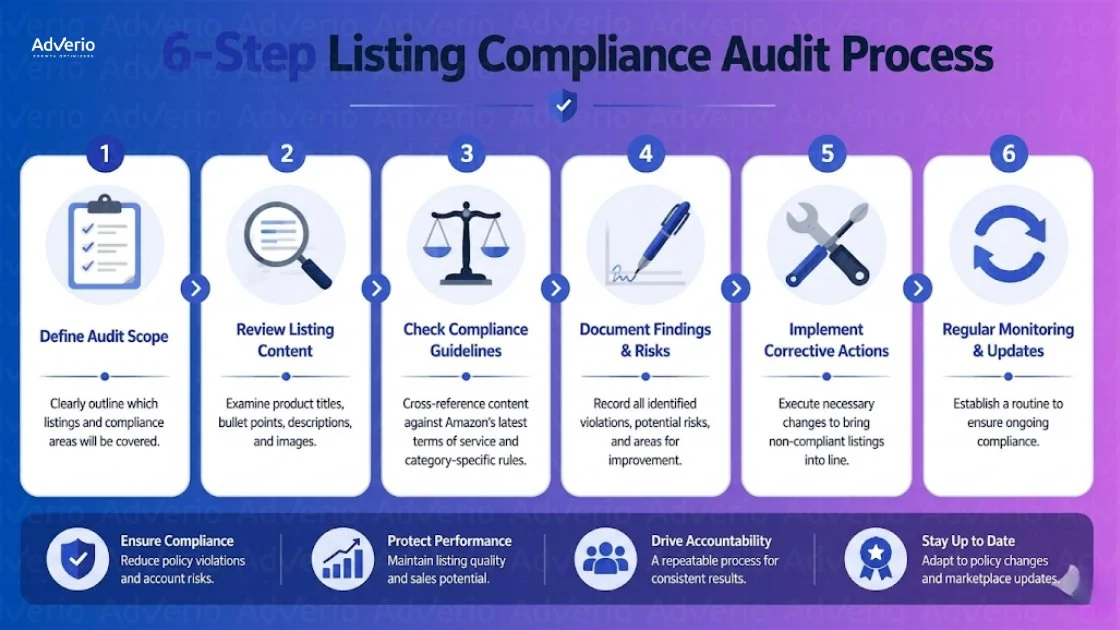
A good audit process is fast, repeatable, and hard on old content. You are not reviewing pages for style. You are finding the exact claims, image treatments, and documentation gaps Amazon’s systems now flag, even if they passed internal review three years ago.
The six-step workflow
-
Export your catalog with revenue, traffic, and last-edit dates: Old, high-output ASINs carry the most hidden risk because they often contain untouched 2021 to 2023 language.
-
Run a first-pass scan for banned claim patterns: Search titles, bullets, descriptions, A+ modules, backend fields, and image text for policy-sensitive phrasing.
-
Force a manual review on stale or inconsistent pages: If copy, packaging, and variation data do not match cleanly, treat the listing as exposed.
-
Score each ASIN against the six risk elements: Use one audit framework across the catalog so your team does not miss repeat offenses.
-
Verify category-specific requirements and supporting records: A compliant-looking page still gets flagged if the documentation behind it is weak or outdated.
-
Push fixes immediately and log what changed: Every day an exposed listing stays live, it keeps collecting traffic and risk at the same time.
One shortcut works well at scale. Pull all listing text into a spreadsheet and search for words like “relieves,” “reduces,” “treats,” “prevents,” “supports,” and “improves” when they appear near a health condition, symptom, or guaranteed outcome. That simple filter usually surfaces old copy blocks your team forgot existed.
Where storefront strategy fits
Storefront strategy belongs in the audit because traffic routing can hide weak detail pages. Check where storefront modules, brand navigation, and campaign links send shoppers. If a high-traffic tile points to a stale listing with risky copy or outdated images, the storefront is feeding exposure into the problem.
Use source-tagged URLs for launches, seasonal pushes, and campaign paths. Then compare engagement and sales by destination page, not just by click volume. That helps you spot which pages need compliance fixes first and where tighter control can protect listings across your full catalog.
How to Prioritize Which Listings to Audit First
Don’t start with the easiest listings. Start with the most expensive risk.
If one ASIN drives a major share of your revenue, that page gets audited first. A suppression on a high-output product is not a content problem. It’s a profit problem. Operators who treat compliance as equal-opportunity maintenance waste time on low-impact pages while high-impact ones sit exposed.
Use a simple order:
-
Revenue first
-
Storefront traffic second
-
Ad-supported ASINs third
-
Complex variation families next
That sequence protects the most money fastest.
This is also where compliance and conversion connect. The pages that deserve first attention are usually the same pages where better structure, cleaner copy, and stronger merchandising can improve Amazon conversion rate.
How Adverio Manages Listing Compliance Across Catalogs
Large catalogs fail on coordination, not intent. The risk usually sits in older PDP copy, inherited templates, and image sets that were approved years ago and never rechecked against Amazon’s current AI review patterns.
Adverio manages compliance at the catalog level, not as one-off listing edits. The team maps policy-sensitive fields across ASIN groups, tracks Listing Quality Score changes, flags legacy content that can trigger 2026 enforcement, and routes fixes through one operating workflow so merchandising, compliance, and operations are not working from different versions of the truth.
That matters most for established brands with 2021 to 2023 content still live across top sellers, child variations, and duplicate storefront assets. Amazon’s automated enforcement does not care that the copy was accepted before. It only cares what the system flags now.
If you need a partner to manage your Amazon account with listing compliance tied to performance operations, Adverio handles the audit queue, update coordination, and catalog-wide rollout discipline that internal teams often struggle to maintain at scale.
Book Your ROI Forecast. 15-minute diagnostic call. No pitch deck.
FAQs about Amazon Listing Compliance
Can a listing come back after a compliance action?
Yes. Recovery depends on how fast you identify the flagged element, remove the risky claim or asset, and submit a correction Amazon can verify. In 2026, weak appeals fail because the system is checking the live listing against policy-sensitive fields, not rewarding vague explanations. If you are already in remediation, review how to recover a suspended Amazon account before you resubmit anything.
Does Brand Registry help with compliance?
It helps you control content and protect ownership. It does not protect old 2021 to 2023 listing copy from current AI enforcement. Brands still get flagged when titles, bullets, images, A plus content, or backend fields contain claims Amazon now treats as risky.
Why is my competitor still live if their listing looks worse than mine?
Because enforcement is uneven and batch-driven. Amazon does not review every ASIN at the same time, and one bad listing staying live is not evidence that your version is safe. Copying a weaker competitor is one of the fastest ways to inherit preventable risk.
How often should we review our storefront?
Review it on a schedule, not when sales dip. A quarterly review is the minimum. Amazon’s own data shows Brand Stores updated within the past 90 days had 11% more repeat visitors and 13% higher attributed sales per visitor, according to Amazon Ads best practices. Audit sooner after a packaging change, claim update, creative refresh, catalog expansion, or any compliance notice tied to related ASINs. Legacy storefront assets often keep sending traffic into listings that have never been rechecked against current enforcement patterns.
Can storefront work materially affect sales?
Yes. A storefront shapes where traffic lands, which products get attention, and how cleanly shoppers move into conversion paths. It also concentrates risk. If your Store is driving paid and branded traffic into older PDPs with outdated claims, suppressed child ASINs, or image text the system now flags, the sales impact is immediate.
Read Next
Old storefront traffic often masks listing risk until Amazon enforces at scale. If your Store is still routing shoppers into PDPs built or lightly edited in 2021 to 2023, the next useful read depends on where that risk is already showing up.
Start with account suspension recovery if enforcement has already cost you visibility or selling privileges. Revisit Brand Registry benefits only if your team still confuses ownership control with listing safety. Then review Amazon review strategy if you need stronger proof on the page without creating fresh compliance exposure.
A storefront should direct traffic into current, audited listings. If it sends paid and branded traffic into aging content, it is concentrating risk and wasting demand.
Adverio manages catalog control for established brands that need tighter review cycles across large ASIN sets. Book Your ROI Forecast. 15-minute diagnostic call. No pitch deck.