


Table of Contents
The Amazon FBA fee impact in 2026 is not a budgeting problem. It is a portfolio problem, and most sellers are treating it wrong.
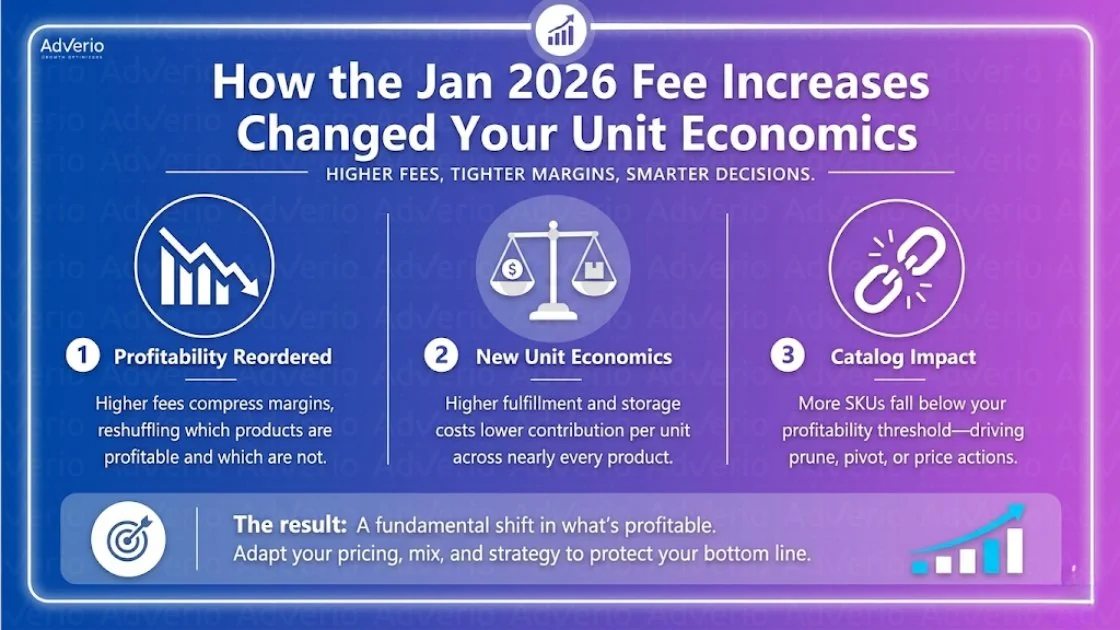
January 2026 reshuffled SKU economics across your catalog. A product that looked healthy under the old fee stack can now absorb cash, while a product with less revenue can produce more contribution profit. If your team is still using last quarter’s margin logic, you are making pricing, ad, and inventory decisions off bad numbers.
If you need the full breakdown of every fee line, what changed in January 2026, and how to calculate the impact by product type, that lives in the Amazon FBA fee breakdown guide.
What follows here is the next step: how to run a triage decision across your catalog once you have those numbers, and which products to keep, fix, or remove.
If you already know your contribution margin is bleeding and you want a system-level read on which SKUs are funding the catalog and which are draining it, get your Profit ROI Forecast and skip the modeling spreadsheet entirely.
How the Jan 2026 Fee Increases Changed Your Unit Economics
By January 15, 2026, Amazon’s U.S. FBA fulfillment fees for products in the $10 to $50 range increased by about $0.25 per unit on average, according to Seller Labs (2026). For a seller moving 40,000 units per year at a $25 average selling price, that wipes roughly $10,000 from annual profit.
That’s the point most operators underestimate. A small per-unit change doesn’t stay small when it hits every order, every month, across a large catalog.
At a Glance
-
Your old SKU ranking is obsolete. The Jan 2026 fee update changed contribution margin at the ASIN level, not just total account expense.
-
Average increases hide real damage. Amazon’s fee model is SKU-specific, so some products absorb the change. Others flip from profitable to marginal.
-
Gross margin won’t save you. Once fulfillment, storage, inbound, returns, and ad spend stack up, products that looked healthy can turn into cash drains.
-
You need triage, not commentary. Every SKU now belongs in one of three buckets: keep, reoptimize, or exit.
-
Delay is expensive. Every week you run stale unit economics, you fund low-quality revenue with real cash.

Amazon fba fee impact 2026: the sku triage framework for catalog profit recovery 20
Why this hits harder than a normal fee update
The dangerous mistake is treating the Amazon FBA fee impact like a bookkeeping adjustment. It is a ranking event.
A SKU that used to fund your ad budget may now be your weakest contributor. A product you tolerated because it still moved may now be dead weight. The right response is a catalog triage, not a cost-cutting memo. That is what this framework delivers.
The Full Unit Economics Formula at the New Fee Structure
Gross margin can make a bad SKU look respectable. Contribution margin shows whether that SKU deserves capital.
That distinction matters more under the 2026 fee structure because Amazon charges hit at different points in the sale cycle. Some costs scale with revenue. Others scale with size, weight, storage time, or replenishment flow. If your model still treats FBA as one blended deduction, you are hiding the true drivers of profit loss.
The formula that matters
Run every ASIN through the same equation:
Net contribution margin per unit = Selling price – referral fee – FBA fulfillment fee – storage fee – inbound placement fee – tariff-adjusted COGS – ad spend per unit – returns cost per unit
That is the operating view. Everything else is a summary.
If your finance team reports gross margin while your media team reports ROAS, you have two incomplete stories and no control system. Use one SKU-level model.
For the full methodology behind building and maintaining contribution margin by ASIN, including what healthy margins look like by category and how to use the model to set ad spend floors, that framework lives in the Amazon contribution margin strategy guide. What this article adds is the triage decision layer on top of that model: what to do with the numbers once you have them.
Pair it with the Amazon profit KPIs guide so finance, inventory, and acquisition are reading from the same scoreboard.
| Line item | Formula | Example for a $30 product |
|---|---|---|
| Gross revenue | Selling price | $30.00 |
| Referral fee | Selling price × referral fee rate | $30.00 × referral fee rate |
| FBA fulfillment fee | Current fee from Seller Central | Use current per-unit FBA fee for that ASIN |
| FBA storage fee | Monthly storage cost allocated per unit sold | Monthly storage allocation per unit |
| Inbound placement fee | Current inbound placement charge per unit | Per-unit inbound placement cost |
| COGS | Product cost + tariff-adjusted landed cost | Tariff-adjusted COGS per unit |
| Ad spend per unit | Total ad spend for SKU ÷ units sold, or TACoS-based allocation | Ad spend allocated per unit sold |
| Returns cost per unit | Total returns-related cost ÷ units sold | Average returns cost allocated per unit sold |
| Net contribution margin | Revenue minus all variable costs above | Residual profit per unit after full variable stack |
1. Pull the live fee stack by ASIN
Start in Seller Central. Export the current fee detail for each SKU. Use actual fulfillment fees, storage charges, and inbound placement costs tied to that product.
Old planning sheets are a liability here. Fee averages hide the products getting hit hardest by size tier changes, storage friction, or inbound routing costs.
2. Replace old COGS with replenishment reality
Use the cost you will pay on the next purchase order, not the cost you wish still existed.
That means product cost, freight, duties, tariffs, prep, and any packaging change required to keep the item compliant or fee-efficient. Historical COGS belongs in reporting. Forward-looking COGS belongs in decisions.
3. Keep referral fees in the model every time
Referral fees feel predictable, so teams get lazy with them. Stop doing that.
They move directly with price, which means any repricing decision changes both revenue and Amazon’s take. If you are modeling price increases to recover margin, include the referral fee effect in the same row.
4. Treat ad spend as a unit cost, not a marketing footnote
A common accounting error is to claim a SKU is profitable while omitting media spend.
If the product needs PPC to maintain rank, defend branded search, or convert at target velocity, that spend belongs in unit economics. Allocate it per unit sold using actual SKU spend where possible. If campaigns span multiple ASINs, use a clean allocation method and keep it consistent. A disciplined Amazon PPC management system ties ad spend back to contribution margin instead of letting it float as a marketing line item.
5. Add returns cost before you call the SKU healthy
Returns are not background noise. They are a direct drag on contribution margin, especially in categories with high defect sensitivity, sizing issues, or remorse-driven purchase behavior.
Include processing fees, write-offs, refurb risk, and the resale haircut if returned units come back unsellable or downgraded. A SKU with acceptable pre-return economics can become a margin problem fast once return behavior is priced in.
6. Calculate contribution margin and make decisions from that number
Once every variable cost is loaded, the Amazon FBA fee impact becomes visible at the SKU level. You will see which products generate cash, which need a fix, and which are burning working capital under the new fee structure.
Use this model offensively. It is not just a way to cut costs. It is how you identify where a price increase will stick, where a bundle can absorb fees better, where packaging changes improve economics, and where ad budget should be concentrated for the highest incremental profit.
Practical rule: If your team cannot explain contribution margin by ASIN on one screen, it is making pricing, advertising, and inventory decisions with partial information.
If you need the full fee reference before rebuilding the model, start with the Amazon FBA fee breakdown guide.
Most operators don’t have this view because building it cleanly across hundreds of SKUs is the actual work. If you’d rather have it built and maintained by a team that does this daily, book a Profit ROI Forecast and we’ll model your catalog against the new fee stack before you change a single price.
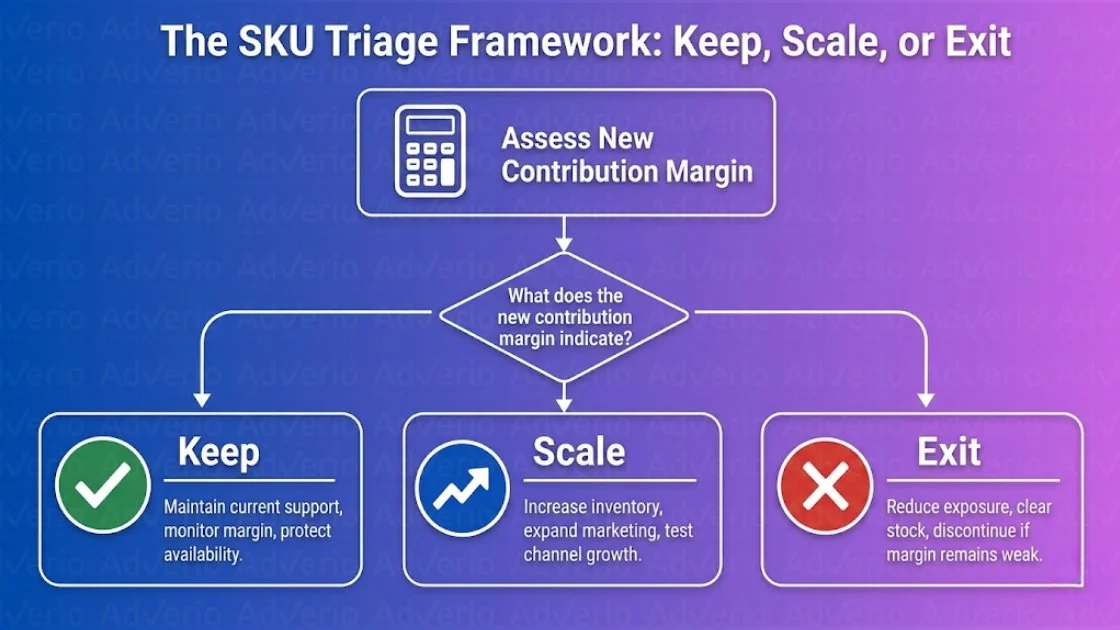
The SKU Triage Framework: Which Products to Keep, Scale, or Exit
Once you have rebuilt the contribution margin by ASIN under the new fee structure, you need a decision trigger for each product. The full rationalization methodology, including Kill/Fix/Maintain/Scale criteria, break-even ACoS thresholds, and catalog governance cadence, lives in the Amazon SKU rationalization strategy guide and the unprofitable SKUs guide.
What this section adds is the fee-event filter: which bucket does each SKU fall into specifically because of the January 2026 fee change, not as a general catalog audit.
Keep and scale
These are your margin engines. Products with contribution margin comfortably above your break-even ACoS threshold, stable organic visibility, and a credible case for more inventory and ad support. Protect these first.
For the specific threshold benchmarks by category, the Amazon contribution margin strategy guide covers what healthy, marginal, and danger-zone margins look like across catalog types. Use those benchmarks as your entry criteria for this bucket.
Reoptimize
These are the swing products. Contribution margin is positive but thin, and they usually need one operational fix, not a funeral. That fix might be packaging, price, bundle construction, ad spend discipline, or inventory treatment. These SKUs carry the fastest profit recovery potential.
Exit
Products that cannot reach an acceptable contribution margin under the new fee structure with any realistic fix path. Stop romanticizing them. They are draining cash.
Review removal cost versus continued storage drag. Then decide whether to liquidate, remove, or clear through a controlled pricing action.
A useful outside angle is competitor assortment research. Use Brand Analytics Market Basket data to identify natural product adjacencies before building bundles around underperforming SKUs.
What operators should check inside each bucket
-
Keep and scale: protect inventory position, defend conversion rate, and avoid starving winners because weaker SKUs are consuming budget.
-
Reoptimize: identify one lever with the highest financial payoff first. Don’t stack five changes at once.
-
Exit: cut slowly only if cash flow allows. Otherwise, remove decisively and reallocate capital.
For the full catalog governance process beyond the fee-event filter, the Amazon SKU rationalization strategy guide is the right next step.
How to Respond: Repricing, Bundling, and Catalog Exits
Margin recovery lives inside the reoptimize bucket. Within this, disciplined operators claw back profit while everyone else complains about Amazon.
Fee pressure is structural, not cyclical. Treating each increase as a one-time event is how brands end up perpetually behind on margin. The right frame is permanent: your catalog needs a response mechanism, not a one-off adjustment.

Repricing
Raise price where the brand and category can support it. Don’t do this blindly. Watch conversion rate, Buy Box behavior, and unit velocity. The goal is not to force margin onto a brittle SKU. The goal is to find the highest sustainable price that preserves efficient sell-through.
If you need a tighter method for this, use the Amazon pricing strategy guide.
Bundling
A weak standalone SKU can become a viable bundle component if paired with a stronger complementary product. The bundle lifts revenue per order and can change the economics enough to keep the customer relationship while avoiding a direct margin drag on the individual unit. Products with repeat purchase behavior are the best bundling candidates since they already prove demand. Pair this with proper Amazon listing optimization so the bundle PDP converts at the higher price point instead of leaking buyers to single-unit competitors.
Catalog exits
Some products aren’t turnaround candidates. They’re distractions. If a SKU needs constant ad support, carries fee pressure poorly, and has no packaging or pricing fix, remove it from the growth conversation.
Run the unit economics model on your bottom 20% of SKUs by contribution margin first. The goal is not to find products to kill. It is to find products where a modest price move or packaging adjustment pushes them from marginal to healthy.
Use a sequencing model, not random action. Adverio’s Fix-This-Next prioritization framework is the right kind of thinking here. Start with the lever that changes margin fastest with the least operational disruption.
How Adverio Runs the Unit Economics Rebuild
For Adverio clients, SKU-level unit economics is a standard diagnostic, not a cleanup project you do once a year. Our Amazon account management system maps current fees, ad spend, and landed cost into a live contribution view by ASIN, then uses the Profit Pulse System to flag products that should be scaled, repaired, or removed. That work feeds pricing, PPC, and inventory decisions instead of sitting in a spreadsheet no one trusts.
If you want that process applied to your catalog, book your Profit ROI Forecast and we’ll show you which SKUs are quietly funding the rest of your catalog.
Frequently Asked Questions
How often should you rerun the unit economics model?
Run it whenever a major fee change hits, when your landed cost changes, when ad efficiency shifts materially, or when catalog mix changes. For active operators, this is not an annual exercise. It should be part of ongoing margin management, especially for high-volume and high-variation catalogs.
How should you handle high-return products in the model?
Treat returns as part of the variable cost picture. Amazon’s fee structure includes returns-related processing exposure, and products with unstable return behavior can look stronger on paper than they are in practice. If a SKU has return issues, judge it more harshly. A product that needs heavy ad support and throws off margin through returns is rarely worth defending for long.
Does this framework only apply to Amazon?
No. The logic travels well across Walmart, Target, and DTC. The exact fee stack changes by channel, but the decision principle does not. Every SKU should earn its right to inventory, ad budget, and management attention based on contribution economics, not vanity sales.
What is the biggest mistake brands make after fee increases?
They spread the pain evenly. That’s lazy finance. Strong catalogs are not built by applying one pricing move or one ad cut across every product. They’re built by identifying which ASINs deserve investment, which need repair, and which should be cut before they absorb more cash.
What should you do first if your catalog is too large to model all at once?
Start with the worst performers by contribution margin, the highest-volume products, and the SKUs that require the most ad spend to hold position. That gets you to the most meaningful financial decisions faster. If your team needs a sequence, use a clear operating filter instead of debating every product individually.
What is the Amazon FBA fee impact for sellers in 2026?
The Amazon FBA fee impact in 2026 is structural, not seasonal. Fulfillment, storage, and inbound placement charges shifted the contribution margin on individual SKUs, which means catalog rankings based on old unit economics are no longer accurate. The right response is SKU-level triage, not a flat cost-cutting pass.
If your margin is shrinking while revenue looks fine, your model is broken. Adverio helps brands rebuild Amazon unit economics at the SKU level so pricing, ad spend, and catalog decisions follow real contribution margin instead of guesswork.
Read Next
-
Amazon FBA fee breakdown 2026 — full fee list, what changed, and how to model the impact
-
Minimize Amazon FBA inbound placement fees: inbound fee reduction strategies