


Table of Contents
Identify and eliminate unprofitable SKUs on Amazon using a profit-first framework that reallocates capital to your highest-return products.
Revenue is up. Ad spend is up.
Profit didn’t move.
That’s not a marketing problem. That’s a capital allocation failure.
Most brands blame PPC, conversion rate, or fees.
They’re wrong. The deeper problem is that too many SKUs are still being treated like assortment decisions instead of capital allocation decisions.
Zombie SKUs look alive. They sell. They get impressions. They show movement in reporting. But structurally, they drain cash, absorb ad spend, age inventory, and distort the story your dashboard tells you.
If you are not identifying unprofitable skus on amazon with discipline, your winners are subsidizing your laggards. That is not growth. That is cross-funded inefficiency.
See exactly which SKUs are draining profit—and where to reallocate for growth.
Your Revenue Is Up But Your Profit Is Flat
The most dangerous catalog problem is the one hidden behind growth.
You can grow revenue for months while margin quality gets worse underneath. More sessions. More orders. More ad spend. More inventory commitments. Then finance closes the month and nothing improved where it matters.
That is what happens when you scale a catalog without SKU governance. You keep feeding products that never should have earned more budget in the first place. And if your team still treats fees as a summary line instead of a SKU-level diagnostic, start with an Amazon FBA fee breakdown and then go deeper.
Why this gets missed
Most operators are looking at blended account performance.
That view is comfortable. It is also dangerous.
A blended dashboard can show acceptable ACoS, stable sales, and decent top-line momentum while a chunk of the catalog destroys contribution margin. Your hero SKUs hide the damage.
If profit is flat while revenue climbs, assume the issue is SKU mix until proven otherwise.
What that means in practice
A zombie SKU is not dead inventory sitting in a forgotten corner. It is active. It gets attention. It gets budget. That is why it is expensive.
Your best products are often carrying products that should be fixed, contained, or removed. If you do not know which is which, you are not managing a catalog. You are financing a leak.
At a Glance The SKU Governance Mindset
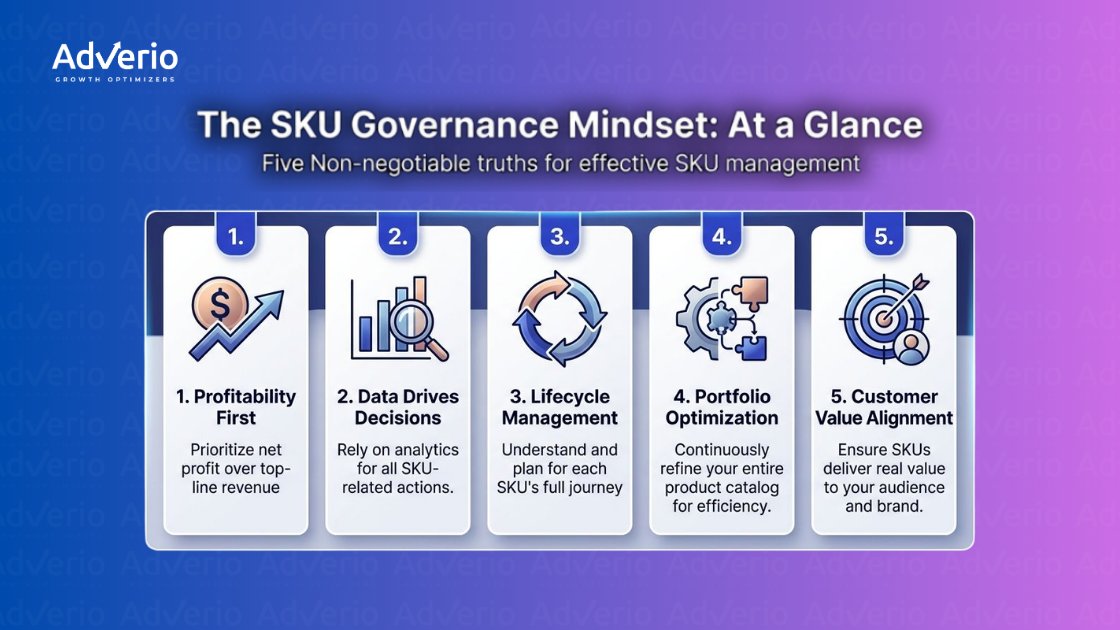
Most brands overcomplicate this. The rules are simple—and non-negotiable.
-
Revenue is not the goal. Profit quality is.
-
Zombie SKUs dilute ad efficiency. They make blended performance look healthier than it is.
-
Portfolio compression improves margin. Fewer better bets usually beats broad weak coverage.
-
Kill, Fix, and Scale decisions must be modeled. Guessing is expensive.
-
SKU rationalization Amazon work is a growth lever. It is not a cleanup project.
Brands managing broad catalogs need operating discipline, not more tabs in a spreadsheet. This is the difference between reacting to sales reports and governing a portfolio at scale, especially if you are trying to manage 1000 SKUs on Amazon.
What Is a Zombie SKU
A zombie SKU is not just a product with low sales.
That definition is too shallow and it leads to bad decisions.
A zombie SKU usually falls into one of three buckets:
-
Negative contribution margin. It sells, but every sale erodes profit after costs are fully allocated.
-
Break-even ACoS that is already broken. The product cannot support the ad intensity needed to stay visible.
-
Inventory-heavy with weak velocity. It ties up cash and compounds carrying costs.
What it is not
A low performing SKU is not automatically a zombie.
Some low performing SKUs are underexposed, priced wrong, merchandised badly, or trapped inside weak variation architecture. Those are fix candidates. Different problem.
The reverse is also true. Some high-revenue products are absolutely zombie SKUs on Amazon. They look important because they move units. But once fees, ads, returns, and inventory drag are allocated properly, they are profit traps.
Contribution margin decides the answer
If you are serious about amazon sku profitability analysis, stop using sales rank or top-line revenue as the proxy for value.
You need item economics. That means SKU-level math, not account-level storytelling. If your team has not built that discipline, start with a framework for utilizing SKU economics on Amazon.
Amazon is already forcing the issue
Amazon is already penalizing brands that ignore SKU profitability.
Amazon’s “Bend the Curve” project purged over 24 billion unproductive ASINs by December 2024, and Business Insider reported that the shift prioritizes contribution profit over pure relevance, actively demoting unprofitable third-party listings (Business Insider on Amazon’s Bend the Curve purge).
That matters for one reason. Inaction is no longer just a margin problem. It is a visibility problem.
If your SKU economics are weak, the algorithm has less reason to keep showing you.
Why Unprofitable SKUs on Amazon Destroy Growth
The damage is rarely dramatic at first.
That is why operators tolerate it for too long.
Most brands do not wake up to a single obvious collapse. They just feel constant compression. Cash gets tighter. Ad efficiency gets harder. Inventory planning gets messier. Reporting gets noisier. Teams work harder and trust the numbers less.
Blended reporting protects weak SKUs
This is the core problem.
Blended reporting makes weak products look acceptable because strong products carry the account. You do not see the underperformers clearly enough to act with confidence.
Most Amazon vendors unknowingly subsidize loss-making products, with 20-30% of their catalog operating at negative margins, and those SKUs can consume 30-50% of the profits generated by successful products (RT7 Digital on unprofitable SKU identification).
That is not a rounding error. That is a governance failure.
Where the damage shows up
-
Ad budgets get diluted. Spend goes to products that cannot return enough margin to justify the visibility.
This is where Amazon DSP management services become critical—retargeting and audience strategy only work when SKU economics are solid.
-
Blended ACoS gets distorted. Good products make bad products look survivable.
-
Storage pressure rises. Slow movers hold cash hostage.
-
Operations get dragged down. More exceptions, more complexity, more attention on products that deserve less of it.
-
Planning gets worse. Teams forecast demand for products that should not be scaled.
Why this blocks real growth
A weak SKU does not only lose money on its own line.
It also blocks a stronger use of capital. That is the part too many teams miss. Every dollar tied up in a structurally weak product is a dollar you cannot push into a faster-turning, healthier item.
A lot of brands say they want scale. What they really have is spread. Those are not the same thing.
The Kill Fix Scale Framework Without Guessing

Revenue is climbing. The catalog looks healthy from 30,000 feet. Then you pull SKU-level contribution and find a quarter of the assortment failing to earn its keep.
That’s not optimization. That’s misallocated capital.
Catalog teams often hold weak products for political reasons. A founder pushed the launch. Sales wants assortment breadth. An ops lead does not trust the margin inputs. Finance pays for that indecision with trapped cash, diluted ad efficiency, and inventory that should have been redeployed months ago.
A serious amazon kill or scale strategy follows a disciplined sequence. Model economics. Diagnose the cause. Classify the asset. Reallocate capital.
Step 1 Model contribution margin at SKU level
Every SKU needs its own P&L. No blended reporting. No category averages. No hiding behind top-line growth.
At minimum, include:
-
Revenue
-
COGS
-
Amazon fees
-
Fulfillment
-
Ad spend
-
Other variable costs
That gets you to contribution margin, which is the number that decides whether a SKU deserves more capital.
Then calculate break-even ACoS. If actual ACoS sits above break-even, the SKU has failed its financial gate. Teams that start with bid tuning before they validate unit economics are solving the wrong problem in the wrong order.
Large catalogs usually need better reporting than Seller Central can provide on its own. Teams often use Amazon analytics tools to pull margin, ads, listings, and inventory into one SKU-level view that finance and operators can both trust.
Step 2 Classify every SKU into four buckets
Once the math is clean, force a decision. Every SKU belongs in one of four groups.
Scale
These are the assets that compound. They produce healthy contribution margin, turn inventory cleanly, and justify more media, better creative, and tighter in-stock protection.
Fix
These SKUs still deserve a case review. The economics can work, but execution is suppressing output. Conversion is weak.
Before killing a SKU, evaluate how to [improve Amazon conversion rate] through listing and offer optimization.
Variation structure is broken. Pricing is off. Campaign mix is wasteful. A Fix SKU earns a short, aggressive repair window.
Maintain
These products serve a role, but they are not where you push for breakout growth. They may support assortment coverage or retention, yet they do not deserve heavy incremental investment.
Kill
These SKUs consume capital without a realistic path to acceptable return. Low or negative contribution margin. Weak strategic role. No pricing power. No meaningful support for the rest of the catalog.
That is sku rationalization amazon handled properly. You are not cleaning up a messy catalog. You are deciding which assets qualify for inventory, media, and operating attention.
Step 3 Diagnose before you kill
A bad P&L does not always mean a bad product. Sometimes it means the asset has been mismanaged.
Run a short diagnosis across the repair levers that change economics fast:
-
Parent-child restructuring. Broken variation logic suppresses discoverability and review aggregation.
-
Image optimization. Weak main images and low-quality stacks depress click-through and conversion before PPC ever has a chance.
This is where Amazon listing optimization services directly impact SKU profitability.
-
Price elasticity testing. A SKU can look structurally weak when the core issue is a pricing position that the market will not accept.
Most issues here are actually pricing—fix your Amazon pricing strategy before cutting the SKU.
-
Ad reallocation. Waste often comes from poor query targeting and campaign structure, not from the product itself.
-
Inventory alignment. Stockouts, aged units, and bad replenishment timing can distort margin enough to create a false negative.
Set a time limit on this work. A Fix SKU should have a defined recovery plan, a target metric, and a deadline. If the economics do not improve after that intervention, exit the position and move the capital.
Catalog, media, and inventory teams need to make this decision together. Siloed teams create false saves and delayed kills.
Step 4 Reallocate capital like a portfolio manager
Cutting a weak SKU is only half the job. The primary gain comes from where that capital goes next.
Redeployment should be immediate and deliberate:
-
Shift budget into Scale SKUs with proven contribution
-
Increase inventory support behind faster-turning products
-
Clean up cash flow planning by removing low-return positions
-
Improve portfolio TACoS through a stronger SKU mix
-
Reduce exposure to markdowns, aging stock, and dead inventory
We’ve seen brands unlock six-figure working capital simply by cutting low-return SKUs and reallocating spend into products with stronger margin structure and faster inventory turns.
That is the point of portfolio compression. Fewer passengers. More capital behind assets that can compound.
If you don’t know which SKUs to cut, you’re guessing.
What finance teams should demand
If leadership cannot answer these questions quickly, the catalog is being managed loosely:
-
Which SKUs are negative on contribution margin after ad spend?
-
Which SKUs survive only because blended reporting hides the loss?
-
Which products are absorbing inventory dollars without clear strategic value?
-
Which SKUs should receive incremental capital as soon as weak positions are cut?
Those are finance decisions with merchandising consequences. Treat them that way.
The Governance Model Shift Your Brand Needs
There are two ways to run a catalog.
One is reactive. The other deserves to scale.
Governance beats activity.
If you don’t have rules for capital allocation at the SKU level, you don’t have a growth strategy.
| Reactive Brand | Governance Brand |
|---|---|
| Pause ads randomly | Model break-even ACoS |
| Keep every SKU active | Kill / Fix / Scale classification |
| Blended margin | SKU-level margin modeling |
| Emotional decisions | Data-driven rationalization |
| Revenue obsession | Contribution margin discipline |
What this table is really saying
Reactive brands confuse activity with management.
Governance brands build operating rules. They decide in advance what must be true for a SKU to earn inventory, creative, and media support.
The shift most brands resist
The hard part is not building the math.
The hard part is accepting what the math says.
A lot of catalogs are carrying historical decisions that no longer deserve protection. Once you move to governance, you stop asking whether a SKU is popular internally. You ask whether it merits capital.
Warning Signs You Have a Zombie SKU Problem

Most brands do not discover zombie SKUs through one clean report.
They notice symptoms. Finance feels them. Ops feels them. Paid media feels them. Then everyone debates the cause.
Here are the signs that usually point to unprofitable skus on amazon.
Your catalog has obvious passenger SKUs
If a small slice of the catalog clearly carries the business while the long tail absorbs constant attention, you likely have too many products with weak economic justification.
That does not mean every tail SKU should be removed. It means they should have to earn their place.
Storage fees keep irritating the business
Rising storage pressure is usually treated like an inventory issue.
It is often a SKU quality issue. If the bottom tier of the catalog turns slowly, you do not have a forecasting problem alone. You have a portfolio mix problem. That is why tighter Amazon inventory management has to be tied to profitability, not just stock levels.
Your dashboards are still blended
If your core ad and margin reviews happen at account level, weak SKUs are being protected by reporting design.
That is not a minor analytics flaw. It changes decisions.
You advertise almost everything
Heavy ad coverage across the catalog often looks ambitious. In reality, it usually means nobody has set profitability thresholds.
If every product gets budget, budget is being wasted.
Revenue looks stable but margin keeps shrinking
This is the classic signal.
The account still looks alive. Orders still come through. But the cost to support that revenue keeps rising and the portfolio gets harder to defend.
Every unprofitable SKU costs an average of $247 per month in hidden expenses, and a brand with 50 zombie SKUs can burn more than $148,000 annually (NovaData on Amazon SKU rationalization).
That burn rate is why “we’ll review it later” is not a neutral decision.
Every extra month you keep weak SKUs alive without a plan is a capital allocation decision. Just not a smart one.
When Not to Kill an Amazon SKU
A blunt slash-and-burn approach is amateur thinking.
Some SKUs deserve protection even if their direct economics are weak at a given moment.
It supports premium price architecture
Certain products anchor how shoppers interpret the rest of the line.
If removing one SKU weakens perceived value across the assortment, the decision cannot be made on direct margin alone.
It strengthens the variation structure
Some products pull their weight by making a parent listing more competitive.
A color, size, or pack variation may not be a star on its own but still improve discoverability, conversion behavior, or assortment depth.
It contributes strategic traffic
Some SKUs attract useful traffic that supports stronger products downstream.
That does not mean you subsidize them forever. It means you validate whether they play a strategic role before cutting them.
It is seasonally out of sync
Do not misclassify a seasonal SKU because you reviewed it in the wrong window.
Weak recent economics may reflect timing, not structural failure. Review the item in context before you call it dead.
What to do instead of rushing the kill call
Use a short decision memo for every questionable SKU:
-
Direct economics
-
Strategic role in the catalog
-
Repair options
-
Time-bound decision window
That forces discipline. It also prevents teams from hiding behind vague claims that a product is “important.”
How Adverio Turns SKU Chaos Into Profit Systems
Most brands separate ads, inventory, and catalog decisions. That’s why profit stalls.
That happens when ads, pricing, inventory, and catalog decisions sit in different dashboards with different owners. Media teams optimize traffic. Operations manages complexity. Finance reviews results after the money is already gone. No one is running the catalog like a portfolio.
Strong Amazon PPC management services require tying campaign decisions to product economics.
Adverio executes SKU rationalization by combining listing, ads, pricing, and inventory signals into one profit view, so teams can classify products into fix, maintain, kill, or scale buckets based on contribution, not channel-level noise.
What execution should look like
A scalable model has five parts:
-
SKU-level contribution margin modeling
-
Break-even ACoS guardrails
-
Portfolio segmentation dashboards
-
Cohort-based rollout plans
-
Profit-first capital reallocation rules
The point is not cleaner reporting. The point is better capital deployment.
At the SKU level, that means isolating which products earn more support, which products need a defined repair plan, and which products should lose budget, inventory priority, and operational attention. At the portfolio level, it means reallocating spend out of weak bets before they drain cash, suppress margin, and inflate complexity across the account.
Done right, this changes how the business is managed
Marketing stops funding products that cannot justify acquisition cost.
Operations stops absorbing avoidable catalog complexity.
Finance gets a clearer view of which SKUs produce return on working capital.
Leadership gets a governance system instead of a recurring profitability surprise.
Large catalogs do not need more reporting. They need stricter investment discipline applied at the product level, every review cycle.
FAQs About Unprofitable Amazon SKUs
How do I identify unprofitable SKUs on Amazon
Model contribution margin at the SKU level. Include revenue, COGS, Amazon fees, fulfillment, ad spend, and other variable costs. Then compare actual ACoS to break-even ACoS.
What is SKU rationalization on Amazon
It is the structured classification of products into Kill, Fix, Maintain, or Scale. Good SKU rationalization Amazon work is not emotional pruning. It is governed decision-making based on economics and strategic role.
Should I stop advertising low performing SKUs
Not before you model margin and diagnose the cause. Some low performing SKUs are fixable through pricing, image work, variation restructuring, or better ad allocation. Others should lose support fast. Do the math first.
How often should I review SKU profitability
Quarterly at minimum. Monthly for large catalogs. That cadence is necessary when you have broad assortments, shifting ad costs, and inventory exposure.
Can killing SKUs improve TACoS
Yes. Removing or containing zombie SKUs lets you redeploy spend into healthier products, which improves portfolio efficiency and usually gives you cleaner ad economics overall.
If you’re still managing your catalog with blended reporting and campaign-first thinking, you’re not scaling—you’re leaking capital.
We’ll show you exactly which SKUs to kill, fix, or scale—based on contribution margin, not guesswork.