



Table of Contents
Most brands treat inbound placement fees as a logistics detail. Smart operators treat them as a margin lever.
Staring at a new line item on your Amazon statement? You’re not alone. The Amazon FBA inbound placement fee is what Amazon now charges to distribute your inventory across its massive network.
It’s not a logistics fee. It’s a margin decision. You send one large shipment to a single warehouse, and Amazon handles the complex, cross-country logistics of getting your products closer to customers. But that convenience comes with a direct hit to your margins. Most sellers absorb it. High-margin brands engineer around it. Smart operators use these fees as a signal—to optimize logistics, reduce fulfillment costs, and protect ASIN-level margin.
What Are Inbound Placement Fees on Amazon FBA?
As of March 2025, and now standard practice in 2026, Amazon applies these per-unit charges every time you create an FBA shipment. The fee covers the cost for Amazon to receive your inventory at one or a few fulfillment centers and then spread it out across the country on your behalf.
This fee forces a decision that used to be buried in the background: do you pay for operational ease, or do you take on more of the logistical work yourself to protect your bottom line?
If you’re shipping volume and ignoring this fee, you’re actively compressing contribution margin. It’s a direct addition to your cost of goods sold (COGS), and it adds up fast.
The fee itself is calculated based on a few key factors:
- Product Size and Weight: Fees are tiered. Standard-size items ($0.21–$0.68) cost less per unit than large or bulky products ($2.16–$6.00+). A few ounces can be the difference between one price bracket and the next.
- Shipment Destination: Sending all your inventory to a single, centralized location will almost always cost you more in fees than if you split it up yourself.
- How You Split Shipments: You get a choice. Send everything to one location (minimal split), two or three (partial split), or let Amazon tell you where to send it (Amazon-optimized split, usually four or more locations). The more you split the shipment yourself, the lower your per-unit fee gets—often dropping to zero if you follow Amazon’s optimized plan.
One tricky detail is that the fee doesn’t show up immediately. It’s charged 45 days after your shipment is received, appearing as a service fee in your transaction reports. This delay makes it dangerously easy to miss, but its impact is massive over time. Understanding this cost is the first step toward controlling it.
Why This Fee Exists (And Why It Matters)
Amazon didn’t introduce this fee to annoy sellers. It’s a strategic move to balance its fulfillment center distribution for one-day Prime delivery. By incentivizing sellers to pre-distribute their inventory, Amazon makes its own network more efficient. In short, it’s an efficiency tax passed directly to you.
The hidden impact? This fee creeps into your COGS and crushes margin if left unmanaged. Here’s the uncomfortable truth: this fee doesn’t hurt once. It compounds with every shipment, every month, across every SKU. But that’s a critical—and incredibly expensive—mistake. These aren’t just minor charges; they’re a silent drain on your profitability, quietly eating into your margins with every single shipment you create.
Simply absorbing these costs is no longer a viable strategy. This passive approach is a classic symptom of what we call Optimization Myopia—the dangerous habit of obsessing over flashy metrics like ACoS while ignoring massive profit leaks in your operations. A 1% improvement in ACoS feels like a win, but it’s completely meaningless if a new fee is simultaneously eroding your per-unit profit by 3%. That’s why true profitability requires coordination between fulfillment strategy and Amazon PPC management services.
For brands managing large catalogs, the impact is staggering. A fee of just $0.25 per unit might seem insignificant. But multiply that across a shipment of 10,000 units, and you’ve just lost $2,500. Do that every month, and you’re looking at a $30,000 annual loss that never even showed up in your ad reports. This is how healthy brands slowly bleed out their profits without even realizing it.
How Inbound Placement Fees Are Calculated
If you want to control a cost, you have to understand it first. Amazon’s math for inbound placement fees isn’t random—it’s a direct reflection of the logistical heavy lifting you’re asking them to do for you. Flying blind here is a great way to watch your margins mysteriously shrink.
The formula boils down to a few core variables: unit size, weight, and shipping tier. Amazon weighs each one to spit out a final per-unit cost, creating a crystal-clear incentive for sellers to handle more of the initial inventory distribution themselves.
This flow chart shows exactly how these unmanaged fees become a direct profit drain.
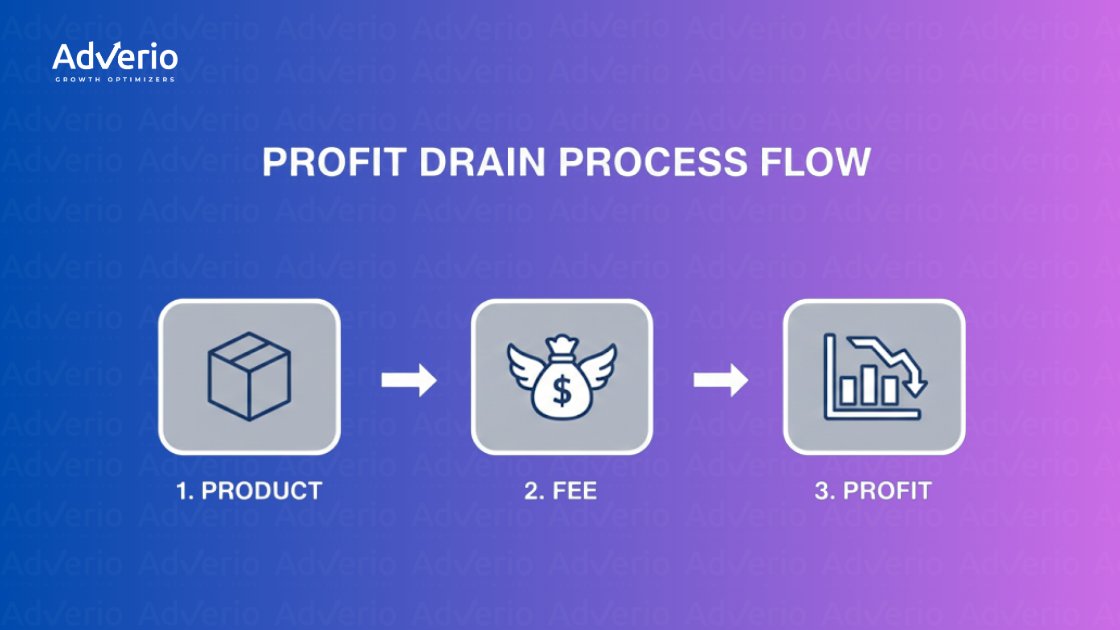
Think of it this way: every unit sent without a clear inbound strategy triggers a small fee that slowly but surely erodes its profitability before it even has a chance to sell.
A Look at the Numbers
The cost differences here aren’t trivial. For a standard-size product, you might pay between $0.21 to $0.68 per unit if you opt for a minimal split to one warehouse. For a large, bulky item, a minimal split could cost you anywhere from $2.16 to over $6.00 per unit. By simply agreeing to split the shipment yourself, you can slash this cost dramatically.
Here’s a simplified table to give you a feel for the cost ranges.
| Size Tier | Example Weight Range | Estimated Fee Range Per Unit |
|---|---|---|
| Small Standard | 4-16 oz | $0.21 – $0.30 |
| Large Standard | 1-3 lbs | $0.38 – $0.68 |
| Large Bulky | 20+ lbs | $2.16 – $6.00+ |
Let’s make this more concrete with a mock shipment calculation.
Example Shipment Calculation
Imagine you’re sending in 2,000 units of a large standard product that weighs 2 lbs. Here’s how your choices stack up:
| Shipment Option | Locations | Estimated Fee Per Unit | Total Placement Fee |
|---|---|---|---|
| Minimal Split | 1 | $0.49 | $980.00 |
| Partial Split | 2-3 | $0.34 | $680.00 |
| Amazon-Optimized | 4+ | $0.00 | $0.00 |
In this case, choosing the Amazon-optimized plan saves you nearly $1,000 on a single shipment. Yes, it takes more work on your end, but the savings are undeniable. For brands shipping tens of thousands of units every month, this isn’t just a minor optimization—it’s a critical financial decision.
The fee isn’t a punishment; it’s a price tag. Amazon is telling you exactly what it costs for them to handle your inventory distribution. The smart move is to decide when it’s worth paying for that service and when it’s more profitable to manage it yourself.
Smart Ways to Minimize Inbound Placement Fees
Just accepting Amazon’s FBA inbound placement fees is a surefire way to bleed your margins dry. Smart operators see these fees as a signal from Amazon to get more strategic about logistics. Proactive management can slash or even wipe out this cost.
This isn’t about finding sketchy loopholes. It’s about making deliberate, data-backed decisions before a single box leaves your warehouse.
Ship to Multiple Fulfillment Centers Yourself
The most direct way to dodge the inbound placement fee is to do Amazon’s distribution work for them. When you create a shipment, you can select the “Amazon-Optimized Shipment Splits” option (what used to be called Distributed Inventory Placement). This means you agree to send your inventory to four or more different fulfillment centers that Amazon picks. In exchange for you handling the extra legwork, Amazon typically waives the placement fee completely.
Use Box-Level Content Info + Proper Labeling
This one is non-negotiable. Providing accurate box-level content information is foundational to a smooth inbound process and critical for compliance. When you tell Amazon precisely what’s in every single box, their algorithm can make much smarter routing decisions, reducing the chance of random FC assignments and unexpected rerouting. This level of precision lowers the chance your shipments get hit with surprise fees and painful receiving delays.
Bundle Strategically
Reduce total units shipped (and fees paid) by combining slow-movers with high-volume SKUs. If you have products that don’t justify a large, multi-location shipment on their own, bundle them into a shipment with a more popular product. This allows you to replenish multiple ASINs while optimizing your inbound plan for the lowest possible cost.
Rethink Product Packaging Dimensions
In Amazon’s world, a fraction of an inch can be the difference between a standard-size product and a much more expensive, bulky one. You have to relentlessly audit your packaging to make sure it’s as compact as possible. A small packaging redesign that pushes a product just below a dimensional weight threshold can save you money on not only inbound placement fees but also on FBA fulfillment fees and long-term storage costs.
Consider a 3PL or Hybrid Fulfillment
For many brands, the most sophisticated play is a hybrid approach using a third-party logistics (3PL) partner. Instead of shipping all your inventory straight to FBA, you send it in bulk to a 3PL. The 3PL then drips smaller, more frequent replenishment shipments into FBA as needed. Integrating solid supply chain automation here can make the process incredibly efficient.
This model gives you a powerful mix of cost control and flexibility. Here’s a quick comparison of FBA vs 3PL inbound costs.
| Factor | Direct-to-FBA (Minimal Split) | Hybrid 3PL Model |
|---|---|---|
| Placement Fees | Highest per-unit fee from Amazon | Often eliminated or greatly reduced |
| Upfront Shipping | Lower cost for one large shipment | Higher cost for multiple small shipments |
| Storage Costs | High risk of long-term FBA storage fees | Lower-cost 3PL storage, just-in-time FBA |
| Control | Low; Amazon dictates final distribution | High; You control replenishment frequency/size |
| Best For | Simplicity-focused, lower-volume sellers | Profit-focused, high-volume brands |
How to Track the True Cost of Inbound Fees Per ASIN
If it’s not on your SKU P&L, you’re guessing. To get this fee under control, you have to track it with surgical precision, turning it from a mysterious deduction into a manageable line item on your SKU-level P&L. Without this, you’re flying blind on critical business decisions. Your best-selling ASIN could be your biggest profit leak once placement fees are layered in.
The single biggest mistake brands make is lumping these placement fees into a general “shipping” or “FBA fees” bucket. This is a critical error because it completely masks the true fulfillment cost of individual products.
Key Takeaway: Inbound placement fees must be treated as a distinct line item in your P&L, right alongside your Cost of Goods Sold (COGS) and ad spend. It’s the only way to get a clear, honest picture of an ASIN’s actual profitability.
You can find the charges in your Amazon Settlement Report or the dedicated FBA inbound placement service fees report. This is the raw data you need to build a true P&L. Once this cost is isolated, you can finally ask the right questions:
- Does this product’s margin actually support the high placement fees from a minimal split?
- Can a small price increase offset the cost, or do we need to fundamentally change our shipping strategy?
- Is this SKU still profitable enough to even justify its place in our catalog?
This level of financial clarity is non-negotiable for anyone trying to scale profitably. For a deeper look into this process, our guide on SKU-level profitability analysis framework provides a detailed framework for this essential analysis.
Common Mistakes to Avoid
Experience in the Amazon ecosystem teaches tough lessons. When it comes to Amazon FBA inbound placement fees, a passive approach isn’t just inefficient—it’s a direct drain on your profits. Strategic operators learn to sidestep the common traps.
- Sending all shipments to a single FC with no control: Blindly accepting Amazon’s default shipment plan means you are almost certainly paying the highest possible placement fee for convenience.
- Ignoring unit dimension thresholds: A fraction of an inch in your packaging can be the difference between a “Large Standard” and a “Large Bulky” classification, triggering a significantly higher fee.
- Poor packaging → bumped to bulky tier: Inefficient packaging that fails to minimize dead space leads to re-classification and unnecessary costs.
- Not auditing Amazon’s placement decisions: Just because you created a shipment plan doesn’t mean Amazon won’t reroute inventory on its own, potentially triggering unexpected fees. Without a system to track and question these changes, you’re letting Amazon’s algorithm dictate your unit economics without any oversight.
The most successful brands don’t just react to fees—they build a fulfillment strategy that anticipates and minimizes them from the start. This means treating every shipment as a strategic financial decision, not just a logistical task.
These mistakes often overlap with other margin-eroding fees. You can read our guide on how to navigate Amazon’s low-inventory fee strategy to develop a more resilient fulfillment strategy.
How Adverio Protects Margin from Hidden Amazon Fees
Inbound placement fees aren’t a shipping problem. They’re a systems problem.
At Adverio, we align:
- Inventory forecasting
- Packaging optimization
- SKU-level P&L modeling
- PPC incrementality analysis
- Catalog structure
Through our Profit Pulse System, we identify whether fees should be eliminated, absorbed, or strategically offset.
If your team is optimizing ads while ignoring fulfillment leakage, you’re solving the wrong problem.
FAQ – Amazon FBA Inbound Placement Fees
Let’s clear the air. Here are the straight-up, no-fluff answers to the questions we hear most often.
What is Amazon’s inbound placement service?
It’s Amazon’s internal logistics service. Instead of you splitting your inventory into multiple small shipments destined for warehouses across the country, Amazon lets you send one big shipment to a single location. They then handle the distribution. The inbound placement fee is what you pay for that convenience.
When did Amazon start charging placement fees?
The current FBA inbound placement fee structure officially went live in 2025. This was a major change that immediately made strategic shipment planning a non-negotiable part of staying profitable.
Can I opt out of placement fees?
Yes, but not with a simple toggle switch. The only way to “opt out” and get the fee down to $0 is by doing the distribution work yourself. This means choosing the Amazon-Optimized Shipment Splits option, where you agree to send inventory to the four or more different fulfillment centers Amazon specifies.
How much does it cost per unit?
There’s no single answer—the cost depends on your product’s size, weight, and which shipment split option you pick. The general range is $0.21–$0.68 for standard-size items and $2.16–$6.00+ for bulky items if you choose the most convenient (and expensive) single-destination option.
Are placement fees refundable?
No. Once the fee is charged, it’s final. Amazon considers it a standard charge for a service rendered. The only way to avoid the cost is by making the right decision before you approve your shipment plan, not by trying to reverse it after the fact.
🚚 Tired of margin-eating fees like Amazon’s inbound placement cost?
Adverio helps brands optimize fulfillment strategy, SKU packaging, and unit economics to protect profit on every sale.
Book your free margin strategy session →