


Table of Contents
You got the invitation. Good. That means Target already sees brand fit.
Now the part that burns time and margin starts. Most brands treat Target Plus onboarding like a marketplace form fill. It isn’t. It is an operations, compliance, content, and integration project with real failure points. Miss one requirement and your launch slips. That delay costs revenue from a channel you already earned access to.
That matters more now because Target Plus is no side project. The marketplace launched in 2019, grew to more than 1,500 brands by 2024, crossed over $1 billion in GMV, and Target is aiming for more than $5 billion in third-party GMV by 2030, according to Target’s official March 2025 strategic plan announcement (corporate.target.com). If you’re building a broader channel plan, pair this with these Target Plus selling strategies so you don’t evaluate each marketplace in a silo.
There is no universal “good” Target Plus onboarding requires U.S. business setup (W-9, EIN, DUNS, domestic bank), retail-ready SKU data with valid GS1 UPCs, fast domestic fulfillment within 24 hours, EDI integration across orders and shipments, and category-specific compliance documentation. Brands that run these workstreams in parallel launch on time. Brands that run them in sequence lose weeks.
Target Plus Vendor Requirements At a Glance
-
Product and content requirements: Your SKU data, taxonomy, barcodes, images, and pricing have to match Target’s standards. Amazon-style shortcuts cause rework.
-
Operational and fulfillment requirements: You need domestic fulfillment, fast ship speed, approved carriers, inventory accuracy, and a returns process that won’t break on day one.
-
Legal and compliance requirements: Your business docs, tax setup, bank details, and category-specific compliance paperwork must be ready before the onboarding team asks for them.
-
Integration requirements: Partners Online access, item-data submission, GS1 UPC setup, and EDI or channel integration work can’t be left to the last minute.
-
First move: Start legal and compliance paperwork first. It’s usually the slowest workstream and the easiest place to lose weeks.
The biggest mistake I see is simple. A brand gets the invite, celebrates, then waits to organize internal owners. Bad move. Every day you delay setup is a day your products aren’t live, your media can’t launch, and your competitor keeps taking the sale.
If your launch window is already shrinking, get My Profit ROI Forecast before onboarding delays cost you another quarter.
What is Target Plus? Target Plus is Target’s invite-only third-party marketplace, launched in 2019, that lets approved brands sell on Target.com without going through Target’s traditional retail vendor process. Unlike open marketplaces, you cannot apply. Target picks the brands.
The Four Requirement Categories for Target Plus Onboarding
Target Plus onboarding only works when four gates clear at the same time. Product data, operational logistics, legal compliance, and brand alignment all matter. You don’t get to be excellent in one and weak in the others.
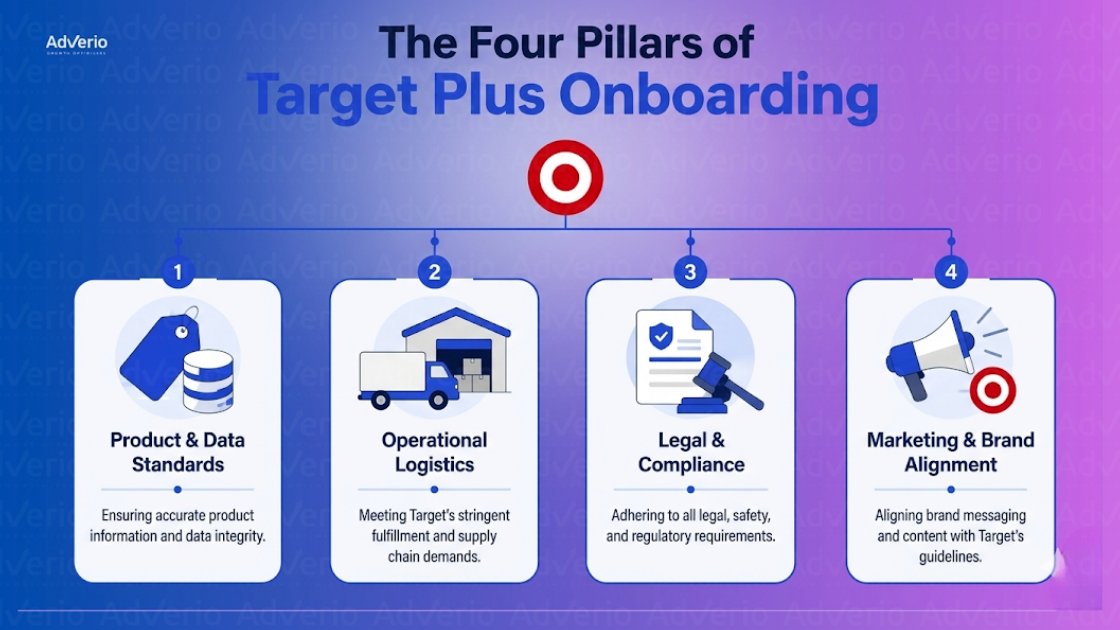
Think like an operator, not a merchandiser. If your content is clean but your warehouse misses cutoffs, you stall. If your shipping works but your item data is incomplete, you stall. If your documents are ready but your integration team starts late, you stall.
Product and Content Requirements
Bad catalog setup burns time before your first order ships. You have the invite. That means the risk is no longer access. The risk is wasting the launch window because your item file, taxonomy, images, and pricing controls are sloppy.
Item setup and taxonomy requirements
Target reviews your assortment at the SKU level. If your internal catalog is loose, Target will expose it fast. Category mapping, variant structure, UPC assignment, and required attributes need to be right before submission. Fixing them after review starts is how brands lose weeks and frustrate the onboarding team.
The practical rule is simple. Build your Target assortment for Target, not by copying what sits on Amazon, Shopify, or your ERP.
Your team should check:
-
Taxonomy fit: Map every item to Target’s category structure and product type logic.
-
Attribute completeness: Fill in the fields that drive discoverability and approval, including size, material, color, dimensions, and variant relationships.
-
Barcode integrity: Match valid GS1 UPCs to the correct SKU records and packaging.
-
Assortment discipline: Hold back marginal SKUs with weak content. Launching fewer clean listings beats launching a bloated catalog full of avoidable errors.
One bad parent-child setup can stall an entire family of products. One missing attribute can force resubmission. Treat item setup like revenue protection, because that is exactly what it is.
Image and content standards
Target expects retail-ready content, not drafts your team plans to clean up later. Hero images need to be clear. Supporting images need to explain the product. Titles, bullets, and descriptions need to match the item exactly and answer the obvious customer questions before they become returns.
Do not use onboarding as your content production phase.
If your catalog still has missing dimensions, duplicate UPCs, weak titles, inconsistent variant naming, or image gaps, stop and fix it now. Start with the SKUs that will carry launch revenue and Fix my target catalog before item setup turns into a preventable delay.
Pricing and MAP requirements
Pricing problems create fast trust issues. If Target sees a channel pricing mess, your launch gets harder to manage and your margin gets harder to defend.
Audit these three areas before submission:
| Checkpoint | What to do |
|---|---|
| Channel price parity | Align Target pricing with your other digital channels |
| MAP policy enforcement | Resolve reseller violations before they create launch-day conflicts |
| Promo governance | Set approval rules for discounts so one team does not undercut another |
If your brand cannot hold price across channels, fix that before onboarding advances. A weak pricing policy does not stay contained. It turns into margin loss, partner friction, and immediate cleanup work you could have avoided.
Operational and Fulfillment Requirements

Fulfillment standards and delivery SLAs
You got the invite. Then your first orders hit, your warehouse misses the cut-off, tracking uploads late, and Target starts its relationship with your brand by questioning execution. That is how invited brands delay revenue before the launch has a chance to work.
Target expects fast, predictable fulfillment. If your operation cannot release orders quickly, hand them to approved carriers on time, and keep delivery windows tight, fix that before onboarding moves any further. A weak 3PL, slow pick-pack flow, or lagging inventory sync will cost you sales, trigger avoidable support tickets, and create friction with Target from day one.
Run this audit before go-live:
-
Order release timing: Confirm how often orders enter your OMS or WMS and who monitors failures
-
Warehouse cut-off discipline: Set a hard same-day processing window and test it with real order scenarios
-
Carrier setup: Verify approved domestic carriers, service levels, label logic, and tracking transmission
-
Inventory accuracy: Reconcile available-to-sell inventory across ERP, warehouse, and marketplace feeds
-
Exception handling: Define what happens when an item is oversold, delayed, damaged, or split across locations
If any of those answers are unclear, you are not launch-ready.
Return policy requirements
Returns are an operations test, not a customer service footnote. If your returns flow is vague, your margin erodes fast through manual handling, missed refunds, and inventory that sits in limbo.
Set ownership before the first order ships. One person should own returns policy, warehouse disposition, and escalation rules across support and ops. Teams that leave this split across departments create conflicting answers for customers and slow internal decisions that should take minutes.
Your process needs three decisions locked in early:
-
Who approves exceptions and customer accommodations
-
Which returned units go back to stock, move to liquidation, or get destroyed
-
How refund timing and return status updates are communicated internally
If you sell in regulated categories, your returns handling should also reflect the legal exposure tied to product condition, labeling, and resale eligibility. Your policy needs to be operational, SKU-specific, and enforceable in the warehouse.
EDI and integration requirements
Integration failures are one of the fastest ways to stall an invited brand. The work is not technical housekeeping. It is the operating layer that controls whether orders flow cleanly, acknowledgments go out on time, shipments confirm correctly, and inventory stays trustworthy.
Target Plus onboarding requires EDI integration across the core transaction set used to accept orders, confirm them, transmit shipment data, and keep inventory current. Handle that as a cross-functional project with clear owners across IT, operations, and account management. Late acknowledgments and weak ASN discipline do not stay isolated in the system. They turn into order defects, support volume, and scorecard problems that are expensive to clean up.
Test every handoff before launch. Test order ingestion. Test acknowledgments. Test shipment confirmations. Test inventory updates after a cancellation, after a return, and after a partial shipment.
If your internal team cannot run that workstream tightly, bring in a partner who can manage my Target account and keep merchandising, operations, and systems aligned.
Legal and Compliance Requirements
Insurance and liability documentation
Legal prep needs to start first because it usually moves slowest. Public onboarding guidance confirms that approved Target Plus partners must be U.S.-based, have a physical business address, a domestic bank account, a W-9/EIN, and a DUNS number, and must be able to fulfill orders within 24 hours and deliver within five business days using approved carriers, according to Shopify’s Target Plus overview.
Get these documents in order before anyone asks:
-
Business identity docs: U.S. registration details must match across systems
-
Tax and banking records: W-9/EIN and domestic bank setup can’t be inconsistent
-
DUNS record: Validate it early so legal names and addresses line up
-
Insurance packet: Prepare certificates and endorsement requests with your broker
Product compliance and testing requirements
Compliance isn’t generic. It’s category-specific. Children’s items, ingestibles, regulated materials, and products with labeling exposure need documentation ready before review. If your team treats compliance like a last-mile admin task, you’re asking for rejection.
The actual work is internal. Your SKU file, packaging, claims, and testing documents all need to agree.
Start with the products most likely to trigger scrutiny. If one regulated SKU slows review, it can hold up more than that single listing.
The Target Plus Onboarding Timeline
Brands that treat onboarding as a linear task list rather than parallel workstreams routinely miss launch windows and absorb avoidable delays during item review and integration setup. They think in tasks. Target Plus onboarding rewards parallel workstreams.
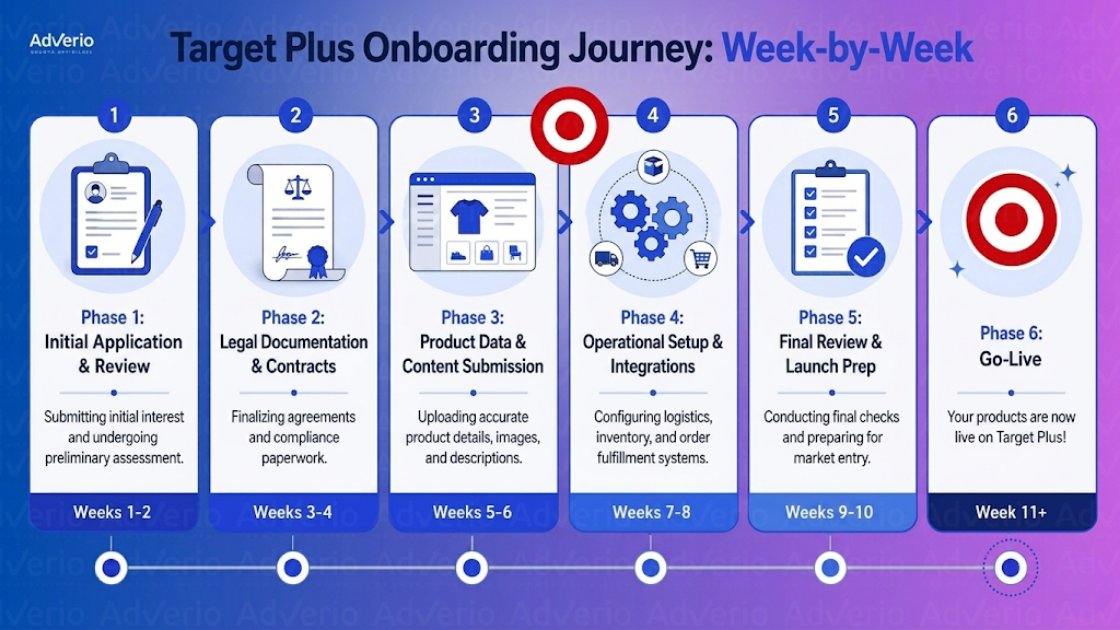
Use this as your working timeline:
| Phase | Focus |
|---|---|
| Early stage | Kick off legal docs, tax validation, bank validation, DUNS check |
| In parallel | Start integration planning, portal setup, and item-data prep |
| Middle stage | Submit product content, validate attributes, test order workflows |
| Final stage | Complete review cycles, resolve errors, confirm launch assortment |
Smart brands assign dedicated resources and stay active in the Partners Online portal throughout onboarding. If your team treats this as spare-time work, it drags. If you assign accountable owners by function, it moves.
Common Onboarding Delays and How to Avoid Them
Most delays aren’t strategic. They’re self-inflicted.
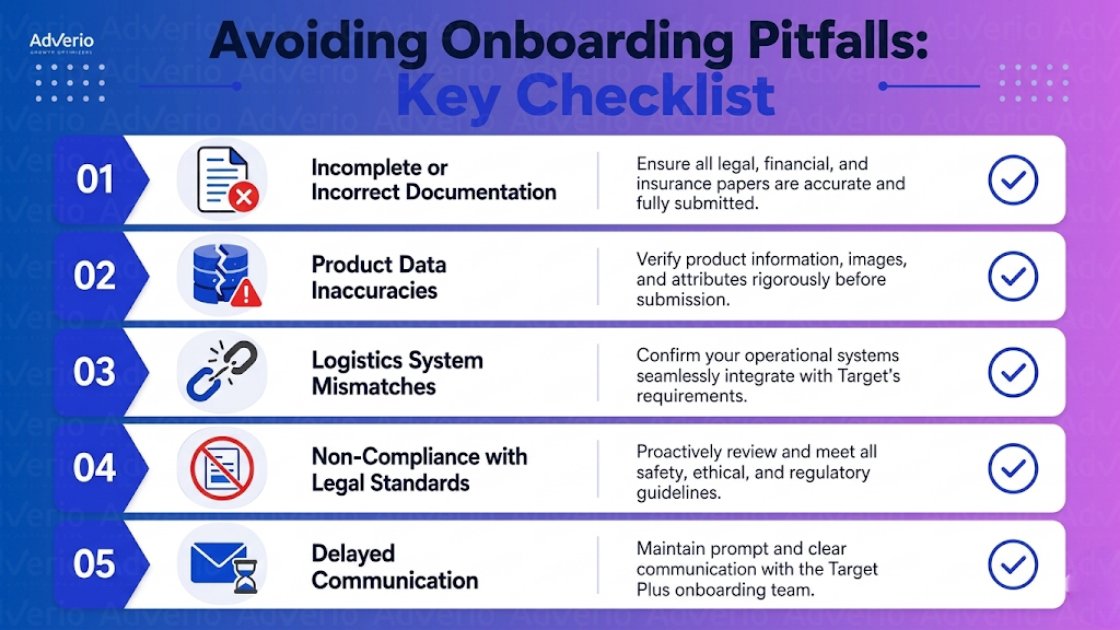
The repeat offenders are easy to spot:
-
Insurance starts too late: Your broker is not waiting on your launch calendar.
-
EDI ownership is vague: If no one owns mapping, testing, and exception handling, the clock slips.
-
SKU data is incomplete: Missing attributes and weak barcode records stall activation.
-
Images aren’t ready: Asset revisions always take longer than teams think.
-
Pricing isn’t aligned: Channel conflict surfaces right when you need approval.
Pro tip: Start the insurance certificate request the day you receive the invitation. Waiting until you’re “almost ready” is how brands lose momentum and miss their own launch window.
If your reviews need to transfer with credibility once listings go live, plan that early too. Don’t wait until traffic starts. Brands often need to add my DTC reviews to Target as part of launch readiness.
How Adverio Supports Target Plus Onboarding
Adverio handles Target onboarding as an operational readiness project, not a paperwork task. The system pulls four workstreams into one timeline: legal and compliance prep, Target catalog optimization, integration setup, and a launch plan tied to real channel performance, not vanity activity.
Once your listings are live, the same system manages execution: Target account management, media governance through Target advertising, and Target review syndication so your category presence matches your category claim. Get My Profit ROI Forecast before your launch gets delayed by preventable mistakes.
Frequently Asked Questions
Can we qualify if we don’t have in-house marketplace ops support?
Yes, but someone still needs clear ownership across content, logistics, and integration. A part-time internal owner with no authority is usually where delays start.
Is Target Plus onboarding mostly a merchandising task?
No. It’s a cross-functional build. Merchandising matters, but operations and integration usually decide whether you launch on time.
Can we use the same content we built for Amazon?
Not blindly. Rework is common when brands copy Amazon content structures, taxonomy assumptions, or SKU logic into Target.
What’s the fastest way to reduce onboarding risk?
Audit your legal docs, SKU data, and fulfillment capability before the first submission. Most stalls are visible early if someone looks hard enough.
Should review syndication wait until after launch?
No. Plan it before go-live so your listings don’t start cold if your category depends on social proof.
If Target already opened the door, don’t lose revenue by fumbling the handoff. Adverio helps established brands tighten Target onboarding, clean up launch risk, and build a channel plan that doesn’t bleed margin. Get My Profit ROI Forecast