


Table of Contents
Most advice on Amazon Brand Tailored Promotions is backwards. It treats discounts like a growth lever first and a margin decision second. That’s how established brands end up celebrating promo sales while quietly cutting the profit out of their own account.
If you’re running $3M–$50M on Amazon and promotions feel like a volume tool, that’s the problem. A disciplined Amazon Brand Tailored Promotions strategy does one thing: it changes behavior you would not have captured at full price. If it doesn’t do that, you’re not running retention marketing — you’re subsidizing demand that was already yours.
The tool matters. The sequencing matters more. If you’re running broad discounts, overlapping deal types, or lazy audience selection, fix that before you spend another dollar. Need a baseline on where BTP sits among other promo mechanics?
Start with Adverio’s coupons vs. deals vs. lightning deals breakdown.
Want a profit-first framework for your full promo stack? Book your ROI Forecast
Brand Tailored Promotions The Double-Edged Sword of Amazon Discounts
Discounts do not create demand. They reprice it.
That is why Brand Customized Promotions deserve more caution than the average Amazon feature update. Amazon gave Brand Registry sellers a way to send segmented discounts to defined customer groups, with offers ranging from 10% to 50% and audience eligibility tied to a minimum threshold.
The setup appears intricate. Used carelessly, it becomes a clean way to destroy contribution margin while calling it growth.
The mistake is predictable. Brands look at BTP and ask how many extra orders it can produce. That is amateur thinking. The only question that matters is whether the discount changed customer behavior you would not have captured at full price.
If the buyer was already on track to convert, the promo did not drive growth. It funded a cheaper sale.
Practical rule: If you cannot name the behavior you are trying to change, do not launch the promotion.
BTP works best as a precision re-engagement tool. It is useful for recovering stalled intent, reviving lapsed shoppers, and nudging selected prospects who showed interest but did not purchase. It performs poorly when brands use it like a broad revenue button, especially on audiences with high natural conversion probability. That includes many campaigns aimed at loyal customers, repeat buyers, or recent purchasers with no clear retention risk.
What BTP is actually for
BTP gives you a way to match offers to customer behavior instead of pushing the same discount across the account. The strategic use cases are straightforward:
-
Acquisition from shoppers who engaged but did not buy
-
Re-engagement for cart abandoners or lapsed customers
-
Retention only when there is a credible risk of drop-off
-
Cross-sell only when the second purchase would not happen cleanly at full price
That last point matters more than brands admit. Better audience selection does not automatically mean better economics. More relevant discounts can still lose money if you aim them at shoppers who needed no incentive.
The hidden trap
The margin problem is not the discount itself. The problem is paying for conversions that were already likely to happen.
A well-chosen offer can recover missed demand. A lazy offer trains customers to wait for price cuts, lowers unit economics, and makes future full-price conversion harder. That is the double edge. BTP gives you more control, but it also gives you more ways to be precisely wrong.
This is why dashboard wins are dangerous here. Higher conversion rate, more units, and stronger promo-attributed sales can all look good while profit gets worse. If a repeat buyer would have reordered anyway, your campaign did not create value. It transferred margin from your account to the customer.
At a glance
Here is the operator’s view:
| Item | What matters |
|---|---|
| What BTP is | Amazon promotions sent to defined customer segments |
| Discount range | 10% to 50% |
| Audience minimum | Eligible segments must meet Amazon’s minimum audience threshold |
| Best use | Recovery, re-engagement, selective acquisition, disciplined cross-sell |
| Worst use | Discounting loyal or high-intent buyers without proof the offer changed behavior |
| Primary risk | Paying for orders that would have happened anyway |
Use BTP like a scalpel. The moment you treat it like a volume lever, it stops being a retention tool and starts becoming margin leakage.
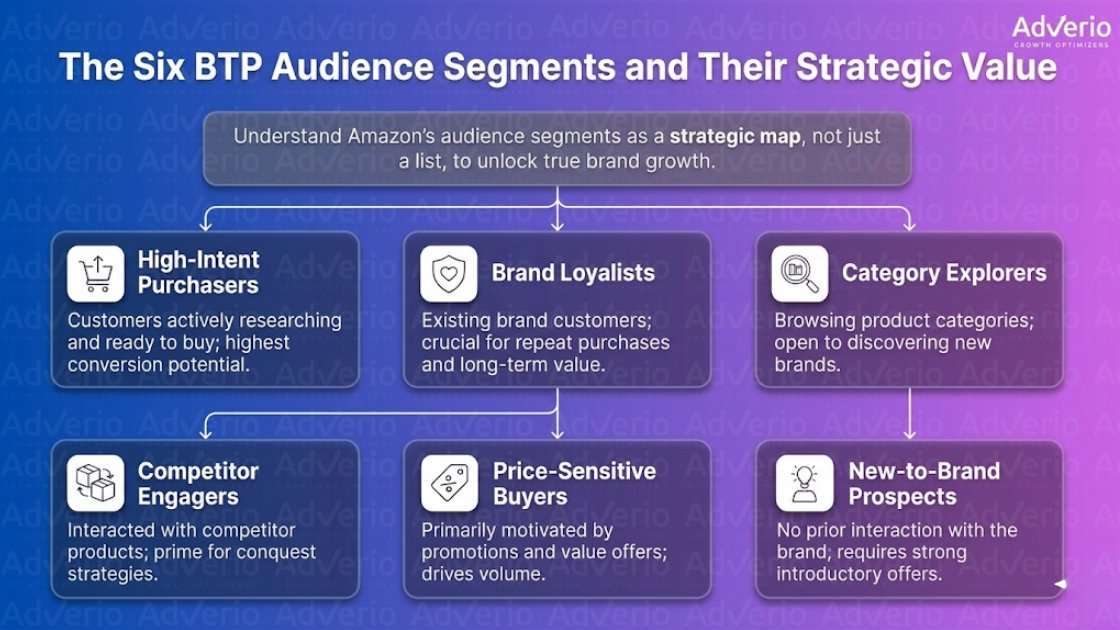
The Six BTP Audience Segments and Their Strategic Value
The six BTP audiences are not six equal opportunities. They sit on a risk curve. A few can recover the demand you were about to lose. A few can help you sell the next product to the right buyer. One can inadvertently hand margin back to customers who would have purchased anyway.
That distinction matters more than campaign setup. Segment choice determines whether BTP acts like a precision re-engagement tool or a coupon tax on your existing demand.
Start by ranking segments by incrementality
Use a simple rule. The closer the shopper was to buying and then stopped, the stronger the case for a promotion. The more likely they are to buy again without help, the weaker the case.
Here is the strategic order I recommend.
High-priority segments
These audiences usually deserve first access to budget because they have a clearer path to incremental profit.
-
Cart abandoners
This is the cleanest recovery play in BTP. These shoppers showed strong intent, then failed to complete the purchase. A controlled offer can recover sales that leaked out of the funnel. Keep the discount disciplined and watch timing closely. If the offer arrives too late, you are not recovering demand. You are discounting a decision the shopper already made elsewhere. -
New customer prospects
These shoppers engaged with the brand but never purchased. That makes them useful for selective acquisition, especially on products with healthy first-order economics and strong repeat potential. Do not chase top-line revenue here. Use BTP only when the first order can lead to profitable downstream value. -
Lapsed customers
This segment works when your catalog has a real replenishment cycle or an obvious reorder window. The job is not to “drive sales.” The job is to pull back a customer who has started to drift. If the product has weak repeat economics, skip this audience.
Medium-priority segments
These can work, but sloppy execution turns them into margin leakage fast.
-
Brand followers
Followers are warm. Warm does not mean under-converted. It often means they just need the right product, message, or timing. Use offers here for launches, bundles, or complementary products. Do not use this group as an easy volume bucket. -
High-spend customers
This audience has value when you are cross-selling into adjacent products or increasing basket depth with a logical next purchase. It loses value the moment you start rewarding your best customers with broad discounts just because they spend more. Premium buyers should not be trained to wait for a deal.
High customer value is not a reason to discount. It is a reason to protect margin.
High-risk segment
Weak operators often fool themselves.
- Repeat customers
Repeat buyers are often the worst place to start. If they already reorder on habit, a discount does not create demand. It cuts into margin on demand you already owned. Use this segment only when you have evidence of slowing reorder behavior, rising competitor pressure, or a specific retention problem tied to a product cycle.
Strategic value by audience
| Audience | Best use | Main risk |
|---|---|---|
| Cart abandoners | Recovering near-conversions | Offering too much discount for a short hesitation |
| New customer prospects | Selective first-order acquisition | Attracting promo-driven buyers with weak lifetime value |
| Lapsed customers | Re-engaging past buyers with reorder potential | Reactivating low-quality customers at a loss |
| Brand followers | Product launch support and controlled cross-sell | Discounting warm demand that may have converted anyway |
| High-spend customers | Basket expansion and adjacent-product cross-sell | Eroding margin from your best customers |
| Repeat customers | Targeted retention only when demand is softening | Cannibalizing full-price reorder behavior |
Where each segment fits in the larger system
BTP should sit downstream from demand generation, not replace it. Sponsored Ads and DSP create qualified traffic and audience signals. BTP should then target the subset that needs a pricing nudge, not the entire pool. If your brand still struggles to win beyond Sponsored Ads, fix that before adding more discounts.
Run every segment through a profit screen before launch. If you need a fast way to pressure-test the economics, Adverio’s Amazon profit ROI forecast forces the math before a single promotion goes live. Revenue attribution is cheap. Protected margin is harder, and it matters more.
The Profit-First Framework for Your BTP Campaign
BTP does not fix weak economics. It exposes them.
Too many brands treat promotions like a growth shortcut. They see audience access, set a discount that feels reasonable, and call it strategy. That is how margin disappears. Start with unit economics, then decide whether the campaign deserves to exist.
Amazon’s setup is simple enough. You define the goal, choose products, pick the audience, and assign a budget. Amazon also requires a minimum eligible audience size before the promotion can run.
Practical testing should compare percentage-off versus dollar-off offers for cart abandoners, and selective discounting during competitor-heavy periods — both produce measurably different margin outcomes depending on product economics and audience intent.
Start with product economics, not audience enthusiasm
A high-intent audience can still produce a bad campaign if the ASIN cannot carry the discount.
Review each candidate ASIN with blunt discipline:
-
Gross margin after Amazon fees, fulfillment, and returns exposure
-
Contribution margin after the proposed discount
-
Expected reorder behavior if this is a retention or replenishment play
-
Cannibalization risk if the customer likely would have purchased at full price
-
Account-level effect if the campaign scales beyond a small test
If you are not modeling this before launch, you are guessing. Use a framework that forces the math — Adverio’s profit-first Amazon account management system is built specifically for this before any promotion goes live.
The campaign screen that filters out bad ideas
Use this framework before you approve a single offer.
-
Set one objective
Pick acquisition, reactivation, retention, or cross-sell. One campaign cannot do all four well. -
Choose ASINs with a reason to be discounted
Include products with healthy margin, obvious conversion friction, or clear replenishment logic. Exclude products that already convert efficiently at full price. -
Match discount depth to buying intent
Cart abandoners may need a nudge. Repeat buyers often do not. Sending the same offer to both groups is lazy planning. -
Set a hard redemption limit
Promotions should change behavior once. They should not train customers to wait for private coupons. -
Define the failure point before launch
Know the margin floor, redemption threshold, and reorder expectation that would make you stop the campaign.
One bad product choice can ruin a decent audience strategy.
Discount range is a margin decision, not a platform suggestion
General discount ranges can help frame a test. They should never dictate one.
Use smaller offers on products with strong repeat behavior or high baseline conversion. Reserve deeper discounts for cases where the buying signal is stronger and the lost margin has a clear job to do, such as recovering an abandoned basket or reactivating a previously valuable customer. If the only reason you are offering 20 percent off is that the audience looks promising, you are paying for uncertainty.
The right question is simple. What incremental behavior is this discount buying, and is that behavior worth the margin you are giving up?
Handle the audience threshold without forcing bad campaigns
The minimum audience requirement blocks many brands, and that is a useful constraint. It stops you from pretending a tiny segment is a scalable program.
Use practical fixes:
-
Group related ASINs into one strategic product set if a single product audience is too small
-
Build qualified remarketing pools through PPC and DSP first if audience depth is weak
-
Avoid forcing niche segments live when Amazon does not show enough eligible users
If your account struggles to scale, the problem usually sits upstream. Poor traffic quality, shallow catalog depth, or weak remarketing signals will not be solved by a discount. Brands focused on real Amazon profit growth test promotions against total account economics, customer quality, and expected repeat purchase behavior. That is the standard.
Measuring True Incrementality and Avoiding Optimization Myopia
A BTP campaign can post strong sales and still destroy profit.
That happens when a discount captures orders you were already going to win. The dashboard looks healthy. Your margin does not. If you judge these promotions by redemptions, attributed sales, or conversion rate alone, you are measuring activity, not incremental demand.
The right measurement framework ties these promotions to TACoS and incremental ACoS — not just promo revenue. Product-to-product remarketing improves cross-sell performance while narrower audience targeting cuts waste versus broad discounting. Weak frequency control trains shoppers to wait for the next offer, which collapses full-price conversion over time.
The metrics that hide bad decisions
If your team opens the report with these numbers, expect blind spots:
-
Promo-attributed sales
-
Redemption count
-
Conversion rate without a pre-promo baseline
-
ACoS in isolation
Use those metrics for diagnosis. Do not use them to approve spend.
What deserves your attention
Measure these promotions against business impact:
| Metric | What it tells you |
|---|---|
| Incremental orders | Which purchases likely happened because of the offer |
| TACoS movement | Whether the campaign improved or weakened total account efficiency |
| Margin after discount | Whether added volume covered the margin you gave away |
| Repeat purchase behavior | Whether discounted buyers became valuable customers later |
| Segment saturation | Whether the same audience is being trained to delay purchase until the next code |
Teams that want a cleaner operating model should separate channel activity from commercial outcome — this is where Amazon PPC management and BTP need to operate from the same profit baseline, not independent dashboards.
Ask a harder question. Did the offer create profitable behavior that would not have happened without it?
A practical test for incrementality
Amazon does not give you a perfect lab setup, so build a disciplined comparison yourself.
Start with the same ASIN and audience window before the promotion. Then compare sales mix during the offer period, especially the balance between discounted demand and full-price organic demand. Review post-promo repeat rate for buyers who came in on the code. Check account-level efficiency at the same time, including total margin movement, not just campaign performance. Finally, control for overlap with PPC pushes, seasonal spikes, coupons, and events that can inflate demand on their own.
The pattern matters more than the promo report. If redemptions go up while account profitability drops, you did not create value. You shifted existing demand into a lower-margin transaction.
Adverio calls this Optimization Myopia. Teams obsess over the metric Amazon surfaces most clearly and ignore the one that matters, total profit. If you need a stricter method to prove actual ad spend growth, use one that isolates lift, checks margin after discount, and forces a comparison against baseline behavior.
Integrating BTP with Your Full-Funnel Advertising Strategy
BTP should not sit off to the side like a random promo tactic. It belongs inside your full-funnel system.
Amazon’s own positioning is clear. BTP supports acquisition, retention, and cross-selling by delivering promo codes to specific audiences such as repeat purchasers with 2+ buys in 12 months or new prospects showing interest signals in the last 90 days. Amazon also frames it as a way to convert ad-driven traffic from Search Query Performance and improve Share of Voice when paired with PPC and DSP, as described in Amazon’s overview of Brand Tailored Promotions.
How the funnel should work
Your ad stack should build the audience that BTP later converts.
Top of funnel
Use Sponsored Brands, Sponsored Display, and DSP to create qualified traffic and brand interaction. You’re not just buying clicks. You’re building future targetable pools.
Mid funnel
Use BTP to recover high-intent shoppers who viewed, clicked, carted, or nearly converted but didn’t complete purchase.
Post-purchase and retention
Use BTP selectively for replenishment, complementary products, or at-risk customer recovery. Don’t turn it into a standing loyalty discount.
The handoff matters
Many brands waste money. They spend heavily on awareness, then fail to build a coherent retargeting and offer structure around the traffic they just bought.
A better sequence looks like this:
-
Drive qualified discovery with paid media
-
Segment by behavior rather than broad customer labels
-
Offer only where friction exists
-
Feed the response data back into media and catalog decisions
BTP works best after intent is created, not before.
That same logic applies if you’re thinking about category or geographic expansion. A strong Amazon growth strategy always starts with market positioning and audience sequencing, not random discounting. You want pricing pressure to support your funnel, not replace it.
When BTP is integrated properly, it acts like a conversion bridge. When it’s isolated, it becomes a discount habit.
The Adverio Playbook How We Deploy BTP Without Risk
Most agencies treat promotions like a setup task. Pick audience. Pick discount. Launch. Then they send a report full of sales numbers and hope nobody asks whether the campaign made money.
That’s not operationally serious.
What disciplined deployment looks like
The process should be tighter than the platform makes it seem.
-
Audit the funnel first
We look for where demand stalls. Search to click. Click to detail page. Detail page to cart. Cart to purchase. BTP belongs where behavior stalls, not where management wants a revenue bump. -
Screen for margin safety
Not every ASIN should enter a promotion. Products with weak economics, heavy fee burden, or active overlapping deals stay out. -
Prioritize customer value, not just conversion likelihood
The most convertible segment isn’t always the best segment. A lapsed buyer with proven lifetime value can be worth more than a recent shopper who only buys on discount. -
Test cadence, not just discount depth
A decent offer sent too often weakens the brand. A smaller offer delivered at the right moment can be stronger than a larger one delivered lazily.
Where platform management usually fails
The common failure mode is over-reliance on in-platform attribution. You see redemptions. You assume success. Meanwhile:
-
repeat buyers are getting unnecessary discounts
-
promo overlap is muddying true contribution
-
segment fatigue is building
-
account-level margin is slipping
That is exactly why BTP should sit inside a broader pricing doctrine, not live as a one-off marketing widget.
For brands that want operational support around Amazon Brand Tailored Promotions, the question isn’t whether someone can activate the feature.
It’s whether they can tie audience selection, LTV logic, pricing discipline, and incrementality measurement into one system. Adverio’s Amazon PPC management and Amazon DSP management are built to feed qualified audiences into BTP — not run parallel to it.
Common BTP Mistakes That Cost Brands Money
Amazon makes BTP easy to launch. That is the problem. A few clicks can turn a margin leak into an account habit.
Mistake one, forcing a tiny audience
If a segment is too small, accept the signal. You do not have enough qualified demand yet. Do not stuff unrelated ASINs into one promotion just to clear the threshold. That inflates redemption numbers while hiding weak audience logic.
Build audience size the hard way. Group closely related products, improve traffic quality, and increase repeat shopper volume before you run the offer. If the audience still does not qualify, wait.
Mistake two, treating every segment like a conversion problem
Different segments fail for different reasons. Cart abandoners may need a small push. Lapsed buyers may need a stronger reason to return. Repeat buyers often need no discount at all.
Running one offer across every audience is lazy account management. It also destroys your ability to measure incrementality. If every segment gets the same incentive, you cannot tell whether the discount changed behavior or just subsidized purchases that were already coming.
Mistake three, training your best customers to wait for a deal
This is one of the most expensive mistakes brands make. High-value customers look attractive because they convert fast, but fast conversion is not the same as profitable conversion. If a loyal buyer would have purchased anyway, your promotion did not create demand. It just cut margin.
Protect your best customers from routine discounts. Reserve offers for reactivation, basket expansion, or stalled purchase behavior. Do not hand out discounts to your healthiest buyers and call it retention.
Mistake four, ignoring overlap with the rest of the account
These promotions do not operate alone. If they run at the same time as coupons, deals, price cuts, or aggressive PPC pushes, your reporting gets distorted fast. Revenue may rise while profit falls.
Check every active incentive before launch. Then check traffic sources. A promotion tied to a heavy ad push can look successful even when the ads were primarily responsible for the success. Brands that need help preventing Amazon PPC profit killers usually have the same blind spot here. They judge channel performance in isolation and miss the account-level hit to margin.
Mistake five, setting it and forgetting it
BTP is not a coupon you fire off and revisit next quarter. It needs review, suppression rules, offer fatigue controls, and post-campaign analysis tied to contribution margin.
Watch repeat redemption patterns. Watch branded search lift. Watch whether full-price sales soften after each promotion window. If your team only tracks redemptions, you are optimizing for activity, not profit.
The fix is stricter selection, tighter controls, and a higher bar for what counts as success.
Frequently Asked Questions About Amazon Brand Tailored Promotions
What is Amazon Brand Tailored Promotions?
Amazon Brand Tailored Promotions (BTP) is a feature available to Brand Registry sellers that allows you to send segmented discount offers between 10%–50% to defined customer groups — including cart abandoners, lapsed buyers, repeat purchasers, and new customer prospects.
Are Brand Tailored Promotions worth it?
Only when the discount changes behavior you would not have captured at full price. If the audience was already likely to convert, BTP does not create demand — it just cuts your margin. The offer has to earn its cost.
Which BTP audience segment performs best?
Cart abandoners consistently offer the clearest incremental recovery. They showed strong purchase intent but did not complete.
A controlled offer at the right timing recovers real leaked demand — rather than subsidizing purchases that were already coming.
How is BTP different from coupons and Lightning Deals?
BTP targets specific customer segments privately. Coupons and Lightning Deals are public-facing and visible to all shoppers.
BTP gives you more precision — but also more ways to discount the wrong audience if selection is not governed carefully.
How do you measure if a BTP campaign was actually incremental?
Compare full-price organic sales before and during the promo window. Track post-promo repeat rate for discounted buyers.
Monitor account-level TACoS movement — not just promo-attributed revenue. If redemptions go up while account profitability drops, the campaign did not create value.
Ready to Run Promotions That Actually Protect Profit?
If your brand is using BTP to chase revenue instead of protect margin, you’re funding cheaper versions of sales you already owned.
Adverio builds promotion systems that tie audience selection, pricing discipline, and incrementality measurement into one operating framework — not a one-off campaign setup.
Read Next: Coupons vs. Best Deals vs. Lightning Deals on Amazon