


Table of Contents
Your TACoS hasn’t moved in three months. You’re pulling the search term report every week, adding negatives, harvesting winners. The process looks clean. The profit doesn’t move.
That’s not a workflow problem. It’s a strategy problem.
For $3M–$50M Amazon brands, the search term report is the most underused demand intelligence asset in the account. Most teams treat it like a cleanup checklist — cut waste, promote converters, repeat. That loop keeps campaigns tidy. It doesn’t tell you where profitable demand is forming, where your offer is losing intent, or which queries deserve a real budget commitment.
If your Amazon PPC management process still revolves around housekeeping, you’re leaving margin on the table.
Book Your ROI Forecast to pressure-test where your query data is actually failing you.
Your Amazon Search Term Report Is Demand Intelligence — Stop Using It as a Cleanup File
The search term report is not a cleanup file. It is your clearest read on demand.
In account audits, we routinely see PPC teams use the STR for one narrow task set: trim waste, harvest converting terms, tweak bids, export, repeat. That keeps campaigns tidy. It does not tell you where profitable demand is forming, where your offer is losing intent, or which queries deserve bigger strategic bets.
The search term report shows you every query that triggered a click before a shopper engaged with your listing. That’s not admin data — that’s a direct read on market demand. Your account structure lives upstream from shopper language. You choose targets. Shoppers choose queries. Amazon decides how closely those line up. Treating those as the same thing is where the money gets lost.
That matters because your account structure sits upstream from shopper language. You choose targets. Shoppers choose queries. Amazon decides how closely those two line up. If you flatten those into the same concept, you miss the only layer that reflects real demand.
That is why weak amazon search term report strategy creates fake confidence. Teams celebrate cleaner ACoS while total account economics stay stubborn. If that pattern sounds familiar, get sharper on ROAS vs TACoS and what each metric actually tells you.
The bigger problem is data discipline. Bad naming, messy match-type sprawl, and incomplete segmentation turn the STR into a noisy export instead of a decision tool. If your source data is sloppy, your conclusions will be sloppy too. Start by fixing the inputs that improve data quality.
The ritual that keeps teams busy and keeps profit hidden
A weekly STR routine usually looks productive on paper:
-
Cut obvious waste: Add negatives for irrelevant or weak terms.
-
Promote visible winners: Move converting terms into manual campaigns.
-
Adjust bids: Increase on efficient queries and pull back on expensive ones.
-
Close the sheet: Call it optimization.
That process handles maintenance. It does not extract intelligence.
A stronger read of the STR shows where shopper language is changing before your keyword list catches up, where your listing earns clicks but fails to close, where branded traffic is inflating performance, and where demand is concentrated in a handful of high-value queries that deserve dedicated budget and creative attention. Those are not housekeeping insights. They are strategic ones.
This is the shift Adverio’s QRY-IQ system is built around. The STR should help you rank queries by business value, not just ad efficiency. That means looking past clicks and conversion rate into signals like new-to-brand contribution, query concentration, and intent clusters that reveal whether you are buying incremental demand or recycling demand you already owned.
Every competitor has access to the same report. The one running demand intelligence instead of janitorial rounds is the one expanding market share.
Why Your Current Search Term Strategy Is Producing Activity Without Profit
The routine is not the strategy. Pull, cut, harvest, adjust, repeat — that keeps the account tidy. It doesn’t tell you where profit is concentrated, where it’s fragile, or which query behaviors deserve actual budget conviction.
A mistake is smaller and more expensive than people think. Teams review search terms at the row level, then make row-level decisions. That leaves money sitting in patterns that never get examined. Shopper intent shows up in query language, recurring modifiers, branded overlap, and concentration around a small set of terms that carry an outsized share of sales. Adverio’s QRY-IQ system is built to surface those signals because they drive better decisions than another round of bid edits.
You are reading keywords. Shoppers are speaking in queries
Amazon advertising rewards teams that understand the gap between what they targeted and what the customer typed.
A keyword is your instruction to Amazon. A search term is the shopper’s intent, in plain language. If you only review exact queries one by one, you miss the repeated words and phrase structures that keep attracting the wrong click or producing the right kind of sale. The point is not to ask whether one keyword performed. The point is to identify which query patterns bring in profitable demand, which ones only defend branded traffic, and which ones signal a mismatch between the search and the offer.
That is where weak STR habits fall apart.
A term with clicks and no orders is not automatically a negative. It may be exposing a pricing problem, a weak main image, bad review positioning, or a variant setup that confuses shoppers after the click. A term with efficient ACoS is not automatically a scale candidate either. If it is mostly branded or low-incrementality traffic, you may just be paying to intercept demand your brand already created elsewhere.
If your inputs are messy, delayed, or inconsistently labeled, your conclusions will be too. Bad classification turns analysis into spreadsheet theater — and that’s where weak Amazon PPC management strategy hides.
Visible activity keeps teams busy and keeps weak strategy hidden
The account can look well managed while the strategy stays shallow.
| Visible action | Strategic question getting ignored |
|---|---|
| Add a negative keyword | Which recurring query theme is creating bad traffic across campaigns? |
| Promote a converter to exact match | Did this query bring in new demand or just capture branded intent? |
| Lower bids on high ACoS terms | Is the conversion problem caused by the listing, price, or review profile? |
| Scale top performers | How concentrated are sales in a handful of queries, and how risky is that dependence? |
This is why polished accounts still stall. The team is optimizing what is easy to change instead of diagnosing what controls profit.
This is the exact pattern Adverio’s Amazon account management system is built to fix — diagnosing what controls profit, not optimizing what’s easy to change.
QRY-IQ approaches the STR differently. It groups query behavior into intent clusters, measures how much revenue is concentrated in a narrow set of terms, and separates acquisition value from defense value. That gives you a much harder standard for what deserves budget. It also tells you when the fix belongs in campaign structure and when it belongs on the product page.
The report gets more useful when you connect it to broader demand signals
The ad console alone gives you a partial view. A stronger strategy compares STR behavior with wider query and product signals so you can see whether demand is expanding, shifting, or getting crowded. That is why a disciplined Search Query Performance reporting strategy matters. It adds context that the raw STR cannot provide by itself.
This is the part many brands avoid because it forces harder conclusions. Maybe the broad campaign is not a discovery engine. Maybe it is a confusion engine. Maybe your top converting query is carrying too much of total revenue, which means one ranking slip can hurt the whole account. Maybe your strongest ad terms are poor customer acquisition terms, which means your paid search is protecting revenue, not growing it.
Those are strategic decisions, not housekeeping tasks.
If your amazon search term report strategy still revolves around negatives, harvesting, and bid edits, you are maintaining campaigns while missing demand intelligence. That is why the report feels busy but rarely changes the trajectory of the business.
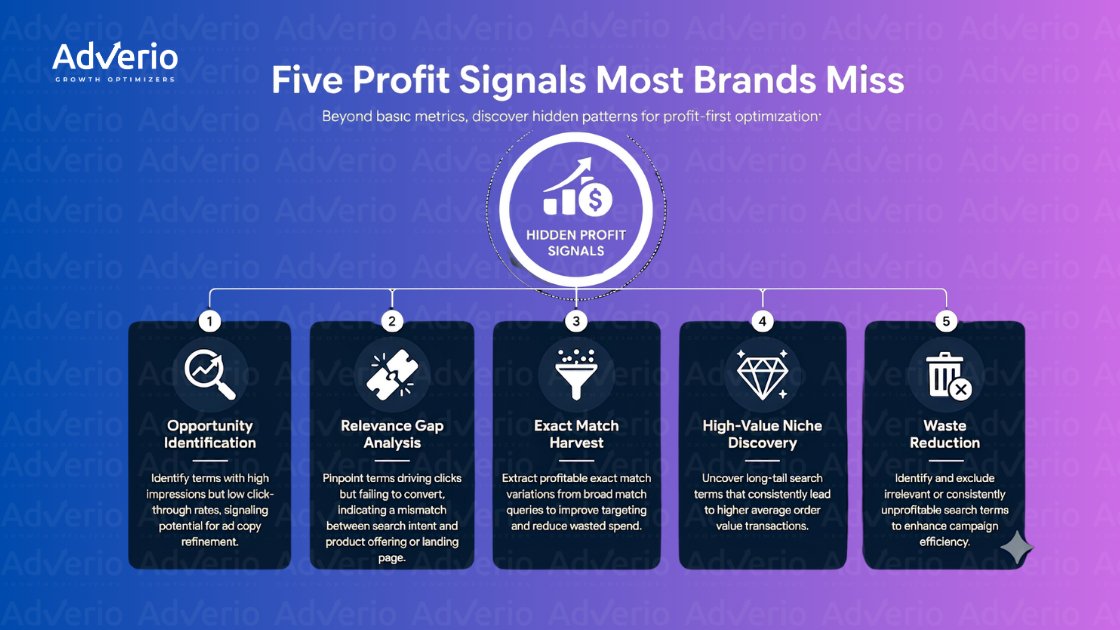
Five Profit Signals Most Brands Miss in Their Search Term Reports
Clicks, spend, and sales are table stakes. If that is still your whole read on the report, you are not running search strategy. You are doing account maintenance with prettier columns.
The inherent value sits in the patterns behind the rows. QRY-IQ is built around that idea. It reads the Search Term Report as demand intelligence, not a cleanup log. These are the five signals that usually separate brands that buy revenue from brands that build profitable growth.
New-to-brand terms
A conversion is not automatically growth.
Some queries bring in first-time customers. Others capture shoppers who were already headed to you. If you treat those two outcomes the same, you will overfund defense and underinvest in acquisition.
Amazon’s own reporting stack gives you enough to separate the two if you bother to look. Sponsored Brands reporting includes new-to-brand detail for eligible metrics, and Brand Analytics adds query-level market context through Search Query Performance and related reports in the Amazon Ads help center documentation.
Read those terms in three buckets:
-
Queries that drive first-time customer orders
-
Queries that mostly protect branded demand
-
Queries that convert efficiently but add little incremental reach
That split changes budget decisions fast. A term with weaker short-term efficiency can still deserve investment if it consistently pulls in new buyers — this is exactly the incrementality lens Adverio applies across every Amazon DSP management and PPC engagement.
Branded versus non-branded split
A lot of brands claim they are growing. Their search term report says otherwise.
If branded queries are doing the heavy lifting, paid search is often protecting demand your brand already created through ranking, repeat purchase, retail media, email, or off-Amazon traffic. That has value. It is not the same as market expansion.
Separate branded and non-branded terms aggressively. Then force yourself to answer the uncomfortable questions. Are generic terms failing because bids are too low, because the listing does not convert cold traffic, or because the offer is weak?
Amazon’s Brand Analytics gives you the branded vs. non-branded split at the query level. Use it. If your “best” terms all carry your brand name, you’re paying to intercept demand you already created.
If your “best” terms all include your brand name, stop congratulating yourself. You may be paying to catch shoppers who were already in the bag.
Query share concentration
Revenue concentration is one of the clearest risk signals in the whole report, and almost nobody treats it with enough seriousness.
You need to know how much sales volume sits in your top handful of queries. If a tiny cluster drives a huge share of paid revenue, your account is fragile. Ranking slips, competitor conquesting, a retail readiness issue, or one bad review cycle can hit that cluster and drag the whole program down with it.
QRY-IQ proves its utility. It measures query concentration so you can separate three groups cleanly: core terms carrying the business, support terms with upside, and filler traffic burning budget.
Use that view to make structural decisions:
-
Isolate heavy-revenue queries so you can protect margin
-
Build coverage around adjacent terms before concentration turns into dependency
-
Flag accounts where one query family is carrying more risk than it should
Analysts who use query concentration this way manage paid search more like portfolio risk than bid tuning. That is the correct mindset.
Search terms that expose unmet demand
The Search Term Report also tells you where your merchandising is behind your customer.
Recurring modifiers in converting queries show what shoppers care about in plain language. Feature phrases, use-case wording, compatibility terms, size signals, ingredient preferences, problem-solution phrasing. These patterns often show up in query data before they show up in your listing copy.
Amazon’s Search Query Performance documentation makes that broader view useful because it pairs query behavior with product-level purchase signals across the funnel in Brand Analytics Search Query Performance guidance.
Examine repeated phrasing for clues like:
-
Feature words that convert but barely appear in the title or bullets
-
Use-case language with strong purchase intent
-
Modifier patterns that signal a different buying motive than your creative suggests
-
New phrasing that hints the market is shifting
Then fix the listing. Fix the images. Fix the offer if needed.
A sharper negative keyword strategy on Amazon helps here too. It trims junk traffic, but the bigger job is clarifying intent so the winning language stands out faster.
High clicks and zero orders
This signal gets mishandled all the time because teams rush to block terms before they diagnose the cause.
A query with heavy clicks and no orders can mean irrelevance. It can also mean your price is off, your creative overpromises, your reviews are weak, your selected ASIN is wrong for that intent, or the traffic belongs with another SKU in the catalog.
Amazon’s guidance on search term reporting for Sponsored Products supports using customer search term data to identify poor matches and improve targeting decisions in the Sponsored Products search term reporting documentation.
Don’t negate before you diagnose. Sort zero-order terms by root cause:
- Wrong query for the product → negate
- Right query, wrong listing → fix the PDP or main image
- Right query, wrong SKU → re-route to the correct ASIN
- Right query, wrong economics → price or margin problem, not a targeting problem
One bucket is a negative. The other three require Amazon listing optimization or catalog fixes — not more bid edits.
The SKU blind spot
Multi-SKU brands lose money here because they pretend messy structure can produce clean insight.
If similar products are lumped into the same campaigns and ad groups, query-level performance gets muddy fast. You stop knowing which ASIN actually deserves the traffic. Then bids become guesses dressed up as optimization.
Amazon’s campaign reporting and advertised product dimensions make segmentation choices matter, especially for brands trying to connect query behavior back to specific products in the Amazon Ads reporting metrics and dimensions reference.
The fix is blunt. Segment campaigns in a way that preserves product intent. If a query should map to one hero ASIN, structure it that way. If a term family belongs to a product group, isolate that group instead of cramming half the catalog into one catch-all campaign.
Bad structure creates fake ambiguity. Clean structure creates useful signals.
Your New Playbook Building a Profit-First Strategy from Query Data

The average search term report workflow is too small-minded. It treats query data like a clean-up task. Harvest a few winners, negate a few losers, call it optimization.
That approach leaves money on the table because the STR is not just a keyword file. It is demand intelligence. It shows where your brand pulls in first-time buyers, where spend is concentrated in a dangerous handful of queries, and where traffic is relevant but economically broken. That is the core shift behind a profit-first system and the logic behind Adverio’s QRY-IQ approach.
Start with a review window that reflects buying reality
Seven-day snapshots are for people who enjoy reacting to noise.
Use a window long enough to capture repeat patterns, delayed conversions, and enough click volume to separate a real signal from random movement. For many brands, that means reviewing query data over 30 to 60 days, then checking shorter windows only after the baseline is clear. Amazon’s own reporting setup supports this kind of disciplined filtering in the Sponsored Products search term report documentation.
Then sort queries by decision type, not by gut feel:
-
Promote terms that convert efficiently and deserve tighter control
-
Contain terms that generate spend but still need match-type or bid limits
-
Repair terms with relevant intent but weak conversion, where the problem is likely price, content, or SKU selection
-
Block terms that are clearly off-target and keep draining budget
A team without these buckets does not have a strategy. It has a habit.
Stop judging every query by ACoS alone
ACoS is useful. It is also one of the fastest ways to misread growth.
A query with average ACoS but strong new-to-brand performance can be more valuable than a branded term with pretty efficiency and almost no incremental customer gain. Amazon’s Brand Metrics documentation lays out why new-to-brand behavior matters if your goal is category growth, not just harvesting existing demand from shoppers who were already looking for you: Amazon Ads Brand Metrics.
QRY-IQ redefines the job. It classifies search terms by role in the account:
| Query role | What to examine | Likely action |
|---|---|---|
| Brand defense | Conversion efficiency, impression share, incremental value | Protect coverage, cap overspend |
| Non-branded acquisition | New-to-brand rate, CVR, margin after ad spend | Increase bids and isolate winners |
| Product-specific intent | SKU fit, listing alignment, variation mapping | Route to the right ASIN and campaign |
| Curiosity traffic | Clicks without buying signals, weak commercial intent | Reduce bids or negate |
| Concentrated revenue driver | Share of sales from a small query cluster | Defend aggressively and build backups |
That last row gets ignored constantly.
Measure query concentration before it becomes a revenue risk
If too much sales volume comes from a tiny cluster of search terms, the account is fragile. One ranking drop, one aggressive competitor, one inventory issue, and performance breaks fast.
Review how much spend, sales, and conversions are tied to your top query cluster. If a narrow group of terms carries the account, build protection around them. Isolate them. Defend them. Expand around them with close variants and adjacent commercial intent. Then develop secondary query themes so growth does not depend on a few keywords carrying the whole machine.
This is a cleaner version of an Amazon keyword strategy built for profit. You are not just chasing what worked last month. You are reducing concentration risk while building the next layer of demand.
Use n-grams for market insight, not just negative mining
Basic n-gram work helps you find waste. Strong n-gram work tells you how shoppers frame the category.
Break queries into recurring modifiers, use cases, attributes, and comparison language. Then look at what those patterns say about buyer priorities:
-
Feature words that convert but barely appear in your listing
-
Use-case phrases that deserve their own ad group or landing angle
-
Low-intent modifiers that should be excluded across multiple campaigns
-
Competitor or substitute language that signals a positioning problem
-
Repeated phrase fragments that reveal where your offer is winning, or losing
That analysis should influence more than bids. It should shape listing copy, image sequencing, product bundling, and even which ASIN gets pushed as the hero for a term family.
Budget by contribution to profit, not by campaign politics
Budget allocation usually follows account structure. That is backward.
Budget should follow contribution. Queries and query groups that produce profitable sales, attract new customers, or show clear expansion potential should get priority. Everything else gets tested under control or cut back.
Use a simple operating rule:
-
Fund proven query clusters first.
-
Fund high-potential acquisition terms second.
-
Keep exploration spend capped.
-
Remove budget from queries that need a listing fix, not more ad spend.
That is the difference between optimization theater and actual account management.
If you’re running a $5M+ catalog and this playbook feels like a rebuild, that’s the point. Adverio’s Amazon growth strategy engagements start exactly here — diagnosing query concentration, separating branded from incremental demand, and building the budget logic that actually moves TACoS.
Your search term report should tell you where profit comes from, where it is leaking, and where future demand is forming. If you only use it to harvest exact match keywords and add negatives, you are using one of Amazon’s best intelligence assets like a janitor’s checklist.
How Adverio Uses QRY-IQ to Turn Query Data Into Guaranteed Growth
Manual query analysis has a ceiling. At 500+ SKUs across variant-heavy catalogs, the spreadsheet approach breaks down — not because teams don’t know what to look for, but because the execution lag means the account has already moved by the time insights become actions.
That’s where systems matter.
Adverio uses QRY-IQ, a query-mapping workflow built to classify search terms, separate branded from non-branded demand, surface profit leaks, and connect query behavior to broader marketplace decisions. It’s paired with a relevance layer called Rufus Analysis, which helps evaluate whether query traffic is aligned with the product, listing, and shopper intent. If you’re comparing reporting stacks and analysis options, this overview of Amazon analytics tools for brand operators is a useful place to calibrate what your current setup is missing.
Why manual review stops scaling
A team can review one account manually. Maybe a few. But once the catalog expands, three problems show up:
-
Classification drift: Different people label query intent differently.
-
Decision lag: By the time insights become actions, the account has already moved.
-
Missed patterning: Humans catch rows. Systems catch clusters.
That matters because search term strategy compounds when actions happen quickly and consistently.
What better looks like
A stronger system should do more than spit out a list of negatives and harvest candidates. It should help you answer harder questions:
-
Which queries are adding new customers
-
Which search themes deserve listing changes
-
Where branded demand is masking weak discovery
-
Which campaign structures are creating SKU blind spots
-
Where query concentration creates risk
That’s the difference between ad management and growth management.
If your best insights are still sitting in a CSV waiting for someone to act on them, you don’t have a search strategy. You have a recurring task.
If your current workflow still depends on a smart person remembering what they saw in last week’s CSV, you don’t have a system. You have a routine.
Frequently Asked Questions About Search Term Report Strategy
How often should you review the search term report
Weekly reviews keep waste under control. They do not give you strategy.
Use the weekly pass for negatives, bid corrections, and obvious query-level spend leaks. Then run a separate monthly or quarterly analysis across a longer window to spot demand shifts, branded dependence, new-to-brand pockets, and concentration risk. Short windows reward overreaction. Longer windows show where profit is forming.
Split the work on purpose:
-
Weekly review: Waste control, harvesting, bid triage
-
Periodic deeper review: Query clustering, branded versus non-branded mix, concentration risk, new-to-brand patterns, listing feedback, catalog segmentation
Teams that only do the weekly pass stay active. They do not get smarter.
What’s the best way to handle SKU attribution issues in multi-product catalogs
Stop asking the report to do a job your campaign structure refused to support.
SKU attribution problems usually start upstream. If multiple close-substitute ASINs sit inside the same campaigns and ad groups, query performance gets blurred. You end up making bid and budget decisions on blended demand, which is how strong products subsidize weak ones without anyone noticing.
The fix is cleaner architecture, not more spreadsheet gymnastics. Separate hero SKUs from long-tail SKUs. Split campaigns by product family, price tier, or margin profile. Keep search intent mapping tight enough that a winning query points to a product decision you can trust. Amazon’s own advertising documentation on campaign structure and report use supports this approach. QRY-IQ pushes it further by grouping query behavior around commercial outcomes, so you can see where blended structures are hiding real winners and real drags.
Does this strategy matter outside Sponsored Products
Yes. Query intelligence should shape every ad type you run.
Sponsored Brands adds a layer many brands ignore. It is one of the few places where query analysis can be tied directly to customer acquisition quality, especially through new-to-brand metrics. Amazon’s guide to new-to-brand metrics in Sponsored Brands and Sponsored Display makes the point clearly. If a query drives sales but rarely brings in new buyers, treat it differently from a query that expands your customer base.
That is the mistake basic STR workflows keep making. They treat all conversions as equal. They are not. A mature search term strategy compares efficiency, incrementality, and concentration across ad types, then reallocates budget toward the query themes that build the account instead of merely keeping it busy.
What should you do first if your TACoS hasn’t moved in months
Audit the query portfolio, not just the bids.
Start with four checks:
-
Brand dependence
If branded searches carry the account, your acquisition engine is weaker than your dashboard suggests. -
Profitless volume
Find queries that generate clicks and even sales, but fail on margin, new-to-brand rate, or repeatability. -
Revenue concentration
If a small cluster of queries drives most sales, your account has more fragility than scale. -
Offer and listing mismatch
If high-intent queries convert in ads but stall on page, the problem is merchandising, not targeting.
QRY-IQ changes the conversation. Instead of asking which keywords to add or block, it asks which query clusters create profitable demand, which ones trap spend, and which ones expose weaknesses in your listings, SKU mix, or budget allocation.
If your team pulls the search term report every week and TACoS still hasn’t moved, the process isn’t the problem — the thinking is. Adverio works with established $3M–$50M Amazon brands to turn query data into operating decisions: tighter spend allocation, real incrementality, and profit growth that shows up in the P&L — not just the ad console.
Book your ROI Forecast to see exactly where your query strategy is leaking margin.
Read next: Amazon Keyword Strategy Built for Profit