



Table of Contents
A profit-first framework to fix margin leaks, scale contribution, and turn Amazon into a predictable growth engine.
Revenue growth can make an Amazon brand look healthy while profit collapses.
That’s the mistake killing your margin—and most brands don’t even see it. Too many operators treat sales as proof of progress, then act surprised when cash gets tighter, ad efficiency slips, and the P&L carries less than the dashboard promised. Amazon does not reward revenue vanity. It rewards control over contribution margin, inventory discipline, pricing power, and spend quality.
Your amazon profit margin strategy is the operating system for that control—and it only works when built on a clear amazon contribution margin strategy. Without it, growth usually magnifies weak economics instead of improving them.
Sellers often report healthy margins on paper. According to Seller Assistant, 61% of sellers achieve margins above 10%, and about one-third exceed 20%. Those numbers do not make margin management easier. They make the gap clearer. Brands can still lose ground fast when referral fees, fulfillment costs, storage exposure, returns, and ad creep are not governed at the SKU level.
Revenue is easy to measure. Profit quality is harder, so it gets ignored.
If your brand is growing and cash feels tighter, the problem is not demand. The problem is governance. You need a reporting system that shows which sales create earnings, which sales consume them, and where margin breaks first. A disciplined stack of Amazon analytics tools should make that visible every week, not after the month is already lost.
At a glance
-
Revenue can rise while profit deteriorates. That is common on Amazon.
-
Margin needs weekly governance. Monthly review is too late.
-
SKU-level contribution beats blended reporting.
-
Ad metrics matter only in the context of net profit.
-
Bestsellers often hide the worst economics.
Your Dashboard Is Lying to You
A rising sales graph does not mean your Amazon business is healthier.
It usually means demand exists. That’s where most operators stop—and where the real problem starts.
What the dashboard hides is the cost stack behind every sale. Amazon fees. Storage drag, return friction, ad dependence, and pricing pressure. A SKU that looks strong at the revenue layer can be weak once full operating costs hit it. That’s why growth feels good—but cash feels tight. The marketplace says growth. The bank account says strain.
Growth isn’t the problem. Measuring it wrong is.
For a complete picture, stop staring at top-line screenshots and start building a profit-view system that ties together pricing, inventory, media, and returns. That is the difference between operating blind and operating with control. Your BI stack should tell you—weekly—what’s making money and what’s draining it.
Key takeaway: Revenue is an activity metric. Profit is a business health metric.
Shinesty is the kind of example most brands miss. Flat topline can still hide a better business if the conversion engine improves and refunds fall. That is progress. It just does not flatter the dashboard.
Stop scaling revenue that doesn’t convert to profit. Book Your ROI Forecast.
The Six Hidden Ways Amazon Revenue Growth Destroys Profit
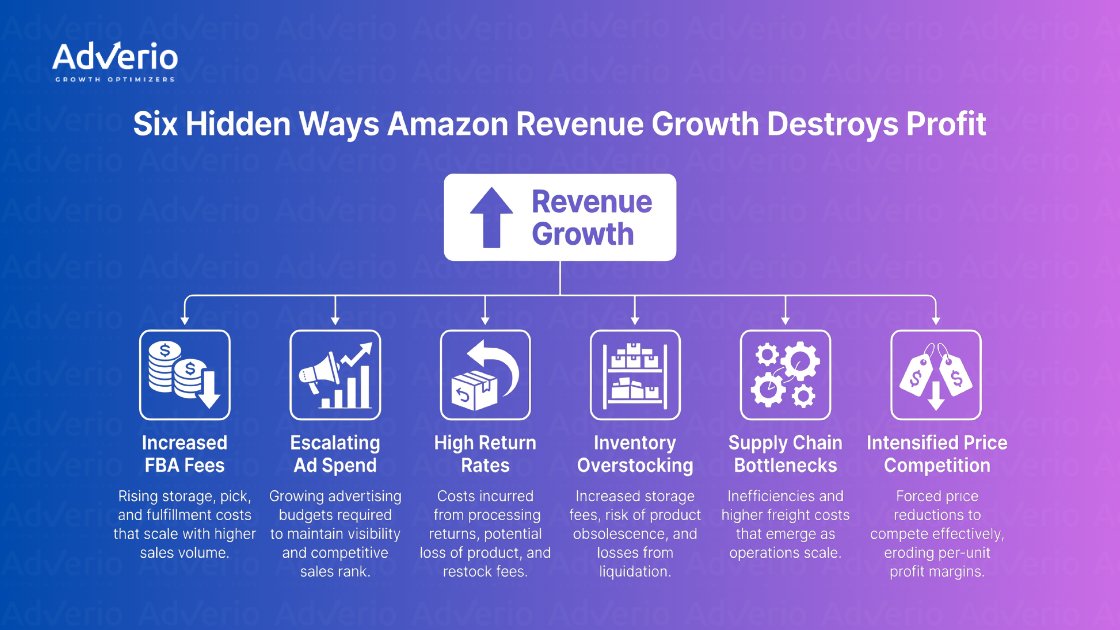
Revenue doesn’t fix weak economics—it scales them.
Top-line growth feels like progress, so teams protect it, report it, and celebrate it. Meanwhile, the bottom line gets drained by six failure points that sit below the sales graph and outside the usual weekly review.
Fee compounding
Amazon takes its cut first. Your margin gets what is left.
Referral fees are commonly around 15% depending on category, and Amazon’s own Seller Central fee schedule shows how fast those charges stack up once fulfillment, storage, and aged inventory costs are added. Revenue growth makes that worse when the catalog expands faster than inventory discipline.
You only notice the damage after it hits cash flow. A brand adds variants, buys deeper to avoid stockouts, and keeps weak SKUs alive because they contribute revenue. Then storage costs rise, aging inventory sits longer, and cash gets trapped in products that never had the margin to justify the working capital.
Use tighter Amazon inventory management before you buy more traffic.
What to do
-
Review aged inventory every week. Old stock is a margin problem, not just an ops problem.
-
Cut low-quality assortment. More SKUs often means more carrying cost, more markdowns, and slower turns.
-
Forecast on contribution dollars. Unit growth without contribution growth is expensive theater.
Ad efficiency decay
Paid media rarely gets cheaper as a brand scales. It usually gets harder.
Teams push into broader terms, more competitive placements, and defensive campaigns just to hold the same rank. Campaign dashboards can still look acceptable while account economics deteriorate. That is why executives who manage by ACoS alone get blindsided.
Set ad guardrails from unit economics—this is where structured amazon ppc management services actually protect margin instead of just scaling spend. If a SKU cannot support the spend required to keep rank, stop pretending the traffic is profitable. Rework conversion, pricing, bundling, or offer quality first.
Mary Maxim is the right model here. Revenue improved after conversion improved, without relying on more ad spend. That is what healthy growth looks like. Better economics first. More traffic second.
Tip: If spend has to rise every month just to maintain visibility, you do not have momentum. You have dependency.
Return rate drag
Returns run a shadow P&L.
The sale posts now. The refund, processing cost, resale loss, and inventory distortion show up later. That delay is why return damage gets ignored until margin compression becomes impossible to explain away.
Shinesty makes the point clearly. A flatter revenue line with fewer refunds can produce a better business than a faster-growing line with heavier leakage. Finance teams understand that. Growth teams often do not.
This isn’t random. It’s an operational failure:
-
Listing mismatch. The product sold is not the product the customer expected.
-
Quality drift. The page converts, then the product disappoints.
-
Bad traffic. Promotions and loose targeting bring in shoppers who were never a fit.
Track refunds like an early warning signal—this is usually a conversion problem, not just an ops issue, which is why amazon conversion rate optimization matters more than most teams think. If return rate worsens, profit quality is already under pressure.
Mix shift toward low-margin SKUs
The bestseller is often the problem.
High-revenue ASINs attract budget, attention, and inventory support. They also tend to carry the heaviest ad load, the most promotional pressure, and the most aggressive pricing. Analysts at Podean describe the core issue well. A top-selling product can become one of the least profitable once full costs are allocated.
That means quieter SKUs can subsidize the hero product without anyone noticing. Blended account reporting hides this every day.
| SKU type | Looks strong in revenue view | Looks strong in profit view |
|---|---|---|
| Hero ASIN with heavy ad support | Yes | Often no |
| Mid-volume SKU with stable conversion | Sometimes ignored | Often yes |
| Slow mover with high storage drag | Sometimes tolerated | Rarely |
If you can’t rank SKUs by contribution after fees, ads, and returns, you’re not operating a business. You’re guessing. You are hoping the blend works out.
This is also where outside finance support pays for itself. Strong Financial Analysts can build SKU-level reporting that exposes which products deserve scale and which ones are consuming capital.
Pricing erosion under competitive pressure
Most brands treat pricing reactively—here’s how a real amazon dynamic pricing strategy protects margin instead.
Price cuts protect revenue faster than they protect profit.
Repricers respond to the market in real time. Without margin floors, they also train the business to accept worse economics every week. That is how a brand wins sales volume and loses earnings power. My Real Profit explains the operational risk well. Reactive repricing can trigger repeated price drops that are hard to recover from.
Set rules your systems cannot violate:
-
Define a minimum acceptable margin by SKU.
-
Limit automated repricing ranges.
-
Review pricing with inventory position and ad pressure together.
A commodity product with weak differentiation cannot afford pricing mistakes. It has no margin cushion.
Volume incentivized at the wrong margin
Bad incentives create fake growth.
The media team gets rewarded for attributed sales. The marketplace lead gets rewarded for revenue. Promotions get approved to hit the month. Nobody owns the marginal profit on the next order after discounting, PPC, returns, and fee burden are included.
That is how brands get busier and poorer at the same time.
The fix is governance. Every growth decision needs a profit threshold before it gets budget. Promotions should clear a contribution hurdle. Media should be judged against margin by SKU, not only attributed revenue. Sales targets should exclude volume that destroys earnings.
One product can show healthy gross margin and still fail at the net level once the full cost stack is applied. That is the trap. Revenue vanity hides it. Profit governance exposes it.
Bottom line: If growth is not screened through contribution, return rate, fee burden, and price discipline, it is not growth. It is margin destruction with better reporting.
The Metrics That Predict Profitability
You do not need more dashboards. You need a better hierarchy of metrics.
Revenue belongs low on the list. Profitability sits higher. The leading indicators that shape profitability sit higher still.
Contribution margin per SKU
This is the first metric that matters because it forces honesty.
If you are still evaluating products mainly on sales rank, total revenue, or blended account averages, fix that now. A proper Amazon contribution margin strategy measures what each SKU contributes after direct product cost, marketplace fees, ad spend, storage burden, and return drag.
The distinction between gross and net matters here. Many sellers achieve healthy net profit, but this often requires a substantial gross profit margin to absorb advertising, returns, and fees. One example shows a product with 67% gross margin dropping to 20% net margin after overhead expenses are included (SellerApp).
That is why gross margin alone is a comfort blanket. It is not governance.
If your internal finance support is thin, this is one place where experienced Financial Analysts can help structure product-level reporting and prevent bad scaling decisions.
TACoS versus ACoS
ACoS is a campaign metric. It is useful. It is not enough.
The executive view needs a broader measure because account health can deteriorate even while individual campaigns look “efficient.” That is where TACoS becomes more revealing. It ties ad spend to the full revenue base and exposes whether paid media is becoming a permanent tax on growth.
ACoS-only management creates what Adverio calls optimization myopia. Teams trim campaigns to protect a local metric while the business loses momentum, or they scale campaigns that hit an acceptable ACoS while total economics worsen.
For a cleaner executive scorecard, build your Amazon KPIs around contribution, blended ad burden, refund trajectory, and margin by SKU cluster.
Refund rate trajectory
Refund rate is one of the clearest signals that your offer quality, listing accuracy, or post-click expectation is breaking down.
Track the direction, not just the snapshot. A rising trajectory usually means future margin pressure. A declining one often means your business is getting healthier even if revenue growth looks modest.
That is why flat topline plus better conversion and fewer refunds can be a stronger outcome than noisy revenue growth built on weak economics.
LTV versus CAC ratio
This matters most for brands with repeat purchase behavior or meaningful cross-sell potential.
If acquisition cost rises and downstream value does not, your marketplace machine becomes brittle. You keep paying for transactions instead of building a customer base with lasting value. Strong operators do not just ask whether media drove sales. They ask whether customer acquisition economics justify continued spend.
Practical rule: Every metric on your weekly dashboard should answer one question. Did this make the business more profitable, or just more active?
What Governance-First Growth Looks Like
Revenue without control is not growth. It is expensive drift.
Governance-first growth gives one team clear authority over the decisions that shape profit. Pricing, inventory, advertising, listing quality, and returns cannot sit in separate scorecards with separate owners chasing separate wins. If they do, you get the familiar Amazon failure pattern. Sales rise, cash tightens, ad spend creeps up, and margin disappears SKU by SKU.
The operating model
Run the catalog like an investment portfolio—especially if you’re dealing with scale and complexity like how to manage 1000 skus on amazon.
Every SKU should have a job and a rule set. Fund the products that create contribution. Repair the products that can recover with pricing, content, or supply chain changes. Cut the products that absorb working capital and never pay it back. That’s what real operators do. It replaces reactive channel management with capital allocation discipline.
A useful review cadence includes four decisions:
-
Profit scoring by SKU. Revenue rank is not enough.
-
Inventory aging control. Old units turn into fee drag and forced discounting.
-
Pricing guardrails. Every promotion needs a margin floor.
-
Ad allocation tied to contribution. Budget follows profit potential, not gross sales.
Large catalogs make weak governance expensive fast. Variants, bundles, and parent-child relationships create enough complexity to hide bad decisions for months. Brands handling that sprawl need operating rules, not more reporting, especially when they are dealing with how to manage 1000 SKUs on Amazon.
The benchmark reality
Healthy margin on Amazon is possible. It is never automatic.
As noted earlier, many sellers do clear double-digit margins, but that outcome depends on disciplined control of the fee stack, discounting, ad pressure, and inventory exposure. Amazon referral fees alone commonly take a meaningful cut of every sale. Amazon outlines its category referral fee structure on its Selling on Amazon fee schedule. Storage costs add another layer of pressure, especially when slow-moving inventory rolls into peak fee periods.
That is why governance matters. Margin does not improve because a dashboard says TACoS is stable or sales are up. It improves because someone reviews the catalog every week, enforces thresholds, and acts before fee creep, return leakage, or pricing mistakes show up in the monthly P&L.
One practical way to support that discipline is an integrated BI layer—but data alone doesn’t fix margin leaks. Execution does. That’s where structured amazon ppc management services turn insight into profitable growth by controlling spend at the SKU level.
Key takeaway: Governance-first growth means no SKU gets budget, inventory, or discount approval without a clear profit case.
Book Your ROI Forecast if your catalog is growing but profit quality is not.
How Adverio Fixes Margin Leaks at Scale
Most brands don’t have a growth problem. They have a profit governance problem.
Adverio connects pricing, inventory, ads, and conversion into one system—so every decision ties back to contribution margin.
That means fewer leaks, better allocation, and scalable profit—not just revenue spikes.
If your brand is growing but your margins aren’t, that’s the system breaking—not the market.
FAQs for a Bulletproof Amazon Profit Strategy
What is a good Amazon profit margin strategy for an established brand
A good amazon profit margin strategy starts with a required net margin, then forces every operating decision to respect it. Product cost ceilings, ad caps, pricing floors, and inventory limits should all flow from that number.
Revenue targets without margin rules create fake growth. Teams tell themselves profit will show up later. On Amazon, later usually means after fee creep, ad inflation, and discounting behavior have already hardened into the model.
Build the strategy at the SKU level. Account averages hide the products that are soaking up cash.
Why does my revenue grow while profit falls
Because top-line growth is easy to buy.
You can push revenue up with more ad spend, lower pricing, broader promotions, and heavier inventory bets. If that volume comes through weak-margin SKUs, rising return rates, or bloated fulfillment costs, the P&L gets worse while the dashboard celebrates.
This is the core Amazon mistake. Brands treat revenue as proof of traction instead of asking whether each incremental dollar of sales leaves more cash behind.
Should I focus on ACoS or TACoS
Use both. Give them different jobs.
ACoS is a campaign control metric. TACoS is a business control metric. If leadership only sees ACoS, they are evaluating ad efficiency without seeing whether advertising is swallowing the profit pool across the account.
That blind spot leads to expensive decisions. Campaigns can look cleaner while the brand gets less profitable.
You need a wider framework built around real amazon kpis—not just ad efficiency metrics.
How often should we review profitability
Review weekly for operating control. Review monthly for formal finance.
A monthly close is too slow for a channel where pricing, conversion, ad costs, and inventory exposure can shift in days. Weekly review should cover SKU contribution, pricing exceptions, ad burden, refund direction, and aging inventory. Monthly review should confirm the broader financial picture and catch issues that operating reports miss.
Delay is expensive. The longer a margin leak stays live, the harder it is to reverse without hurting demand.
What usually gets missed in Amazon margin analysis
Back-office friction.
Many brands model product cost, fees, and ad spend, then fail to clean up the operational mess around reimbursements, invoice reconciliation, returns processing, and charge discrepancies. That distorts both reported profit and cash visibility. If your finance team needs tighter controls, this guide on managing invoices from Amazon is useful.
Clean accounting does not fix bad unit economics. It does stop bad reporting from hiding them.
Is repricing always bad for profit
Repricing is useful when it follows margin guardrails.
It becomes destructive when software chases competitors without a floor, or when teams cut price to protect volume that was never profitable in the first place. Brands with weak differentiation get trapped here fast. Lower prices train customers to wait for deals and leave less room for ads, returns, and cost spikes.
Price should defend margin and share. It should never operate on autopilot.
How do I know which SKUs deserve more ad budget
Start with contribution margin. Then check traffic efficiency.
A SKU deserves more ad budget when it still makes money after full costs, converts well, and improves the economics of the wider catalog. Some ASINs earn that investment on their own. Others justify support because they help repeat purchase or basket value. A bestseller does not automatically qualify.
Revenue vanity causes real damage in such cases. Teams keep funding the loudest SKU instead of the most financially useful one.
What should I do first if my margins are already compressing
Find the leak with the highest financial impact and fix that first.
Start with SKU-level profit, campaign-level spend quality, and inventory positions that are tying up cash or forcing discounting. Then act. You may need to raise price, cut ad waste, reduce overstock, or fix a listing that is driving returns through poor expectation setting.
Random cost cutting usually hits healthy parts of the business and leaves the core problem untouched.
Adverio helps established marketplace brands stop confusing activity with earnings. If your Amazon revenue looks strong but your margins keep slipping, work with a team that treats Amazon like a financial system—not a traffic channel, not a vanity metric. Book your ROI Forecast at Adverio.
References
-
https://podean.com/blog/navigating-amazons-hidden-costs-to-protect-your-profit-margins
-
https://myrealprofit.com/blog/profitable-amazon-pricing-strategies/