


Table of Contents
A sound Amazon DSP strategy does not start with the channel. It starts with whether your business is ready for it.
Most Amazon agencies pitch DSP as the next step after Sponsored Ads. It is not. It is a conditional step, one that earns deployment only when four specific business conditions are true and destroys margin when those conditions are not met.
This is the only DSP framework that starts with your economics instead of with the channel.
DSP is the most overpitched channel in Amazon advertising. Most agencies recommend it too early, before conversion floors are ready, before incrementality is measured, before Sponsored Products structure is clean. The result is premium CPMs funding leaky funnels. DSP works when the business underneath it deserves the traffic. The diagnostic tells you whether yours does.
We run the DSP readiness check before recommending a dollar of programmatic spend. No pitch deck. No commitment.
Quick Answer:Amazon DSP is worth using when your Sponsored Ads foundation is profitable, your organic rank is stable, and you have a specific incremental goal. If you are still optimizing basic PPC, DSP adds cost before the foundation can support it.
The Four Scenarios Where Amazon DSP Creates Real Return

Amazon DSP earns its budget in four situations. Outside of these, it usually becomes expensive theater.
For brands building a complete Amazon advertising strategy, understanding where DSP fits within the broader ad stack is the starting point — not the channel pitch. Read the complete Amazon advertising strategy guide to see how DSP slots in after search is mature.
Retargeting shoppers who viewed but didn’t buy
Start here first.
If a shopper hit your product detail page, browsed your category, or signaled clear intent and then left, DSP can recover value your search campaigns already paid to create. That is a financial use case with teeth. You are not funding cold traffic. You are trying to convert traffic that already crossed the line from passive browsing into active consideration.
That makes DSP a margin protection tool. It gives you another chance to convert high-intent shoppers across more placements than Sponsored Products can cover on its own.
If you want a clearer view of how these campaigns work in practice, this Amazon DSP ads breakdown covers the mechanics.
Branded defense when competitors are circling
Brands with real category share get attacked. Competitors target your audiences, show up around your branded demand, and try to intercept shoppers who were already close to buying from you.
DSP creates a defensive layer around those buyers. You can stay in front of people who already know your brand, reinforce your message, and reduce the number of easy conversions competitors steal. In crowded categories, that matters more than another awareness campaign ever will. Protecting demand you already created is usually cheaper than rebuilding it after someone else captures it.
A simple rule applies here. If your branded traffic is expensive to win, it is expensive to lose.
Tentpole launch amplification
Launch periods expose bad capital allocation fast.
Brands spend heavily on inventory, offers, creative, and retail prep, then support the launch with a search-only plan and act surprised when momentum fades after the first spike. DSP makes sense when the launch already deserves scale and your job is to extend reach, reinforce recall, and keep conversion windows open longer than search alone can manage.
The upside comes from orchestration, not from spraying impressions everywhere.
Incremental reach after sponsored search is saturated
This is the scenario brands want to claim. Few have actually earned it.
DSP becomes attractive when your sponsored ad engine is already disciplined, your listings convert, and your search program has stopped producing enough efficient volume to drive the next stage of growth. At that point, DSP can add incremental reach with audience-based targeting that search cannot provide on its own.
The mistake is obvious. Brands jump into DSP before they have squeezed waste out of Sponsored Products, Sponsored Brands, and Sponsored Display. Then they blame the channel when returns disappoint. The problem was timing. DSP should expand a mature acquisition system, not compensate for a sloppy one.
The decision standard
Use DSP when one of these four conditions is true:
- You need retargeting depth. High-intent shoppers are slipping away and your current ad stack is not bringing enough of them back.
- You need brand defense. Competitors are pressuring your branded demand and winning conversions that should have stayed with you.
- You need launch force multiplication. A tentpole event or major launch needs broader reinforcement than search can provide alone.
- You need incremental scale. Your sponsored search program is already efficient and you need another profitable source of reach.
If your reason does not fit one of these four, do not run DSP. Fix the underlying economics first.
Pro tip: Before approving any DSP budget request ask your agency which of the four deployment scenarios applies and what the incrementality measurement plan is. If they cannot answer both questions the DSP proposal is premature.
Amazon DSP (Demand-Side Platform) is Amazon’s programmatic advertising system. It lets brands buy display, video, and streaming ad inventory using Amazon’s first-party audience data. The fundamental difference between DSP and Sponsored Ads is this: Sponsored Ads capture people already searching. DSP reaches people who are not. That makes it a demand generation and retargeting tool, not a demand capture tool. Conflating the two is one of the most expensive mistakes brands make. If you run DSP like search ads, you will spend like a billboard and convert like a bus bench.
The Three Traps Where DSP Will Burn Your Budget
The market keeps selling DSP as the answer for ambitious brands. It isn’t. In the wrong situation, it’s just a faster way to waste serious money.
Trap one: using DSP as a top-of-funnel fix before conversion is proven
If your listings are weak, your reviews are shaky, your pricing is off, or your PDP experience leaks conversions, DSP won’t solve the problem. It just sends more traffic into a broken machine.
This is the classic operator mistake. They think broader reach will compensate for weak retail readiness. It won’t. Search traffic was already telling you the truth. You just didn’t like the answer.
DSP works best when demand capture is already healthy. If your detail pages don’t convert and your offer isn’t compelling, awareness spend is just expensive denial.
Trap two: spending too little and expecting enterprise results
DSP has a budget floor for a reason. It’s not designed to be a casual side test.
Below $10K per month the platform cannot gather enough signal to measure incrementality reliably. That’s the part too many brands ignore. They want incremental impact, but they fund the channel below the level where it can build enough reach or retarget with enough consistency to matter.
| Monthly DSP Budget | Expected Outcome | Verdict |
|---|---|---|
| Under $5,000 | Insufficient signal — no meaningful incrementality measurable | Do not run |
| $5,000 – $10,000 | Minimal reach — some retargeting signal but not enough for reliable incrementality | Test only with defined exit criteria |
| $10,000 – $30,000 | Functional retargeting and branded defense at mid-market scale | Viable if readiness checklist passed |
| Above $30,000 | Full deployment across retargeting, defense, and incremental reach | Full DSP programme eligible |
If you’re asking whether a small budget can “at least get something going” — it can’t. Fund it properly or don’t fund it.
Wasted spend hurts twice. You lose cash, and you lose confidence in a channel that might have worked later under the right conditions.
Trap three: layering DSP on top of bad PPC economics
This is the most dangerous one because it sounds complex. It isn’t.
If your PPC operation is already inefficient, DSP amplifies the mess. Brands should avoid DSP if TACoS from PPC alone exceeds 25%, because DSP won’t fix the underlying inefficiency, it will magnify it.
That’s why disciplined operators treat DSP as a second-order investment. They don’t use it to cover for bad keyword structure, lazy bid strategy, poor ASIN prioritization, broken inventory flow, or weak unit economics.
If your search campaigns still have structural gaps, a focused Amazon PPC management audit is where the fix starts — not DSP.
For brands evaluating a full Amazon DSP management programme, the readiness checklist above applies before any engagement begins.
For a deeper read on how Amazon incrementality measurement works and why it governs DSP deployment decisions, that framework is worth understanding before any budget conversation.
Here’s the blunt version:
- Bad search economics plus DSP equals more expensive inefficiency.
- Unstable inventory plus DSP equals demand you can’t reliably convert.
- Weak conversion plus DSP equals more traffic leaking out of the funnel.
A fast no-go test
DSP is probably the wrong move right now if any of these are true:
| Condition | What it means |
|---|---|
| Your main goal is generic awareness | You’re buying exposure without a clear path to payback |
| Your DSP budget is too small to matter | The platform won’t have enough room to perform |
| Your PPC is still financially loose | You’re scaling a leak, not a winner |
Brands don’t usually lose money on DSP because the platform is flawed. They lose money because they assign it the wrong job.
The brands that lose money on DSP almost never had a DSP problem. They had a sequencing problem. They paid premium CPMs to send audiences back to listings that weren’t built to close them, into campaigns that couldn’t measure whether the spend was incremental, on top of a Sponsored Products structure that was still bleeding at the foundation. We fix the foundation first. DSP comes after the business earns it.
Free DSP readiness diagnostic. We show you exactly what needs to be true before DSP belongs in your account.
The Pre-DSP Readiness Checklist Your Brand Must Pass
DSP should be earned. Not attempted.
If your team can’t pass a readiness check, your next dollar belongs in fundamentals. This isn’t about being conservative. It’s about not paying premium media costs before your operation deserves premium media support.
Revenue scale and spend capacity
Amazon DSP is generally most effective for brands with annual Amazon revenues exceeding $1–2 million. The self-service platform requires a $35,000 minimum commitment. That tells you exactly who the platform is for.
It’s for brands with enough scale to support advanced audience targeting, enough margin discipline to evaluate incrementality, and enough operational maturity to avoid treating DSP like a lottery ticket.
If your business is smaller, that doesn’t mean you’ll never use DSP. It means you probably haven’t earned the right yet.
Sponsored Ads maturity
You should already be competent in Sponsored Products, Sponsored Brands, and the parts of Sponsored Display that fit your business. Not “running them.” Competent.
That means your team understands:
- Query discipline: you know where spend is converting and where it’s bleeding.
- ASIN prioritization: you’re not spreading budget evenly across catalog dead weight.
- Profit logic: you make decisions based on contribution, not vanity revenue.
- Search saturation: you can tell the difference between headroom and overfunding.
If those things aren’t true, fix them first. DSP should extend a winning system, not substitute for one.
Listing and offer readiness
Traffic quality matters. So does destination quality.
Before you add DSP, pressure-test the basics:
- Your listings convert: titles, bullets, A+ content, images, and storefront flow need to pull their weight. If they don’t, Amazon listing optimization is the constraint to fix first — not the media channel.
- Your price is defendable: if your offer loses on value perception, more impressions won’t save it.
- Your reviews aren’t a drag: weak social proof destroys paid traffic efficiency.
- Your catalog is organized: hero SKUs should get the attention, not every SKU with a barcode.
Operator check: If you wouldn’t confidently send more branded search traffic to the listing, don’t pay to send DSP traffic there either.
Inventory readiness belongs in this same gate. If inventory is unstable, DSP becomes self-sabotage because it pushes demand into stock risk, suppressed sales windows, and poor customer experience.
At this point, basic operational control is essential. If replenishment is unstable, fix it through a stronger Amazon account management system before adding any traffic pressure.
Most brands that fail with DSP passed a surface-level readiness check and skipped the financial one. Listings looked clean. Reviews were acceptable. The real gap was in whether the conversion floor, Unit Session %, price-to-CVR elasticity, and A+ impact could actually absorb incremental programmatic traffic profitably. We model that before recommending DSP to any brand.
We run the conversion readiness diagnostic and tell you exactly whether DSP would compound your growth or fund a leaky funnel.
Measurement readiness
A brand that can’t measure incrementality shouldn’t be spending on DSP yet.
You need a credible way to judge whether DSP is driving net-new demand, improving branded defense, supporting launch velocity, or creating cross-channel lift. If your team still judges everything through simplistic last-touch logic, you’ll either kill good campaigns too early or keep bad ones alive too long.
The pass-fail checklist
Use this as your gate:
- You have enough scale to justify advanced programmatic media.
- Your Sponsored Ads engine is already disciplined and producing dependable results.
- Your listings and pricing are conversion-ready for paid traffic.
- Your inventory is stable enough to support incremental demand.
- Your reporting can evaluate incrementality, not just attributed sales.
Fail one or two of these, and DSP probably needs to wait. That delay saves money.
For a foundational overview of how Amazon measures audience reach, Amazon’s DSP guide outlines the platform’s targeting and measurement capabilities.
DSP vs Sponsored Display: Which Tool Do You Actually Need
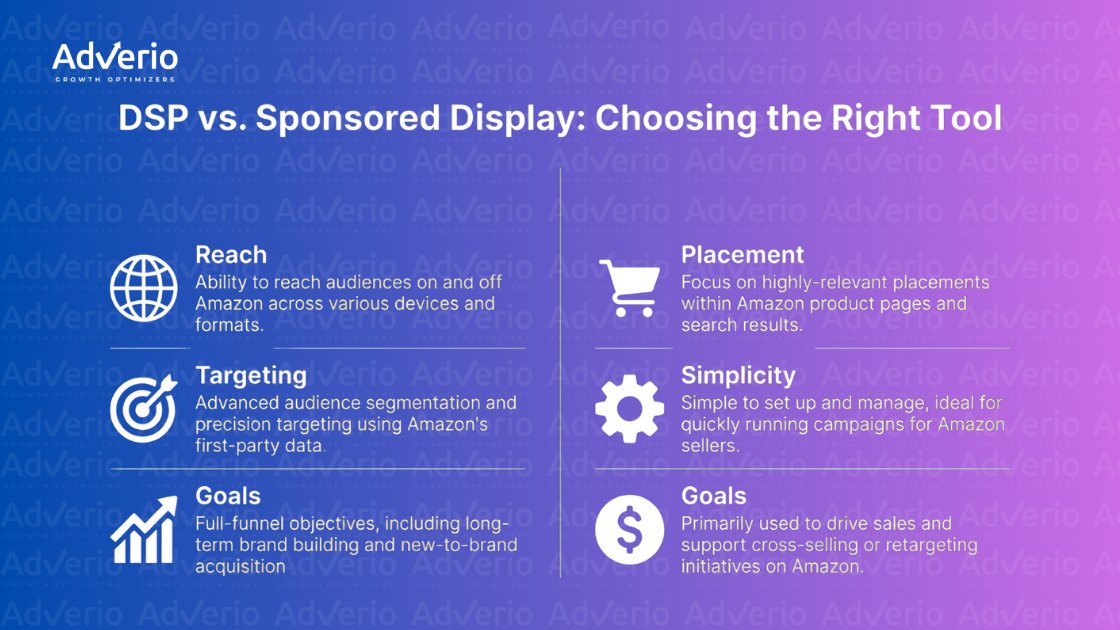
Brands waste money on DSP because they use it to solve problems that Sponsored Display already handles at a lower cost and with less operational drag.
The choice is not about which platform sounds more advanced. It is about whether the extra control, reach, and measurement options in DSP will produce incremental profit after fees, media spend, and internal complexity. If the answer is no, use Sponsored Display and keep your stack simpler.
When Sponsored Display is the better choice
Sponsored Display is the right tool when the job is close to conversion and mostly contained inside Amazon. Use it for product detail page visibility, basic retargeting, and audience activation that does not require a programmatic setup.
It also fits brands that need speed and control more than sophistication. If your team can already hit the goal with Amazon-native placements, DSP is overkill.
For teams sorting through the broader Sponsored Ads mix, this breakdown of how each ad type earns its budget clarifies where each format belongs.
When DSP is the better choice
DSP earns its keep when Sponsored Display stops being enough.
Use DSP when you need off-Amazon reach, tighter audience construction, cross-format sequencing, or retargeting that follows shoppers beyond Amazon-owned inventory. That matters when the financial goal is larger than a single conversion path — such as defending branded demand off-platform, re-engaging high-value audiences across the web, or controlling media exposure across multiple touchpoints.
DSP is a surgical tool. Sponsored Display is a simpler retail ad unit. Confusing those roles is how brands end up paying enterprise media costs for mid-funnel tasks.
The decision filter
Ask one question first: will broader audience control create profit that Sponsored Display cannot capture?
If yes, DSP deserves consideration. If no, stay with Sponsored Display.
| Question | Better fit |
|---|---|
| Is the goal mostly on-Amazon retargeting and product page support? | Sponsored Display |
| Do you need to reach shoppers off Amazon? | DSP |
| Does the team need a faster, easier setup with fewer moving parts? | Sponsored Display |
| Do you need more control over audiences, placements, and media mix? | DSP |
Bad channel selection usually looks sophisticated in a slide deck and ugly in a P&L.
How Adverio Decides When to Deploy DSP For Clients
DSP is not a capability question. Any agency can turn it on. The only question that governs deployment at Adverio is whether DSP is the highest-return next move for your brand right now — and most of the time it is not.
Adverio treats DSP as controlled deployment — not an always-on default, not a prestige channel, not something you turn on to impress a board. Most brands don’t need more complexity. They need cleaner sequencing and someone willing to say not yet.
The decision path
Adverio’s framework starts with profit leakage first. Before DSP enters the conversation, the account gets evaluated through a financial lens that looks at catalog efficiency, ad waste, conversion readiness, and operational risk.
That’s where systems like Profit Pulse System, AMOS, and the broader Growth Cultivator framework matter. They force the media decision to follow business conditions instead of internal enthusiasm.
The logic is simple:
- First fix margin erosion
- Then tighten Sponsored Ads
- Then verify inventory and PDP readiness
- Then decide whether one of the four DSP use cases exists
This sequence is less exciting than a full-funnel strategy slide. It is also why the DSP campaigns that do launch perform — because the business they are running on was ready for them.
Why that matters financially
A lot of agencies pitch full-funnel strategy because it sounds impressive. Adverio’s stronger stance is that full-funnel only works when the lower funnel already deserves more fuel.
That’s why DSP gets deployed after the business proves it can convert incremental traffic and measure whether that traffic created real return. The objective isn’t activity. It’s profitable lift.
If your team is evaluating whether a managed service partner should own that decision, this page on Amazon DSP management outlines what that relationship looks like in practice.
Good DSP strategy starts with someone willing to say no. Most wasted media spend happens before the campaign launches — because nobody pushed back.
The operational difference
The true separation isn’t who has access to DSP. It’s who has the discipline to delay it.
Adverio’s point of view is that marketplace growth has to be coordinated across paid media, catalog quality, and operations. That’s why the decision sits inside three bigger pillars: Profit-Driven Catalog Optimization, Intelligent Growth Marketing, and Integrated Marketplace Conversion Rate Optimization.
That framework changes DSP from a channel experiment into a financial instrument. That’s the right way to use it.
How Adverio Helps
Adverio treats DSP as controlled deployment inside a broader profit-first operating model. Before DSP enters any client conversation the account is evaluated through the Growth Cultivator framework, catalog efficiency, ad waste, conversion readiness, and operational risk. DSP is only recommended when one of the four deployment scenarios is clearly present and the five readiness gates are passed. If they are not, we say not yet. That discipline is what separates DSP that compounds from DSP that burns.
Every Adverio DSP engagement starts the same way. Before a single DSP dollar is committed, we run the catalog through Profit Pulse System, AMOS, and the Growth Cultivator readiness gates. If the fundamentals pass, DSP gets funded. If they don’t, we tell you what to fix first and what that fix is worth in incremental margin before DSP becomes the next conversation.
We model your DSP readiness and show you the profit upside before recommending a single programmatic campaign.
Frequently Asked Questions
A decision framework helps. The edge cases still matter.
How do you measure whether DSP is actually incremental?
Don’t judge DSP on last-touch attribution alone. That’s the fastest way to misunderstand what it’s doing.
Judge it against the business problem you hired it to solve. Did branded defense improve? Did retargeting recover more high-intent shoppers? Did launch support hold momentum better? Did reach expansion create better quality traffic after search had matured?
The point isn’t just scale. Underfunded campaigns often never get enough signal to show what’s incremental. That’s why budget floor matters as much as strategy.
Should you use managed service or self-service DSP?
If your team doesn’t already understand programmatic buying, audience construction, creative testing, and incrementality analysis, managed service is usually the smarter call. Self-service only makes sense when you want more control and your internal team can effectively use that control.
Bad self-service DSP is dangerous because it gives powerful buttons to an immature process. The platform is not forgiving.
How should you think about PPC versus DSP budget allocation?
Start from hierarchy, not channel politics.
PPC captures existing demand. DSP helps shape, extend, defend, and recover demand. That means PPC usually keeps first claim on spend until your search engine is mature and your economic model says the next dollar there is less productive than the next dollar in DSP.
If your search campaigns are still full of obvious waste, fix that first. If they’re disciplined and one of the four DSP scenarios is clearly present, then reallocate.
What is the fastest way to make the wrong DSP decision?
Using it because it sounds advanced.
That’s it. Brands get pulled into DSP for status reasons all the time. They want a more advanced media mix, a bigger-looking strategy deck, or a top-of-funnel story to tell leadership. None of that matters if the business can’t convert the traffic and prove incremental payback.
When should a brand move from Sponsored Display to DSP?
Move to DSP when Sponsored Display has been maxed out on retargeting depth, your budget can support a minimum $10,000 per month commitment, and the business goal requires off-Amazon reach or tighter audience construction than Sponsored Display allows. If Sponsored Display is still delivering efficient retargeting results at your current budget level DSP is not yet the right move. Do not upgrade the channel until the channel you have stops being enough.
Read Next
- The complete Amazon advertising strategy guide
- Amazon Marketing Cloud and multi-touch attribution
- How Amazon incrementality measurement works
- How to allocate budget across Sponsored Products, Brands, and Display
DSP earns its place in an account when the lower funnel is already profitable, conversion is proven, and incremental measurement is in place. Brands that launch DSP before those conditions exist don’t have a DSP problem after the fact. They have a sequencing problem that started before the first campaign went live.
The diagnostic maps where your account stands against every readiness gate, before a single programmatic dollar is committed.
Free diagnostic. We run the full DSP readiness check and model the incremental profit upside before recommending anything.