


Amazon’s AI tools aren’t features. They’re control systems.
In 2026, Amazon decides who gets visibility, who converts, and who scales based on how clean, structured, and machine-readable your catalog is. If your listings, ads, and merchandising don’t speak AI fluently, you don’t compete, you disappear.
This guide breaks down the Amazon AI tools that actually matter, how they influence rankings and conversions, and where most brands misuse automation without strategy.
For ambitious brands, mastering these tools isn’t a “nice-to-have” for Q4. It’s the baseline for competitive survival. Ignoring them is a fast track to becoming invisible on the world’s biggest digital shelf.
Overview: Amazon’s AI Arms Race and Why It Matters
Amazon isn’t just an e-commerce platform anymore. It’s an AI-powered colosseum where success is dictated by how well your brand communicates with its algorithms. From the seller backend to the shopper’s search bar, AI is being woven into every transaction, search, and recommendation.
This isn’t a trend; it’s a strategic mandate backed by staggering investment. This push sends a clear message: the future of Amazon is AI. Brands that can’t adapt to feed the algorithm what it wants won’t just fall behind—they’ll disappear. Knowing these tools isn’t just about efficiency; it’s a critical competitive advantage for 2026 and beyond.
The core challenge has shifted. It’s no longer enough to appeal to human shoppers. You must now make your entire catalog “AI-readable”—structured, complete, and packed with the rich data Amazon’s AI needs to favor your products.
AI Tools for Amazon Sellers (Inside Seller Central)
Amazon has dropped its AI arsenal directly into your Seller Central dashboard. These aren’t just gadgets; they are purpose-built amazon seller ai tools designed to inject speed and intelligence into your operations. Ignoring them is like showing up to a drag race on a bicycle. Your competitors are already using them to automate listing creation, generate ad creative, and pull insights.
This diagram shows you exactly how Amazon thinks about its AI strategy—it’s a three-pronged attack focused on visibility, conversions, and growth.
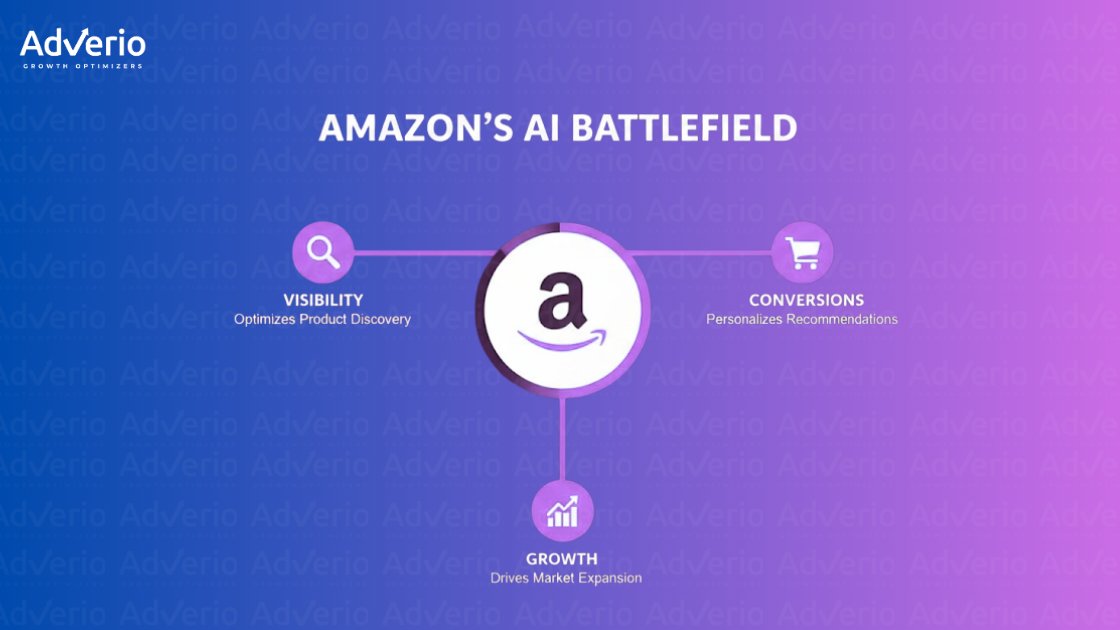
Every tool Amazon rolls out is built to fuel one of these pillars. For brands that get it, this creates a powerful growth flywheel. Let’s cut through the noise and break down what these tools actually do.
Generative AI for Product Listings
Writing hundreds of unique product listings is a soul-crushing bottleneck. Amazon’s generative AI for product listings attacks this problem head-on. Feed it a few simple inputs—an image, a short phrase—and it generates a full set of titles, bullets, and descriptions in seconds. It accelerates listing creation, but only structured inputs and human refinement determine whether those listings actually rank and convert.
But here’s the pro-tip: the AI is only as smart as the information you give it.
- Weak Input: “red cotton t-shirt”
- Strategic Input: “Men’s athletic fit t-shirt, 100% Pima cotton, moisture-wicking, tagless design, available in crimson red, ideal for gym or casual wear.”
The second input gives the AI the raw material to craft copy that’s actually optimized for search and conversion. Think of it as a force multiplier for your product knowledge, not a replacement for it. Most brands discover their biggest AI blind spots during a structured Amazon listing audit, where missing attributes, weak entity coverage, and broken parents quietly suppress rankings.
A+ Content Manager AI
Solid A+ Content is table stakes for boosting conversions. The A+ Content Manager AI assists by suggesting optimized layouts, image placements, and copy modules based on what has historically performed well for similar products. It reduces guesswork, but conversion gains only happen when A+ Content is aligned to how Amazon’s AI parses attributes, images, and comparison logic.
Video Generator for Ads
Sponsored Brand Video ads are conversion machines, but creating video assets is a huge bottleneck. The Video Generator is Amazon’s answer. It automatically creates simple video ads from your existing static product images.
No, it won’t replace a high-end brand film. But it’s perfect for rapidly testing video creative across hundreds of SKUs at zero production cost. This is a core part of a modern amazon ai advertising tools strategy, letting you identify which products get the biggest lift from video before spending a dime on production.
Enhance My Listing
This tool is like a digital assistant that scans your listings for missing information and helps you fill the gaps. This matters because AI assistants like Rufus and Amazon’s ranking systems rely on complete attribute-level data—not marketing copy—to surface products. Incomplete listings become invisible listings. It helps ensure your products are more complete and discoverable.
Project Amelia (Beta)
Project Amelia is a glimpse into the future. It’s an AI business assistant you can ask questions in plain English about your performance. It delivers revenue insights, flags inventory issues, and summarizes complex data on the fly. For scaling brands managing large catalogs or ad budgets, this tool turns massive datasets into actionable intelligence.
Amazon AI Tools That Impact Shoppers (and Why Sellers Should Care)
Most brands obsess over the seller-facing tools but miss the bigger picture. The real power shift is happening on the buyer’s side, where AI is actively shaping purchasing decisions.
Ignoring these tools is like designing a product without ever talking to a customer—you’re operating blind. The AI your shoppers interact with dictates who wins. Your listings and ad strategy must now be engineered to send the right signals to these systems.

Amazon Rufus (Beta)
Meet Amazon Rufus, the conversational AI shopping assistant inside the Amazon app. Shoppers can now ask natural-language questions like, “What are the best hiking boots for rocky trails under $150?” or “Compare these two air fryers.”
Rufus doesn’t just scan keywords; it parses structured data, attributes, and A+ Content to provide answers.
Implication for sellers: If your listing lacks structured attributes, Rufus doesn’t rank you lower—it skips you entirely. In other words, an incomplete listing is an invisible listing.
Your product pages are no longer just for human eyes. They are now data feeds for an AI that holds immense power over product discovery. Brands that meticulously fill out every field are the ones whose products will get surfaced. This new reality demands a strategy that understands how to be the brand that AI assistants like ChatGPT recommend.
AI-Generated Review Summaries
Nobody has time to read hundreds of reviews. Amazon uses LLMs to generate concise, bulleted AI review summaries right at the top of the reviews section. These summaries instantly highlight recurring themes, both good and bad.
This has massive implications:
- Amplified Reputation: Positive themes get broadcasted, reinforcing your value proposition.
- Magnified Flaws: Consistent negative feedback becomes impossible to miss, which can kill your conversion rates.
Sellers benefit from strong reviews and clarity in user-generated content, but you can no longer hope bad reviews get buried. The AI ensures the most common feedback is the first thing a potential customer sees.
Personalized Recommendations
Those “Frequently bought together” and “You may also like” sections are sophisticated AI engines analyzing shopper behavior. While you can’t directly control them, you can influence them. Your pricing, bundling, and advertising strategies all send signals to these systems.
It requires a deep understanding of customer journeys and using advertising not just for direct sales, but to strategically shape the AI’s understanding of your product’s place in the market. Mastering this is a key component of a modern Amazon personalization and content strategy.
Why This Matters for Sellers
Knowing about these Amazon AI tools is one thing. Turning them into a consistent engine for profitable growth requires structured governance across ads, listings, and catalog systems the kind of oversight built into professional Amazon PPC management services. It requires a strategic shift—moving beyond features and adopting a framework where every AI interaction is a lever for real business results.
The bridge between AI features and profit is built on a simple idea: make your brand exceptionally easy for Amazon’s algorithms to understand and recommend. Listings that are AI-readable (clean structure, rich content) will perform better in this ecosystem. Every well-optimized listing sends clear, positive signals to systems like Rufus and the A9 algorithm. The cumulative effect isn’t just better visibility; it’s a direct line to higher organic rank and stronger sales. Sellers who leverage them well gain an advantage with fewer manual inputs.
For Amazon sellers, a key metric in achieving this is understanding how to effectively improve ecommerce conversion rates.
Amazon’s AI advertising tools are phenomenal at optimizing for specific metrics. But leaning too heavily on automation without a human strategy leads to Optimization Myopia—a dangerous tunnel vision where you win the battle for a single metric but lose the war for overall market share.
A low ACoS is irrelevant if your market share, velocity, and incrementality are declining. True growth requires balancing automated efficiency with human-led strategy.
AI can’t tell you when to invest aggressively in a new product launch or map out a full-funnel DSP strategy. That’s where human oversight becomes critical.
Putting the Conductor in Front of the AI Orchestra
The constant stream of new Amazon AI tools has created a dangerous trap: Shiny Object Syndrome. It’s the impulse to chase every new generative AI feature without a clear, overarching strategy. The outcome is always the same: wasted time, inconsistent results, and a collection of tools that never deliver a real ROI.
Tools aren’t a strategy. They’re instruments. Adopting them without a plan is like handing a world-class orchestra a score but forgetting the conductor. Without expert direction, it just becomes noise.

Beyond Tools: A Strategic Framework for AI
At Adverio, we act as the governance layer—deciding what AI should optimize, when to override automation, and how each system ladders into profit. We don’t just use Amazon’s AI suite; we integrate it into our proprietary Growth Cultivator framework, ensuring every tool serves a specific, profit-focused purpose. We transform AI’s raw potential into measurable, profit-driven outcomes.
AI can tell you which keyword is converting today. Human strategy decides if that keyword aligns with your long-term brand positioning and profitability goals. Adverio bridges that gap.
This approach is built on our Three Strategic Pillars, giving AI the structure it needs to deliver real-world results:
- Profit-Driven Catalog Optimization
We use generative AI for Amazon listings to create SEO-aligned drafts in minutes, but our human experts refine them for brand voice and conversion. Tools like Enhance My Listing are deployed systematically to ensure every product is perfectly structured for AI assistants like Rufus. - Intelligent Growth Marketing
We use Amazon AI advertising tools for surgical precision but overlay it with a human-led, full-funnel strategy. We direct the AI to balance short-term ACoS targets with long-term goals like capturing market share. - Holistic Marketplace Conversion Rate Optimization
We dig into AI-generated review summaries to pinpoint product flaws. AI suggestions for A+ Content aren’t just accepted; they are tested and validated against real-world performance data.
Ultimately, these tools need a framework to direct their energy toward a single, unified goal: profitable growth. For brands that want to truly unlock the power of these systems, understanding our COSMO framework provides a clear roadmap. Adverio doesn’t just help you use the best Amazon AI tools 2026; we integrate them into a proven system that turns marketplace potential into dominant performance.
Ready to move beyond just playing with tools and start executing a profit-driven AI strategy? Adverio integrates Amazon’s AI capabilities into a proven growth framework that delivers measurable results.