



Table of Contents
Amazon broad match burns money the moment you treat it like a scaling tool.
That is the mistake. Brand operators see extra reach, leave it loose, and then act surprised when spend climbs faster than profit. Broad match can find new query paths. It can also fund irrelevant clicks, duplicate traffic your exact campaigns should own, and keep doing it until your account is paying discovery prices for performance traffic.
The answer is not to kill broad match. The answer is to govern it. Separate discovery from revenue capture. Set hard rules for where broad match can spend, how low bids need to stay, how often search terms get reviewed, and when a query graduates into exact. Without that system, broad match stops being useful and starts acting like a tax on the rest of the account.
This article treats Amazon’s broad match spending control as an operating discipline, not a keyword setting. The waste patterns are predictable. The fix is a governance framework.
If you need the full negative keyword strategy, including n-gram analysis, layered negation architecture, and when not to negate, those live in the Amazon negative keywords guide and the negative keywords deep-dive. What this article adds is the broad match governance layer: the operating rules that prevent discovery spend from cannibalizing your performance campaigns in the first place.
Before you read the framework, the fastest way to find out if broad match is bleeding your account is to model it against your own numbers.
Get My Profit ROI Forecast to see where discovery spend is funding clicks your exact campaigns should already own.
At a Glance
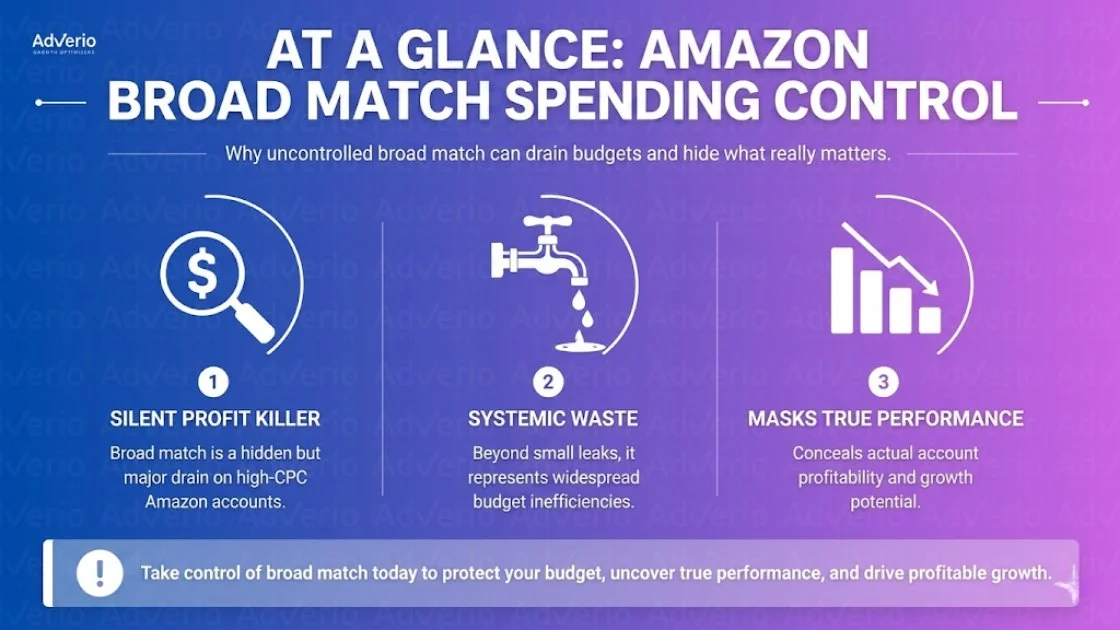
Broad match gets misused because operators treat it like a growth lever instead of a governed discovery system.
-
Broad match should buy search term intelligence first. Revenue is a bonus. The moment it absorbs too much budget, it starts funding clicks your exact, phrase, or product targeting campaigns should own.
-
Waste follows a small set of repeatable patterns. Broad match overpays for competitor queries, overlaps with traffic already harvested elsewhere, and drifts into adjacent searches with weak purchase intent.
-
Control comes from operating rules, not keyword tweaks. Separate discovery campaigns from revenue campaigns, set bid floors and ceilings, review search terms on a fixed cadence, and move proven queries into exact fast. This breakdown shows up consistently in stalled accounts.
-
Budget allocation needs hard boundaries. Keep discovery spend contained and deliberate. Broad and auto should have a defined role, while exact match and product targeting carry the profit burden.
-
The goal is predictability. Broad match works when it is managed like an intake channel with harvesting rules, exclusion rules, and spending limits. Without that framework, it turns into a slow leak across the account.
Why Broad Match Behaves Differently at Higher CPCs
Broad match used to be easier to tolerate because the cost of being wrong felt smaller. That logic breaks the second your category gets expensive and crowded.
At that point, broad match stops being a harmless discovery setting and becomes a margin management issue. One bad click is not just “data.” It’s budget that could’ve gone to exact match, product targeting, or branded defense.
In our work with 7-8 figure brands, the accounts that scale without margin damage keep discovery spend (auto plus broad or phrase) around a third of total ad budget. The majority sits in exact or product targeting where intent is proven. The exact split depends on category maturity and query density. In narrow categories with limited search variation, broad match surfaces very little new data. In broad categories with high query diversity, it earns more room. Either way, the rule is the same: cap it deliberately, not by accident.
That’s the hard truth. Broad match isn’t automatically good or bad. It’s expensive when unmanaged and useful when capped.
Pro tip: If a query is proven, broad match has done its job. Keeping it live there is not discovery. It’s duplication. Adverio Account Team
Here’s the simple financial lens:
| Match type role | What it should do | What happens when mismanaged |
|---|---|---|
| Broad match | Discover new search behavior | Burns budget on loose relevance |
| Phrase match | Narrow intent testing | Gets bloated if negatives are weak |
| Exact match | Capture proven demand | Gets underfunded when discovery campaigns sprawl |
The Three Broad Match Problems That Waste Budget

Most broad match waste doesn’t look dramatic inside campaign dashboards. That’s why it survives. You have to inspect the search term report and force the account to confess.
If you want a wider lens on where budgets disappear, start with the patterns that eliminate Amazon ad spend inefficiencies. Broad match usually sits near the top of the list.
Problem 1 Serving against competitor brand terms
Broad match can stretch into competitor-branded searches when there’s enough semantic overlap. That means your budget can end up paying for shoppers who already had another brand in mind.
That traffic often looks active. It can produce clicks. It can even make your team think the keyword is “expanding reach.” But if the shopper is searching for a competitor by name, you’re forcing your product into a low-intent moment.
Fix: Establish a pre-launch exclusion list for competitor brand names before broad match campaigns go live. This is a governance decision made at campaign setup, not a reactive negation task.
Problem 2 Funding queries already covered by exact match
This one is more offensive because it’s self-inflicted. You already have exact match keywords built to capture proven demand, then broad match keeps serving on the same query anyway.
The result is ugly. Your exact campaign loses priority, your broad campaign absorbs spend that should’ve been routed to the tighter control layer, and your data gets dirtier. Now you’re making bid decisions off mixed intent.
Fix: the graduation rule. Once a query moves to exact, broad loses the right to buy it. That is a structural operating rule enforced at the moment of promotion, not a cleanup task done weeks later.
If a query is proven, broad match has done its job. Keeping it live there is not discovery. It’s duplication.
Problem 3 Expanding into adjacent categories with low purchase intent
Amazon broad match can connect to related meanings, reordered terms, and category-adjacent ideas. That’s useful until it isn’t.
A kitchen keyword can drift into cleaning-related search behavior. A bedding term can drift into decor queries. A CPG term can wander into research-heavy searches with weak buying intent. The clicks don’t look insane one by one. Together, they become a tax on your account.
Fix: Set category boundary rules before broad runs, not after. Define which adjacent search themes broad is forbidden to enter. Reactive negation after the spend has already happened is the expensive version of this fix.
The Broad Match Governance Framework
Broad match needs rules, not optimism. If you let it run without hard controls, it stops being a discovery layer and turns into a tax on your account.
The operators who manage broad match well are the ones who track where spend goes, isolate repeatable winners, and cut vague middle traffic fast. “Kind of relevant” traffic is where margin goes to die.
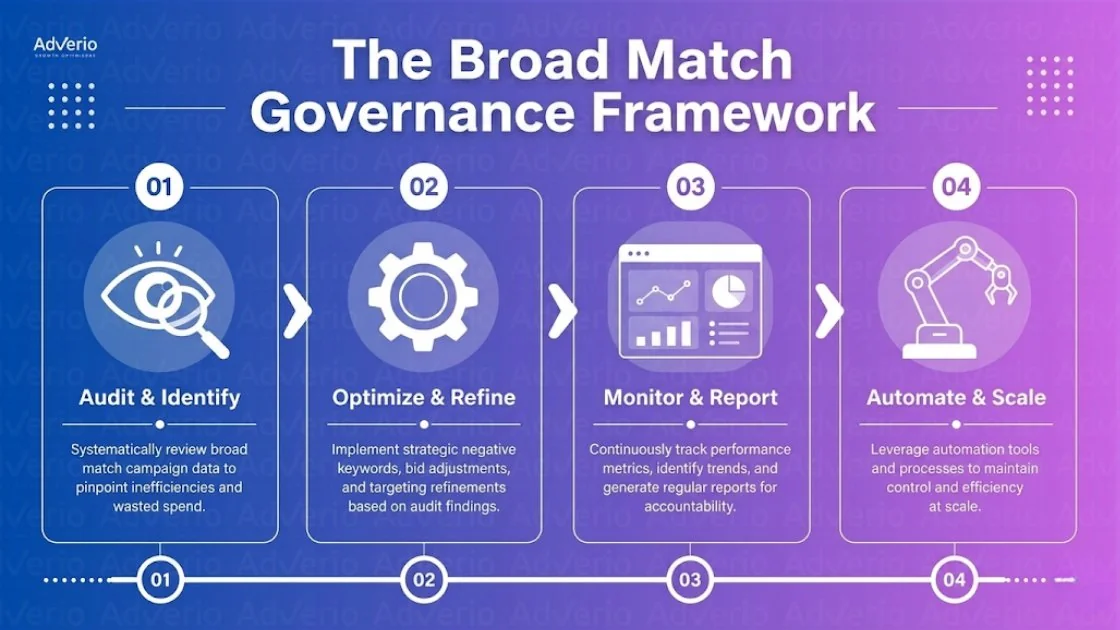
Step 1 Audit broad match by spend every week
Pull the last 30 days of search term data for broad campaigns only. Start with spend. Ignore CTR-first reviews. Ignore impression-first reviews. Cost concentration is the main problem.
Sort every query into three buckets:
-
Cut: irrelevant, adjacent, or clearly unprofitable
-
Watch: relevant enough to test, but still unproven
-
Graduate: strong enough to move into tighter control
Do this weekly. Do a deeper account-level review monthly. Broad match changes fast, especially in categories with volatile CPCs and heavy competition.
Clean structure makes this possible. Messy campaign architecture turns a 20-minute review into a three-hour argument. That is why account setup matters, the Amazon PPC audit checklist covers the structural checks that make weekly broad match reviews fast instead of painful.
Step 2 Build negative controls by theme, not by panic
Negative keyword work is a control system. Treat it that way.
Create negatives in three groups:
-
Irrelevance negatives for terms that should never have matched
-
Duplication negatives for proven exact terms that broad should stop funding
-
Category-drift negatives for adjacent searches that eat clicks without strong buying intent
Use campaign-level negatives to block patterns. Use ad group-level negatives when you need precision. The point is not to react after a spike. The point is to define what broad is allowed to explore and what it is forbidden to touch.
One rule matters more than the rest. If a search term has already earned its place in exact, broad loses the right to buy it.
Step 3 Harvest on a schedule, not when someone remembers
Broad match only earns its keep if discovery turns into controlled coverage. That requires a fixed harvesting cadence.
Run this routine every week:
-
Review broad-match search terms with orders or strong downstream signals.
-
Add proven queries as exact match keywords.
-
Add those same queries back into broad campaigns as negative exact.
-
Recheck the next week to confirm spend shifted into the exact layer.
That last step is where teams get sloppy. They add the exact keyword, forget the negative, and then broad keeps buying the same traffic. Now your reporting is mixed, your exact campaign loses control, and your bids are based on polluted data.
A term is either still being tested or it has graduated. It cannot live in both states forever.
Step 4 Set bid ceilings and floors before broad spends a dollar
Broad should bid below phrase and exact by default. It is buying uncertain intent. Paying premium CPCs for uncertain intent is amateur behavior.
Set a clear bid floor for low-risk testing and a ceiling that broad cannot cross without review. Then apply simple governance rules:
| Broad campaign signal | Action |
|---|---|
| Loose relevance and weak conversion | Lower bids and add negatives |
| Relevant but unproven | Keep in broad with controlled bids |
| Proven converter | Move to exact and negate in broad |
Do not let broad inherit bids from exact. Do not let placement multipliers subtly inflate discovery traffic into full-price traffic either. If broad can only function at aggressive CPCs, it is not discovering profit. It is buying expensive ambiguity.
That is the framework. Audit on cadence. Block waste by pattern. Harvest weekly. Cap bids before broad starts acting like your profit engine. That is how you turn broad match from a budget leak into a managed discovery system.
How to Keep the Discovery Value Without the Waste
Killing broad match is not discipline. It is usually a sign that the account never had rules.
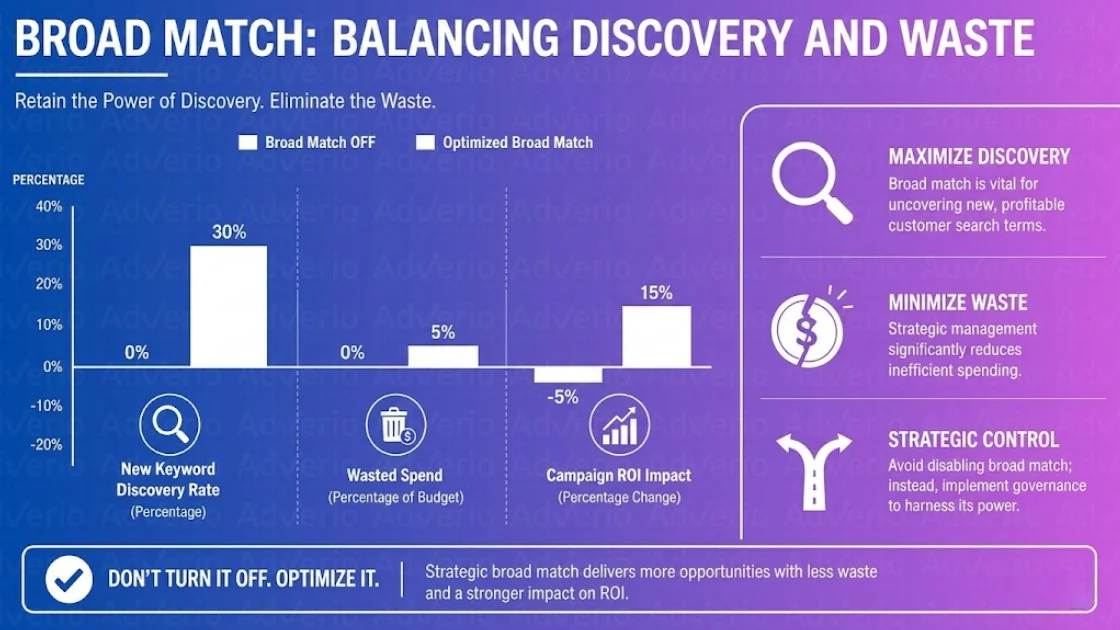
Broad should stay alive for one job only: discovery. The second it starts acting like a scale campaign, it turns into a margin tax. Your goal is not to “use broad carefully.” Your goal is to force broad into a narrow operating lane where it can find new query data without draining budget from proven traffic.
`
That means separating roles across the account. Broad exists to test demand. Exact exists to monetize validated demand. Auto can support discovery, but it should not be the excuse for sloppy broad match management. If those roles blur, broad starts cannibalizing exact, reporting gets muddy, and your bid decisions get worse.
A clean operating rule fixes this. Broad gets a limited budget, controlled bids, and weekly harvesting. Exact gets priority on anything that proves it can convert. Terms that graduate must leave the discovery layer cleanly, or broad will keep rebuying traffic you already identified.
This is why optimizing Amazon PPC campaigns is really an isolation problem, not a keyword expansion problem. Discovery only has value when the account has a strict path for promotion, negation, and bid control.
Keep broad. Box it in. Make it earn the right to spend.
How Adverio Manages Broad Match Governance
Broad match does not need more attention. It needs rules.
Adverio manages broad match with a fixed operating system inside the account: weekly search term reviews, strict promotion rules for winners, fast negation of waste, and bid control that keeps discovery traffic from hijacking spend meant for proven terms. The point is not to keep broad “active.” The point is to keep it contained and useful.
That process sits inside Adverio’s Amazon PPC management system, not off to the side as a cleanup task. Broad match gets reviewed on a cadence. Graduated terms get moved with intent. Exact-match priority stays protected. If that discipline slips, broad starts buying traffic the account already understands, and your margin pays for the mistake.
If broad match is bleeding budget across your account, the fix is not more attention. It’s a governance system.
Get My Profit ROI Forecast and see exactly where discovery spend is leaking into traffic your exact campaigns should already own.
Fast review. Clear recommendations. Profit-first account management.
FAQs About Broad Match Spend Control
How often should you review broad match search terms?
Weekly at minimum. If spend is heavy or CPCs are rising, check twice a week. Broad match can drift fast, and every extra day of neglect gives weak queries more room to burn margin.
Should broad match always have lower bids than exact match?
Yes. Broad is your discovery layer, not your priority traffic source. If broad bids sit too close to exact, Amazon starts buying exploratory traffic at prices better reserved for terms that already proved they can convert.
Should you pause broad match if it looks inefficient?
Pause it only if it fails its job. Broad match should either find new converting search terms or support controlled query expansion. If it does neither, cut it. If it still produces useful search term data, keep it live under tighter bid caps, stricter negation, and faster harvesting into exact.
Can automation handle broad match governance by itself?
No. Automation can adjust bids and surface reports. It cannot decide whether a query belongs in exact, whether a competitor term deserves isolation, or whether a broad ad group is masking bad economics. You still need human judgment tied to profit rules, not just spend rules.
What is the biggest mistake brands make with Amazon broad match spending control?
They let broad become a destination instead of a filter. Winning terms stay in broad too long, losers stay active too long, and the account keeps paying for uncertainty after uncertainty is gone. If you want to judge that waste correctly, you need contribution math, not just ACoS.
Start with the Amazon contribution margin guide to build the right cost model first.
Read Next
Broad match spending problems rarely come from one bad keyword. They come from weak control systems across bids, search term harvesting, and profit thresholds.
Read Next
-
Amazon negative keywords guide: full negation strategy including when not to negate
-
Negative keywords deep-dive: n-gram analysis and layered campaign architecture
-
Amazon PPC audit checklist: full 15-point account review
-
Amazon PPC wasteful spend: the 7 structural waste types
-
Amazon contribution margin by ASIN: unit economics before making any broad match bid decisions
If your Amazon account spends like a growth machine but profits like a hobby brand, fix the system. Adverio’s Amazon account management builds broad match governance into the operating layer, not as a side task. Book Your Profit ROI Forecast to see where discovery spend is leaking, which terms have earned graduation, and where your margin can recover.