


Table of Contents
Amazon PPC waste rarely starts with a bid. It starts with misclassification.
Most brands treat all wasted spend the same way: find the expensive keyword, cut the bid, move on. That approach fails because different structural waste types drain profit for completely different reasons. Cutting a bid on a branded term does not fix a placement mix problem. Tightening match types does not resolve ASIN-level economics. The wrong fix for the right problem still costs money.
This is a classification system, not another audit checklist. It names the seven structural categories of Amazon PPC waste so you can diagnose the right type, apply the right fix, and stop the same leak from reopening two months later. If you’re running a seven- or eight-figure catalog and your TACoS keeps creeping despite constant bid edits, the problem is structural. This is where you find it.
If you want the full 15-step audit process, that lives separately in the Amazon PPC audit checklist. What follows here is the diagnostic layer that determines which of those checks to run first.
Running an account with persistent spending waste, and no clear owner for each type? That’s what we diagnose first.
Get My Profit ROI Forecast → 15-minute call. No pitch deck.
Why Misclassifying Waste Costs More Than the Waste Itself
The ACoS trap runs on misdiagnosis. A keyword looks expensive, so someone cuts the bid. Budget pressure eases for a week. Then sales soften, search term quality deteriorates somewhere else, and the account starts leaking again through a different category of the same structural failure.
That cycle continues because high ACoS is not a root cause. It is a symptom. The underlying problem could be loose match type control, the wrong ASIN attached to the keyword, a bad placement mix, campaign overlap, or a listing that cannot close traffic. A bid cut fixes none of those things.
The same misclassification problem shows up with non-converting clicks. Some spending is pure waste. Some is exploratory spend that generates long-tail search term data and negative keyword opportunities. Over-aggressive pruning in broad and auto campaigns can suppress future discovery before the account has generated enough data to act on. That distinction matters if you want profit, not just cleaner-looking reports.
The working definition I use: waste is spend that has no strategic role and no realistic path to payback. That definition only holds when you know which structural category the spend belongs to. Amazon’s own advertising documentation separates campaign types precisely because each serves a different traffic function, the same logic applies to how you classify and fix waste.
A serious operator names the type of waste before prescribing the fix.
The 7 Structural Types of Amazon PPC Waste
Each type below has a distinct cause, a distinct fingerprint in the data, and a distinct fix. Applying a fix designed for one type to a different type is what keeps the same waste recurring.
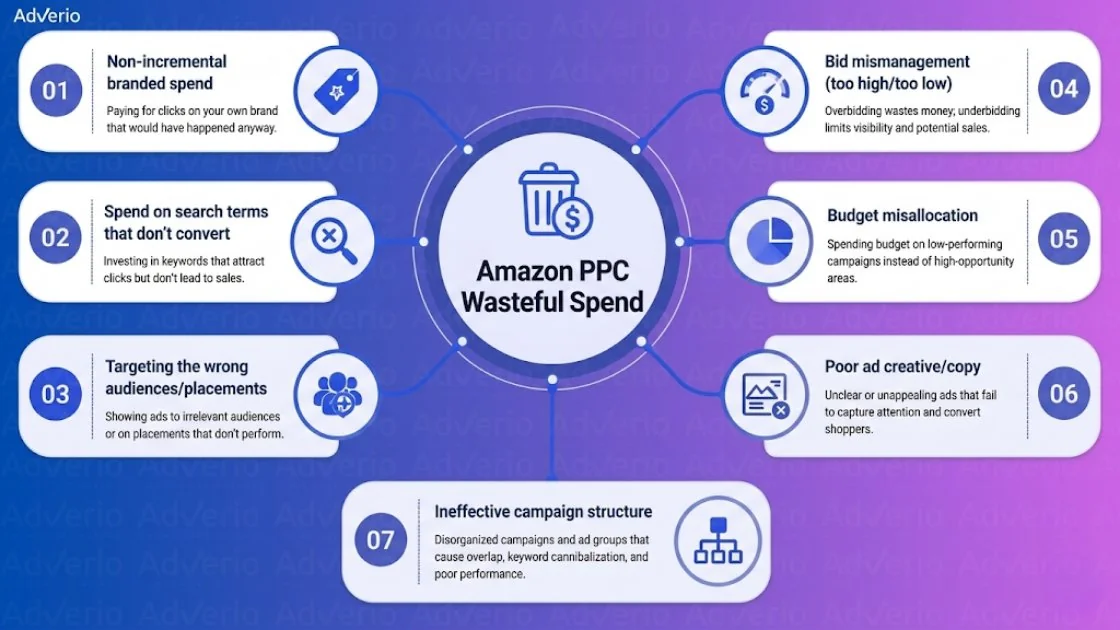
Type 1: Non-incremental branded spend
This leak flatters your dashboard while taxing your margin.
Branded campaigns often post strong ACoS and ROAS because they capture shoppers already looking for you. That spend can protect branded shelf space against competitor conquest. It can also become expensive self-cannibalization if you already dominate organically and keep feeding budget into terms where paid coverage adds no incremental demand.
The distinction matters: branded defense is not the same as branded incrementality. If you are not measuring which portion of branded spend creates net new demand versus recapturing demand you would have won anyway, you are not managing this category. You are funding it.
How to spot it:
-
Branded efficiency looks excellent, while total account economics barely improve
-
Organic rank is already dominant on core brand terms
-
Branded spend keeps expanding without a measurable increase in new-to-brand customers
The fix is a minimum viable defense. Set coverage thresholds that protect brand traffic and block competitor conquest. Stop treating branded search as a growth engine when it is functioning as an attribution trick. The branded vs non-branded ad strategy framework covers how to separate these budgets and judge each on the right standard.
Type 2: Search term overlap between auto and manual campaigns
This is a campaign structure failure, not a bidding problem.
The same query shows up in auto, broad, phrase, and exact simultaneously. Multiple campaigns compete for the same shopper, split conversion data, muddy ownership, and burn budget on redundant coverage. Blended reporting hides this because it aggregates performance across all campaign types before you see it.
How to spot it:
-
The same converting query appears across multiple campaign types
-
Discovery campaigns and exact campaigns spend on identical traffic
-
Exact campaigns never develop clean conversion data on proven terms
The fix is keyword routing with enforced ownership. Pull converting queries out of auto and broad, move them into exact, then block duplicate pathways with negatives. Every search term needs a clear home. Without one, Amazon makes allocation decisions for you. A structured Amazon search term isolation strategy is the operational tool for this.
Type 3: Irrelevant match type serving
Broad match is a discovery tool. It becomes a waste category when left unsupervised on generic terms in competitive categories.
Loose keywords attract low-intent traffic. The fingerprints are visible in the search term report: high spend with low conversion, weak CTR signaling poor query relevance, and click clusters that repeat without producing orders. The issue is not that broad match exists. The issue is using it as a substitute for targeting discipline.
How to spot it:
-
Search intent in the term report does not match the product category
-
CTR is consistently weak across a match type or ad group
-
Click volume accumulates without a proportional order rate
The fix is a tighter structure and a negative keyword system with real review cadence. Discovery spend should generate actionable data. If the same broad terms keep producing low-quality traffic after multiple review cycles, they are not discovery anymore. They are overhead.
Broad match overhead is one of the fastest leaks to confirm. If you want to know where yours is, we’ll surface it in the first diagnostic.
Type 4: Low-converting ASIN overfunding
A large share of wasted spend starts after the click, not before it.
Brands focus on keyword-level performance and miss the product-level constraint. One weak child ASIN, a poor hero image, a damaged review profile, or the wrong variation showing in ads can absorb budget that should go to a stronger converter. In that scenario, the ad account is not broken. The retail asset is. More spending makes it worse.
How to spot it:
-
Spend clusters around products with weak unit economics or below-average conversion rates
-
Child ASIN conversion rates lag the rest of the variation family by a wide margin
-
Traffic flows to products that are not the top margin contributors in the catalog
The fix is budget triage at the ASIN level. Fund products that convert and contribute margin. If an underperforming product deserves investment, repair the listing before buying more traffic. The right order is: optimize the Amazon listing for conversion, then fund the traffic. Reversing that sequence is one of the most common and expensive mistakes in Amazon advertising.
If a product page cannot close traffic, ads just make the loss happen faster.
Type 5: Defensive spend on already-dominated positions
Some brands pay to protect the shelf space they already own organically.
If organic position is already dominant on a term and paid coverage adds no measurable lift in rank, sales, or new-to-brand demand, the spend is not defense. It is duplication. It looks cautious. It is budget allocation by habit rather than by performance logic.
How to spot it:
-
Organic position is strong and stable in terms of receiving paid coverage
-
Paid campaigns on those terms show no lift in total sales or new-to-brand rate
-
Impression share keeps rising without a profit case
The fix is restraint backed by an incrementality test. Pull paid coverage back on organically dominated terms and measure whether total sales decline. If they do not, the spend was redundant. If they do, you have identified terms that actually require paid defense. The Amazon incrementality measurement framework is the right tool for this test.
Type 6: Daypart and budget pacing inefficiency
Amazon spends your daily budget across all hours by default. Your shoppers do not convert evenly across all hours.
That gap creates a predictable waste pattern. Budget depletes during low-intent windows, then high-intent periods arrive with less fuel. The problem intensifies in categories with clear daily demand patterns and during peak events when CPC pressure rises and budget efficiency matters most.
How to spot it:
-
Campaigns deplete budgets early in low-conversion windows
-
Hourly efficiency swings hard while daily performance looks acceptable
-
High-intent time windows are underserved because the budget was consumed earlier
The fix is active budget governance. Use scheduling rules, bid adjustments, or pacing controls to protect strong conversion windows and suppress weak ones. This waste type is one of the few that does not require structural restructuring. It requires consistent management attention that most accounts do not receive.
Type 7: Placement averaging
Campaign-level performance averages are where placement waste hides.
Top of Search, Product Pages, and the rest of Search behave differently in terms of conversion rate, CPC, and margin contribution. Treating them identically within a campaign guarantees overpayment in at least one placement. The performance data is available. Most teams do not break it apart consistently enough to act on it.
How to spot it:
-
One placement drives most profitable volume, while others spend without equivalent return
-
Placement modifiers were set at launch and have not been reviewed since
-
The campaign-level conversion rate looks acceptable, but masks a losing placement
The fix is placement-level analysis run on a consistent cadence. Pull Top of Search, Product Pages, and Rest of Search into separate views. Compare conversion rate, CPC, and contribution margin by placement. Increase pressure where the economics work. Reduce exposure where they do not. For accounts with significant budgets, the placement modifier duplication strategy gives you structural control that bid adjustments alone cannot.
Which Waste Type to Fix First
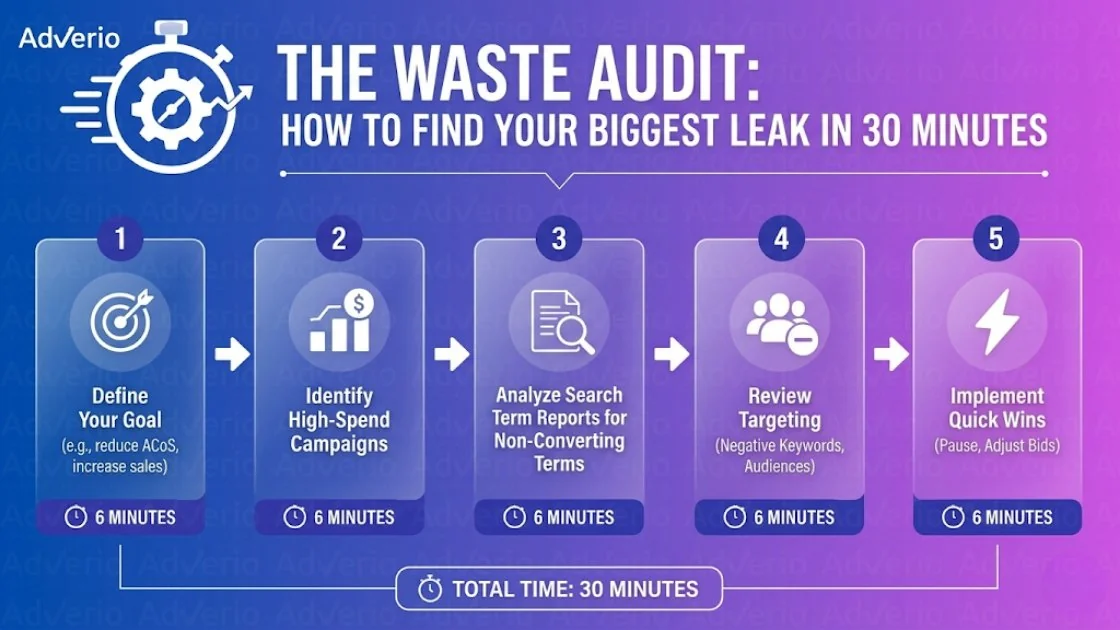
Fix what pays back fastest, not what looks loudest in the dashboard.
| Waste Type | Typical Budget Impact | Fix Difficulty | Priority |
|---|---|---|---|
| Non-incremental branded spend | High | Low | Fix first |
| Low-converting ASIN overfunding | High | Low | Fix first |
| Placement averaging | Medium | Low | Fix second |
| Daypart and budget pacing inefficiency | Medium | Medium | Fix third |
| Irrelevant match type serving | Medium | Medium | Fix third |
| Search term overlap between auto and manual | High | High | Fix fourth |
| Defensive spending on dominant positions | Low | Low | Fix last |
Start with leaks that carry high budget impact and low operational friction. Branded overspend and ASIN misallocation are expensive to tolerate and rarely difficult to correct once you have named them correctly. Placement averaging is similar: the data is already available, and the fix is interpretation, not restructuring.
Search term overlap is often the largest structural leak, but it takes the most discipline to fix cleanly without disrupting existing performance. Sequence matters. Solve the easy, high-impact categories first, then build the operational foundation to tackle structural overlap without breaking what works.
How Adverio Classifies and Fixes Waste
Adverio approaches waste as a classification problem before it becomes a fixing problem. The first job in any account review is to identify which structural category the waste belongs to, because the correction follows directly from the category. Applying a match type fix to a branded spend problem, or an ASIN triage to a placement averaging problem, is how accounts stay inefficient despite constant optimization activity.
In practice, that means reviewing search term routing, ASIN economics, placement behavior, branded incrementality, and budget pacing as interconnected systems rather than separate campaign-level metrics. Amazon PPC waste is rarely a bidding failure in isolation. It is almost always a structure failure that looks like a bidding failure once it shows up in the numbers.
The output of that review is a ranked list of waste types in the account, the structural root cause behind each, and the corrective action with the fastest profit impact.
Brands that need a team to run Amazon PPC management at this level of diagnostic depth get structural correction as the starting point, not another round of bid edits. That distinction is the difference between lower ACoS and actual margin recovery.
If you want to start with the diagnostic before committing to anything.
FAQs About Amazon PPC Waste
What is the most common type of Amazon PPC wasteful spend in mature accounts?
Non-incremental branded spend and search term overlap between campaign types are the two most frequently missed waste categories in accounts that have been running for more than 12 months. Both hide in blended reporting and require deliberate classification to surface. Branded overspend is particularly dangerous because it looks efficient on campaign dashboards while contributing little to net new demand.
Can AI PPC tools fix all seven waste types automatically?
No. Tools can react to bids, budgets, and performance thresholds. They generally cannot determine whether branded spend is incremental, whether an ASIN deserves continued investment despite weak current conversion, or whether campaign overlap is structural or strategic. Automation is useful at the execution layer. The classification work that precedes it requires human judgment.
How often should we run a full structural waste review?
A light classification pass should happen monthly. A deeper structural review is warranted when TACoS rises without an obvious paid traffic explanation, when contribution margin softens despite stable or improving ACoS, or when a major catalog or campaign change has been made. The trigger should be a performance signal, not a calendar.
Do these waste types apply to Walmart and Target?
Yes. Non-incremental branded spend, placement averaging, ASIN-level misallocation, and search term overlap appear across all three platforms. The mechanics and reporting interfaces differ by marketplace, but the structural logic applies. Brands running omnichannel programs often find that waste classification on one platform improves how they structure decisions on the others.
When is non-converting spend still justified?
When it functions as controlled learning spend with a defined evaluation window. Many search terms need 20 or more clicks before conversion patterns become statistically meaningful. Negating terms too early, particularly in auto and broad campaigns, can prevent the account from generating the data it needs to improve targeting over time. Set a threshold, evaluate against it consistently, and treat the review cadence as part of the account management system rather than a reaction to any single week’s report.
A bloated Amazon ad account rarely has a pure bidding problem. It has a classification problem. Brands keep trimming bids and celebrating lower ACoS while structural leaks stay open in branded cannibalization, poor query routing, weak SKU economics, and placement averaging.
Name the type of waste correctly. Fix the root cause in sequence. The leak stops recurring. Adverio helps brands cut through blended reporting noise to identify which structural category is draining the account and what to fix first. Most brands don’t have a bidding problem. They have a classification problem.
15-minute diagnostic call. No pitch deck. No commitment required.