


Table of Contents
Most Amazon search term isolation advice misses the real problem. Sellers treat it like a bid cleanup move. It’s not. It’s campaign architecture, and if yours is broken, every bid change you make is just rearranging furniture on a sinking ship.
For brands running 50+ SKUs with complex catalogs, this is where margin bleeds. When the same shopper query can trigger your auto, broad, phrase, and exact campaigns simultaneously, you’re not reading performance data. You’re reading overlap. That’s why ACoS looks manageable while net profit quietly drops.
This guide covers what search term isolation actually means, why most accounts get it wrong, and how a clean three-layer structure stops your campaigns from competing with each other. If your attribution is dirty, no amount of bid optimization fixes it.
Why Search Term Overlap Is Destroying Your Attribution Data
The biggest leak in most Amazon accounts isn’t a bad bid. It’s overlap.
When the same search query can trigger both auto and manual campaigns, Amazon decides which ad serves in that auction. Not you. That means your campaign data is no longer a clean record of intent and response. It’s a mixed bag of internal competition, inconsistent CPCs, and muddy conversion paths.
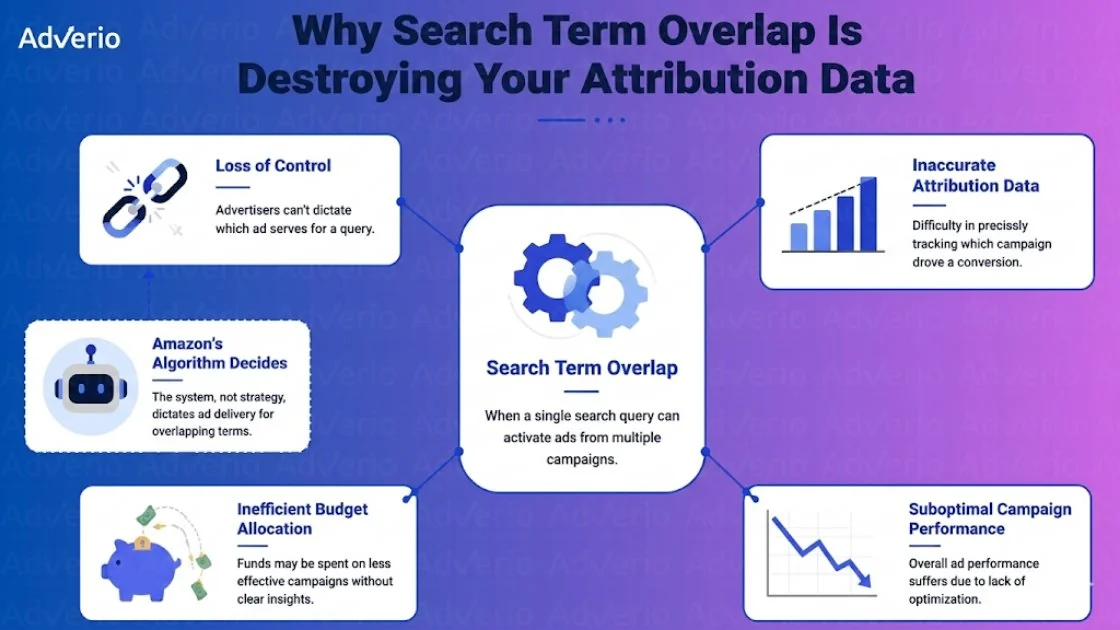
The problem compounds fast. In fragmented accounts, a single search term can appear across dozens of ad groups with CPCs that swing by 2x or more depending on which campaign wins the auction. You’re not getting one read on that query. You’re getting several, all contradictory.
That is why campaign-level ACoS often lies to operators. You think Campaign A is efficient and Campaign B is wasteful. In reality, both may be touching the same demand pocket at different prices and in different contexts. You’re not comparing performance. You’re comparing fragments.
Here’s the practical consequence:
-
Auto campaigns steal credit for terms that should already be controlled in exact.
-
Manual campaigns look inconsistent because discovery traffic and proven traffic are blended together.
-
Budget allocation gets distorted because Amazon, not your structure, decides where spend lands.
If you’re trying to sort out channel-level visibility beyond the ad console, this is why multi-marketplace attribution matters. You can’t fix profitability with dirty inputs.
Practical rule: If one shopper query can appear in more than one campaign layer, your account is not optimized. It is competing with itself.
What Search Term Isolation Actually Means
Amazon search term isolation means you design campaigns so one search term maps to one controllable path.
It is not a toggle. It is not a script. It is not a cosmetic cleanup. It is a hard rule for how traffic should flow through the account.
Think of the account like plumbing. Without isolation, budget runs through a mess of open pipes. The same query leaks into auto, broad, phrase, and exact. You can see spend. You can’t trust what caused it.
With isolation, each important query gets one route. Discovery campaigns can still explore. But once a term proves itself, you move it into exact and block the lower layers from touching it again. That gives you one performance bucket for spend, conversions, and bid changes.
The operating model is simple. Discovery finds terms. Exact owns proven terms. Everything else gets blocked from interfering. That’s the basis of improving Amazon advertising performance when search term reports start showing real winners.
| Without isolation | With isolation |
|---|---|
| Same query can trigger multiple campaigns | One query is controlled by one layer |
| Attribution is mixed | Attribution is cleaner |
| Bids react to noisy data | Bids react to query-level performance |
| Budget gets cannibalized internally | Budget is routed with intent |
The Three-Layer Isolation Structure
This is the structure. Not optional. Not fancy. Just the cleanest way to stop wasting money on mixed-intent traffic.
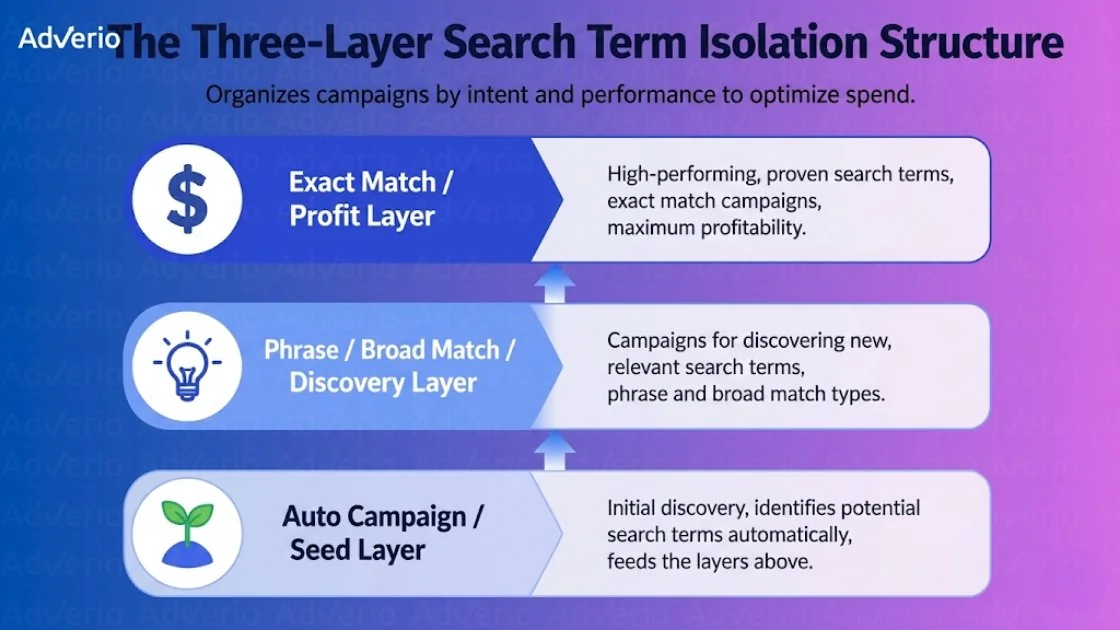
The logic is simple: a small share of search terms generate the bulk of your sales. Isolation protects those terms in exact-match campaigns instead of letting discovery campaigns keep claiming credit for them.
For a broader structural view, this fits directly into a guide to Amazon ad scaling.
Layer 1. Auto campaigns for discovery only
Auto is your research floor. Nothing more.
Its job is to surface new shopper queries you haven’t mapped yet. Keep the bids controlled. Keep the budget contained. The moment a term has proven value, it should stop living here.
What belongs in auto:
-
New ASINs that need early query discovery
-
Unmapped search behavior you haven’t validated yet
-
Exploration spend that you can afford to lose while gathering signal
What does not belong here:
-
Proven converters that already deserve exact ownership
-
Brand-critical terms you need tight control over
Layer 2. Manual broad and phrase for refinement
This is the testing ground between discovery and commitment.
Broad and phrase help you refine around a theme, validate adjacent intent, and learn how variants of a query behave before giving one exact-match ownership. This layer is useful when a term shows promise but hasn’t yet earned a dedicated exact lane.
Use this layer when:
-
A term is relevant but still broad
-
You need to test related phrasing
-
You want more control than auto without locking into exact
This layer should not compete with exact for proven terms. If it does, your refinement layer turns into a budget thief.
Layer 3. Manual exact for proven converters
Your best search terms live here.
Exact is for terms you trust. Terms with clear buying intent. Terms you’re willing to defend with focused budget and deliberate bidding. Once a term reaches this layer, lower layers should be blocked from touching it.
Exact campaigns should feel boring. That’s good. No chaos. No mystery. Just clean query ownership and disciplined scaling.
For brands managing large catalogs across multiple campaigns, this kind of structural discipline is part of what our Amazon account management system enforces at scale.
Good amazon ppc campaign isolation makes your exact campaigns smaller than most brands expect. That’s the point. Exact is not for possibilities. It is for proven demand.
How Negative Keywords Make Isolation Work
Negative keywords are the control system for the entire structure.
Without them, Amazon keeps routing the same search term through multiple campaign types, and your reporting turns into noise. Auto claims part of the spend. Broad or phrase claims more of it. Exact picks up the rest. Then you try to optimize performance from fractured attribution and wonder why every bid change feels random.
Use negatives to assign ownership.
-
Add harvested terms as negative exact in auto campaigns so discovery stops re-entering auctions for queries you already promoted
-
Add harvested terms as negative exact in broad and phrase campaigns so your mid-layer cannot siphon spend from exact
-
Use phrase negatives in auto when you want manual campaigns to control a search term family and keep discovery from drifting into that territory
This is campaign architecture, not cleanup. A weak negative keyword framework guarantees internal competition. A strict one gives you clean query-level accountability.
If your account keeps showing the same converting term in auto, broad, and exact, stop adjusting bids and fix routing first. Adverio’s negative keyword guide covers the mechanics, but the principle is simple. One proven query gets one owner. Every lower layer gets blocked from touching it.
The first thing to check in any underperforming account is whether the same search term appears in both auto and manual campaigns without a negative keyword blocking it. If it does, you are optimizing two campaigns that are competing with each other. Fix the negatives before you touch the bids.
The Harvesting Process: Moving Terms Between Layers
Search term isolation lives or dies on one operating habit: promotion with enforcement.
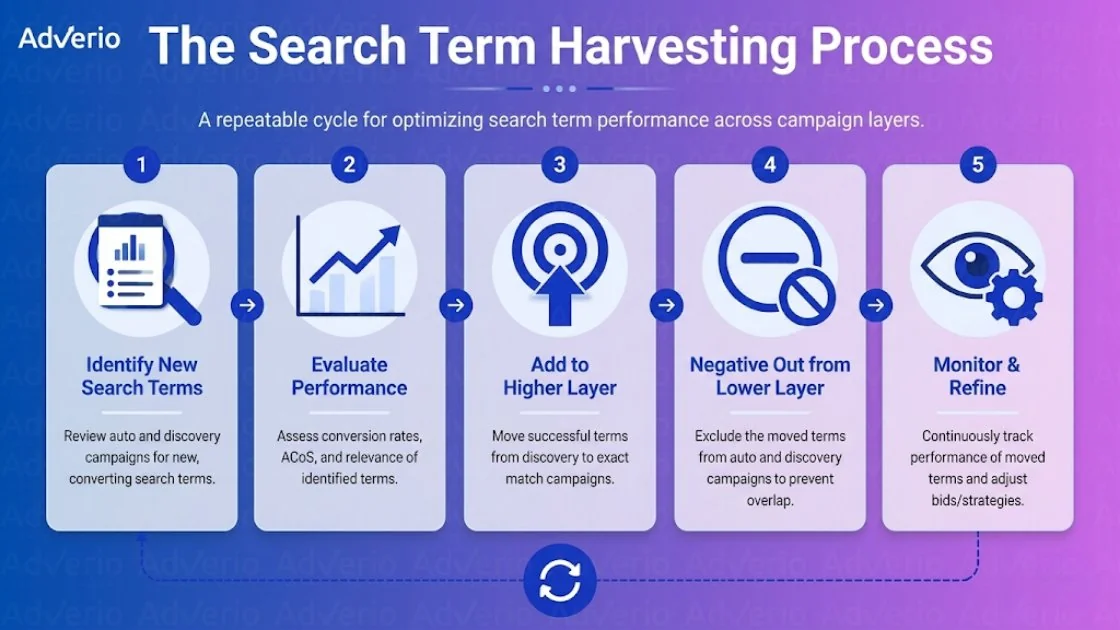
A query should start in discovery, earn its right to graduate, then move into exact with clear ownership. If you skip the transfer step, your structure collapses. The term keeps spending in multiple places, attribution gets split, and your exact campaign never gets a fair read on what that query can do.
The harvesting loop is simple. Review search term reports, identify proven queries, promote them into the right exact campaign, then block the lower layers from touching them again. That is the mechanism that turns isolation from a theory into campaign architecture.
Weekly harvest rules
-
Pull the search term report every week
Review customer queries, not just the keyword targets you entered. -
Filter for purchases first
Start with terms that generated orders or clear buying intent. Traffic without conversion proof stays in discovery. -
Move winners into manual exact
Add the query as an exact-match keyword in the performance campaign built to own it. -
Apply negatives to the source layers
Add that same term as negative exact in the auto and broad or phrase campaigns that discovered it. -
Evaluate the term as a standalone asset
Once isolated, that query has its own spend, sales, and efficiency record. Now your bid changes mean something.
This process should feel strict. Good. Loose harvesting is why so many accounts stay noisy for months. Operators keep searching for bid tricks while proven terms are still bouncing between discovery and performance campaigns.
Use a simple promotion standard and stick to it:
| Stage | What happens | Decision |
|---|---|---|
| Discovery | Auto, broad, or phrase finds a new query | Leave it open until it shows buying intent |
| Validation | The query produces sales or strong commercial signals | Confirm it fits margin and product relevance |
| Promotion | The query is added to manual exact | Give one campaign full ownership |
| Containment | Lower layers receive matching negatives | Stop duplicate spend and split attribution |
Placement segmentation comes after ownership is clean, not before. Once a query is isolated properly, you can break out high-intent traffic with placement-specific campaign structures for Amazon PPC without contaminating your query data.
If your team is still “harvesting” terms without blocking the old routes, you are not isolating anything. You are copying keywords into another campaign and hoping the account behaves. It won’t.
How Adverio Builds Isolated Campaign Structures
Adverio treats search term isolation as account architecture, not campaign cleanup. When the same query slips through multiple routes, every bid change sits on corrupted attribution and every scale decision becomes less reliable.
The first pass is always structural. Our Amazon PPC management process starts with auditing where queries cross between auto, broad, phrase, and exact, then rebuilds routing so each layer has one job. Discovery finds terms. Ownership campaigns hold proven terms. Negative keywords enforce the boundary between them.
AMOS is the internal framework behind that build. It maps overlap, tightens match-type control, and stops campaigns from competing for the same shopper query. Once that foundation is clean, budget decisions reflect actual performance instead of internal conflict.
If your account is still using bid adjustments to compensate for structural bleed, you’re treating a plumbing problem with a pressure gauge. Fix the architecture first.
Want to see exactly where your current structure is leaking?
Book your ROI Forecast and we’ll map it for you.
Amazon Search Term Isolation FAQs
How long should you wait before harvesting a term? Wait until the term has enough conversion evidence to earn its own lane. One sale is not proof. Isolating too early means you’re treating thin signal like certainty.
Are there downsides to Amazon search term isolation? Yes. Over-isolation creates bloated keyword lists and exact campaigns built around short-term noise. Isolation is a routing system, not a reason to spin up a new exact target for every term that converts once.
Should low-volume terms stay in discovery longer? In most cases, yes. Low-volume queries need more time to produce reliable signal. Force them into exact too early and you lose flexibility without gaining cleaner data.
Should you ever reverse isolation? Yes. If an isolated exact term loses volume or efficiency, pause the setup and remove the blocking negative. Let the term re-enter discovery and prove it still earns dedicated budget.
What does this mean for TACoS? It makes your TACoS analysis more honest. Once overlap and self-competition are removed, rising TACoS has fewer places to hide. Most brands realize the culprit was routing, not bids.
Read Next
If your account still lets auto and manual campaigns fight over the same query, you don’t have a PPC optimization problem. You have a structural control problem. Adverio helps established brands fix that architecture so spend maps cleanly to intent, reporting becomes usable, and profit decisions stop relying on bad attribution. If you want to see where your current campaign structure is leaking, book your ROI Forecast.
References
-
https://www.helium10.com/blog/search-term-isolation-ad-optimization/
-
https://help.thinkad.ai/en/articles/12578200-search-term-isolation