



Table of Contents
When to expand Amazon to Walmart is one of the most misread decisions in marketplace growth. Most brands aren’t ready. They just got tired of waiting.
Walmart is not a backup plan for a messy Amazon business. It is a stricter test of whether your operation is under control. Brands that expand too early usually bring the same weak listings, margin problems, inventory gaps, and ad inefficiency into a second channel. Walmart punishes that faster because its algorithm gives you less room to be sloppy.
Treat this decision like a gate, not a growth fantasy.
Expand only when Amazon is producing stable profit, clean operations, and repeatable performance. If you are still debating which marketplace belongs where in your channel mix, review Amazon vs Walmart vs Target first.
This article takes the guesswork out of the decision. You will use five readiness gates with clear KPI thresholds, then score your business based on proof, not optimism. If you fail a gate, you do not launch. You fix the business first.
If you want Adverio to run that readiness check for you, Book Your ROI Forecast.
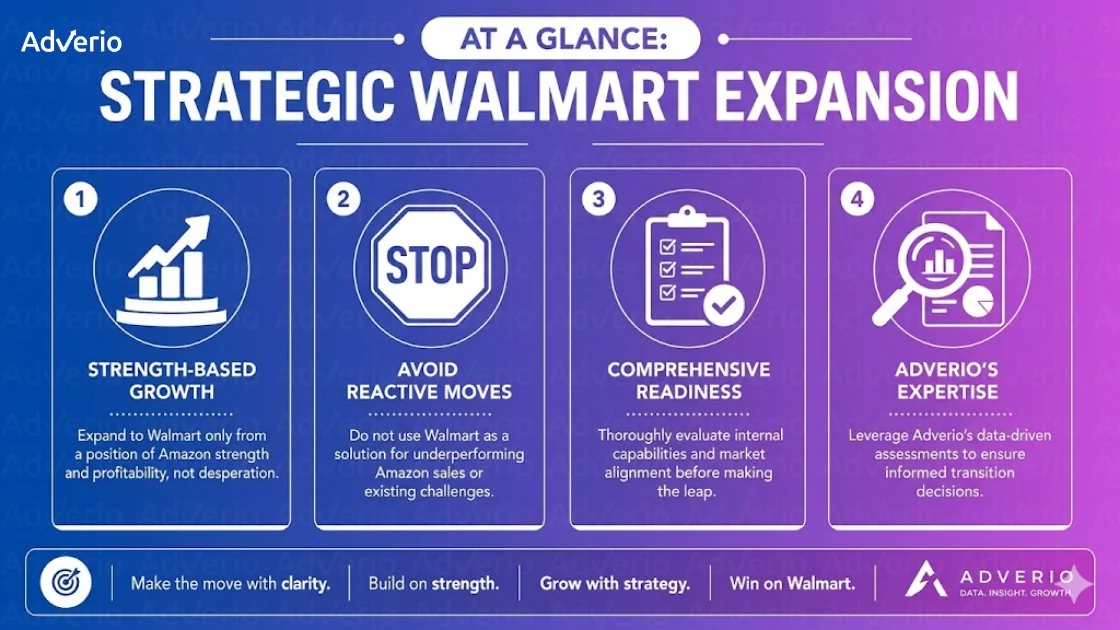
Why Expanding Too Early Is Worse Than Not Expanding
Early expansion feels disciplined. In practice, it usually exposes a team that has not earned a second channel.
Amazon can hide sloppy operations longer than Walmart will. On Walmart, pricing drift, late shipments, catalog errors, and inventory gaps do not stay contained. They suppress visibility, weaken ad performance, and make a weak launch look like low demand when poor execution is the actual problem.
That is why brands fail here. They mistake excitement for readiness.
If your team is still fixing broken replenishment logic, chasing listing issues, or reacting to margin swings every week, Walmart will multiply the problem. The algorithm is less forgiving. You get less room to recover from preventable mistakes. One unstable process becomes several because now every pricing change, stockout, content update, and fulfillment exception has to stay aligned across two marketplaces.
Practical rule: If your Amazon team is still firefighting basics, adding Walmart is not a growth strategy. It is an expensive distraction.
The operational penalty is only half the issue. The bigger risk is false diagnosis. Brands launch, see weak traction, and assume they need more ad spend, more SKUs, or more time. Usually they need better control. Walmart rewards clean execution first. Brands that want to start scaling on Walmart Marketplace without that control are trying to build growth on top of instability.
The org chart makes this worse. One owner handles catalog. Another handles ads. A third touches pricing. Operations manages inventory on a separate cadence. Then leadership acts surprised when Walmart underperforms. Fragmented teams create fragmented signals, and Walmart punishes that faster than Amazon.
Ask a harder question before you expand. Are you extending a stable operating system, or are you copying unresolved Amazon problems into a marketplace with less tolerance for error? If you cannot answer that with confidence, you are not ready.
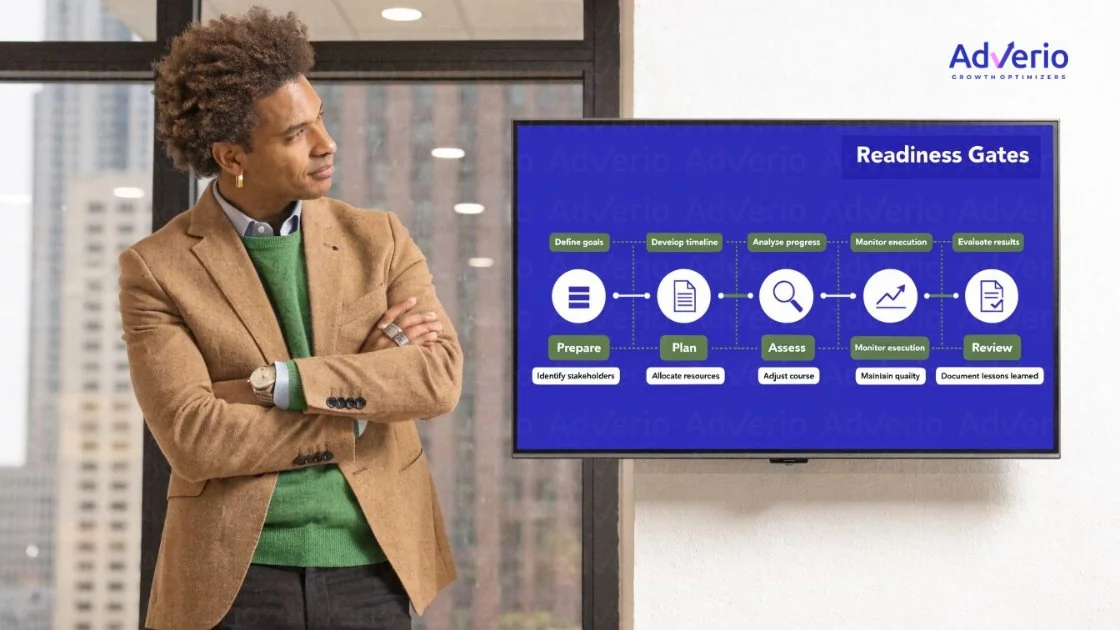
The Five Readiness Gates Before You Expand to Walmart
Expansion decisions fail when they start with optimism instead of control. Walmart rewards disciplined operators and exposes weak ones fast.
Use these five gates as a pass or fail screen. If even one gate breaks under scrutiny, delay the launch. Brands that focus their first Walmart push on a tight set of hero ASINs, clean pricing, and WFS execution give themselves a real chance to build profitable traction. Brands that expand with unresolved process issues usually get noise instead of growth.
Gate 1 Amazon TACoS is stable and trending down
If your TACoS is still swinging, your economics are still unstable. Walmart will not fix that.
The threshold in this framework is below 18 percent for brands under $10M annually, with a clear downward trend over the last quarter. You are looking for repeatable control. If profitability disappears every time you increase spend, you have not earned expansion yet.
Margin projections also need discipline. Walmart can produce better contribution margins for some brands, but only if pricing, fulfillment, and listing quality stay tight.
If your Amazon PPC management engine still needs constant correction, any Walmart margin upside stays hypothetical.
Gate 2 Hero ASIN conversion rate is above the category median
Do not launch your full catalog to prove ambition. Launch products that already prove demand.
Your hero ASINs should beat the category benchmark on Amazon before they earn a Walmart rollout. If your best listings struggle to convert on the channel where you already have review depth and sales history, they will struggle harder on Walmart. Start with products that already show strong click-to-purchase performance, clear offer positioning, and healthy unit economics.
A weak hero ASIN on Amazon usually becomes a weaker hero ASIN on Walmart. You start with less algorithm history, fewer reviews, and less tolerance for listing mistakes.
Gate 3 Inventory is consistently above 95 percent in stock
Inventory discipline is a readiness test, not an operations footnote.
The threshold here is above 95 percent in stock on hero ASINs per Walmart Seller Center fulfillment standards across the last quarter. If core products keep dropping out of stock, Walmart will read that as inconsistency and suppress momentum before you have enough data to improve the launch. Stockouts also corrupt ad testing. You cannot judge demand when the offer keeps disappearing.
Keep the assortment tight. A smaller launch with reliable availability beats a broad launch with chronic interruptions every time.
Gate 4 Buy Box percentage is above 95 percent on hero ASINs
Buy Box instability is channel control failure. Expand with that problem unresolved and you carry the same mess into a less forgiving marketplace.
The threshold is above 95 percent Buy Box ownership on hero ASINs. That signals pricing discipline, seller control, and operational consistency. If resellers, pricing breaks, or listing conflicts already distort your Amazon performance, fix that first. Walmart will not filter out those problems for you.
Brands with channel conflict often mistake expansion for progress. It is usually spillover dysfunction.
Gate 5 You have operational capacity to manage a second channel
This gate ends more launch plans than teams want to admit.
You need a named Walmart owner with actual capacity. That person cannot be the same operator already buried in Amazon account management tasks, catalog fixes, pricing issues, and inventory exceptions.
If nobody owns Walmart execution every week, the channel will drift and performance will stall.
That standard applies even if you are serious about scaling on Walmart Marketplace. Walmart-specific creative changes, WFS coordination, pricing parity, attribute cleanup, and staged ad testing all need active management. Enthusiasm is irrelevant here. Ownership, time, and process decide whether the launch has a chance.
The Walmart Readiness Score How to Calculate It
You don’t need a complicated model to decide if now is the right time. You need honesty.
Score each gate as 1 for pass or 0 for fail.
| Readiness Gate | Pass or Fail | Your Score |
|---|---|---|
| Amazon TACoS is stable and trending down | Pass / Fail | 0 or 1 |
| Hero ASIN conversion rate is above category median | Pass / Fail | 0 or 1 |
| Inventory is consistently above 95 percent in stock | Pass / Fail | 0 or 1 |
| Buy Box percentage is above 95 percent on hero ASINs | Pass / Fail | 0 or 1 |
| You have operational capacity for Walmart | Pass / Fail | 0 or 1 |
Here’s how to read it:
-
5 out of 5: You’re ready to expand. Move into launch planning.
-
3 to 4 out of 5: You’re close, but not ready. Fix the misses first.
-
Below 3: Stay on Amazon. Expansion would be reckless.
If your weak point is conversion, start with the page. Don’t force Walmart expansion before you can confidently say, “I need to fix my Amazon listings.”
What to Do Before You Pass All Five Gates
A failed gate is a stop sign.
If you scored a three or four, you are not close enough to launch. You are close enough to waste money if you ignore the weak points. Walmart punishes sloppy operations faster than Amazon, so every unresolved issue gets exposed sooner and fixed at a higher cost.
Fix problems by financial risk, not by convenience. Start with the issue that threatens margin, stock health, or account control. If inventory slips, stabilize replenishment. If Buy Box control is inconsistent, fix pricing, fulfillment, and reseller interference. If conversion is weak, improve the listing before you buy more traffic.
Do not hide behind busywork.
Teams often rewrite bullets, test images, and tweak campaigns while the underlying blocker sits in operations. That is how brands expand too early and then blame the channel. Walmart did not create the problem. It amplified one that already existed.
Track Amazon and Walmart inputs in one reporting view before you expand. Adverio’s cross-channel reporting shows whether traffic, conversion, and margin hold together across marketplaces instead of judging each channel in isolation.
Pass all five gates first. Then expand. Anything earlier is optimism pretending to be strategy.
Your score tells you the truth your team might be avoiding. If the gates are failing, Adverio starts with Amazon — not Walmart. Book Your ROI Forecast. 15-minute call. No commitment required.
How Amazon Data Accelerates Walmart Launch
Amazon gives you a head start. Use it, or pay to relearn the same lessons on a less forgiving marketplace.
Start with proof, not assumptions. Pull your Amazon search term reports and isolate the queries that already convert at a healthy margin. Those terms should shape your Walmart Connect buildout, your listing copy, and your first product titles. Then rank your catalog by conversion strength, review depth, return rate, and contribution margin. The products that survive that filter are your launch candidates. The rest can wait.
This cuts wasted spend fast.
Amazon also shows you where your launch will break. If a hero ASIN depends on branded search to convert, expect a slower Walmart ramp. If a product wins on Amazon because reviews carry weak creative, fix the content before you port it over. If your margin only works because Amazon demand is deep enough to hide inefficiency, Walmart will expose that weakness early.
Reporting matters just as much as media execution. Split dashboards create false confidence because each marketplace can look healthy on its own while blended margin gets worse. Adverio’s cross-channel reporting gives operators one view of traffic, conversion, and profit across marketplaces, so launch decisions come from economics instead of channel vanity.
How Adverio Manages the Amazon to Walmart Transition
Adverio doesn’t recommend expansion because it sounds exciting. The team assesses whether the move is financially and operationally justified first.
If the readiness gates fail, the work starts on Amazon. If the gates pass, Adverio brings Amazon intelligence into the Walmart launch plan from day one, including catalog priorities, margin targets, and channel-specific ad execution. That creates a cleaner transition and avoids the common mistake of treating Walmart like a copy-paste version of Amazon.
If you need a team to manage my ads on Walmart, the point isn’t just campaign setup. It’s controlling the economics behind scale. Stop guessing about your next growth move.
Book Your ROI Forecast today and get a data-backed expansion plan.
Frequently Asked Questions
What if my category is not a top seller on Walmart?
Category size is not the test. Execution is.
A weaker category on Walmart can still work if your product has clear price-value fit, your listing quality is strong, and your best ASINs already prove demand on Amazon. But lower category demand gives you less room for sloppy pricing, weak content, or stock issues. If your offer only wins in a mature Amazon environment, it is not ready for Walmart.
Should I use Walmart Fulfillment Services or a 3PL?
Start with WFS unless you have a hard operational reason not to. Walmart is stricter about fulfillment signals, and weak delivery performance will hurt visibility fast.
A 3PL can make sense later if it protects margin without hurting service levels. At launch, prove you can meet Walmart’s standards first. Flexibility is useless if the algorithm stops trusting your listings.
How long does Amazon to Walmart expansion usually take?
Setup is the easy part. Stable performance is the essential timeline.
Catalog prep and account setup can move quickly if your data is clean and your operations are disciplined. Getting traction takes longer because Walmart usually gives less forgiveness for weak conversion, bad in-stock rates, and fulfillment mistakes. Expect an extended testing period, not an instant second Amazon channel.
Can I expand if my Amazon revenue is below the usual mid-market threshold?
Yes, if the business is controlled. No, if the revenue number is hiding weak operations.
Use the five gates, not ego, to make the call. A smaller brand with clean margins, reliable inventory, strong hero ASIN conversion, and clear ownership of channel economics is in better shape than a larger brand with unstable performance. Walmart punishes instability faster than Amazon does.
Read Next
Expansion that wrecks margin is just a slower way to fail. If your Amazon operation is ready and you want a team to run the transition properly, Book Your ROI Forecast. 15-minute call. No pitch deck. No commitment required.