


Table of Contents
If your Walmart sales are flat despite “optimized” listings, the issue isn’t keywords — it’s governance. This guide shows you exactly where the constraint is.
Your Amazon playbook won’t save you at Walmart. In fact, it might be the reason you’re invisible. Most brands make the fatal assumption that Walmart SEO is a slightly different flavor of Amazon SEO. That assumption is costing you sales, right now.
If you’ve optimized your Walmart listings with perfect keywords and still can’t crack the first page, it’s because you’re solving the wrong problem. Amazon trains us to think content-first. On Walmart, that logic backfires—hard. Here’s the uncomfortable truth: Walmart doesn’t reward optimization. It rewards operational discipline. It’s about whether the platform trusts you to convert at scale. If your operational signals are weak, your content doesn’t matter.
Here’s the reframe: Walmart is a retail engine first and a search engine second. Before its algorithm even glances at your keywords, it’s already judged your reliability as a retail partner. Your operational excellence—in-stock rates, fulfillment speed, and price stability—dictates your rankings far more than any piece of copy. Weaknesses here aren’t minor hiccups; they are direct ranking penalties. Without a solid foundation of operational governance, every minute you spend on traditional SEO is a waste.
At a Glance — Walmart SEO Reality
Let’s cut the fluff. Success on Walmart isn’t about finding a secret keyword hack; it’s about proving your operational reliability to a retail giant that values logistics above all else. Your listings don’t just earn visibility; they are granted it based on one question: “Can this brand be trusted to fulfill orders at scale without a single hiccup?”
| Core Principle | What It Means for Your Brand |
|---|---|
| Walmart SEO = Distribution Eligibility | Walmart decides if your products get shown based on operational trust, not just keyword relevance. |
| Keywords ≠ Visibility | Flawless copy won’t rescue a listing plagued by poor fulfillment or unstable pricing. |
| Ops Signals > Content Signals | Your in-stock rate and shipping speed carry more weight than your bullet points. |
| SEO Without Governance Stalls Fast | Any effort to optimize content is guaranteed to fail without stable, reliable operations. |
Why Walmart Marketplace SEO Fails for Most Brands
The muscle memory your team built mastering Amazon is actively working against you on Walmart. If you’re copy-pasting your Amazon strategy, you’re on the fastest path to flat sales and invisible listings.
Walmart Is a Retail Engine, Not a Search Engine
Walmart’s algorithm doesn’t care about your keyword research. It cares about delivering a consistent, reliable customer experience that protects its brand reputation. It’s a retail engine that uses search as a tool, not the other way around. This means it rewards sellers who prove they are excellent operational partners.
-
In-Stock Rate: Frequent stockouts are a massive red flag. The algorithm sees this as an unreliable partnership and will demote your listings.
-
Fulfillment Reliability: Slow or inconsistent shipping kills your ranking potential. This is why Walmart Fulfillment Services (WFS) provides a significant boost—it’s a guaranteed signal of reliability.
-
Price Competitiveness: The algorithm frowns on erratic price fluctuations. It prefers partners who offer predictable value, not those engaged in aggressive discounting.
-
Customer Experience Consistency: Walmart will not risk sending a customer to a product that might result in a canceled order or a late delivery, no matter how perfect your content is.
Amazon SEO Assumptions Quietly Backfire
The very tactics that drive rank on Amazon often have the opposite effect on Walmart. Brands that apply the Amazon playbook without adapting see their efforts stall because the core assumptions are wrong for this platform.
-
Keyword Density ≠ Rank: Stuffing titles and bullets with keywords—a classic Amazon tactic—often looks spammy to Walmart’s system. It can hurt trust rather than build relevance.
-
Content-First Without Ops = Suppression: On Amazon, you can often brute-force visibility with aggressive keyword targeting. On Walmart, that’s impossible. Investing in great copy before your fulfillment and inventory are flawless is like buying premium wheels for a car that has no engine.
-
Over-Optimized Copy ≠ Distribution: If retail signals are weak, Walmart limits your reach. Good content cannot overcome fundamental operational failures. A strong Walmart LQS Page (Listing Quality Score) is important, but it’s lipstick on a pig if you can’t get the fundamentals right.

Walmart marketplace seo: the real reason your listings don’t rank (and how to fix it) 26

If your retail signals are weak, Walmart will not distribute you—no matter how good the copy is.
What Actually Drives Walmart Marketplace Rankings
If the classic Amazon content playbook fails, what actually moves the needle? Forget SEO tactics. Walmart’s algorithm is a retail purist; it rewards operational excellence, not clever wordsmithing. Your goal isn’t to please a search bot but to prove you’re a reliable retail partner.
Availability & Fulfillment Signals
The single most powerful lever for your Walmart Marketplace SEO is your fulfillment strategy. This isn’t a minor detail—it’s a massive ranking signal.
-
WFS vs. Seller-Fulfilled Consequences: Opting for WFS is the closest thing to an SEO cheat code. It’s a direct signal that your logistics are reliable. Seller-fulfilled listings are constantly under scrutiny and often lose visibility. The impact of WFS on Walmart’s SEO rankings from goaura.com is undeniable.
-
In-Stock Consistency: Chronic stockouts are poison. Every time a product goes dark, you lose all momentum. Consistent availability proves you’re a dependable partner.
-
Lagging Fulfillment Kills Rank Velocity: Slow fulfillment actively kills your rank velocity, pushing you further down in search results with each delay.
Price Integrity & Offer Stability
Walmart’s algorithm values stability and predictability far more than aggressive, short-term discounting. Aggressive discounting doesn’t compound; it signals instability. Walmart favors predictable contributions from its partners. Erratic price changes or constant deep discounts can be interpreted as signs of unreliability, which the retail engine is designed to avoid.
Catalog Structure & Variant Logic
How you structure your catalog is a direct reflection of your operational discipline. A disorganized or fragmented catalog actively works against your SEO efforts by diluting authority.
-
Parent/Child Misuse Limits Distribution: Incorrectly grouping product variants under the wrong parent SKU confuses the algorithm and can cause entire product families to be suppressed. Proper variant logic and listing quality directly affect distribution eligibility, which is why improving your Walmart Listing Quality Score (LQS) is foundational to ranking.
-
Fragmented Catalogs Dilute Authority: Listing variations as separate products dilutes your sales history and review count across multiple pages. This fragments authority, making it impossible for any single listing to gain traction. Strong catalog management starts with effective product research.
Conversion Feedback Loops
Unlike Amazon, where sales spikes can quickly boost rank, Walmart rewards stable CVR. A predictable Conversion Rate (CVR) over time signals a consistently reliable customer experience.
If your listings only gain traction when ads are running, that’s not growth — it’s dependence. Ads masking weak SEO delay diagnosis. The moment you turn off paid support, visibility collapses because the underlying retail signals aren’t strong enough to sustain organic rank.
Short-term sales bursts driven by aggressive ad spend do not create a sustainable ranking. Incremental growth comes from consistent conversion, stable inventory, and disciplined pricing — not traffic spikes.
Ready to see what’s suppressing your Walmart visibility?
If inventory gaps, pricing instability, or catalog fragmentation are limiting your rank, we’ll diagnose it inside a custom Marketplace Profit Analysis.
Walmart Marketplace SEO vs Amazon SEO
Most brands stumble on Walmart because they default to a keyword-driven playbook. This approach isn’t just ineffective; it’s the very reason their Walmart Marketplace SEO efforts stall. If Amazon SEO logic is copied and pasted, Walmart SEO stalls. The two platforms have fundamentally opposed algorithmic priorities. One rewards sales velocity; the other rewards retail discipline.
This table breaks down the critical differences.
| Factor | Walmart Marketplace | Amazon Marketplace |
|---|---|---|
| Ranking Inputs | Retail Signals (Fulfillment, Price, Stock) | Sales Velocity & Conversion Rate |
| Role of Keywords | Secondary; for categorization and basic relevance | Primary, for driving initial search visibility |
| Role of Fulfillment | CRITICAL; WFS is a major ranking signal | IMPORTANT: FBA provides a significant boost |
| Role of Pricing | HIGH: Favors stability and competitiveness | MODERATE; Price is a Buy Box factor, not a primary rank driver |
| Speed of Rank Movement | Slower; builds over time with consistent performance | Faster; can change quickly based on sales spikes |
| Common Failure Modes | Ignoring operational health while focusing on content | Poor conversion rates and low sales velocity |
Understanding the nuances in a detailed Walmart vs Target vs Amazon marketplace comparison is key to building a platform-specific strategy instead of a one-size-fits-all approach.
When Walmart Marketplace SEO Actually Works
SEO compounds only when your retail fundamentals are locked down. When inventory is stable, pricing is governed, fulfillment is reliable, and catalog structure is intentional, then—and only then—can optimization drive meaningful growth.
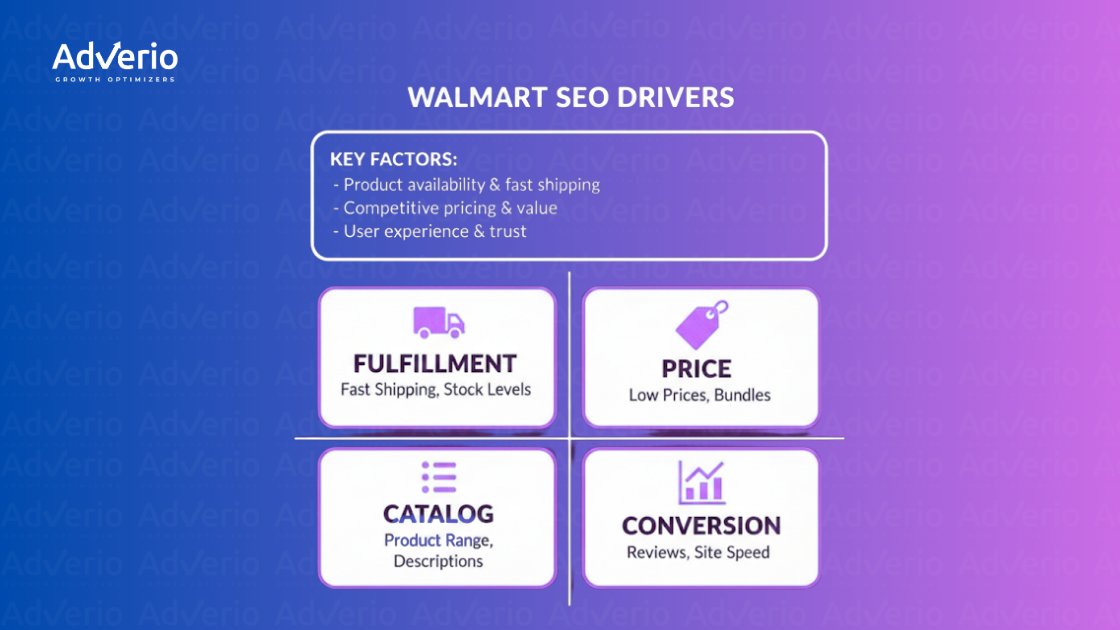
Your performance in these four core areas is what determines whether your listings soar or get buried.
How Adverio Approaches Walmart Marketplace SEO
Trying to fix Walmart Marketplace SEO with content tweaks is like painting a car with a blown engine. It looks productive. It isn’t. Most agencies sell checklists. We fix constraints. If your retail signals are broken, optimization is noise.
That’s why we don’t sell Walmart SEO as a checklist. SEO is embedded inside our Walmart growth systems. Our entire approach is built on one principle: governance before optimization. We fix the engine before we polish the chrome.
-
Retail Signal Diagnostics: Before touching a keyword, we run a full diagnostic on your retail signals—inventory stability, fulfillment performance, price integrity, and catalog health—to pinpoint the weaknesses holding you back.
-
Catalog-Level Fixes: We implement crucial catalog-level fixes, correcting variant logic and consolidating product families to concentrate your ranking power. This foundational work creates the stability needed for optimization to take hold.
-
SEO + Ads Sequencing: Only when the operational foundation is solid do we layer on content optimization and advertising. Content enhancements are timed to capitalize on stable operational signals, and ads are used to accelerate momentum—not to mask foundational weaknesses.
If ads are compensating for weak retail signals, you’re not scaling — you’re subsidizing inefficiency. That’s why our Amazon Account Management approach centers on incrementality and governance, not just spend expansion.
-
Incrementality Awareness: Our systems-based methodology moves brands from flat sales to predictable, triple-digit growth. Walmart’s algorithm is risk-averse. We make you the lowest-risk retail partner in your category.
Walmart marketplace seo: the real reason your listings don’t rank (and how to fix it) 28

How Adverio Helps Brands Scale on Walmart
Adverio builds growth systems grounded in retail fundamentals, not just SEO checklists. We diagnose the operational leaks holding you back and implement a sequenced plan to drive sustainable, profitable growth. For brands that need a full-service partner, our comprehensive Walmart account management services handle this entire process from start to finish, transforming your Walmart presence from a cost center into a profitable, organically growing sales channel. Compare this to our mature Amazon Account Management solutions to see how platform-specific strategies create success.
Stop Optimizing the Wrong Lever
If your Walmart listings aren’t ranking, the issue isn’t your keywords — it’s governance.
We’ll show you exactly where the constraint is.
👉 Book Your Marketplace ROI Forecast
Or explore our:
FAQs
How does Walmart Marketplace SEO work?
Walmart Marketplace SEO is less about keywords and more about proving you’re a reliable retail partner. The algorithm prioritizes operational signals like consistent in-stock availability, fast fulfillment (WFS is key), stable pricing, and a well-managed catalog. Great content closes the deal, but solid operations earn you the chance to make that deal in the first place.
Is Walmart SEO the same as Amazon SEO?
Not even close. Assuming they’re the same is the most expensive mistake a brand can make. Amazon’s algorithm is obsessed with sales velocity and keyword relevance. Walmart operates a risk-averse retail engine that rewards operational discipline. Copy-pasting an Amazon strategy—stuffing keywords and prioritizing content—is doomed to fail because it ignores what Walmart actually values: fulfillment reliability and price integrity.
Why aren’t my Walmart listings ranking?
Your listings are likely invisible due to underlying operational problems, not bad copy. The algorithm is holding your products back because it doesn’t trust your ability to deliver a positive customer experience. The usual suspects are spotty in-stock rates, shaky fulfillment (especially if you’re avoiding WFS), unpredictable pricing, or a messy catalog. No amount of keyword optimization can fix these foundational issues.
Does fulfillment affect Walmart SEO?
Profoundly. It’s one of the most heavily weighted ranking factors. Using Walmart Fulfillment Services (WFS) is like an SEO cheat code. It’s a direct signal to the Walmart search algorithm that you can be trusted to deliver fast, reliable shipping. WFS listings consistently outrank seller-fulfilled products.
Should I run ads before SEO on Walmart?
Running ads to fix a listing with weak operational signals is like putting a Band-Aid on a broken leg. Ads can force short-term sales, but they won’t build lasting organic rank if your fulfillment, pricing, and inventory management are a mess. The winning strategy is to build a rock-solid operational foundation first. Then, use ads to accelerate growth. Otherwise, the second you turn off the ad spend, your product disappears.