


Table of Contents
Most Amazon advice on IPI is too soft. It treats the score like a dashboard metric you watch once a week and hope improves.
That’s backwards.
Your Amazon Inventory Performance Index strategy is a financial control system. If you run a large FBA catalog, IPI affects how much flexibility you have to replenish, how much dead stock you carry, how often listings go stranded, and how much margin gets trapped in inventory nobody wants. Amazon introduced IPI to tie warehouse access to inventory health, and sellers below 350 faced storage limits while stronger accounts avoided that cap, according to Marin Software’s summary of the policy shift.
If you’re running Amazon seriously, weak IPI isn’t an operations annoyance. It’s a growth tax.
If you need the full IPI mechanics, the four components Amazon weights, how sell-through is calculated, and how stranded inventory is defined, those live in the Amazon inventory management guide. What this guide builds on top of that is the financial decision layer: how to use IPI as a capital allocation signal, which inventory problems cost the most money first, and how to run a triage system that clears the right SKUs before fees compound.
Get My Profit ROI Forecast No bloated audit. No generic checklist. Just a clear view of where inventory health is hurting profit.
Your High-IPI Playbook At a Glance
-
Treat IPI like a P&L lever: It controls more than storage. It affects replenishment flexibility, sell-through pressure, and revenue protection.
-
Use inventory age as an early warning system: Don’t wait until old stock becomes a bigger problem. Act while you still have options.
-
Fix the right SKUs first: High-volume dead stock and stranded inventory deserve attention before cosmetic score chasing.
-
Segment inventory by role: Top sellers need tighter control than low-priority catalog fillers.
-
Build a repeatable operating rhythm: Weekly monitoring and monthly clean-up beat occasional panic moves.

Amazon inventory performance index strategy: the financial control system most brands ignore 25
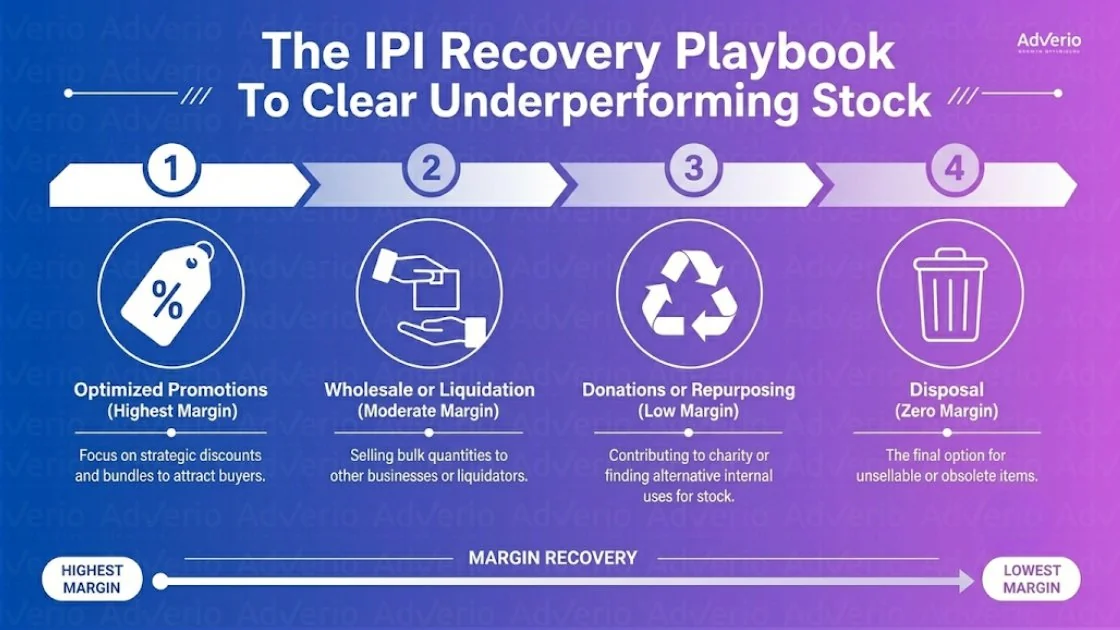
The smartest brands stop asking “How do we raise our score?” and start asking “Which inventory decisions are weakening cash flow, rank stability, and replenishment freedom?”
That shift matters. A real Amazon Inventory Performance Index strategy connects inventory health to demand planning, catalog hygiene, and ad pressure. This guide focuses on the financial triage decisions that follow the diagnosis, not the mechanics of what IPI measures, which are already covered in the inventory management guide.
What a Low IPI Score Actually Costs You
Low IPI is not a reporting problem. It is a margin problem.
Storage limits get the attention, but they are usually the late-stage symptom. The bigger loss starts earlier, when aged inventory absorbs cash, stranded units stop selling, and your best ASINs lose replenishment room to products that no longer deserve it. That is why smart operators treat IPI as a financial control system. It shows whether capital is sitting in inventory that earns, inventory that stalls, or inventory that should have been cleared weeks ago.
The fastest way to improve both profit and IPI is usually the same move. Cut aged inventory before it compounds into higher fees, weaker purchasing flexibility, and forced decisions during peak periods.
Where the money leaks first
| Cost area | What happens when IPI weakens | Financial effect |
|---|---|---|
| Aged inventory | Slow-moving units sit past their productive selling window | More storage charges, more capital trapped, and sharper markdown risk |
| Stranded inventory | Units become unsellable because of listing or catalog issues | Revenue stops while inventory still carries cost |
| Stockouts on proven winners | High-converting products lose availability | Sales disappear, rank slips, and recovery gets more expensive |
| Replenishment pressure | Capacity gets consumed by the wrong SKUs | Purchase orders become reactive and less profitable |
Aged inventory deserves the first callout because it creates the widest financial drag. You pay to store it. You lose the cash tied up in it. You give up space that should go to products with real velocity. Then Amazon adds more pressure through long-term storage exposure and tighter capacity decisions.
That is the trap. Sellers focus on the score after the economics have already turned against them.
Low IPI means your inventory is misallocated. The cost is not just fees. The cost is capital stuck in SKUs with poor odds of producing a strong return.
The practical fix starts with unit economics, not score chasing. If a SKU is old, slow, and unlikely to recover without discounts or ad spend that erase margin, clear it. Protecting dead stock because it once looked promising is how brands lose room for products that can still grow.
This is also why fee visibility matters. Aged inventory looks less harmless once you are reviewing Amazon FBA fees at the SKU level instead of reviewing totals after the damage is done.
Diagnose Your IPI Score’s Critical Failure Point
A low IPI score is not the problem. It is the receipt.

Amazon rewards lower excess inventory, healthier sell-through, fewer stranded units, and stronger in-stock rates. Treat that score as a financial control system, not a vanity metric. If IPI is falling, one part of your catalog is consuming cash, space, and reorder capacity faster than it returns profit.
Start with aged inventory. It is usually the highest-payoff place to investigate because it combines three problems at once: storage cost, trapped capital, and weak probability of full-price recovery. Sellers lose months debating whether an old SKU can bounce back. That delay is expensive.
Find the bucket that is hurting cash flow first
Review your catalog through four lenses:
-
Excess inventory
-
Stranded inventory
-
In-stock risk on proven winners
-
Aged, low-velocity SKUs with no clear recovery path
The fourth bucket deserves priority. Excess units matter, but aged units are where margin goes to die. They sit long enough to absorb fees, block inbound capacity, and force bad decisions on the rest of the assortment.
Run a diagnostic that leads to a decision
A useful review is not a report. It ends with a call.
Use this cadence:
-
Check excess and stranded inventory every week: monthly reviews are too slow for products already losing value.
-
Sort by units, age, and gross margin potential: a large on-hand position with weak margin is a bigger threat than a small operational issue.
-
Mark SKUs with low velocity and no strategic role: no hero status, no bundle role, no strong seasonal case means no protection.
-
Separate listing problems from inventory problems: stranded units need listing fixes. Aging units with weak demand need an economic decision.
-
Split replenishable products from exit candidates: these should never sit in the same planning bucket.
Hard rule: if a SKU is old, slow, and unlikely to recover without discounting or ad spend that kills margin, stop defending it.
Many brands stall at this stage. They diagnose the symptom, then avoid the decision. For the full SKU exit criteria and wind-down sequencing beyond the IPI context, that lives in the Amazon SKU rationalization strategy guide. This framework focuses on which exits serve IPI recovery specifically.
Aged inventory should be judged by forward return, not by sunk cost. What you paid for the units is irrelevant. What matters is whether keeping them in FBA produces more profit than clearing them and giving that space back to products that still earn.
If you need that diagnosis framed at the account level, use Adverio’s Amazon account assessment.
The Four Clearance Options: Which One Fits Each SKU
Once you’ve identified which inventory is dragging the score, the decision is simple. You have four tools. Pick the one that recovers the most value.
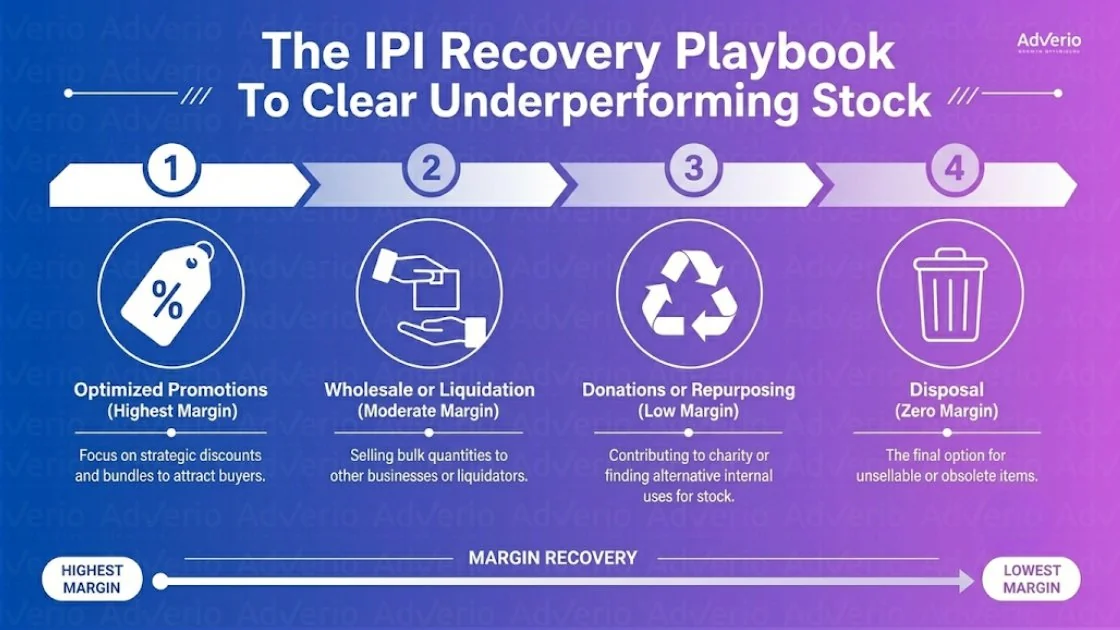
Option 1: Optimized promotions
Use discounts first when the SKU still has believable conversion potential.
The right question is simple: can a lower price move units fast enough without training the market to expect a permanent markdown? If yes, support that move with tightly controlled Sponsored Products. Don’t broad-match your way into a fake sell-through spike.
Option 2: Liquidation channels
If the product still has some value but weak front-end demand, Outlet or liquidation paths can be cleaner than endless promotional spend.
You recover less margin, but you stop carrying inventory that keeps poisoning sell-through and storage efficiency. That’s often the smarter trade.
Option 3: Removal
Some SKUs need to leave. No drama. No attachment.
If a product has low velocity, low strategic value, and weak economics under discount, remove it. The removal cost is almost always lower than continued storage liability plus the eventual deeper markdown.
Option 4: Bundling
A bundle can rescue a weak SKU without making the standalone offer look broken.
This works best when the slow mover complements a hero product naturally. Don’t create bundles nobody asked for. Use them where the combined offer improves perceived value and clears units without crushing margin.
| Option | Best use case | Margin outlook | Speed outlook |
|---|---|---|---|
| Strategic discount | SKU still has market demand | Higher | Moderate |
| Outlet or liquidation | Demand is weak but inventory has residual value | Moderate to low | Faster |
| Removal | Economics are broken | Lowest near-term recovery | Fastest stop-loss |
| Bundle | Slow SKU fits a proven winner | Moderate to higher | Moderate |
For a deeper operating framework around slow stock, review Amazon aged inventory strategies. The difference here is the trigger: this guide uses those clearance options specifically to recover IPI health and free up FBA capacity, not as a general slow-stock playbook.
Book Your Profit ROI Forecast Clear numbers. Straight answers on what poor inventory decisions are costing your business.
The Proactive Model for Sustaining a High IPI Score
Clearing bad inventory is cleanup. The money is in not creating the problem again.
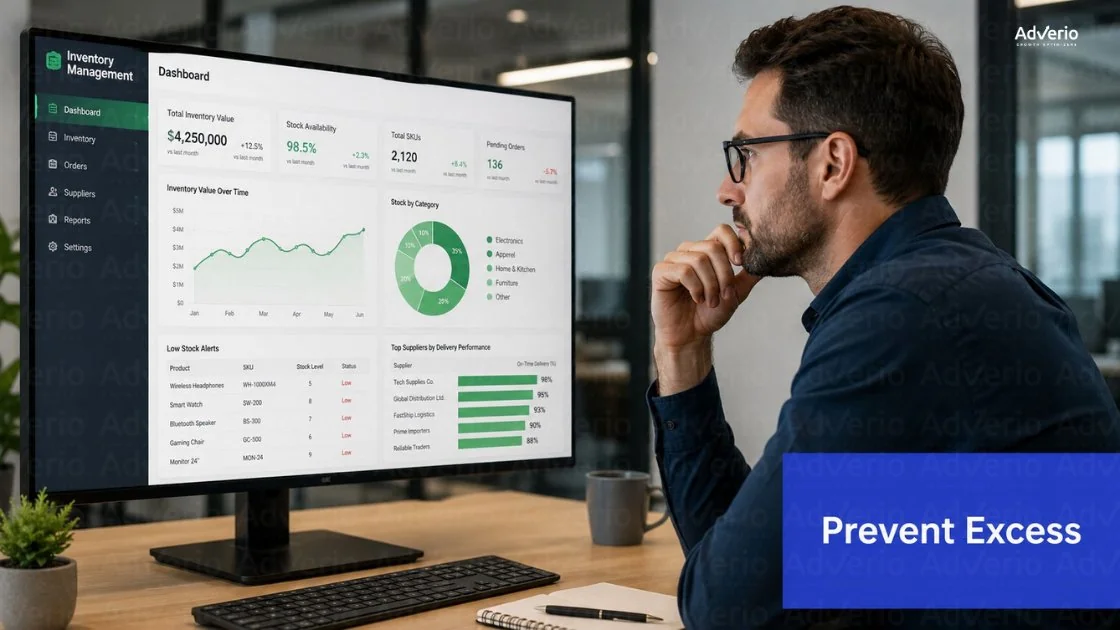
Industry guidance points to a practical operating mix: allocate about 60% of inventory-management effort to A items, 30% to B items, and 10% to C items, while monitoring weekly so low-velocity SKUs don’t drag the score, according to EcomEngine.
Tighten control by SKU role
Top sellers need the most attention. Advanced IPI management calls for tighter service-level targets for A products, often 95%+ in-stock and up to 99% for top sellers, while keeping only 1 to 2 months of stock and clearing excess inventory monthly to protect sell-through and avoid long-term storage drag, per EcomEngine.
That’s the right mindset. Hero products deserve tighter replenishment discipline. Weak tail SKUs do not.
Build a weekly operating rhythm
A strong Amazon Inventory Performance Index strategy runs on three habits:
-
Weekly review: Check excess, stranded, and in-stock risk before problems stack up.
-
Monthly clean-out: Remove or correct low-value inventory before it distorts planning.
-
Role-based forecasting: Forecast A, B, and C items differently. Stop treating every SKU as equal.
Your best IPI move is often boring. Fewer bad reorders. Faster stranded fixes. More ruthless SKU prioritization.
How Adverio Turns IPI Management Into a Profit Engine
A weak IPI score is rarely an ops problem. It is a capital allocation problem.
Brands get into trouble when finance measures carrying cost, storage drag, and forced markdown risk while the Amazon team chases a score in a separate dashboard. That split destroys margin. The fastest path to a stronger IPI is usually the same path to better cash flow: cut aged inventory faster, protect in-stock positions on proven winners, and stop funding SKUs that have already failed the economic test.
Adverio handles IPI through that lens. The work is not limited to fixing stranded listings or cleaning up replenishment settings. It connects catalog decisions, demand generation, and inventory exposure so each SKU is judged by financial return. That matters most in bloated catalogs, variant-heavy assortments, and multi-marketplace accounts where aged units steadily drain profit long before they trigger a bigger operational fire.
The practical value is simple. You get a decision framework for what to clear, what to defend, and what to stop reordering.
Frequently Asked Questions
Should I use PPC to improve IPI?
Sometimes. Not automatically.
Use PPC when a SKU still deserves demand. If the item is strategically important, conversion-ready, and priced to move, ads can help accelerate sell-through. If the product is structurally weak, ads just hide the problem for a few weeks and shrink margin while doing it.
What score should I actually aim for?
Treat 400 as a practical performance threshold because that’s how multiple industry sources commonly frame strong IPI health. But don’t manage to the minimum. Manage to operating freedom. If your score is technically acceptable but your catalog is bloated, you’re still carrying risk.
Is the same IPI strategy valid in every marketplace?
No. Brands should question whether one playbook works globally or whether they need region-specific thresholds for marketplaces with different fulfillment costs, lead times, and demand volatility, a gap highlighted in Amazon Seller Central guidance.
What usually hurts IPI fastest?
The worst combination is excess stock plus stranded inventory plus stockouts on winners. That tells Amazon you’re carrying the wrong products, failing to keep key products available, and letting catalog issues make units unsellable.
How often should I review IPI-related inventory health?
Weekly. That’s the most practical cadence reflected across available industry guidance. Monthly cleanup supports that process, but weekly monitoring catches significant problems before they become expensive.
If your IPI is slipping, your margin is probably slipping first. Adverio helps established brands treat inventory health as a profit system, not a warehouse chore. Book your ROI Forecast and find the SKUs, listings, and replenishment decisions that are dragging growth.