


Table of Contents
Amazon persona-based PPC advice is mostly soft. Define a few avatars. Rename some campaigns. Pretend you’ve modernized your account. That’s not a strategy. That’s cosmetics.
Amazon is no longer just matching products to search terms. It’s matching products to shoppers. If your account is still built like it’s 2023, you’re only capturing obvious demand while Amazon’s recommendation layer sends discovery to someone else.
The campaign structure mechanics, negative keyword architecture, exact match promotion rules, and search term harvesting cadence live in the Amazon PPC audit checklist. What this guide adds is the customer-state layer on top of that structure: how to organize portfolios around buyer intent, not just keyword intent, so Amazon’s AI learns which customer converts profitably.
Get My Profit ROI Forecast
15-minute diagnostic call. No pitch deck.
At a Glance
Keyword structure alone is no longer enough. Amazon’s ad system responds to customer patterns, product context, and conversion behavior. If your account only maps queries to bids, you are feeding the machine half the signal set it needs.
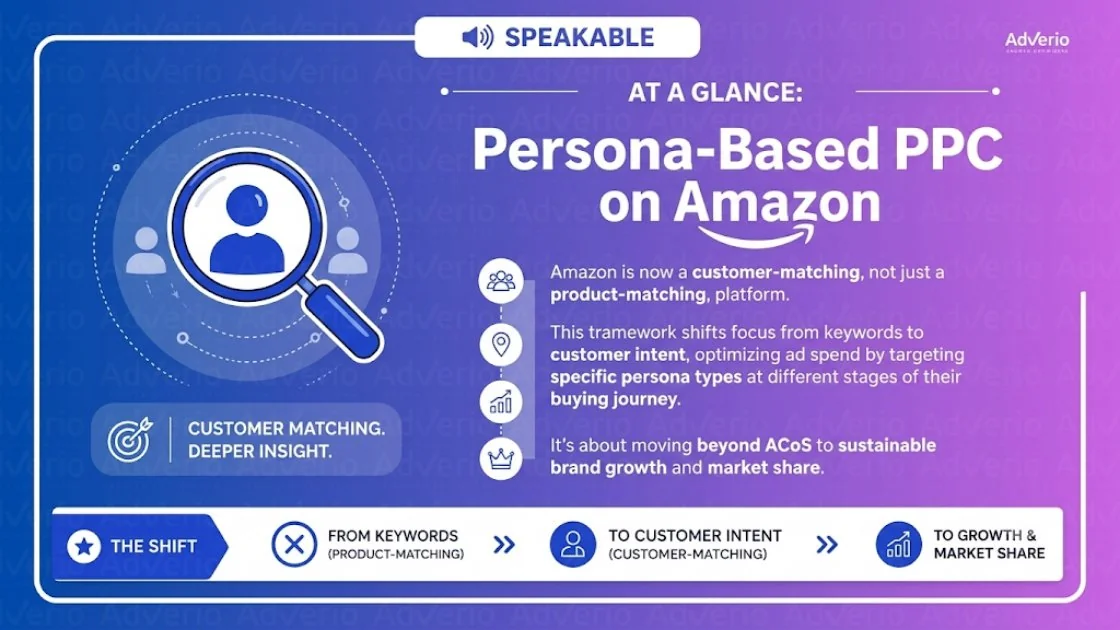
A real amazon persona based ppc framework is an operating model. It groups campaigns by customer state, then measures which audience traits produce profitable orders across branded, category, competitive, and retargeting traffic. The goal is not to write prettier persona documents. The goal is to teach Amazon’s AI who buys, who repeats, and who should see your product earlier in the journey.
That requires campaign architecture, clean portfolio roles, and measurement discipline. Without that, persona targeting turns into vague audience layering that spends money and teaches nothing.
For a broader view of how AI systems should be trained with better inputs, the same persona logic applies across any platform where audience signals shape delivery.
-
Core shift: Stop treating keywords as the full targeting system. Use them as one input inside a customer-state framework.
-
Structural answer: Build four portfolios that separate branded, category, competitive, and retargeting intent so signals stay clean.
-
Data source: Use Amazon-native audience and purchase signals, not fictional avatars built in a slide deck.
-
Management rule: Keep keyword harvesting active, but force every campaign group to teach Amazon which customer profile converts profitably.
-
Operator standard: If your account cannot distinguish your best buyer from your cheapest click, it is underbuilt.
If you want operators who build accounts this way, talk to Adverio.
Why Keyword-First PPC Is Losing Ground to AI-Driven Discovery
Keyword-first PPC is losing because Amazon no longer waits for a shopper to type a perfect query. The platform increasingly decides what to show first, based on who the shopper is, what they have browsed, what they have bought, and which products fit that pattern.
That shift punishes lazy account design.
A keyword-only structure tells Amazon what a shopper searched. It does not tell Amazon which customer segment buys at a high margin, repeats, or converts after broader category exploration. If your campaigns only chase search terms, your account trains the system on clicks. It does not train the system on customer quality.
That is the fundamental change. Discovery is now influenced by audience signals, product signals, and behavioral context. Search still matters, but search is no longer the whole buying journey or the whole relevance model.
| Old assumption | Current reality |
|---|---|
| Shopper types first | Amazon often recommends first |
| Keywords define relevance | Audience and product signals shape relevance |
| PPC captures demand | PPC can also shape discovery |
This is why keyword harvesting alone produces weaker returns over time. You end up bidding harder on crowded terms while Amazon rewards advertisers who give its AI a clearer picture of the buyer behind the query.
The fix is not to abandon keywords. The fix is to demote them from strategy to input. Use keywords to capture expressed intent, then structure campaigns so Amazon can connect that intent to a specific buyer type and stage in the journey. That is how persona-based PPC becomes operational. You are teaching Amazon who your best customers are, not just which phrases they type.
If you need the broader media context, review this breakdown of Amazon DSP vs PPC in your Amazon funnel. For a wider view of AI media execution outside Amazon, the same persona logic applies across any platform where audience signals shape delivery.
What Persona-Based PPC Actually Means
Persona-based PPC is campaign architecture that maps traffic, bids, creative, and measurement to distinct buyer groups, then uses that structure to teach Amazon which customers are worth finding again.
A persona is an operating unit, not a branding exercise. Build it from repeatable signals inside your account: query themes, ASIN paths, basket context, subscribe and save behavior, price sensitivity, new-to-brand rate, and the placements that convert that shopper best. If you cannot tie a persona to observable behavior and a budget line, it is useless.
The shift is practical. Stop organizing campaigns only around search terms. Organize them around the customer behind the search, the product page they need to see, and the action you want Amazon to optimize toward.
That is the primary point of an Amazon PPC campaign structure built for AI-era discovery.
What changes in practice
You stop asking, “What keyword should I bid on?”
Ask better questions. Which buyer type converts on this ASIN. Which campaign type attracts them efficiently. Which message closes them. Which signals should this campaign send back to Amazon so the system finds more shoppers like them.
Keywords still matter. They capture expressed intent. Personas determine how you segment that intent, where you send it, how much you pay for it, and how you judge traffic quality after the click.
Amazon now offers advertisers more audience and demographic inputs than a pure keyword playbook can effectively address.
As noted earlier, persona tooling has moved this from theory into execution. Your job is to turn those signals into a campaign system with clear ownership, clear budget rules, and clear performance thresholds.
Use personas to make allocation decisions. Put more budget behind the primary buyer group for the ASIN. Fund secondary personas only if they convert at an acceptable margin or create useful new-to-brand volume. Cut tertiary personas fast if they add clicks without improving customer mix.
Practical rule: keywords tell you what demand looks like. Personas tell you whether that demand is profitable. Use both, but let customer quality decide structure.
The Four Campaign Portfolio Structure
Most accounts have too many campaigns and not enough architecture. Fix that first.
Your account should be built as four portfolios. Each has one job. Each serves one dominant persona. Each sends a different signal back to Amazon.
This is still a hybrid structure, not a keyword purge. Weekly search-term review, promotion of converting terms into exact match, and active auto campaigns remain essential. The full 15-point process for that work lives in the Amazon PPC audit checklist. This framework focuses on the portfolio layer above that, and how to segment traffic by customer state so each campaign group sends a distinct signal to Amazon’s AI.
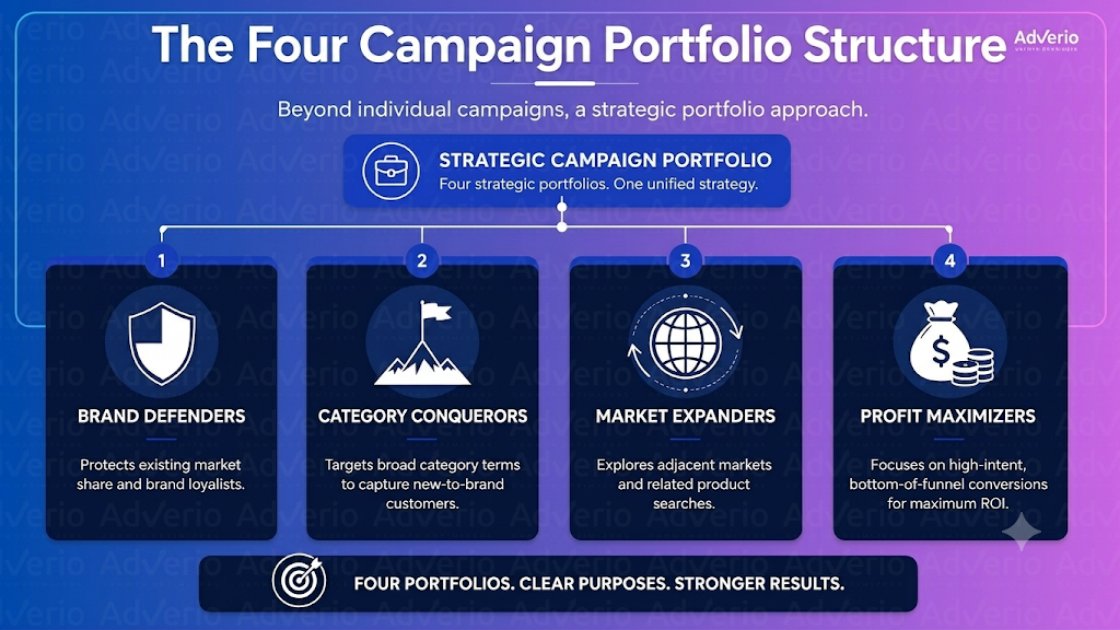
Portfolio 1 Branded campaigns
This portfolio serves the Brand Loyalist.
These campaigns target your brand terms, branded ASIN paths, and your own traffic leakage. The job isn’t growth. The job is defense. Hold top placements. Block competitor conquest. Protect conversion efficiency on shoppers already looking for you.
Treat this portfolio like a brand health utility. Don’t ask it to do discovery work.
Portfolio 2 Category campaigns
This portfolio serves the Problem-Aware Buyer.
These are your non-branded category terms. Broad and phrase can work here, but only with hard governance. You need regular negative management, exact-match promotion for winners, and SKU-level separation where needed. Under these conditions, your account captures shoppers who know the problem, not yet the brand.
This is one of the clearest new-to-brand acquisition engines in the account.
Portfolio 3 Competitive campaigns
This portfolio serves the Evaluator.
Run product targeting against competitor ASINs. Layer competitor brand terms if the economics support it. The point is not noise. The point is interception. These shoppers are already comparing. Your product page, offer, review profile, and creative have to close the argument fast.
Weak listings make competitive PPC expensive. Strong listings turn it into a market-share play.
Portfolio 4 Retargeting campaigns
This portfolio serves the Warmest Audience.
Use Sponsored Display and, where relevant, DSP to re-engage shoppers who viewed your PDPs or adjacent competitor PDPs and didn’t buy. This audience already knows the category. They often just need a reason to return.
Retargeting also gives Amazon a strong closed-loop signal. The shopper saw the product. The shopper came back. The shopper purchased. That feedback matters.
| Portfolio | Primary persona | Job |
|---|---|---|
| Branded | Brand Loyalist | Defend existing demand |
| Category | Problem-Aware Buyer | Capture non-branded intent |
| Competitive | Evaluator | Conquest adjacent buyers |
| Retargeting | Warmest Audience | Re-engage high-intent visitors |
How to Build Customer Personas From Amazon Data
You don’t need a workshop. You need extraction discipline.
Start with Brand Analytics. Pull New-to-Brand percentage by ASIN. That tells you which products already attract fresh customers and which ones mostly recycle existing demand. Then move into search behavior with your Amazon search term report strategy. Your converting non-branded queries reveal problem language, use-case language, and buying context.
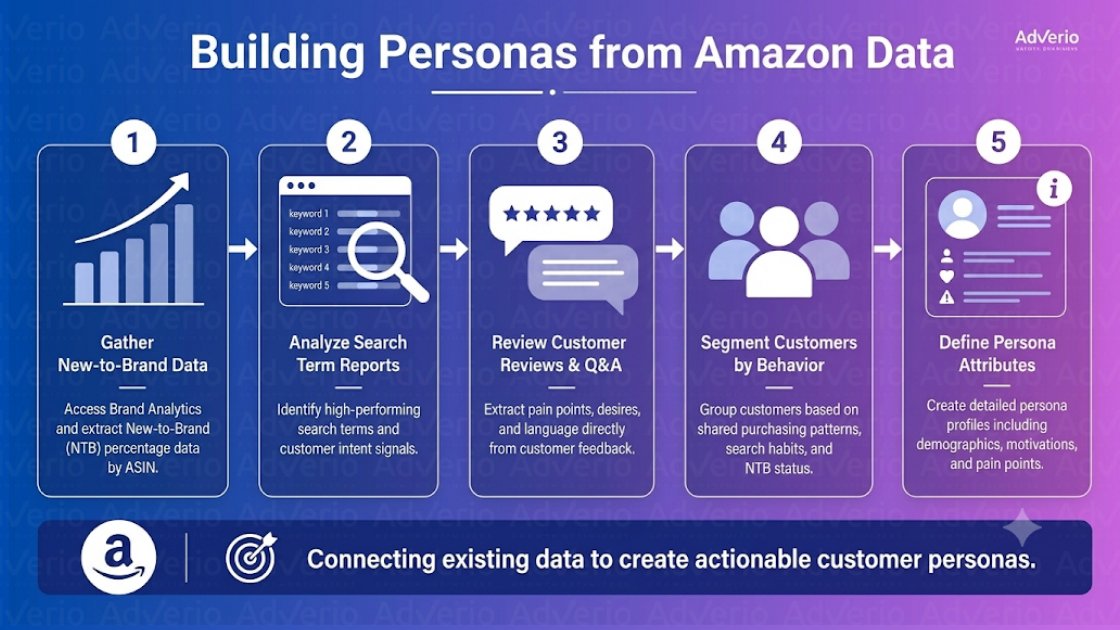
Then pull Market Basket Analysis. That exposes adjacency. Not theory. Actual co-purchase behavior. Add demographic signals where available. Amazon’s audience tooling now supports demographic fields such as age, gender, and affinity in persona construction through its own documentation referenced earlier.
Build the personas from Amazon-native data first. Brand Analytics, search term reports, and Market Basket Analysis give you everything you need without outside tools. Build three working personas
-
Core buyer: Your most obvious buyer with the clearest category intent.
-
Adjacent buyer: A nearby audience with overlapping need, gifting use case, or lifestyle fit.
-
New category entrant: A less educated shopper who needs category framing before brand preference.
Map them to campaigns
| Data source | What it tells you | Persona use |
|---|---|---|
| Brand Analytics NTB | Which ASINs recruit new buyers | Product-persona fit |
| Search query data | How buyers express need | Category messaging |
| Market Basket Analysis | What else buyers buy | Cross-sell and adjacency |
| Demographic signals | Who converts | Audience prioritization |
Keep the persona count tight. Three is useful. Ten is bureaucracy.
How Each Portfolio Teaches Amazon’s AI
Amazon responds to signal quality. Messy accounts produce messy signals.
Your branded portfolio teaches the baseline. It shows Amazon what a loyal customer path looks like around your brand terms and products. Your category portfolio teaches in-market intent outside your brand bubble. That matters because it connects your products with category demand from shoppers who haven’t committed yet.
Competitive campaigns teach substitution behavior. They show where your product wins when a shopper is comparing alternatives. Retargeting campaigns teach reinforcement. They close the loop between interest and purchase.
A portfolio structure isn’t about reporting convenience. It’s about sending four clean behavioral lessons into one system.
When those lessons line up, Amazon sees more than keywords and bids. It sees customer patterns.
That’s also why your reporting setup matters. Clean portfolio reporting is what keeps the feedback loop intact. If your team still pieces together signals from disconnected exports, that is the first operational fix.
How to Measure Whether the Persona Framework Is Working
If you judge persona-based PPC on campaign ACoS, you will kill the strategy before it has time to produce the result you actually want. The job is not to make every campaign look cheap. The job is to increase customer acquisition, grow non-branded demand, and improve total account economics while Amazon learns who converts.
That requires measurement at the portfolio level, not the ad-group level. You are training Amazon’s AI to find profitable customer patterns across branded, category, competitor, and retargeting traffic. Measure whether that training is producing more first-time buyers, stronger organic visibility on priority terms, and a healthier revenue mix. If your team still evaluates upper-funnel traffic like branded defense, fix that operating error now. For the finance lens, review Amazon incrementality measurement.
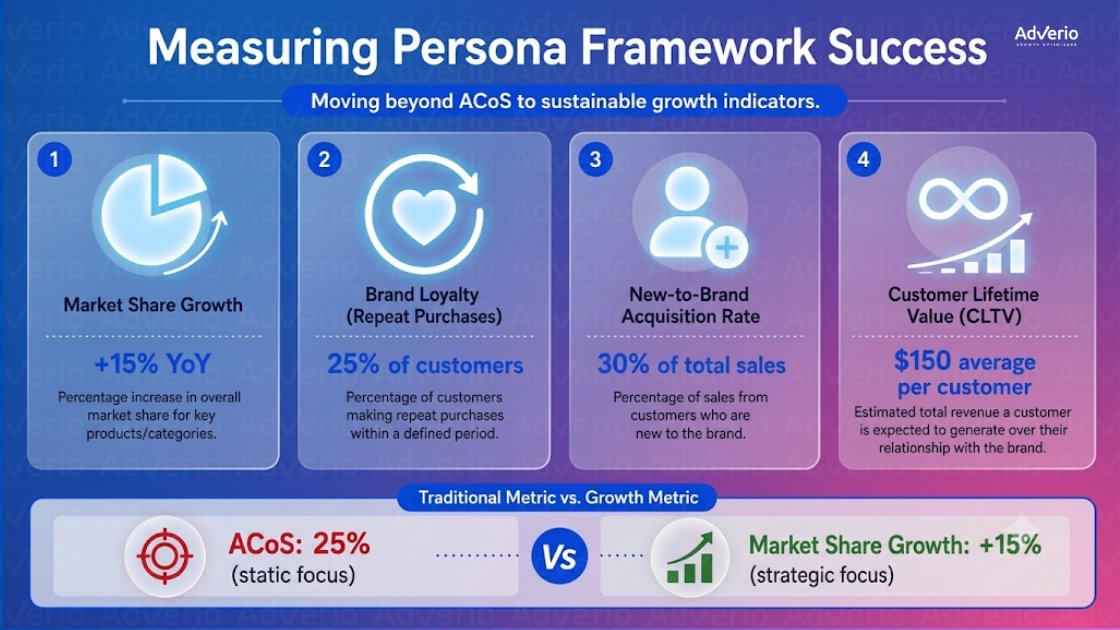
Start with a baseline before you restructure anything. Pull Brand Analytics New-to-Brand performance, isolate non-branded acquisition campaigns, and record where organic rankings sit for your core category terms. Without that snapshot, you are guessing. CEOs should not pay for guessing.
What to watch
-
New-to-Brand trend by portfolio: Track whether category and competitor portfolios are bringing in more first-time buyers over time.
-
Organic share on target non-branded terms: Check whether your core category keywords gain visibility after persona segmentation goes live.
-
Total New-to-Brand revenue share: Measure whether a larger portion of account revenue comes from net-new customer recruitment.
-
Blended account economics: Watch TACoS or blended ACoS to confirm defensive efficiency is funding acquisition instead of masking stagnation.
Review these metrics on a rolling basis. Daily swings create noise. Monthly snapshots hide cause and effect. Weekly portfolio reviews usually show the signal fast enough to act and slow enough to stay rational.
| Metric | Why it matters | What good looks like |
|---|---|---|
| NTB percentage | Shows whether Amazon is finding new buyers, not just harvesting existing demand | Upward trend in acquisition portfolios |
| Organic rank share | Shows whether paid discovery is improving natural visibility | Better placement on priority non-branded terms |
| Total NTB revenue share | Shows whether growth is coming from customer expansion | Larger share of total revenue from new buyers |
| Blended ACoS or TACoS | Shows whether acquisition is improving without breaking profitability | Stable or improving while NTB rises |
One more rule. Segment reporting by portfolio every time. If branded defense and competitor conquesting are blended into one view, you will make bad budget calls and misread what Amazon’s AI is learning.
If your team cannot produce that view cleanly, you do not have a PPC problem. You have an operating system problem.
That is usually the point where founders decide they need a partner to manage their Amazon account.
How Adverio Builds Persona-Based PPC Structures
Adverio builds persona-based PPC as an account operating system, not a campaign checklist. The job is to teach Amazon who should buy, how much that customer is worth, and which traffic sources deserve more capital.
That requires four things to work together. Portfolio design. Search term harvesting rules. Listing readiness by persona. Audience media that reinforces the same buyer signal across Sponsored Ads and retargeting layers.
Adverio uses internal systems such as Profit Pulse System and AMOS to map persona intent to campaign structure, bid logic, query promotion, and margin controls.
That matters because persona strategy fails fast when the architecture is loose. If search terms move without rules, bids drift without contribution targets, or PDPs speak to everyone at once, Amazon learns the wrong customer pattern.
The standard here is simple. Every portfolio must have a job. Every job must have a KPI. Every KPI must connect to profit.
If you need a partner to manage your Amazon account, this is the standard to demand.
Ask how they isolate persona signals, how they graduate search terms between portfolios, how they prevent branded efficiency from stealing budget from acquisition, and how they tie media decisions back to contribution margin. If the answer is more campaigns, broader targeting, or a better ACoS report, keep looking.
FAQs
How quickly does a persona-based framework show results?
Defensive benefits can show up early because branded and retargeting cleanup usually improves account control fast. The bigger payoff takes longer because Amazon needs repeated conversion signals before the system strengthens discovery around your ideal buyers. Judge it on trend lines, not a few days of data.
Can this framework work without Amazon DSP?
Yes. Branded, category, and competitive portfolios can run inside Sponsored Ads. Retargeting gets stronger with DSP because audience controls are deeper, but Sponsored Display can still support a lighter re-engagement layer.
Will this hurt ACoS?
Some acquisition portfolios will carry a higher ACoS than brand defense. That’s normal. The mistake is forcing one efficiency target across every portfolio. Judge the system on blended contribution, new customer growth, and organic support, not one blunt threshold.
Is this only for large catalogs?
No. Smaller catalogs still need the same logic. Defend existing demand. Capture category intent. Conquest competitor traffic where you have an advantage. Re-engage warm audiences. You’ll just run a tighter version with fewer targets and more consolidation.
What is the biggest mistake brands make with persona-based PPC?
They kill classic keyword discipline too early. Hybrid structure wins. Keep auto campaigns active for harvesting. Review search terms weekly. Move converting queries into exact match. Add negatives aggressively. Personas should sharpen your account, not turn it into a vague audience experiment.
If your Amazon ad account still treats keywords as the whole strategy, you’re paying for yesterday’s system. Adverio helps established brands build profit-first marketplace structures that align PPC, DSP, listings, and operational reporting around customer acquisition and margin control.
Book the ROI Forecast and get a direct view of where your current setup is leaking growth.