



Table of Contents
Too many brands run Amazon pricing backward. They hand the job to a repricer, defend the Buy Box, and call that strategy. It isn’t. Pricing is the unit-economics lever that gates demand capture above it, and when you leave it on autopilot, you leave the most direct profit lever unmanaged. That’s why elasticity stays untouched while teams obsess over bids, images, and incremental listing tweaks.
Amazon itself doesn’t treat pricing as a side setting. On competitive items, Amazon reprices constantly, reading competitor pricing, inventory, demand velocity, and margin signals in near real time. The exact cadence is not public, but the direction is clear. Amazon treats price as a live input, not a set-and-forget field. You don’t need to copy Amazon. In fact, that usually fails. You need an operator that treats price as a governed business decision. If you’re already automating workflows elsewhere, even Amazon pricing automation tools, make the bigger point clear: automation without strategy just scales the wrong behavior.
If you need the full Amazon pricing strategy framework, elasticity testing, velocity bands, margin guardrails, and dynamic pricing governance, that lives in the Amazon pricing strategy guide. What this guide adds is the agency comparison layer: how to evaluate any pricing strategy partner against the criteria that protect margin instead of just running repricers.
Get My Profit ROI Forecast
15-minute diagnostic call. No pitch deck.
At a Glance
Amazon pricing strategy agencies matter because a repricer protects position, while real pricing strategy manages elasticity, margin, and demand together. The brands that win don’t just react to competitor prices. They govern price as a profit input tied to inventory, advertising, and SKU-level economics.
The conventional playbook, and where it breaks
Too many agencies still treat pricing like a defensive tactic. That’s the problem.
What repricers and tools do
They run a repricer. It watches competitors. It nudges your price to stay eligible for the Buy Box. On shared listings or reseller-heavy catalogs, that has a place.
But that’s a narrow job. It protects placement. It doesn’t answer whether your current price is too low for the demand your listing already captures, or too high for the margin structure under rising fees, returns, and ad costs.
Where it breaks down
A repricer doesn’t manage elasticity. It doesn’t read unit economics. It doesn’t know whether a lower price is creating profitable demand or just buying unprofitable volume.
Amazon also plays a game most brands can’t. Amazon will sell some products at a loss when the transaction supports broader ecosystem value through Prime, marketplace fees, advertising, or long-term retention. If your agency ignores that, you end up reacting to a competitor with a different profit model than yours.
A Buy Box repricer defends a position. It does not manage elasticity or margin.
The operator approach
The smarter move is simple. Set a hard floor based on cost, fees, returns, and target margin. Set a ceiling based on customer willingness to pay, which is shaped by reviews, brand strength, and imagery. Then test between them and track profit per SKU.
That’s the opening most brands miss. The category is still underdeveloped. There isn’t a clean conventional playbook here, which is exactly why brands that treat price as a governed input are getting an edge.
Why price is the most direct profit lever
Brands overspend on Amazon PPC because bids feel active. Pricing feels risky. That instinct kills margin.
McKinsey’s pricing research found that a 1% improvement in price can lift operating profit by roughly 8%, more than an equivalent gain in volume or cost. That matters on Amazon because price influences three things at once: conversion rate, ad efficiency, and contribution margin. Media spend usually improves one variable at a time. Price changes the math of the whole SKU.
A simple example makes the point. On a $25 product, a modest price increase can add far more profit per unit than another round of bid tuning, even after fees. If your agency can explain TACoS in detail but cannot model how a price move changes contribution profit at the SKU level, they are optimizing around the key lever instead of controlling it.
Practical rule: Review price with the same discipline you use for bids. Weekly for key SKUs. Test-driven, margin-led, and tied to unit economics.
The better way to frame pricing is not “How do we stay competitive?” It is “Where is profit being left on the table?” That is the core of a profit-first Amazon pricing strategy.
Strong operators also treat price as an active input, not a static setting. They run controlled price tests, isolate the variable, and judge outcomes by profit per SKU instead of topline revenue. Revenue growth with weaker margin is not a win. It is expensive self-deception.
Managing elasticity as unit economics
Elasticity decides whether a price change makes you richer or just busier. The only question that matters is simple: after demand adjusts, does contribution profit per SKU go up?
That shifts the job. An agency should model price as part of unit economics, not treat it like a conversion-rate landmine. If they cannot show how a price move affects margin after fees, returns, ad spend, and expected volume change, they are guessing.
Use a tighter operating framework:
-
Set the floor: Build your minimum price from referral fees, FBA fees, storage, returns, promos, and target contribution margin. A floor based on COGS alone is fantasy.
-
Define the ceiling: Estimate the highest acceptable price from review strength, content quality, rating gap versus competitors, brand position, and purchase urgency.
-
Test in controlled windows: Raise price on selected SKUs in small steps, hold the rest of the system as steady as possible, and judge the result by profit dollars, not revenue or unit volume.
-
Segment by elasticity: Separate hero SKUs, replenishable products, premium products, and traffic drivers. They should not share one pricing rule because buyers do not respond the same way.
-
Protect margin-critical ASINs: If a SKU has thin contribution after ads and returns, one sloppy discount can wipe out the month.
While plenty of teams can report TACoS, CVR, and sessions, weak agency work is exposed when fewer can tell you which ASINs are underpriced, which ones can absorb a price increase, and which ones should stop buying demand until pricing is fixed.
Run pricing reviews with the same discipline you use for budget pacing, but with a harder financial standard. If you want a quick benchmark for how much agency performance should translate into profit, use Adverio’s ROI calculator.
Pricing belongs inside one operating system with media, inventory, and margin controls. That is the core of an Amazon growth strategy that compounds. Anything less leaves profit unmanaged.
Repricer versus pricing strategy
The agencies below matter for one reason. They get closer to operator-led pricing than generic account managers do. Some are stronger on price integrity and MAP enforcement. Some are stronger on retail operations and profitability analytics. One stands out if you want pricing governed alongside ads, listings, inventory, and cross-marketplace expansion.
1. Adverio
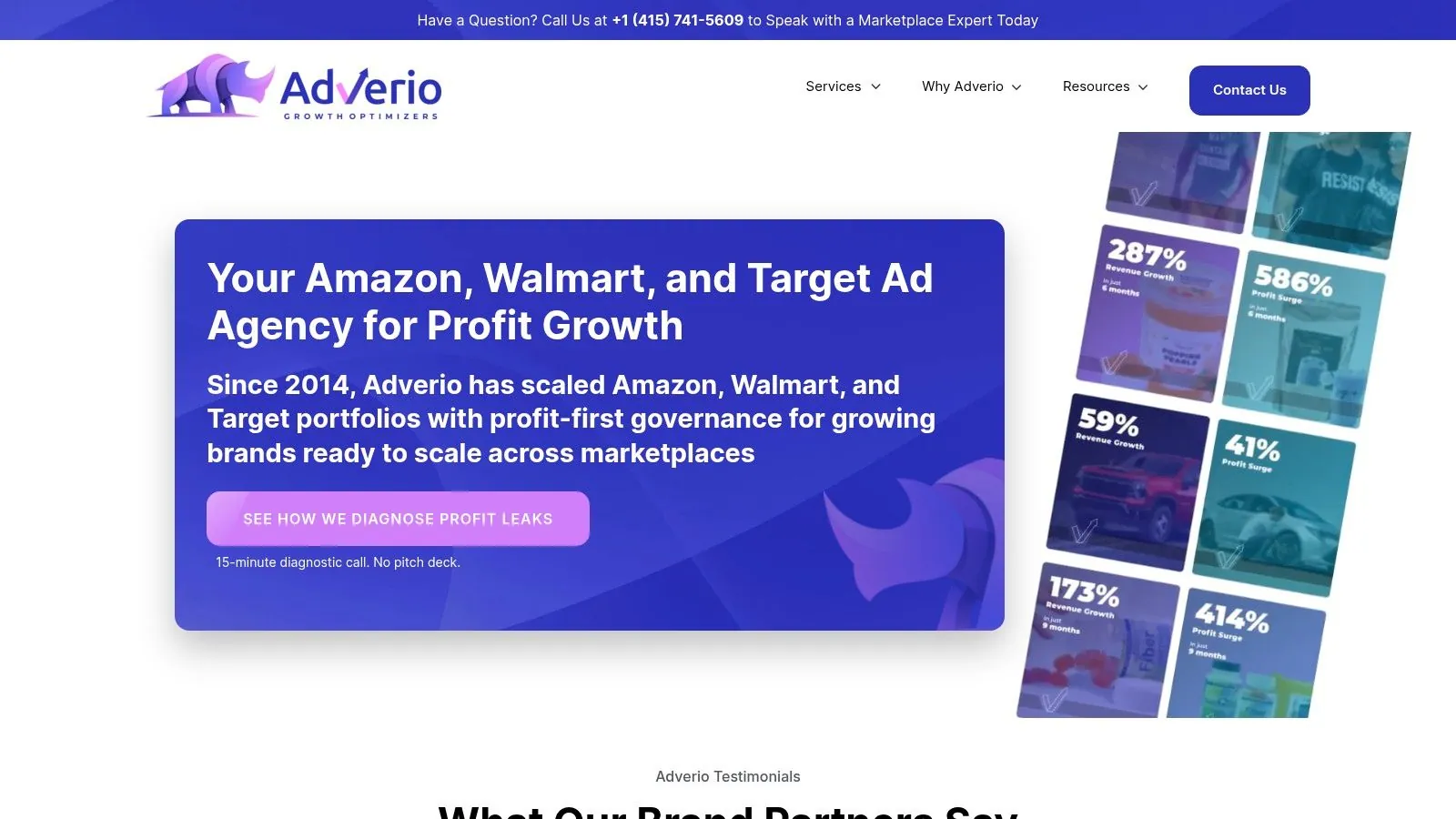
Adverio stands out because it treats price as a profit variable inside the operating model, not as a channel-side setting someone tweaks after the fact. That matters. On Amazon, a pricing decision changes conversion rate, ad efficiency, contribution margin, reorder risk, and how aggressively you can scale a catalog. Agencies that isolate pricing from those inputs usually end up protecting revenue while margin slips.
That operating view is a better fit for established brands with deep catalogs in softlines, hardlines, and CPG. Those teams rarely have a visibility problem. They have a coordination problem.
Why Adverio is a serious option
The strength here is how the work is structured. Adverio combines marketplace execution across Amazon, Walmart, and Target with BI systems such as AMOS and Profit Pulse, then assigns strategy and operations pods instead of handing the account to a generalist. The result is tighter control over decisions that affect profit, especially when pricing, media, and inventory are pulling in different directions.
That matters more than another repricing tool. Repricers react. A pricing strategy partner should help you decide where the brand can hold price, where a lower price expands contribution profit, and where discounting just buys low-quality volume.
Best fit
Adverio fits brands facing operational drag that keeps showing up in the P&L:
-
Growth has stalled: Traffic and conversion work is done, but profit growth still lags.
-
Margin is under pressure: Revenue keeps coming in, yet advertising and pricing decisions are eating contribution.
-
Channel coordination is weak: Amazon, Walmart, Target, and DTC are sending mixed signals into pricing and forecasting.
It also fits teams that want operator judgment, not automation running on autopilot. That distinction matters if your catalog has enough complexity that one pricing rule can create second-order problems across media, replenishment, and channel conflict.
The right question is not whether ads can support the current price. The right question is whether the current price is forcing bad ad economics.
What stands out
-
Profit-centered pricing: Price gets evaluated alongside media efficiency, inventory position, and catalog mix.
-
Cross-marketplace execution: Amazon, Walmart, and Target are managed with one commercial logic instead of separate channel tactics.
-
Operator-led accountability: The model is closer to financial and operational oversight than routine account management.
-
Flexible engagement: Useful for brands that need full execution or a partner that works closely with an internal team.
If your team still treats pricing as a Buy Box issue, you are leaving margin on the table. Adverio is a stronger option for brands that want pricing managed as a unit-economics input.
2. Pattern
Pattern is the right call when pricing control means channel control. Its strength isn’t elasticity testing first. It’s price integrity across marketplaces, MAP enforcement, unauthorized seller cleanup, and tighter governance when leakage outside Amazon keeps crushing margin inside Amazon.
That makes Pattern a strong fit for brands with distribution complexity. If gray-market sellers or marketplace inconsistency are the source of pricing pressure, you need that fixed before you obsess over micro-optimization.
Where Pattern is strongest
Pattern operates closer to an end-to-end commerce partner than a pure agency. It can support brands through 1P and 3P structures, with pricing, content, media, and retail operations moving together. That model won’t suit every brand, but it does close a lot of execution gaps.
Its value shows up when teams keep asking why the Buy Box is unstable even though ads and listings are fine. Often the problem is elsewhere in the channel.
-
MAP governance: Better for brands with retailer relationship risk.
-
Unauthorized seller enforcement: Important when undercutting keeps resetting perceived market price.
-
Omnichannel parity: Useful when Amazon is reacting to broader price inconsistency.
If your team is still debating agency versus internal ownership, this breakdown on making the right call for Amazon growth helps frame the decision.
3. Tinuiti
Tinuiti is built for brands that need pricing to inform promotion and media, not sit in a separate spreadsheet. That’s useful when item-level profitability and campaign planning have to move together.
Tinuiti is less about pure repricing mechanics and more about retail-media-connected operations. For established brands with promo calendars, multiple stakeholders, and pressure to coordinate fees, retail readiness, and paid media, that pays off.
Why brands hire Tinuiti
Their commerce model ties operational inputs to media execution. So if a SKU is already margin-tight, the decision isn’t just whether to bid harder. It’s whether the planned pricing and promotional strategy makes sense at all.
That’s a smarter conversation than the standard agency script.
Teams that separate pricing from media usually overspend to compensate for a weak margin structure.
Tinuiti is strongest for mature brands that need retail media depth, including DSP support, inside a broader commerce structure. If your focus is profitable scale rather than raw attributed revenue, keep that lens sharp with this piece on profitable Amazon scaling for brands.
4. Blue Wheel

Blue Wheel earns its spot because price erosion often starts before a shopper ever lands on your listing. Unauthorized sellers, MAP drift, and weak brand protection create the pricing instability. Blue Wheel goes after those root causes.
This is a strong fit for brands that don’t have an elasticity problem yet. They have a discipline problem in the channel.
What Blue Wheel does well
Blue Wheel combines brand protection with marketplace management. That mix matters because enforcement without execution stalls, and execution without enforcement keeps leaking value.
Its best use cases are clear:
-
Buy Box instability caused by undercutting
-
Price perception damage from unauthorized sellers
-
MAP breakdown across marketplaces
If your pricing discussion hasn’t included customer perception and premium positioning, revisit your profit-first Amazon pricing strategy. Price isn’t just arithmetic. It signals value.
5. Flywheel Digital
Flywheel Digital is built for enterprise complexity. When pricing, availability, digital shelf signals, and media all need to align across markets, Flywheel’s analytics-heavy model becomes attractive.
This is not a lightweight solution. It’s a better fit for brands managing large programs, broader geographies, and a lot of internal moving parts.
Where Flywheel fits best
Flywheel shines when annual planning matters as much as weekly optimization. Think promotional calendar alignment, market-share considerations, and category-level visibility tied back to retail operations.
That’s especially relevant if your pricing strategy needs to coexist with bigger portfolio planning, not just day-to-day account management.
For brands trying to pressure-test whether agency involvement will pay back, run the economics through Adverio’s ROI calculator.
6. Acadia
Acadia is a practical choice for mid-market brands that want operational help and profitability-minded guidance without pretending pricing exists in a vacuum. Its heritage through Bobsled Marketing gives it credibility with brands that need fee shifts, Amazon policy changes, and marketplace realities translated into actual P&L decisions.
That’s the right frame. Pricing advice is only useful if someone turns it into action across content, promotions, and media.
Why Acadia makes this list
Acadia is useful when your team understands Amazon well enough to know the problem, but doesn’t have the bandwidth to operationalize the answer. It can bridge pricing, retail operations, and media with a profitability lens.
This makes it a solid fit for brands that don’t need an enforcement-heavy partner or a full retail operator model, but do need someone who can connect pricing decisions to real marketplace execution.
7. Envision Horizons
Envision Horizons stands out for SKU-level profitability visibility. If your pricing decisions are happening without clean profit-by-ASIN context, the agency isn’t managing strategy. It’s reacting.
That’s where Envision Horizons is strongest. Its myHorizons platform supports account management with profitability and market-share visibility, which is useful for brands that want pricing and promo decisions tied more directly to SKU economics.
Best fit for Envision Horizons
This agency works well for established brands that need tighter analysis by product, not just account-wide reporting. That’s especially relevant for variant-heavy catalogs where one pricing move can improve one cluster while damaging another.
Its qualification bar also makes sense. Early-stage sellers usually don’t need this level of structure. More mature brands do.
Top 7 Amazon Pricing Strategy Agencies Comparison
| Provider | Implementation complexity | Resource requirements | Expected outcomes | Ideal use cases | Key advantages |
|---|---|---|---|---|---|
| Adverio | High, cross‑channel BI and governance setup | Mid-High; access to accounts, inventory, and historic data; enterprise focus | Rapid leak identification, margin-first growth, lower TACoS and higher net profit | Established consumer brands scaling across Amazon, Walmart, Target, and DTC | Unified BI, profit-first model, fast diagnostics, multi-marketplace management |
| Pattern | High, wholesale/operator model with pricing systems | High; may require inventory transfer or 1P/3P integration and legal enforcement work | Restored price integrity, stabilized margins, MAP compliance at scale | Brands prioritizing pricing control, MAP enforcement and channel governance | Proprietary pricing engine, global MAP enforcement, retail operator capability |
| Tinuiti | Medium–High, integrates media with retail ops | Mid–High; agency engagement with retail media and ops coordination | Item‑level profitability alignment, better promo-to-media effectiveness | US brands needing retail media tied to pricing and promotional calendars | Strong retail media and commerce operations integration |
| Blue Wheel (Retail Bloom) | Medium, brand protection plus marketplace ops | Mid; monitoring and enforcement workflows plus operational support | Reduced unauthorized sellers, improved buy box stability and price protection | Brands suffering price undercutting or buy‑box instability | Combines MAP enforcement with day‑to‑day marketplace execution |
| Flywheel Digital | High, enterprise analytics and global program alignment | High; AI analytics platform, consulting, multi‑market operations | Pricing modeled to market share and profitability, aligned supply chain and media | Large/complex multi‑market portfolios needing integrated planning | AI‑driven analytics, global scale, integrated retail operations and media |
| Acadia (formerly Bobsled) | Medium, full‑channel management with advisory | Mid; hands‑on operations plus strategic fee/pricing advisory | Actionable pricing and promo strategies tied to fee impacts and P&L | Mid‑market brands needing operational support and pricing counsel | Practical guidance on fees/margins, full‑channel execution experience |
| Envision Horizons | Medium, ops‑first with SKU‑level tooling | Mid; myHorizons platform and SKU profitability analytics (best for $1M+/yr) | SKU/ASIN‑level profit visibility, pricing and promo decisions informed by margins | Established brands wanting SKU‑level profit reporting and pricing control | Profit‑by‑ASIN analytics, market share monitoring, ops‑focused audits |
How Adverio approaches this
Adverio treats pricing as a profit system, not a Buy Box reaction. That is the right frame. Price changes margin on every unit, shifts conversion, changes ad efficiency, and can either strengthen or wreck contribution profit within days.
The operating model is simple. Adverio reads price with spend, inventory position, listing quality, review profile, and demand signals through its BI stack, including AMOS and Profit Pulse. Then teams make decisions against contribution economics. A SKU does not get cheaper because a competitor blinked. It gets repriced only if the math supports more profit, more durable share, or both.
That matters because elasticity does not live inside a pricing tool. It lives in the full operating system. If your listing is weak, traffic converts poorly and lower prices become a subsidy for bad merchandising. If inventory is thin, aggressive pricing can drain stock and hand future rank to competitors. If ad structure is inefficient, a price cut can hide media waste instead of fixing it.
Adverio’s view is blunt. Pricing should sit next to BI, media, and conversion work under one decision framework. The goal is not constant movement. The goal is controlled testing, cleaner contribution margins, and tighter rules for when to hold price, when to raise it, and when a promotional move earns its keep.
That same logic shows up across marketplace execution. Adverio’s take on Walmart advertising is blunt. Ad scale breaks when listing quality and catalog health are weak. Its Amazon PPC perspective makes a similar point: growth stalls when brands rely too heavily on exact match capture instead of building broader discovery. Pricing follows the same rule. It performs best when the operator handling demand capture, conversion rate, and margin is working from one P&L view instead of three disconnected dashboards.
Adverio also emphasizes frameworks over random optimization. The point is straightforward. Price creates value only when the rest of the system stops leaking it.
Book Your ROI Forecast if you want pricing managed as a unit-economics lever instead of a defensive reflex.
Frequently asked questions
What is price elasticity on Amazon?
Price elasticity on Amazon is how demand changes when you change price. The important part isn’t just unit movement. It’s whether the margin gained or lost produces a better business outcome after ads, fees, and conversion shift with it.
Is a repricer the same as a pricing strategy?
No. A repricer reacts. A pricing strategy governs. One helps you stay competitive in the moment. The other decides what role price should play in profit, demand capture, and catalog economics before the market forces your hand.
Why is pricing the most direct profit lever?
Because it changes profit per unit immediately and influences everything above it. Better pricing can improve margin without requiring more traffic, more spend, or more operational complexity. That’s why mature brands eventually realize they’ve over-managed media and under-managed price.
Who manages Amazon pricing strategy?
The best owner is whoever can connect pricing to unit economics, ad spend, inventory, and listing strength in one decision layer. Sometimes that’s an internal operator. Often it’s one of the stronger Amazon pricing strategy agencies. If your current partner only reports on spend and sales, they’re probably not managing pricing strategy.
Ready to see this in your account?
If your price is on autopilot, your margin is too. That’s the blunt truth.
The next move is simple. Show me my untouched pricing lever. Show me my margin headroom. If you’re a cold reader, start with a diagnostic mindset and map the leaks. If you’re ready to move, Book Your ROI Forecast and get a profit-first read on where pricing, ads, listing strength, and marketplace execution are working against each other.
Inaction is your competitor’s best friend. Don’t give them the advantage.
Adverio is the growth partner for brands that are done guessing. If you want pricing treated as a real profit lever across Amazon, Walmart, and Target, not as a Buy Box reflex, talk to Adverio and book your ROI Forecast.