



Table of Contents
Amazon listing optimization services usually sell the wrong outcome. They rewrite titles, swap a few images, scatter keywords across the catalog, and call the job finished. That work feels productive. It rarely fixes the SKUs that carry your revenue.
The full listing optimization methodology, including keyword architecture, copy standards, A+ content, backend fields, hero ASIN prioritization, and LQS scoring, lives in the Amazon listing optimization guide and the Amazon listing optimization service page. What this guide adds is the buying framework: how to evaluate any listing optimization service before you hire them, what deliverables to demand, and how to tell whether a provider is optimizing for profit or just for activity.
Brands waste money by treating every variation like it matters equally. It does not. A handful of child ASINs usually drive the account, while the long tail exists to capture edge demand, preserve assortment, or support parent-level merchandising. Equal effort across all of them spreads budget thin and leaves the highest-stakes listings underbuilt.
That mistake gets worse when traffic is already expensive. If you are evaluating marketplace conversion mechanics, the model makes one thing obvious. You do not control the shelf. Conversion does the heavy lifting. Every weak hero child ASIN turns paid clicks into waste and organic rank into missed revenue.
Start with revenue concentration at the child-ASIN level. Then decide where copy, image strategy, keyword targeting, and testing will produce a measurable return. Adverio’s framework for Amazon sellers follows that logic because superficial catalog-wide rewrites do not hold up inside a live P&L.
If you want to know which listings deserve deep work and which ones deserve a standardized treatment, book your ROI forecast.
Amazon listing optimization services are worth paying for when the work lifts conversion on revenue-weighted child ASINs, ties every deliverable to profit and ad efficiency, and keeps iterating after launch. Hero ASINs get deep manual work. The long tail gets clean, standardized coverage. If a provider reports keyword coverage but cannot connect it to conversion and margin, it is copywriting, not optimization.
At a Glance
Strong Amazon listing optimization services improve conversion on revenue-weighted SKUs. They do not just rewrite copy across the catalog. Deep manual work belongs on hero child ASINs. The long tail should get standardized treatment. If the service can’t tie deliverables to conversion and profit impact, it isn’t worth your money.
The Conventional Playbook and Where It Fails
The standard Amazon listing optimization service is built like a content mill. The agency charges per listing, rewrites titles and bullets, drops in some backend terms, maybe touches A+ Content, then calls it done.
That model sounds efficient. It usually isn’t.
For operators managing large catalogs, flat per-listing work creates the wrong incentive. The vendor gets paid to touch everything. You need them to improve the pages that carry the business.
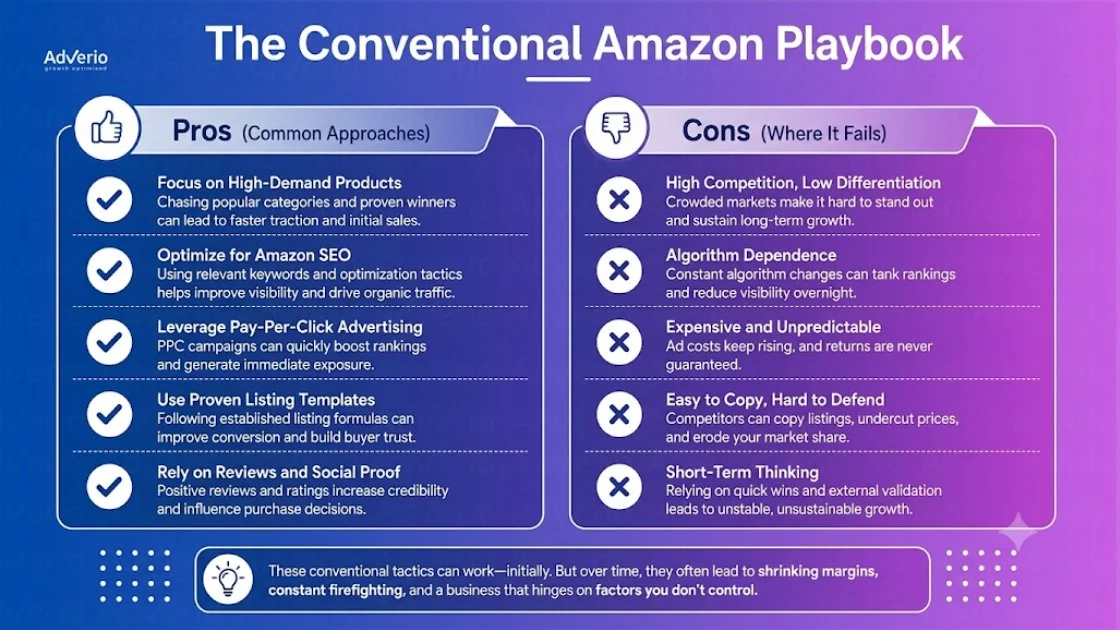
What Agencies and Tools Typically Do
Providers usually sell some version of this package:
-
Copy cleanup: New title, bullets, and description written to “sound better.”
-
Keyword insertion: Primary terms added to visible copy and backend fields.
-
Catalog-wide treatment: Every SKU gets roughly the same level of effort.
-
One-and-done delivery: Files are handed over. Testing and iteration stop.
That made more sense when listing optimization was mostly a keyword placement exercise. It doesn’t hold up now.
If you’re serious about marketplace growth, spend some time evaluating marketplace conversion mechanics, not just channel presence. Marketplaces don’t reward nice copy. They reward relevance, click efficiency, and post-click performance.
Where it breaks down
Amazon’s search environment is moving further away from keyword density and closer to semantic relevance, intent matching, and behavioral signals. That is why a listing can score high on keyword coverage and still lose the sale. Keyword presence does not prove the page answers buyer intent, handles objections, or shows up in AI-generated query responses and shopping-journey patterns.
That gap should end the old debate.
Practical rule: If your listing service reports keyword coverage but can’t explain how the page supports customer intent, return-risk reduction, and shortlist readiness, you bought copywriting, not optimization.
The failure point is deeper than weak copy. A page can be “SEO-optimized” and still lose the sale because it ignores behavioral SEO. That means the structure doesn’t reflect what shoppers need to see, what objections cause returns, or what view-to-buy patterns your DSP and PDP data are exposing.
For established brands, money can vanish. You rank. You get traffic. You still don’t convert enough to justify the spend.
The operator approach
The operator view is simpler. Not every ASIN deserves the same labor. Not every child variation deserves a full creative overhaul. And not every ranking gain matters if it doesn’t translate into better conversion on the products that move the business.
That’s why I’d start with a framework like the Amazon Listing Quality Score before approving broad listing work. The useful question isn’t “Did the copy get rewritten?” It’s “Which child ASINs deserve deep work because the payoff is worth it?”
A Checklist for Serious Listing Optimization Deliverables
A serious listing optimization engagement should produce operating assets your team can use, test, and measure. If all you get is refreshed copy and a keyword sheet, you paid for surface polish while the revenue drivers in your catalog stayed underworked.
Use this checklist to separate serious operators from agencies selling formatted text.
Core deliverables
-
Child-ASIN priority map: The provider should identify which child ASINs drive revenue, margin, and ad spend, then assign effort accordingly. Your best-selling variations need deeper analysis than low-volume tail SKUs.
-
Intent-led copy structure: Titles, bullets, and descriptions should reflect how shoppers compare options, what they worry about before purchase, and what information removes friction.
-
Image sequence plan: The work should specify the job of each image, from click-winning main image to proof, sizing, usage, and objection handling.
-
Backend search term architecture: Backend terms should be organized with discipline, kept within Amazon’s byte limits, and used to support discoverability without stuffing visible copy.
-
Competitor and review mining: The service should extract positioning gaps, recurring complaints, pricing pressure, and language patterns from reviews and competing PDPs.
-
Measurement framework: Success should be tied to conversion rate, organic rank quality, ad efficiency, and variation-level sales impact, not keyword presence alone.
Listing optimization deliverables
| Optimization Area | Commodity Service (The Red Flag) | Strategic Partner (The Standard) |
|---|---|---|
| Copy | Rewrites title and bullets for every SKU the same way | Rebuilds copy around shopper intent, category context, and child-ASIN business value |
| Keywords | Adds obvious terms to title and backend fields | Maps search terms to visible copy, backend fields, and the specific variations that deserve priority |
| Images | Requests “better lifestyle images” | Defines main image logic, image order, objection handling, and visual conversion flow |
| A+ Content | Fills modules with generic brand text | Uses A+ to compare options, educate shoppers, and reduce purchase hesitation |
| Variations | Treats all child ASINs equally | Puts deeper work into the children that carry revenue and standardizes the rest |
| PPC alignment | Leaves ads separate from listing work | Uses search query, CVR, and spend data to guide PDP changes |
| Measurement | Reports keyword presence | Tracks conversion behavior, variation performance, and business impact |
| Iteration | Delivers once and closes ticket | Revisits the listing based on live performance signals |
Get My Profit ROI Forecast: 15-minute diagnostic call. No pitch deck.
The image standard brands still miss
Main images need to meet Amazon’s technical requirements and do the selling work. Hitting the minimum spec is table stakes. The better question is whether the image earns the click, clarifies the product fast, and sets up the rest of the PDP to convert.
A lot of teams fail that test because they treat image quality as a design task instead of a sales task. If your team is cleaning up old assets, confirming images meet both technical specs and conversion requirements is a useful checkpoint before those files enter your listing workflow.
A serious audit should also catch conversion suppressors that have nothing to do with keywords. That is why a structured review like a 12-point conversion suppressor checklist is more useful than another generic SEO package.
If a provider cannot show deliverables at this level, keep your budget. The service is incomplete.
Why Revenue-Weighted Prioritization Is Non-Negotiable
The biggest mistake in Amazon listing optimization services is treating catalog coverage like value creation. It isn’t. Coverage is housekeeping. Value comes from putting the hardest work where the financial upside is concentrated.
In a typical catalog, one or two child ASINs inside a parent do the heavy lifting. Those are the products that deserve the analyst time, the creative testing, the competitive teardown, and the conversion scrutiny.
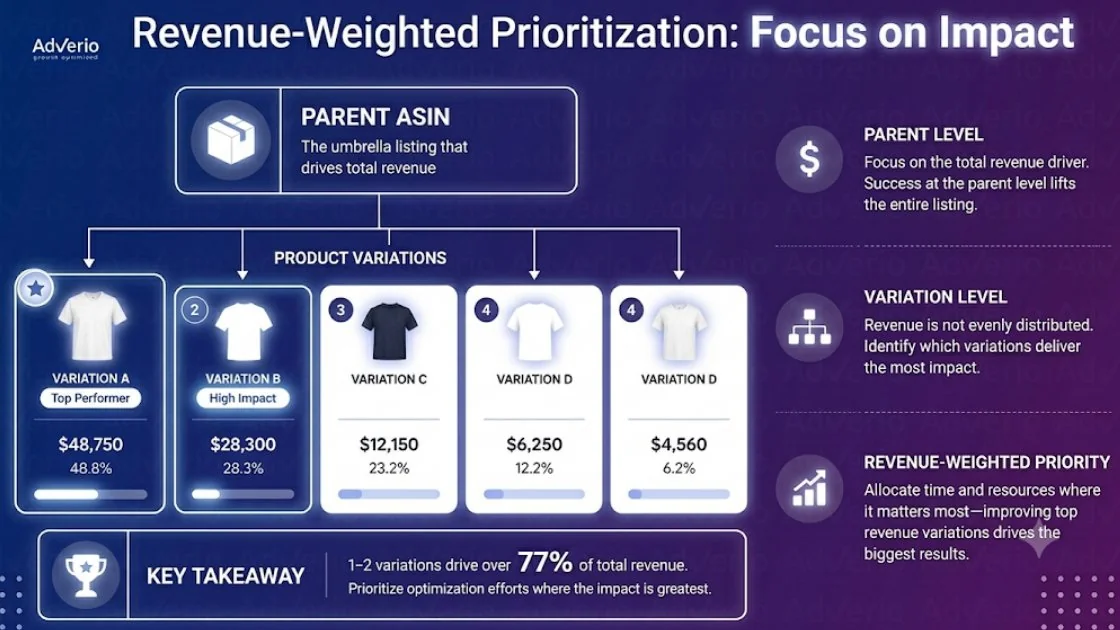
Hero SKUs versus the tail
Hero products need deep work:
-
Manual competitive analysis
-
Image sequencing and main-image testing
-
Offer integration
-
Intent-driven copy
-
Cross-signal refinement from ads, reviews, and returns
The long tail needs something else. Clean structure. Compliance. Baseline discoverability. Reasonable consistency. Not premium labor on every SKU.
That isn’t cutting corners. It’s financial discipline.
Why this matters for operators
Private equity teams, portfolio operators, and established marketplace brands don’t need more output. They need smarter allocation. If your listing service spends the same hours on a minor variation as it spends on a hero SKU, you’re subsidizing low-impact work.
Deep work should follow revenue concentration. Anything else is a staffing model pretending to be strategy.
This logic gets much stronger when you tie it to business intelligence instead of opinion. That’s why frameworks like the Formula to prioritize Amazon products matter. They force prioritization at the child-ASIN level, where the hard tradeoffs live.
The brands that win on Amazon aren’t the ones that “finish” optimization across the whole catalog first. They’re the ones that improve the right pages sooner.
Measuring Commercial Impact Beyond Keywords
Keyword coverage is a vanity report if sales quality does not improve. Plenty of agencies hand over indexing screenshots, a few ranking wins, and a revised title, then act like the work is finished. It is not finished until the right child ASIN converts more profitably.
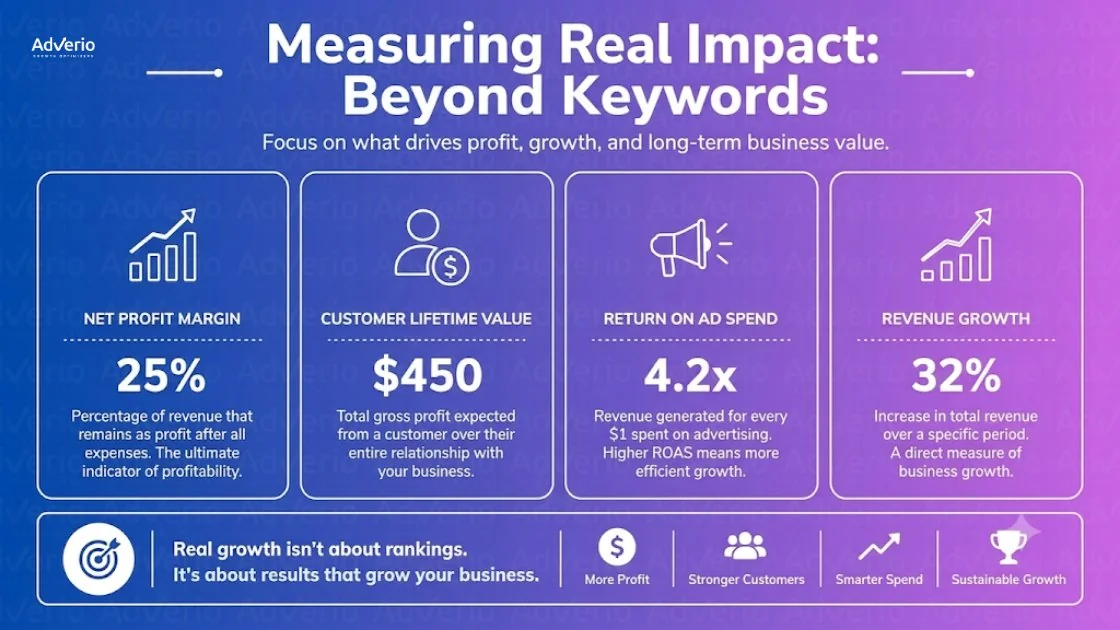
What Should Be Measured
Measure commercial movement, not cosmetic activity.
Start with the child ASINs that drive the business and track outcomes operators can act on:
-
Unit session percentage: This is the clearest early read on whether new copy, images, and offer framing improved conversion.
-
Indexing progress: New terms often begin indexing soon after a listing update, but indexing alone proves nothing if the ASIN does not convert on those terms.
-
Ranking movement: Position changes matter only when they show up on revenue-driving queries for the specific child ASINs that carry the account.
-
Traffic efficiency: Better listing performance should improve the yield from existing traffic, including paid traffic already being bought through PPC.
Those metrics need a time window and context. Conversion usually reacts before rank does. Rank often moves unevenly across parent and child variations. PPC can mask weak listing performance for weeks if you only look at blended account numbers. That is why flat, account-level reporting misses the point. The measurement that matters happens at the child-ASIN level, where margin, conversion, and query intent differ.
Static audits miss the money
A one-time rewrite is maintenance, not optimization. Serious operators keep adjusting listings based on live search query data, ad performance, review language, and conversion behavior. Static annual audits fall behind dynamic optimization cycles, especially in competitive categories where competitors reprice, relaunch, and re-optimize every month.
The bigger mistake is measuring impact evenly across the catalog. If a low-volume variation gains a few ranks, that can look good in a report and mean almost nothing in the P&L. If a hero child ASIN lifts conversion by a small amount, the financial effect is far larger. Revenue weighting fixes that blind spot.
Use a simple standard. Ask which listing changes increased profit density on the SKUs that already command demand. Ask whether those changes reduced paid dependency, improved conversion on high-intent queries, and protected contribution margin. If your vendor cannot answer that clearly, they are producing deliverables, not operating results.
For teams building that measurement discipline, Adverio’s Amazon growth insights offer a better framework than keyword screenshots and before-and-after copy docs.
How Adverio Delivers Profit-Driven Optimization
Many agencies split the work into silos and call that specialization. Listings over here. PPC over there. DSP somewhere else. Then nobody owns the full commercial outcome.
That structure is why brands get stuck.

What a serious operating model looks like
Adverio approaches marketplace growth through a connected model across Amazon, Walmart, and Target.
The work combines listing optimization, Amazon PPC management, DSP, creative, Amazon catalog management, and business intelligence so the team can prioritize the SKUs that matter and act on the data quickly. The model includes Done-for-You and Done-with-You support, dedicated strategy and operations pods, and proprietary systems such as LQS for listing diagnostics, AMOS for revenue-impact prioritization, and SKU Resurrection for catalog recovery.
That matters for one reason. It ties listing decisions to profit decisions.
What brands should demand
If you’re comparing partners, ask these questions:
-
Who owns prioritization? If nobody can explain why one child ASIN gets deep work and another gets baseline treatment, the service isn’t mature.
-
How are PPC and DSP signals used? Listing work should reflect search query performance, view-to-buy behavior, and conversion patterns.
-
Who is accountable for ROI? Reporting without accountability is noise.
-
What happens after launch? Static rewrites age fast.
A vendor ships assets. A strategic financial partner changes how your marketplace business allocates effort, spend, and attention.
If your need goes beyond listing work and into full-funnel execution, the logical next step is to manage your Amazon account through an integrated operating model instead of juggling disconnected specialists.
Frequently Asked Questions
What is included in listing optimization services?
A strong service fixes the parts of the page that win the click and close the sale. That includes titles, bullets, backend terms, image direction, A+ content guidance, review mining, competitor analysis, and a plan to measure what changed after launch.
It also needs judgment.
A vendor that gives the same treatment to every child ASIN is selling labor, not prioritization. Your best-selling variations deserve manual work built around conversion friction, shopper objections, and the search terms already bringing in valuable traffic.
How do you prioritize which listings to optimize?
Start at the child-ASIN level, not the parent listing level. Revenue sits in specific variations, and that is where weak content does the most damage.
Put the deepest effort on the child ASINs that carry sales, have clear conversion upside, or support important category terms. Give the long tail clean, standardized coverage. Anything else burns budget on SKUs that will never pay it back.
Is listing optimization worth the cost?
It is worth it when the work improves conversion, supports stronger ad efficiency, and focuses on the SKUs that matter. As noted earlier, good optimization can show up fast in indexing and conversion behavior.
It is not worth it if you are paying for a full-catalog rewrite with no revenue weighting, no testing discipline, and no follow-through once the new content goes live.
How is success measured?
Start with unit session percentage and conversion rate on the specific child ASINs that received the work. Then check whether those pages are indexing for the intended terms and gaining rank where the upside is worth it.
After that, look at profit signals. Better listings should help the same traffic produce more sales and give paid traffic a better chance to convert. If the report only shows keyword movement, you are looking at output, not return.
Ready to See This in Your Account?
If your current Amazon listing optimization service is treating every SKU the same, you’re overpaying for the tail and under-investing in the products that matter. That’s how brands stay busy and stay flat.
If you want a clear view of which listings deserve deep work, which ones need baseline cleanup, and where your conversion gaps are costing you profit, Book Your ROI Forecast with Adverio. Every sale your competitor closes is one you didn’t. Fix the pages that carry the business first.