



Table of Contents
The best Target.com advertising agencies are true Roundel partners who secure invite-only Target Plus access first, before they run profit-driven media. Roundel works with more than 2,000 vendors, but that scale means nothing to your brand if your agency can’t get you through the door and manage the channel like an operator instead of a media buyer.
Most advice on this topic is backward. Agencies love talking about campaign structure, retail media dashboards, and omnichannel reporting.
Fine. But if they ignore marketplace access, they ignore the first real bottleneck. That makes them a weak choice for brands serious about growth on Target. If you’re still treating Target like a side quest, you’re handing momentum to competitors who won’t.
If you need the full breakdown of how Roundel works, what Target Plus access requires, and how Adverio manages the channel, those live in the Target advertising guide, the sell on Target Plus guide, and the Target account management page. What this guide adds is the agency comparison layer: how to evaluate any Target advertising partner against the criteria that actually predict whether they can grow your brand on Target, not just run campaigns.
What Are the Best Target.com Advertising Agencies, and What Do Roundel Partners Do?
The best Target.com advertising agencies are the ones that handle the full path. They help qualified brands pursue Target Plus access, then manage Roundel media, content relevance, and profit discipline inside Target’s ecosystem. Most agencies only do the second part. That’s the problem.
At a Glance
-
Access is the real gate. Target Plus is invite-only. If a partner can’t get you in, media strategy is beside the point.
-
Relevance before bids. Weak titles and bullets raise your cost per click no matter how hard you bid.
-
Roundel Media Studio changed the math. No DSP or access fees frees up roughly 15 to 20% of spend.
-
Manage Target on purpose. It’s usually the smallest slice of a multi-marketplace budget, so treat it as a profit call, not a vanity channel.
The conventional playbook, and where it breaks
Most agencies treat Target like a lightweight extension of Amazon or Walmart. They copy over bidding habits, plug campaigns into a reporting stack, and call it Target strategy.
That approach is lazy. It also misses how under-documented this channel still is for buyers trying to understand what a roundel agency or target retail media agency does.
What most agencies and tools do
You’ll usually get some version of this:
-
Campaign setup: Search and product ad management inside the available Target ad environment.
-
Basic reporting: Performance summaries tied to spend, RoAS, and conversion trends.
-
Retail media add-on support: A bolt-on service beside Amazon and Walmart work.
-
Content nods: Light mention of titles, bullets, and listing quality without hard operational ownership.
Some of that matters. None of it is enough on its own.
Where it breaks down
The first break is access. If Target Plus is invite-only, then your first screening question shouldn’t be about dashboards or creative testing. It should be whether the agency can help your brand get onto the platform at all.
The second break is execution quality. Most agencies treat paid search and native content as two separate problems. They test search terms but rarely admit that weak relevance in your titles and bullets drags down ad performance, even when bids are aggressive. On Target, a thin PDP makes every click more expensive.
Most brands don’t have a bidding problem first. They have a relevance problem first.
The third break is buying model clarity. Roundel Media Studio is Target’s self-service ad platform, and it dropped the DSP and access fees that used to eat into Target Product Ads budgets. That frees up roughly 15 to 20% of spend most brands were quietly losing to fees. Most agency content still won’t explain how that shift changes your campaign economics.
The operator approach
A real Target growth partner handles access, listing relevance, media, and measurement as one operating system. That’s what separates a vendor from a growth partner.
If you’re evaluating agencies, screen in this order:
-
Access first: Can they help your brand pursue the invite-only marketplace path?
-
Operational control second: Do they own the title, bullet, content, and catalog quality issues that affect ad efficiency?
-
Profit discipline third: Do they optimize to margin and TACoS pressure, or just spend pacing?
Midway through your evaluation, compare any agency’s Target offering against its actual Target PPC management approach and how it connects media to profit, not just platform metrics.
1. Adverio
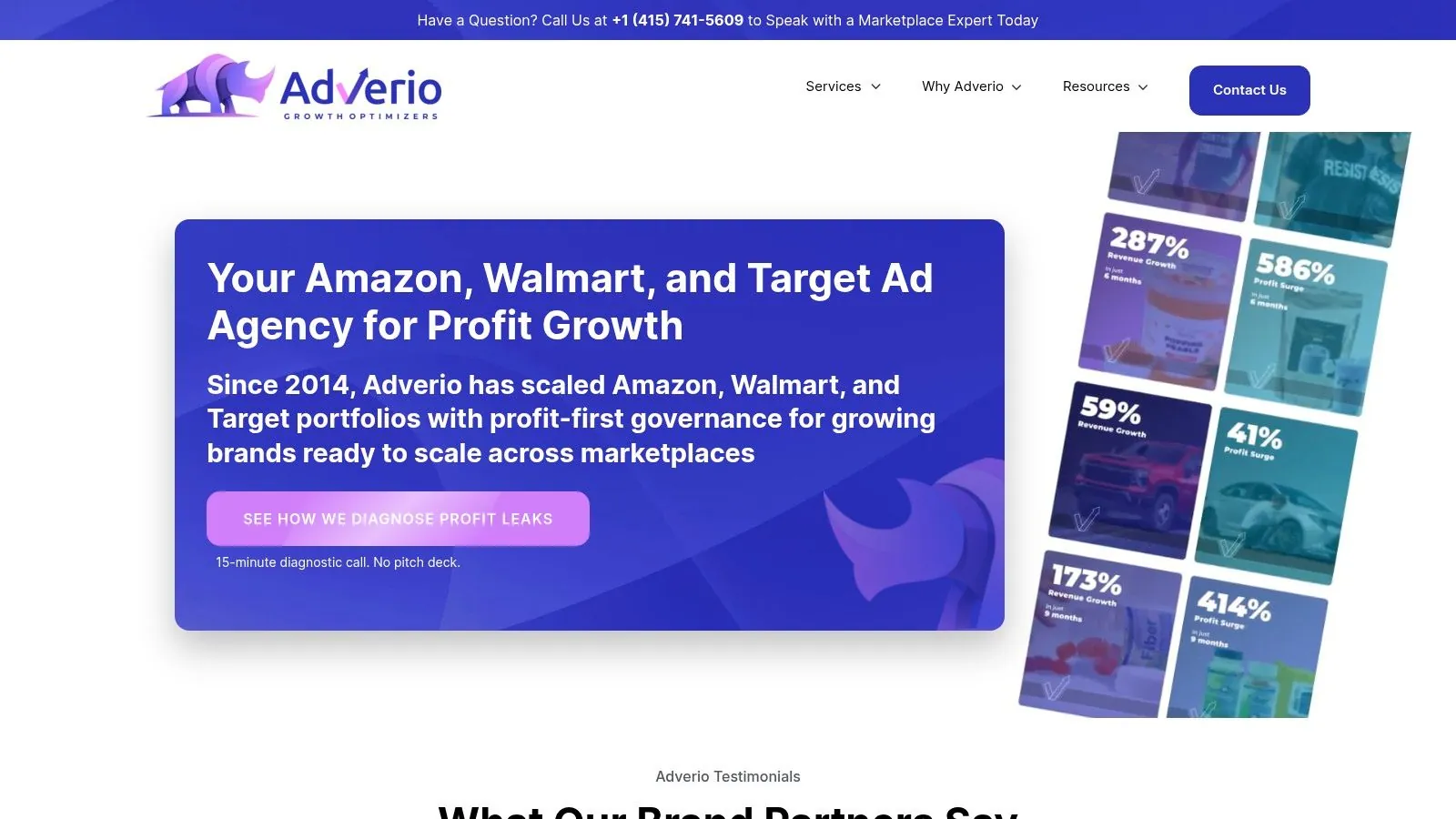
Adverio is the strongest pick for established brands that don’t need another ad manager. They need an operator. That’s a different standard.
The firm positions Target inside a wider Amazon, Walmart, and DTC growth system, which matters because channel conflict kills profit faster than bad campaign settings. The same Amazon growth strategy discipline that governs its core marketplace carries straight into how it runs Target. Adverio doesn’t isolate Roundel work from listing quality, inventory pressure, pricing, or portfolio-level margin decisions. That’s the right model for brands already doing meaningful volume and trying to break out of a plateau.
Why Adverio stands out
Adverio’s edge is simple. It treats Target expansion as an access-plus-execution problem, not a media task.
That means the work starts before ads. If your brand belongs on the platform, Adverio can help you evaluate the path to selling on Target Plus. That’s the filter most agencies can’t clear. Once access is in play, the team runs media with the same operator discipline behind its Amazon account management work across Amazon and Walmart.
The second differentiator is governance. Adverio frames growth around proprietary systems including the Growth Cultivator framework, Profit Pulse System, AMOS, GEAR, LQS, PPS, SKU Resurrection, and Brand Drain Reversal. Whether you’re in softlines, hardlines, or CPG, that matters because growth stalls rarely come from one broken tactic. They come from compounding leaks across catalog, media, conversion, and operations.
Practical rule: If your agency only owns ads, you’ll keep paying for problems it doesn’t fix.
Who it’s best for
Adverio is a fit for brands that are already established and care about profit more than vanity scale.
-
Multi-marketplace brands: Best for operators selling across Amazon, Walmart, and Target who need one profit lens.
-
Large catalogs: Strong fit for brands with complex variant structures and fragmented catalog issues.
-
Margin-focused teams: Better for companies that care about TACoS, contribution, and operational drag, not just top-line spend efficiency.
-
Decision-makers who want visibility: Useful for CMOs, founders, and portfolio teams tired of black-box reporting.
The clearest proof point is from Adverio’s own case study library. One client reached +173% revenue growth and +414% profit increase in 9 months while securing the #3 category position, as shown in Adverio’s published Hemrid growth case study. That’s not a Target-specific claim, but it does show the level of commercial rigor the team brings to marketplace growth.
If you want cleaner measurement across retail channels, Adverio’s business intelligence services are the right place to inspect how it ties media decisions back to profitability.
2. Tinuiti
Tinuiti is a serious option if you want a large independent commerce media agency with broad retail media coverage and a visible point of view on Roundel changes. It has the scale, process, and cross-channel depth that enterprise brands often want.
That said, Tinuiti is a media-led choice. If your real bottleneck is Target Plus access, don’t confuse broad retail media capability with marketplace entry support.
Where Tinuiti fits
Tinuiti works best for brands that already have internal readiness and need a strong retail media execution partner across several networks. Its public material regularly addresses retail media trends, and its positioning around Target Product Ads and Media Studio signals solid channel familiarity.
This is useful if your team needs a partner that can connect Roundel work with search, social, CTV, and wider measurement planning. For larger organizations, that’s often enough to justify the relationship.
Watch-outs
Tinuiti is less compelling for brands that still need the basics solved. If your listing relevance is weak or your path onto the platform isn’t clear, enterprise process won’t save you.
Strong media strategy doesn’t fix a closed door.
Use Tinuiti when your brand is already operating at a level where scale, structure, and integrated measurement matter more than access support.
For direct review context, agency buyers should ask directly for client references and case studies specific to Target.com advertising before committing.
3. Flywheel Digital (Omnicom Commerce Group)
Flywheel Digital is built for brands that want retail media and retail operations talking to each other. That’s the appeal. Its model isn’t just about campaign activation. It’s about connecting commerce intelligence, placements, and operational signals in one system.
For Target work, that matters because weak coordination between media and retail operations creates waste fast. Flywheel’s public Target education and commerce positioning make it a credible pick for scaled brands.
Why brands consider Flywheel
Flywheel’s value is strongest when your business needs more than hands-on-keyboard ad work. If your team is juggling assortment decisions, retail media pressure, and marketplace execution across major retailers, Flywheel’s broader commerce stack can make sense.
Its Omnicom backing also puts it in the enterprise lane. That gives buyers confidence on breadth, but it also means the fit is usually better for larger brands with more complexity.
Best use case
Choose Flywheel when your challenge is coordination. If your content, supply, retail media, and marketplace intelligence live in separate silos, a more integrated operating environment can help.
Skip it if you need a simple plug-in Target specialist or if marketplace access is your first issue. Flywheel is stronger as an execution and systems partner than as an answer to the invite-only problem.
4. Harvest Group
Harvest Group is one of the more Target-native names on this list. If Target is a strategic priority for your business, not a side channel, Harvest deserves a close look.
Its positioning is tightly aligned with Target account management and Target Product Ads. That can be a major advantage for brands that want one partner steeped in the retailer’s operating environment.
Why Harvest is different
Harvest’s strength is channel specificity. It isn’t trying to be everything to every marketplace. It knows Target’s ecosystem, retailer relationships, and operational realities.
That focus can make it a strong fit for vendors that need close alignment between account services and retail media execution.
What to screen for
The same caution applies here as with every agency in this category. Ask whether the firm can address access, not just ads. If the answer is vague, you still have the same strategic gap.
Also remember the content gap noted earlier. Harvest’s own guidance mentions search term testing, but brands still need a partner that takes native content relevance seriously inside campaign performance management.
5. Pacvue
Pacvue sits in a different category because it’s a platform with managed-services support, not just an agency. That changes the buying decision.
If your brand has meaningful SKU depth and wants tighter control over automation, inventory-aware advertising, and retail media workflows, Pacvue is worth considering. It’s especially useful when wasted spend is tied to operational blind spots.
Where Pacvue earns its place
Pacvue is built for teams that want software plus support. That’s powerful when your media performance depends on inventory, shelf signals, and campaign automation working together.
For Target, that can help prevent common waste patterns such as pushing budget into products that aren’t in position to convert well.
Best fit and tradeoff
Pacvue makes the most sense for mature in-house teams or brands comfortable adopting a platform layer. If you want a pure operator to own strategy and execution end to end, an agency-first model may feel cleaner.
Choose Pacvue when systems control is the priority. Choose an operator-first partner when accountability is the priority.
6. Blue Wheel
Blue Wheel is a good choice for brands that know their Target performance problem isn’t just media. It’s usually content, operations, and marketplace execution showing up inside media results.
That broader marketplace lens is useful. Too many agencies still separate ads from catalog health, and then wonder why performance stalls.
Why Blue Wheel is appealing
Blue Wheel connects ads, content, and operations across marketplaces. That’s the right conceptual model for Target, especially when product detail relevance and retail readiness shape paid outcomes.
If Target is one part of a multi-marketplace strategy, Blue Wheel can be a practical fit.
Where it lands
This isn’t the agency I’d pick for a pure Roundel-only mandate. It makes more sense when your team wants Target included inside a broader commerce plan across Amazon and Walmart.
That matters because many brands shouldn’t over-allocate to Target in the first place. A common starting split for brands active on all three marketplaces is roughly 70% Amazon, 20% Walmart, and 10% Target, then you adjust based on where your margin actually lives. Whether you follow that exact mix or not, the point holds. Target should be managed intentionally, not sentimentally.
7. Channel Bakers (part of Havas)
Channel Bakers brings a retail media and creative angle that some brands will value more than pure marketplace mechanics. Now backed by Havas, it offers more scale and broader cross-channel support than a boutique specialist.
That makes it interesting for brands that need retail storytelling, activation, and broader media planning around retailer ecosystems including Target.
When Channel Bakers makes sense
If your brand needs stronger creative support tied to retail media execution, Channel Bakers has a sensible position in the market. Not every Target growth problem is a bid or catalog issue. Some brands need stronger retail-facing communication and campaign packaging.
The tradeoff
Its public positioning is lighter on Target-specific detail than some other names here. That doesn’t make it weak. It just means buyers need to ask sharper questions during evaluation.
If you’re considering a larger network-backed partner, also pressure-test how well they understand Target’s customer promise. Target differentiates itself through free shipping and free returns, added shipping and return tiers for RedCard holders, and the app-led Drive Up experience. A Target Plus agency should understand that shopper context because it shapes merchandising and media strategy.
Top 7 Target.com Advertising Agencies Comparison
| Provider | Implementation complexity | Resource requirements | Expected outcomes | Ideal use cases | Key advantages | Key limitations |
|---|---|---|---|---|---|---|
| Adverio | High, deep cross‑channel systems and governance | Mid‑market to enterprise budgets; cross‑platform data integration | Rapid profit‑leak detection; measurable TACoS and profit improvements | 7‑ and 8‑figure brands scaling across Amazon, Walmart, Target and DTC | Unified profit‑first BI, cross‑market operator model, guaranteed ROI diagnostic | Premium, tailored services; prescriptive governance may not suit small sellers |
| Tinuiti | Medium–High, process‑heavy onboarding and measurement design | Enterprise budgets and large media spend; dedicated retail‑media teams | Full‑funnel retail media performance and Roundel optimizations | Enterprise brands needing Roundel/Target strategy and omnichannel planning | Broad retail‑media coverage, up‑to‑date Roundel expertise and benchmarks | Enterprise focus may exclude smaller budgets; onboarding can be slow |
| Flywheel Digital (Omnicom) | Medium–High, tech + managed services integration | Mid‑market/enterprise, requires data and process integration | Unified retail media + operations insights; Target playbook activation | CPG and scaled brands needing commerce cloud and Target guidance | Deep Target specialization, combined tech and managed services | Oriented to larger brands; tech stack needs integration effort |
| Harvest Group | Medium, Target‑centric setup with partner integrations | Resources to integrate POS and Roundel; Target operations alignment | Improved Target Product Ads performance and omnichannel reporting | Brands prioritizing Target as a strategic retail channel | Official Roundel Premium Partner, POS + advertising reporting | Highly Target‑centric; partner guardrails can limit custom tooling |
| Pacvue | Medium, platform adoption with optional managed services | Platform subscription fees; best with substantial SKU/media scale | Automated campaigns tied to inventory; reduced wasted spend | Brands with many SKUs and inventory complexity on Target | Purpose‑built Target tooling, real‑time commerce signals, automation | Subscription costs; may not suit brands avoiding new software |
| Blue Wheel | Medium, multi‑marketplace coordination across ads, content, ops | Marketplace content and operational support required | Unified marketplace growth linking ads, catalog health and distribution | Sellers active on multiple marketplaces (Amazon, Walmart, Target) | Holistic marketplace approach beyond media; catalog and protection focus | Less public Roundel‑specific case studies; stronger Amazon/Walmart emphasis |
| Channel Bakers (Havas) | Medium, network agency processes and full‑funnel planning | Creative and media budgets; access to Havas resources for scale | Creative‑led retail activations and scalable retail‑media programs | Brands seeking high‑impact creative integrated with retail media | Retail‑creative strength, network backing for cross‑channel work | Target‑specific documentation is lighter; network layers may slow some projects |
Get My Profit ROI Forecast
15-minute diagnostic call. No pitch deck.
FAQs
Do I need Target Plus access before running Roundel ads?
Yes. Target Plus is invite-only, and Roundel media only works once your products are live on the platform. If a partner can’t help you pursue access, they can’t run a full Target program. Access first, media second.
What is the difference between Roundel and a Target advertising agency?
Roundel is Target’s own retail media network, the ad system itself. A Target growth partner runs that system for you, plus the listing, content, and profit decisions Roundel doesn’t touch. Roundel gives you the tools. A good partner tells you which levers to pull and why.
How is Roundel Media Studio different from the old Target Product Ads setup?
Roundel Media Studio is Target’s self-service platform for Target Product Ads. It removed the DSP and access fees that used to sit on top of spend, freeing up roughly 15 to 20% of budget for actual media. It also adds keyword controls and reporting most brands didn’t have before.
Should my brand advertise on Target if it already sells on Amazon and Walmart?
Only if the margin math works; for most multi-marketplace brands, Target is the smallest slice of the budget, often around 10%. Treat it as a profit decision, not a box to check. The right partner tells you when Target is worth it and when your money belongs elsewhere.
Ready to See If Your Brand Can Get on Target Plus?
Your Target.com strategy is either winning or losing. There is no middle ground. Choosing a partner that can’t get you through the door on Target Plus is choosing to stay constrained while someone else takes the shelf, the visibility, and the customer.
Roundel matters. Target’s retail media business works with more than 2,000 vendors and is built to create personalized ad experiences across Target’s digital ecosystem, according to Target’s Roundel fact sheet. But here’s the hard truth. Access still comes first. Media can’t scale a brand that isn’t positioned to enter and operate correctly.
That’s why your screening process should be brutally simple. Can the partner help with eligibility and application? Can the team manage content relevance, media, and reporting as one profit system? Can they think like operators instead of ad buyers? If not, move on.
Adverio is the best fit here for brands that are serious about retail expansion because it doesn’t stop at campaign management. It approaches Target the way it should be approached. As an invite-only access challenge first, then as a governed profit engine. That’s the difference between activity and growth.
If your team is still comparing agencies based on media features alone, you’re asking the wrong question. Start with access. Then demand profit discipline.
If you’re done guessing, book your ROI Forecast with Adverio. We’ll tell you whether your brand is a fit for Target Plus, where your current retail media approach is leaking profit, and what your retail expansion options actually look like.