


Table of Contents
Stop chasing revenue at all costs.
There’s one metric that separates cash-burning brands from sustainably scaling brands, and most businesses are completely ignoring it: your CAC Payback Period. It’s the time it takes to earn back every single dollar you spent to acquire a new customer. This is the metric that determines whether your growth is self-funding—or slowly killing your cash flow.
If you don’t know your payback period, you’re scaling blind. Get Your ROI Forecast and see exactly where profit is leaking—and how to fix it. And get a clear picture of your brand’s untapped potential.
Your Profitability Blind Spot
Most brands are obsessed with vanity metrics. They pop the champagne when sales charts go up and to the right or when ACoS drops, but they never ask the most important question: When do we actually start making money from these new customers?
This is classic Optimization Myopia—optimizing channels while ignoring whether the business actually makes money, and it’s the fastest way to burn through your cash reserves. The CAC Payback Period cuts right through that noise. It’s a simple, brutally honest measure of how efficient your marketing machine really is.
-
It’s a Cash Flow Predictor: It tells you exactly how long your cash is tied up in customer acquisition before it comes back as profit. The shorter the payback, the faster you can reinvest that capital into more growth—without needing to raise another round.
-
It’s a Health Diagnostic: A long or creeping payback period is a massive red flag. It’s screaming that your acquisition costs are too high, your margins are razor-thin, or your customers simply aren’t valuable enough to justify what you’re spending to get them. If you don’t know where the leak is, you need a profitability audit to diagnose it properly.
-
It’s a Strategic Filter: This metric forces you to look at every single channel, campaign, and strategy through a profit-first lens. It’s the final word on whether your growth is sustainable or just an expensive illusion.
If you don’t know where the leak is, you need a profitability audit to diagnose it properly.
Ditching Vanity Metrics for Real Growth
Metrics like ROAS and ACoS are useful for measuring campaign-level efficiency, but they don’t tell the whole story. A campaign can have a fantastic ROAS but attract low-margin, one-and-done buyers, leading to a dangerously long payback period.
On the flip side, a campaign with a higher ACoS might bring in customers who make repeat purchases, dramatically shortening your payback period and fueling long-term profitability.
The difference between a brand that scales sustainably and one that hits a wall is often an obsession with payback speed. Leaders who master this metric know that true growth isn’t about getting the most customers—it’s about getting the most profitable ones, faster.
Thinking about profitability demands a full-funnel view. Even something as seemingly disconnected as your returns process can eat into your margins, which directly impacts how quickly you pay back acquisition costs. Understanding key Amazon return recovery strategies is just one piece of a much larger profitability puzzle that starts with knowing your numbers.
This guide will walk you through exactly how to calculate, benchmark, and shorten your CAC Payback Period, shifting your focus from chasing sales to building a resilient, profit-driven e-commerce machine.
Here’s a quick look at why this metric is so critical for e-commerce brands.
Why Your CAC Payback Period Matters More Than You Think
| Payback Period | Business Health Indicator | Strategic Implication |
|---|---|---|
| Under 6 Months | Excellent: You’re a cash flow machine. | You can reinvest profits rapidly, fund growth organically, and outspend competitors without relying on external capital. |
| 6-12 Months | Healthy & Sustainable: A solid, venture-backable model. | You have a proven, efficient growth engine. Scaling is manageable, and your business model is attractive to investors. |
| 12-18 Months | Caution Zone: Your model is capital-intensive. | Growth is expensive and slow. You’re vulnerable to market shifts and may struggle to scale without significant funding. |
| 18+ Months | Danger Zone: You’re likely burning cash to grow. | Your business model is unsustainable. You’re at high risk of running out of money before customers become profitable. |
Ultimately, a shorter payback period gives you more control, more options, and a much more resilient business.
How to Calculate Your CAC Payback Period (Without the Fluff)
Forget the fuzzy math and messy spreadsheets. Figuring out your CAC payback period is actually pretty straightforward once you cut through the noise. At its core, it’s all about answering one simple question: when does a customer stop being a cost and start making you money?
The formula itself is brutally simple:
CAC Payback Period (in months) = Customer Acquisition Cost / (Average Monthly Revenue Per Customer x Gross Margin %)
Let’s pull apart each piece of that equation so you can calculate this with total confidence.
Deconstructing the Formula
To get a payback period you can actually trust, you have to be brutally honest with the numbers you plug in. Cutting corners here will give you a dangerously misleading result, making your marketing look way more efficient than it really is.
1. Customer Acquisition Cost (CAC)
This is the total, all-in cost to get one new customer. Don’t just count your ad spend. A fully-loaded CAC includes everything:
-
Total Ad Spend: Your PPC budgets across Amazon, Walmart, Target, etc.
-
Agency & Partner Fees: The cost for experts like us at Adverio.
-
Creative & Content Costs: Everything from A+ Content design to ad creative.
-
Salaries: A slice of your marketing team’s salaries that’s dedicated to acquisition.
-
Software & Tools: Any analytics, keyword, or campaign management tools you pay for.
Just add up all these costs for a set period (like a month) and divide by the number of new customers you brought in during that same time.
2. Average Monthly Revenue Per Customer
This is exactly what it sounds like: the average amount of money a single customer brings in each month. For e-commerce brands without a subscription model, you can often use Average Order Value (AOV) as a solid starting point, especially if repeat purchases aren’t super frequent.
3. Gross Margin %
This is the tripwire for so many brands. Never, ever use revenue alone. You have to use gross profit—that’s the money left over after you’ve paid for the cost of goods sold (COGS), marketplace fees, and fulfillment.
Gross Margin is your reality check. It’s the actual cash you have from each sale to pay back acquisition costs and fund the rest of your business. Using revenue will make your payback period look dangerously shorter than it really is.
The simple flow below shows this journey perfectly, from the initial spend to the day you finally turn a profit on that customer.
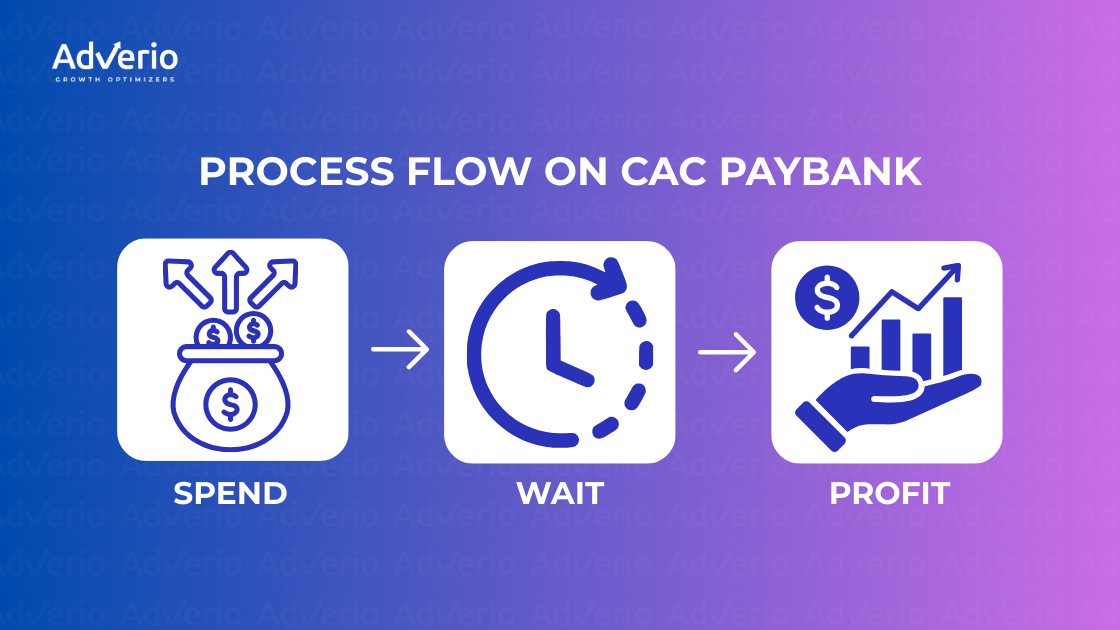
This visual strips the whole concept down. You spend money, you wait for that investment to pay for itself, and then you start reaping the rewards.
A Real-World Calculation Example
Let’s put this into practice with an apparel brand selling on Amazon.
-
Total Monthly Acquisition Spend: $30,000 (this includes ad spend, agency fees, and creative)
-
New Customers Acquired: 500
-
Average Order Value (AOV): $100
-
Gross Margin: 40%
Step 1: Calculate CAC
$30,000 / 500 new customers = $60 CAC
Step 2: Calculate Monthly Gross Profit Per Customer
$100 AOV x 40% Gross Margin = $40 Gross Profit Per Customer
Step 3: Calculate CAC Payback Period
$60 CAC / $40 Monthly Gross Profit = 1.5 Months
So, it’ll take this brand a month and a half to earn back the money it spent acquiring each customer. After that 1.5-month mark, every purchase that customer makes is pure profit. This ties directly into the fundamentals of calculating ROI, since your payback period is essentially just a time-based return on your acquisition investment.
It’s also worth noting this metric looks very different depending on the business model. In the B2C world, payback periods are generally much shorter than in B2B. That’s just the nature of different sales cycles. Top-tier B2C companies might see a payback in just six months, while a B2B enterprise software company could be looking at 24 months.
So, What’s a Good CAC Payback Period for an E-commerce Brand?
Knowing your CAC payback number is half the battle. The other half is knowing what that number actually means for your business. There’s no universal answer—but there is a clear threshold where growth becomes dangerous when it comes to what makes a “good” payback period. It’s a moving target that depends on your industry, your margins, and how fast you’re trying to grow.
What’s perfectly healthy for a high-end furniture brand could be a death sentence for a company selling coffee pods. The goal isn’t just to calculate this metric. It’s to hold it up against the right benchmarks for your specific corner of the e-commerce world. Without that context, you’re just staring at a number on a spreadsheet, totally blind to whether it’s a green light for growth or a flashing red warning sign.
Setting Realistic E-commerce Benchmarks
For most e-commerce and DTC brands, the operational threshold is under 12 months. Anything longer than that, and you’re tying up way too much cash for far too long. It chokes your ability to reinvest, restock, and actually scale the business.
But we can get a lot more specific.
-
CPG & Consumables: Are you selling things people buy over and over, like supplements, coffee, or cleaning supplies? Your target should be aggressive: under 6 months. Your whole model is built on frequent, predictable repeat purchases, so you need to get your acquisition cost back in the bank ASAP to fund the next cycle.
-
Apparel & Softlines: Selling clothes, shoes, or home textiles? A payback period between 6 and 9 months is a healthy range. People come back, but the buying cycle is naturally longer than for CPGs. This window strikes a great balance between investing in growth and keeping cash flow healthy.
-
Hardlines & High-Margin Goods: If you’re in the business of higher-ticket items—think furniture, automotive parts, or specialized equipment—a longer payback period of up to 12 months can work. The bigger gross margin on each sale gives you more breathing room to patiently recoup that initial ad spend.
Now, you’ll see a lot of benchmarks online that are heavily skewed by the SaaS world. Don’t get tripped up by those. Software companies play by different rules with recurring subscriptions and totally different margin structures. The median CAC payback for a private SaaS company might be 12 to 15 months—a timeline that would put most physical product brands out of business. If you’re curious, you can see how SaaS payback benchmarks differ and why you shouldn’t apply them directly to e-commerce.
The Critical Link: Payback Period and Customer Lifetime Value (cLTV)
Your CAC payback period doesn’t exist in a vacuum. It has a partner in crime, and that partner is Customer Lifetime Value (cLTV). The relationship between these two metrics is the real indicator of your business’s long-term health.
Think of it this way: CAC payback tells you when you break even on a customer. Your cLTV tells you how much profit you’ll make from them over their entire relationship with your brand.
A longer payback period can be a smart, strategic move—but only if it’s backed up by a monster cLTV. For instance, if you know a customer you acquire today is going to generate 10x their acquisition cost over the next three years, you can absolutely stomach a 12-month payback. You’re not just spending money; you’re making a calculated investment in a highly profitable asset.
On the flip side, if your payback period is creeping toward 12 months and your cLTV is only 2x your CAC, you have a massive problem. You’re spending a lot of time and money just to acquire customers who barely turn a profit. That’s the financial quicksand that sinks otherwise promising brands.
The key is making sure there’s a healthy, profitable gap between when you break even and when that customer stops buying from you. That gap is where your business truly thrives.
Five Profit Levers That Actually Shorten Payback
Knowing your payback period is one thing. Actively shrinking it is how you build a cash-flow machine that funds its own growth. A long payback period acts like a brake on your business, tying up capital that you could be using to outmaneuver competitors or scale up operations.
It’s time to stop waiting for customers to become profitable and start engineering that outcome from day one. These five strategies are pulled directly from how we structure profit-driven growth across marketplaces and are designed to do exactly that—slash your payback period and put you back in control of your financial destiny.
1. Profit-Driven Catalog Optimization
The fastest way to get your money back is to simply make more of it on the very first sale. This isn’t just about cranking up prices across the board; it’s about strategically increasing the value of every single transaction.
Your goal here is to boost Average Order Value (AOV) and Gross Margin at the same time. When a customer’s initial purchase generates more profit, the math for your payback period shifts dramatically in your favor.
Here are a few actionable ways to do this:
-
Strategic Bundling: Group complementary products together. Instead of just selling a single bedding sheet, you could offer a “Complete Sleep Set” with sheets, pillowcases, and a duvet cover at an attractive bundle price. This move instantly increases the total transaction value.
-
Tiered Pricing: Introduce “good-better-best” options. For an automotive part, this might look like a standard version, a premium version with a longer warranty, and a professional-grade version for enthusiasts. This naturally guides customers toward higher-margin choices.
-
Intelligent Cross-Sells: Use marketplace tools like Amazon’s “Frequently Bought Together” to your advantage. Make sure your product listings are surfacing high-margin add-ons, turning a simple purchase into a much more profitable basket.
2. Intelligent Growth Marketing
Stop wasting your ad budget on low-intent audiences. This is where a strong Amazon PPC management strategy directly reduces CAC and accelerates payback. The secret to a shorter CAC payback period is focusing your ad spend on shoppers who are ready to buy now and are likely to come back for more. This means ditching the old “spray and pray” approach for surgical, data-driven targeting.
This is where a strong Amazon PPC and DSP strategy directly reduces CAC and accelerates payback. When you acquire customers for less, you shrink the “CAC” part of the payback equation, making it that much easier to recoup your investment. To really move the needle and reduce your CAC, you might look into advanced strategies like leveraging AI for ads and user acquisition.
Focus on these high-leverage areas:
-
Target High-Intent Keywords: Go after long-tail keywords that signal a strong intent to purchase (think “organic cotton king size sheet set” instead of just “bed sheets”). These searches might have lower volume, but they convert at a much higher clip.
-
Optimize Ad Placements: Dig into your data. Figure out which ad placements—Top of Search, Product Pages, etc.—are delivering the most profitable customers, not just the most clicks. Then, reallocate your budget to what works.
-
Leverage Audience Targeting: Use platforms like Amazon DSP to retarget shoppers who viewed your products but didn’t buy. You can also target audiences based on their past purchase behavior in your category, which is incredibly powerful.
3. Holistic Marketplace Conversion Rate Optimization
Every click that doesn’t turn into a sale is just wasted ad spend, stretching out your payback period. Your product detail pages need to be finely-tuned conversion machines.
Holistic conversion rate optimization (CRO) means looking beyond just keywords and bids to fix the entire customer experience on the page itself. True conversion rate optimization across marketplaces is what turns traffic into profitable customers.
A higher conversion rate means you get more customers for the same amount of ad spend, which directly lowers your CAC. That’s exactly what Amazon listing optimization is designed to improve at scale.
A 1% increase in your conversion rate can have a monumental impact. For a product with a 10% conversion rate, improving it to 11% is a 10% increase in efficiency, directly cutting the cost to acquire each new customer.
Key CRO levers to pull:
-
A+ Content and Storefronts: Use compelling visuals and copy to tell your brand story, answer common questions before they’re asked, and build trust. A well-designed storefront can also be a great driver for multi-item orders.
-
Review Management: Actively manage and syndicate your reviews. A strong review score is one of the most powerful conversion drivers you have on any marketplace. Period.
-
Image and Video Optimization: Your main image has to grab attention and communicate value instantly. Lifestyle photos and videos that show the product in use can dramatically lift conversion rates.
4. Engineer Repeat Purchases from Day One
Why leave a second purchase up to chance? The most successful brands build retention right into their acquisition strategy. A customer who buys a second time has effectively cut their payback period in half and sent their customer lifetime value (cLTV) soaring.
Your goal should be to create a seamless, almost irresistible path from the first purchase to the second.
Tactics for engineering repeat business:
-
Post-Purchase Email Flows: Use automated email sequences to onboard new customers, provide genuine value (like care instructions for an apparel item), and introduce them to complementary products they might love.
-
Subscription Models: For CPG or other consumable goods, a “Subscribe & Save” option is the ultimate tool for shortening your payback period. It guarantees recurring revenue from the moment of acquisition.
-
Loyalty Programs: Implement a simple points-based system that rewards customers for their second and third purchases. This creates a powerful, tangible incentive for them to return.
5. Optimize Your Ad Spend for Profitability
Finally, you have to connect your ad spend directly to profitability, not just revenue. So many brands fall into the trap of optimizing for a low ACoS, accidentally acquiring a bunch of low-margin customers. Shifting your focus to profit-driven bidding is a complete game-changer for your CAC payback period.
This is where a lot of brands get stuck in “Optimization Myopia.” For a deep dive into breaking this cycle, our guide on reducing Amazon PPC ad spend without sacrificing sales offers a framework for profit-focused campaign management.
The core idea is simple: bid more aggressively on the products and keywords that deliver high-margin customers and pull back on those that don’t—even if the ACoS looks good on the surface. This ensures every single ad dollar is working hard to shorten your payback period, not just generate empty revenue.
Connecting Payback Period to Your Broader Growth Strategy
Your CAC payback period isn’t some number you calculate once, file away, and then forget about. It’s the central gear in your entire growth machine. Too many brands treat it like just another marketing metric and always end up a step behind. The best operators, on the other hand, know it’s a core financial instrument that dictates strategy, not just measures it.
Think of this metric as your strategic filter. It’s what protects you from chasing channels, tools, and tactics that don’t improve profitability—the constant chase for the newest tool, channel, or AI gimmick without any clear line of sight to profitability.
When every potential investment gets scrutinized through the lens of, “How will this shorten our payback period?” your decisions get sharper. Your capital gets more efficient. Your growth becomes sustainable.
This simple shift changes the game. Instead of reactively managing campaigns, you start proactively engineering profit. The conversation moves from “How’s our ACoS?” to “How quickly can we redeploy capital from this new customer cohort?” It’s the fundamental difference between frantic activity and intentional, strategic action.
From Metric to Growth Engine
When you integrate your CAC payback period into your operational rhythm, it transforms from a historical report card into a forward-looking GPS. It should directly influence your most critical business decisions, giving you a clear, data-backed reason for every move you make.
Here’s how to embed it into your strategic planning:
-
Inform Budget Allocation: A short payback period is a green light to pour fuel on the fire. It tells you the acquisition engine is humming, letting you confidently scale ad spend on high-performing channels like Amazon PPC and DSP. A long payback period? That’s your signal to pump the brakes and shift funds toward margin-improving work like CRO or retention marketing.
-
Forecast Cash Flow with Precision: Your payback period is one of the most reliable inputs you have for cash flow forecasting. If you know it takes four months to recoup acquisition costs, you can model your cash needs with brutal accuracy. This helps you avoid the cash crunch that cripples overly aggressive brands. This is especially critical for managing the complex finances of marketplaces, where understanding how to approach optimizing deferred transactions for cash flow on Amazon is a huge piece of the puzzle.
-
Set Realistic Growth Targets: Ambitious growth goals mean nothing without a realistic plan to fund them. Your payback period dictates the natural speed limit of your organic growth. It forces you to set targets that actually align with your capital efficiency, ensuring you can sustain momentum without torching your reserves.
Payback Period as a Predictor of Success
The strategic weight of this metric isn’t just theoretical—it’s a proven indicator of long-term viability. The evolution of CAC payback has been tracked closely, with data showing a clear link between efficiency and growth. According to one report, the average payback period has shrunk significantly over the last decade, a direct reflection of intense market pressure to show rapid ROI.
The data also reveals a powerful correlation: companies that consistently hit payback in under 12 months grow at twice the rate of their less efficient peers. It’s a stark reminder of how critical this metric is. For a deeper look at these trends, you can explore the full report on the CAC payback period.
Your payback period is the ultimate truth serum for your growth strategy. It tells you whether you’re building a resilient, self-funding powerhouse or a fragile business running on borrowed time and hope.
By elevating the CAC payback period from a simple KPI to a central strategic pillar, you stop guessing and start executing with precision. It becomes the anchor for your decisions across Amazon, Walmart, and Target, making sure every dollar you spend is an investment in sustainable, long-term dominance—not just a short-term sales spike.
If your CAC payback period is stuck in the double digits and your team is running on fumes, that’s not a sign of failure. It’s a signal that you’ve outgrown your current strategy. Hitting a growth plateau is one of the most common pain points for established brands, but staying there is a choice.
The real question is whether you have the right kind of partner to break through it.
The warning lights are usually flashing long before a crisis hits. Inconsistent sales, murky visibility into ad performance, and a string of disappointing results from previous agencies are all symptoms of a deeper issue. You’re likely managing marketplaces with a fragmented approach—where PPC, DSP, and operations exist in separate silos, never truly working together. This is the fast lane to stagnant growth and declining profits.
Moving Beyond Generic Agency Models
Most agencies optimize channels. They don’t optimize the business. They manage campaigns, pull reports, and focus on tactical execution. A strategic financial partner operates like an extension of your leadership team. The entire focus shifts from hitting a target ACoS to engineering a shorter CAC payback period and maximizing your company’s enterprise value.
This is the core of how we operate at Adverio. We don’t just manage your ads; we integrate directly into your financial strategy.
-
Holistic Integration: We merge PPC, DSP, creative optimization, and catalog management under one roof. This unified strategy ensures every dollar spent is tied directly to profitable growth, not just chasing vanity metrics.
-
Proprietary Systems: Our tools, like the Profit Pulse System, provide a level of clarity that black-box tech platforms simply can’t match. We track every bit of performance through a profit-first lens.
-
ROI-Backed Delivery: We move beyond empty promises with an ROI-backed delivery model. We become a strategic financial partner invested in your bottom line, not just a service provider cashing a check.
When to Make the Call
Recognizing the need for a true partner is the first step. You should be looking for a different kind of help if your team is overwhelmed by the sheer complexity of modern marketplaces, or if you’re tired of generic account managers who lack deep strategic insight.
When your brand is ready to stop chasing fleeting sales spikes and start building a resilient, profit-driven growth engine, the conversation changes. It’s time to stop accepting mediocrity. A specialized growth partner provides the strategic firepower, marketplace expertise, and integrated approach necessary to transform your profitability and break through performance plateaus for good.
Ready to see what a true strategic financial partner can do for your bottom line? Book Your ROI Forecast and get a clear picture of your brand’s untapped potential.
Frequently Asked Questions About CAC Payback Period
Here are quick, no-nonsense answers to the questions we hear most often from brands trying to get a handle on their CAC payback period.
What Is a Good CAC Payback Period for E-commerce?
It really depends on your business model, but for most e-commerce brands, the sweet spot is under 12 months. Anything longer puts a serious strain on your cash flow and makes it incredibly difficult to scale without raising outside capital.
Here’s a rough breakdown by category:
-
CPG & Consumables: You need to be aiming for under 6 months. Your entire model is built on frequent repeat purchases, so you have to recoup acquisition costs fast to pour that money back into the next growth cycle.
-
Apparel & Softlines: A healthy range is 6-9 months. This gives you enough time to balance investing in growth while maintaining a steady cash flow.
-
Hardlines & High-Margin Goods: You can stretch this out to 12 months. The larger profit you make on each sale gives you a bit more breathing room.
Does CAC Include Salaries?
Yes, a fully loaded CAC absolutely includes salaries. A classic mistake is to only count your ad spend. That gives you a dangerously optimistic view of your payback period and leads to bad decisions.
Your calculation must include a prorated portion of the salaries for your marketing and sales teams—basically, anyone whose job directly contributes to bringing in a new customer. This is the only way to get a true picture of how efficient your acquisition engine really is.
What Is the Difference Between CAC Payback and LTV to CAC Ratio?
These two metrics are partners, but they tell you different parts of the story.
Think of it this way: CAC Payback tells you when you break even on a customer. The LTV to CAC ratio tells you how much profit you’ll ultimately make from them.
CAC Payback is all about speed and cash flow efficiency. A short payback period means you get your investment back into the business faster. LTV to CAC is about long-term profitability and return on investment. A healthy ratio, usually 3:1 or higher, confirms that you’re not just acquiring customers, but valuable ones.
How Can I Shorten My CAC Payback Period?
You really only have two levers to pull here: either reduce what it costs to get a customer (CAC) or increase the profit you make from them early on.
Here are a few tactics that work:
-
Boost Average Order Value (AOV): Don’t just settle for one sale. Use strategic bundles, compelling cross-sells, and tiered pricing to get more cash from that very first purchase.
-
Improve Conversion Rates: Get more customers from the same ad spend. This means optimizing your listings with top-notch creative and A+ content to turn browsers into buyers.
-
Refine Ad Targeting: Stop wasting money on low-intent audiences. Double down on the keywords and customer segments that are ready to buy now to lower your cost per acquisition.
-
Engineer Repeat Purchases: The fastest way to pay back CAC is to get a second sale. Use smart email flows and loyalty programs to bring customers back sooner, effectively slicing your payback time.
If your payback period is stuck and your team is hitting a wall, it’s time to upgrade your strategy. Adverio acts as a strategic financial partner to break through growth plateaus by integrating your entire marketplace operation—from PPC to operations—under a single, profit-focused strategy.
If your payback period isn’t under control, growth will eventually stall. Fix it now. Book Your ROI Forecast