


Amazon reinstatement starts with one decision. Stop writing for a person first.
In 2026, a plan of action has to clear automated review before a human investigator gives it real attention. That changes how you write. Your POA needs rigid structure, plain compliance language, past-tense corrective actions, and zero emotional filler. Sellers who submit apologies, long backstories, or recycled templates get ignored, delayed, or denied.
A strong POA reads like an incident report. It identifies the exact failure, shows what you already corrected, and documents the controls now in place. Every sentence should help Amazon verify one thing: the risk has been removed.
That is why outdated advice fails. It treats the appeal like persuasion. Amazon treats it like risk screening.
The full suspension recovery workflow, including what to prepare, how to document the case, and what Amazon typically does at each stage, lives in the Amazon account suspension guide. What this guide adds is the 2026-specific layer: how Amazon’s automated screening now filters POAs before a human reviewer reads them, and how to write specifically for that machine-readable format.
If a suspension is already costing you daily sales, the fastest path back is fixing the operation and documenting it cleanly.
Book your ROI Forecast to see where account risk and profit are leaking.
At a Glance Your POA Reinstatement Checklist
Table of Contents
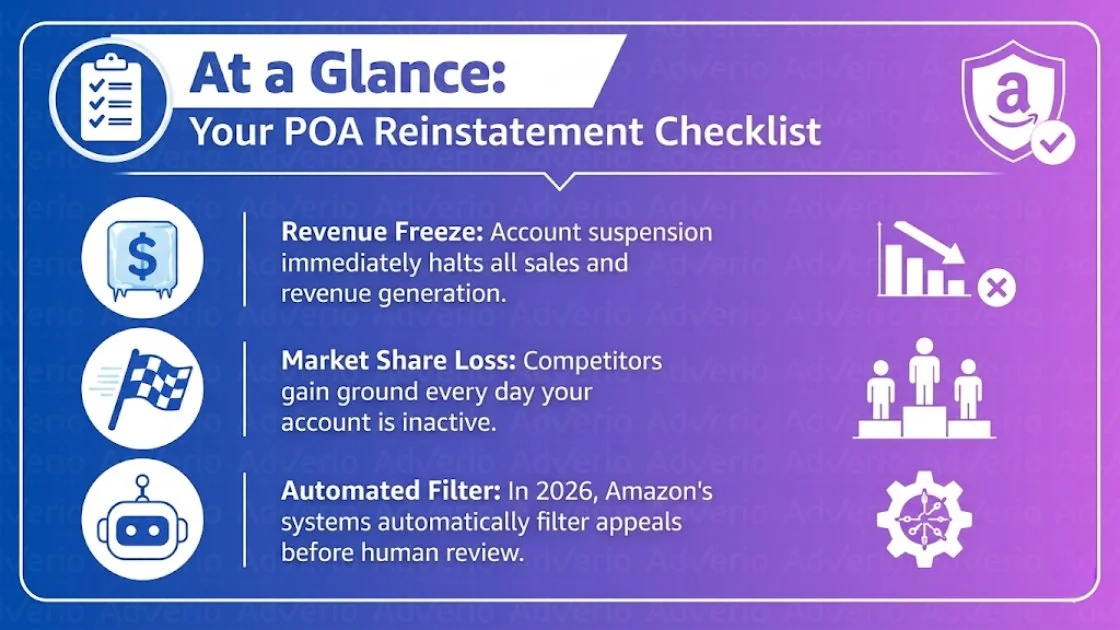
A fast reinstatement usually comes down to one thing. Submitting a POA that an automated review system can parse cleanly before an investigator reads it.
Use this checklist:
-
Use the three-part format only: Structure the document as Root Cause Analysis, Immediate Corrective Actions, and Preventive Measures. Anything outside that format creates noise and raises the chance of rejection.
-
Write in past tense: Describe actions you already completed. Amazon approves fixed operations, not intentions.
-
Keep it short and document-heavy: Stay in the 400 to 800 word range and attach dated proof such as invoices, supplier agreements, QC logs, product images, or training records.
-
Submit once, with everything included: A rushed first appeal full of gaps slows the case down. One complete submission beats three reactive follow-ups.
-
Cite the exact policy you violated: Name the policy section, match your fixes to that policy, and include screenshots or references where needed.
-
Remove emotion and backstory: Cut apologies, frustration, and long timelines. Write like an internal compliance report.
-
Match every root cause to a control: If the failure was supplier verification, show the supplier verification step you added. If the failure was listing accuracy, show the review process now in place.
-
Check the suspension notice line by line: Your POA must answer the stated trigger, not the issue you assume Amazon meant.
-
Review the suspension workflow before you file: the full suspension guide linked in the intro explains how Amazon typically handles these cases and what to prepare before submission.
Why Most Plans of Action Fail
Bad POAs usually fail before a person reads them.
In 2026, Amazon review processes have become more stringent. Sellers who submit generic, emotional, or loosely structured appeals tend to get faster denials. That pattern points to algorithmic triage before a human reviewer ever opens the case. Amazon’s appeal volume makes rapid triage inevitable, even if the specific mechanism is not published. Sellers still write for sympathy. Amazon evaluates for control, clarity, and whether the business issue was fixed.
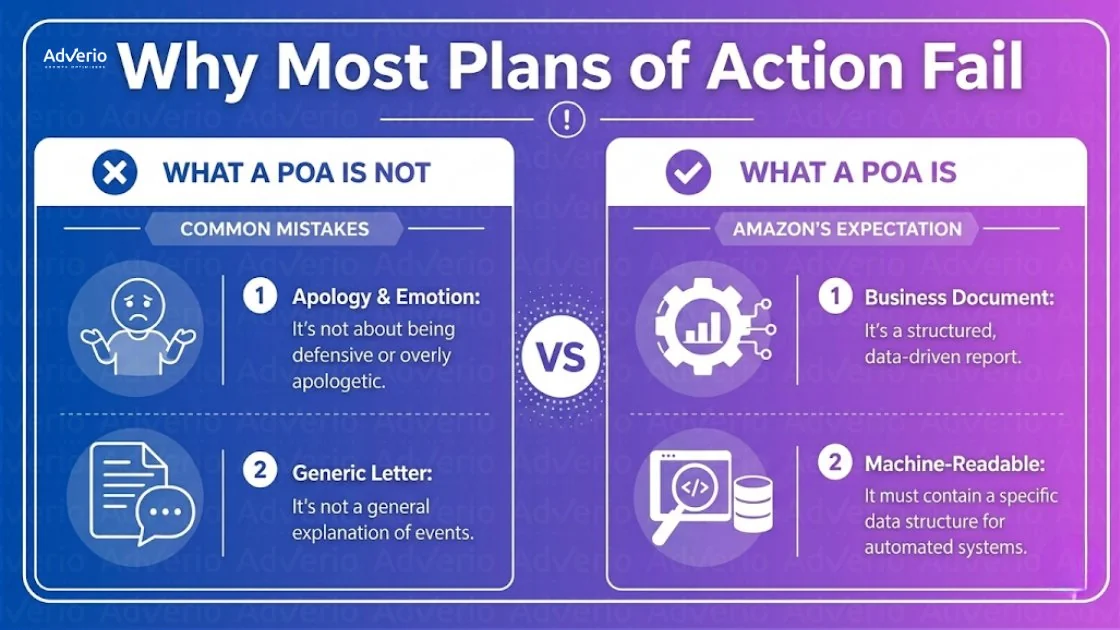
The pattern is predictable. The seller explains the history, argues with the complaint, promises to improve, and submits a document that reads like a customer service email. That format fails because Amazon wants an operations record. Short, factual, machine-readable, and tied directly to the suspension notice.
Four rejection triggers
| Rejection trigger | Why it fails |
|---|---|
| Defensive language | It signals the seller still has not isolated the internal failure |
| Generic wording | It looks copied, low-trust, and difficult for automated review to classify |
| Future-tense promises | It suggests the fix has not been completed |
| Loose formatting | It makes the appeal harder to parse against the policy trigger and supporting evidence |
A weak statement looks like this: “We experienced some issues in our process.”
A reviewable statement looks like this: “Customer complaints increased because our inbound inspection process failed to identify packaging damage on ASIN B07XXXXX before units were shipped.”
That difference matters. The second version gives Amazon something it can verify. It identifies the failed process, the result, and the affected item. The first version says nothing.
Another common failure is writing for persuasion instead of review logic. Long apologies, personal backstory, and claims that the suspension was unfair do not improve approval odds. They create noise. Automated screening does not reward sincerity. It rewards clean cause-and-control language that matches the notice.
Policy matching is also a quality signal. If Amazon cited a listing policy, your appeal should use that policy language, not a broad explanation about account health. If Amazon cited product authenticity, your appeal should stay on sourcing, invoices, supplier records, and verification controls. Sellers who want help preventing Amazon account issues for brands should build those controls before the next notice arrives.
The bottom line is simple. POAs fail when they read like arguments. Approved POAs read like compliance documents.
Most suspensions trace back to a control that was never built, not a one-time mistake. If repeat notices keep landing, the gap is structural.
Book your ROI Forecast and see what’s breaking before the next suspension.
The Three-Part POA Structure Amazon Requires
Amazon approves POAs that read like compliance records. In 2026, that means a document an automated screen can parse before a human reviews it. Use a rigid three-part format. Match the notice language. Keep the tone factual. Write corrective actions in the past tense only.
According to Amazon Sellers Lawyer’s POA guidance, strong POAs follow a three-part structure: root cause, corrective actions already completed, and preventive measures tied to controls and records.
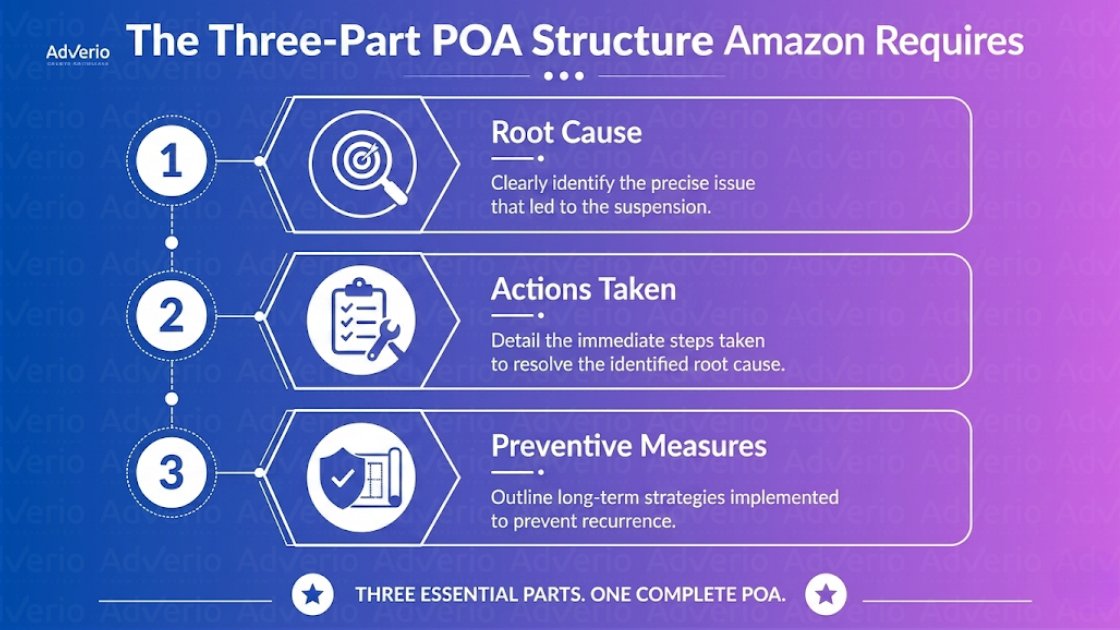
Part 1 Root cause
Keep this short. One or two sentences is enough. State the exact process failure that caused the violation, complaint, or metric spike.
Bad root causes are vague. Good root causes identify the failed step, the affected ASIN or workflow, and the result Amazon saw.
Example language
-
“Our Order Defect Rate exceeded the allowed threshold because damaged units of ASIN B07XXXXX were shipped after our packaging specification failed to protect the item in transit.”
-
“The listing violated Amazon policy because our team published a claim in the bullet points that was not approved in our internal compliance review.”
Write for review logic. If Amazon can map your sentence to the notice and the evidence, you are on track.
Part 2 Corrective actions already taken
This section decides whether your POA sounds real or recycled. Every action should be completed, dated, and written in the past tense. If a sentence starts to sound like a future promise, rewrite it.
Use concrete actions that show containment and cleanup.
Example language
-
“On April 21, we removed inventory associated with ASIN B07XXXXX from active sale.”
-
“On April 22, we reviewed all recent customer contacts tied to the complaint and issued refunds or replacements where appropriate.”
-
“On April 23, we replaced the previous packaging specification with a double-wall corrugated packaging standard for this SKU.”
-
“On April 23, we removed the non-compliant claim from the product detail page and updated our internal content approval checklist.”
Write this part first if you are stuck. The actions you already took often reveal the root cause more quickly than abstract brainstorming.
Part 3 Preventive measures with specific processes and dates
At this point, weak appeals collapse. Amazon is looking for a changed business process it can verify later. General promises do not help. Named controls do.
Independent legal guidance from Traverse Legal’s POA analysis points to the same standard. Strong POAs describe the control, assign ownership, and show what records will be retained.
Example language
-
“Starting April 24, the Operations Manager owns a weekly review of customer complaint categories by ASIN, with the report retained in our account health folder.”
-
“Starting April 24, warehouse staff complete and retain a packaging QC checklist for every outbound shipment of this ASIN.”
-
“Starting April 25, all listing copy changes require compliance approval before publication, and screenshots of final approved content are stored in the product record.”
-
“Starting April 26, supplier invoices and contracts are reviewed and archived before replenishment orders are approved.”
A preventive measure is only useful if Amazon can picture the record it would ask for next month.
A simple POA blueprint
| POA section | What Amazon wants to see | Bad version | Better version |
|---|---|---|---|
| Root cause | Exact failure point | “We had issues” | “Our inspection step failed to identify damaged packaging” |
| Corrective actions | Completed steps with dates | “We will improve shipping” | “On April 23, we changed the packaging standard” |
| Preventive measures | Ongoing controls, owners, records | “We will be more careful” | “Operations Manager reviews complaint logs weekly and retains records” |
Common Suspension Types and How to Address Each
Suspension type decides the document. If you send the same POA for every violation, Amazon’s system will read it as generic and reject it before a human reviews it.
Write for the violation notice you received. Use past tense. State what failed, what you already corrected, and what records now exist.
POA focus by suspension type
| Suspension type | Primary focus for POA | Required evidence |
|---|---|---|
| Performance-based | Operational failure that caused poor metrics | Order review notes, shipping process changes, internal SOP updates, customer remediation records |
| Policy violation | Exact policy breached and what content or action was corrected | Policy citation, screenshots, removed or updated content, revised review workflow |
| Authenticity | Proof the product is genuine and traceable to approved supply | Supplier invoices, contracts, verification records, QC logs |
| IP complaint | Removal of offending content and pre-listing review controls | Updated listing assets, rights review workflow, internal approval records |
Performance-based suspensions
These cases fail when sellers describe symptoms instead of the breakdown. “Late shipment rate increased” is not a root cause. “Warehouse staff released orders before same-day carrier cutoff controls were updated” is.
Product Condition complaints are a common driver here, and successful appeals usually include inspection records, supplier checks, and a dated process change. Amazon wants proof that the bad units stopped entering sellable inventory.
Use language like this:
-
“We traced the complaints to inadequate pre-fulfillment inspection for ASIN B07XXXXX.”
-
“On April 23, we added a documented condition check before inventory was released for sale.”
-
“We retained inspection records and supplier verification documents for future review.”
Policy violation suspensions
Policy suspensions require exact matching. Your POA should mirror the violation notice in plain language, then show the correction in the same order Amazon expects to read it.
If the issue was listing content, identify the claim, image, keyword, or attribute that violated policy. State when it was removed. State who reviewed the updated version. State what approval record now exists. Keep it mechanical.
Brands fixing recurring listing-content flags should tighten the source process with a structured Amazon listing optimization service so claims and assets clear compliance before they go live.
If unauthorized resale or pricing issues contributed to the violation, your operation may need tighter channel controls outside the POA itself. Adverio’s Amazon MAP solutions address the pricing and distribution breakdowns that often create repeat compliance problems.
Authenticity and inauthentic item suspensions
These appeals are document tests. Explanations do not carry the case.
Show chain of custody from supplier to saleable inventory. That means clean invoices, matching business names and addresses, supplier contact details, contracts if available, and internal verification records that line up with the ASIN under review. If dates, quantities, or supplier identities do not match, the appeal gets rejected fast.
Strong wording stays plain:
-
“We verified all recent units against supplier records and removed inventory lacking complete source documentation.”
-
“We implemented supplier approval rules that require invoice review before replenishment.”
-
“We segregated affected inventory and retained verification records in the product compliance file.”
IP complaint suspensions
Speed matters, but format matters more. Amazon wants to see that the disputed material was removed and that a control now blocks the next violation.
Address the complaint in a fixed sequence:
-
Removed content: product images, bullets, A+ content, brand references, and storefront claims were reviewed and corrected.
-
Approval owner: a named employee now approves listing assets before publication.
-
Stored records: final approved content is saved with source files and timestamps.
-
Scope check: related ASINs were reviewed for the same issue and corrected where needed.
A strong IP appeal proves the content is gone, the review step exists, and the record can be produced on request.
What Never to Include in a Plan of Action
A POA is not the place for emotion, outrage, or a long story about how much money you’re losing.
Leave these out:
-
Blame language: “Amazon misunderstood,” “the customer was wrong,” or “the complaint was unfair.”
-
Soft promises: “We will try harder,” “we will monitor things more closely,” or “we will improve quality.”
-
Template phrasing: recycled language from forums, consultants, or other sellers.
-
Business drama: payroll pressure, inventory exposure, investor pressure, or missed revenue targets.
Keep it sterile. Keep it factual. Keep it tied to the violation notice.
If a sentence doesn’t explain the failure, the fix, or the control, cut it.
The POA Submission Process in 2026
A good POA can still fail at submission.
In 2026, Amazon often filters appeals before a human reviewer reads a line. That changes how you submit. Your document needs to be machine-readable, tightly structured, and easy to verify line by line. If your appeal looks like a wall of text, buries the dates, or forces the reviewer to hunt through attachments, you slow down the case and increase the odds of a boilerplate denial.
How to submit so the case gets reviewed cleanly
-
Submit through the exact appeal path tied to the violation. Use Account Health or the performance notification linked to the suspension. Do not open duplicate cases or send the same POA through unrelated channels.
-
Match the POA to the notice. Use the same policy language Amazon used in the suspension message. Keep the wording literal and specific.
-
Write in past tense. Amazon wants completed actions, not intentions. “We audited supplier invoices on May 4, 2026” works. “We will review invoices more carefully” fails.
-
Keep the format rigid. Use short headings, short bullets, and plain file names. A reviewer should be able to scan the root cause, corrective actions, and preventive controls in under a minute.
-
Label every attachment for fast validation. “Invoice-ASIN-B07XXXXX-2026-04-18.pdf” is usable. “document-final2.pdf” is not.
-
Cross-reference attachments inside the POA. If you mention supplier verification, name the attached invoice, authorization letter, or QC record in that same bullet.
-
Use dates everywhere they matter. Include the date of the failure, the date of the fix, and the date each control was implemented.
Length still matters, but readability matters more. Shorter usually wins for performance issues. Policy, authenticity, and supply chain cases need more supporting proof, yet the writing still has to stay plain and mechanical.
A simple rule works well here. Write for a parser first, then for a reviewer. That means consistent headings, no emotional filler, no storytelling, and no vague future promises.
If outside prep centers, logistics firms, or compliance vendors touch your inventory or documentation, clean up that chain before you submit. Start with understanding the Amazon SPN program so your records, handoffs, and partner accountability are easier to prove in the next appeal.
How Adverio Supports Account Reinstatement
Fast reinstatement comes from fixing the operation behind the suspension, then documenting that fix in a format Amazon can process quickly.
Adverio helps sellers do both. The work is not a generic appeal rewrite. It starts with identifying the exact breakdown, cleaning up the records, and building a POA that states what happened, what was corrected, and what controls were already put in place. The goal is simple. Submit a machine-readable appeal that clears automated review before it reaches a human reviewer.
If the suspension exposed wider account issues, the next step is to manage your Amazon account with tighter control over account health, listing changes, catalog operations, and performance monitoring. That reduces repeat violations and gives you clearer evidence if Amazon asks questions again.
Frequently Asked Questions
What should I do if my first POA is rejected?
Rebuild it from the ground up. Amazon already rejected your first version, so a light edit usually fails again.
Write a new POA that fixes the core weakness. In most cases, that means the first appeal had one of three problems. The root cause was vague, the corrective actions were written as promises instead of completed actions, or the evidence did not clearly support the claim. In 2026, your appeal also needs to read cleanly for automated review. Use a rigid format, write in past tense, and match every action to a record you can attach.
Should I send multiple appeals to get faster attention?
No. Repeated submissions before a response usually create more noise, not more urgency.
Send one clean appeal, then wait. If you keep filing new versions, you increase the chance that Amazon treats the case as inconsistent, incomplete, or poorly controlled. The better move is simple. Submit one machine-readable POA with complete attachments and let that version get reviewed.
How long should I wait for a response?
Amazon’s response time varies by case type and queue volume. Simple, complete appeals often get a reply within 48 hours. Complex cases can take significantly longer.
Do not change strategy too early. If the appeal was clear, in the past tense, and supported by documents, wait for the reply before sending anything else. Premature resubmissions create avoidable confusion inside the case log.
Do I need supporting documents for every suspension?
Assume yes whenever proof exists.
Amazon does not want reassurance. Amazon wants records. Depending on the suspension, that can mean invoices, supplier agreements, inspection results, shipment records, screenshots, training logs, or policy acknowledgments. Every document should support a specific statement inside the POA. Random attachments weaken the file.
Can a short POA still work?
Yes. Short usually works better.
For most suspensions, 400 to 800 words is enough if the writing is specific and structured correctly. The document should state what caused the violation, what you already corrected, and what controls you already implemented. Long emotional appeals fail because they bury the facts Amazon needs to process fast.
Read Next
If your Amazon operation is growing but your controls aren’t, that’s a margin problem waiting to become a suspension problem. Adverio helps brands tighten marketplace operations before preventable account risk turns into lost revenue. If you want a clearer view of where profit and compliance are breaking down, book your ROI Forecast